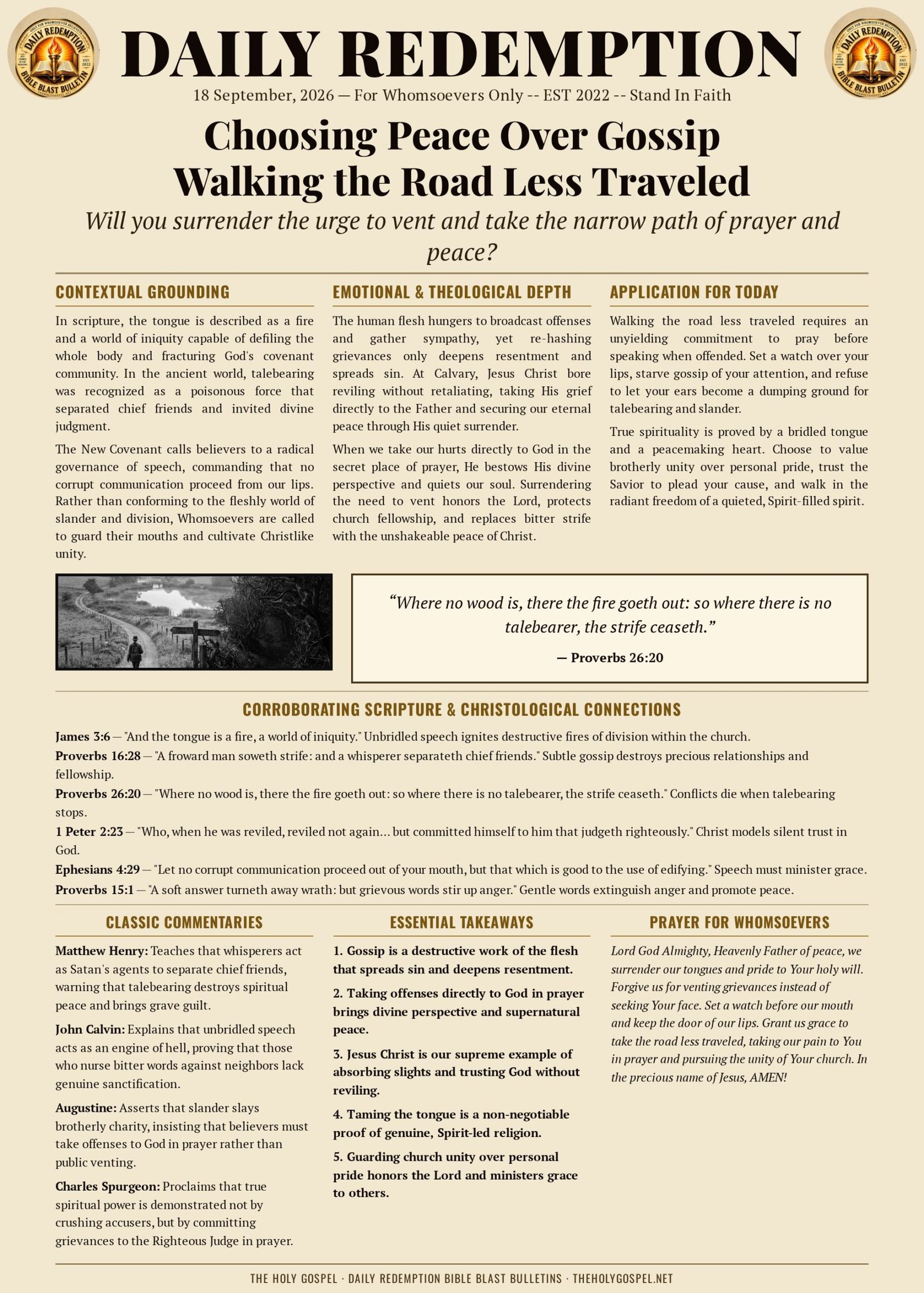
Choosing Peace Over Gossip — Walking the Road Less Traveled
When offenses and personal slights arise within the body of believers, the human flesh hungers to broadcast grievances, seek worldly sympathy, and spread destructive gossip. Yet Holy Scripture calls every Whomsoever to a higher, narrow path—taking our hurt directly to God in the secret closet of prayer and allowing His divine perspective to quiet our troubled souls. By choosing quiet surrender over venomous talebearing, we crucify the flesh, protect the sacred unity of the saints, and experience the unshakeable peace of Jesus Christ. Step onto this road less traveled today, lay down the urge to vent, and discover the radiant liberty of a quieted heart.
Contextual Grounding
In the ancient Near East and throughout the apostolic assemblies, the power of the spoken word was understood as a force of immense spiritual weight. When the apostle James wrote his epistle to the early believers scattered abroad, he warned with alarming vividness that “the tongue is a fire, a world of iniquity” capable of defiling the whole body and setting the entire course of nature ablaze (James 3:6). In ancient Israel, talebearing was not viewed as harmless social chatter, but as a treacherous poison that fractured covenant communities and invited divine judgment. Proverbs explicitly declares that “a whisperer separateth chief friends” (Proverbs 16:28), highlighting how subtle slander undermines the sacred fellowship of God’s people.
Throughout the Old Covenant, God established strict moral boundaries around the mouth, commanding His people in Leviticus not to go up and down as a talebearer among the people. The Hebrew wisdom literature repeatedly contrasts the destructive fury of the slanderer with the quiet dignity of the righteous. Proverbs 26:20 reveals a timeless spiritual principle: “Where no wood is, there the fire goeth out: so where there is no talebearer, the strife ceaseth.” In a world governed by fallen human passions, spreading grievances was the natural, unregenerate impulse of the flesh, whereas guarding one’s lips required divine wisdom and holy self-restraint.
When the New Covenant unfolded through the ministry of Jesus Christ and His apostles, this call to govern the speech became an essential mark of genuine regeneration. The apostle Paul admonished the believers at Ephesus, “Let no corrupt communication proceed out of your mouth, but that which is good to the use of edifying, that it may minister grace unto the hearers” (Ephesians 4:29). For the early Christian assemblies operating under intense cultural pressure, internal gossip and strife were deadlier than external persecution. True Christian community could only flourish when believers refused the fleshly road of talebearing and embraced the Christlike path of peacemaking and spiritual restraint.
Emotional & Theological Depth
Why is the urge to gossip so intoxicating to the unrenewed human heart? When someone offends us, hurts our feelings, or treats us unfairly, the immediate instinct of the flesh is to seek vindication and worldly sympathy. We hunger to tell our side of the story to as many ears as will listen, carefully framing the offender’s faults while highlighting our own righteousness. Yet this temporary satisfaction is a demonic trap. Every time we re-hash an offense to others, we re-wound our own hearts, deepen our resentment, and entice our listeners to join us in the sin of bitter judgment. What promises quick emotional relief actually breeds spiritual paralysis, disharmony, and deep dishonor to the Lord.
At the heart of Calvary lies the supreme theological model for handling injustice and offense. When Jesus Christ bore the cruel mockery, false accusations, and horrific violence of the cross, He did not rally a mob, vent His grievances, or slander His tormentors. As the apostle Peter recorded, “Who, when he was reviled, reviled not again; when he suffered, he threatened not; but committed himself to him that judgeth righteously” (1 Peter 2:23). Christ absorbed the full impact of human malice and took His grief directly to the Father in prayer, crying out, “Father, forgive them; for they know not what they do” (Luke 23:34). Through His selfless quietness, Jesus defeated sin and reconciled rebellious sinners unto God.
When a Whomsoever chooses to take the road less traveled—taking offenses directly to the throne of grace rather than broadcasting them to men—a glorious divine exchange takes place. In the secret place of prayer, God receives our raw pain, aligns our hearts with His eternal perspective, and pours out the supernatural peace that passeth all understanding. The desperate need to vent vanishes because the Sovereign Lord has comforted our spirit. By choosing peace over gossip, we honor God, value the unity of the church above our fleeting pride, and demonstrate that the Holy Spirit truly governs our tongue.
Application For Today
For every believer navigating the frictions of daily life, living out this truth requires an intentional, moment-by-moment decision when offense strikes. When someone speaks ill of you, misjudges your motives, or causes you deep distress, the crossroad appears immediately. The broad road invites you to pick up the phone, assemble your sympathizers, and scatter seeds of discord. The narrow road—the road less traveled—calls you to close your door, bow your knees, and pour out your heart before the Lord. Make it your unyielding rule never to discuss a brother’s or sister’s faults with others until you have spent significant time weeping over them in private prayer before God.
Practically, taming the tongue demands active spiritual guardrails. David understood this profound necessity when he prayed, “Set a watch, O LORD, before my mouth; keep the door of my lips” (Psalm 141:3). Before speaking about any interpersonal conflict, ask yourself three essential questions: Is it true? Is it edifying? Is it mine to share? If a conversation does not minister grace or build up the body of Christ, starve it of your attention. Furthermore, when others approach you with juicy morsels of gossip, have the holy courage to gently stop them, refusing to let your ears become a dumping ground for talebearing.
Finally, remember that choosing peace is not passive weakness; it is spiritual strength empowered by the Holy Spirit. As James 1:26 sternly warns, “If any man among you seem to be religious, and bridleth not his tongue, but deceiveth his own heart, this man’s religion is vain.” True spirituality is proved by a controlled mouth and a peacemaking heart. Step onto the road less traveled today. Value the unity of God’s house over the cheap thrill of slander, trust the Lord to plead your cause, and walk in the unshakeable freedom of a quiet, Christ-centered spirit.
Classic Commentaries Corner
Matthew Henry observed on Proverbs 16:28 that whisperers and talebearers are the devil’s chief agents for destroying holy fellowship among believers. Henry noted that a slandering tongue acts as a wedge driven by Satan to separate chief friends, warning that those who take pleasure in hearing or spreading secret faults forfeit the sweet peace of God and bring grave guilt upon their own souls.
John Calvin emphasized on James 3:6 that the human tongue, when unbridled by divine grace, becomes an engine of hellish destruction capable of setting entire communities ablaze with strife. Calvin argued that true sanctification must govern the mouth, asserting that those who claim to belong to Christ while nursing bitter words against their neighbors prove that their hearts remain unrenewed by the Holy Spirit.
Augustine wrote in his Rule concerning the strict governance of speech among the brethren, warning that slander is a deadly venom that slays brotherly charity. He insisted that when a believer is hurt or offended, Christian love demands direct, private prayer and gracious reconciliation rather than public venting, concluding that he who guards his tongue guards his soul from deep spiritual ruin.
Charles Spurgeon preached with fiery conviction on 1 Peter 2:23, exalting the magnificent silence of the Savior before His revilers. Spurgeon proclaimed that the highest mark of spiritual power is not the ability to crush our accusers with sharp words, but the Christlike grace to commit our grievances to the Father in prayer, leaving all vindication in the hands of the Righteous Judge.
Corroborating Scripture & Christological Connections
James 3:6 — “And the tongue is a fire, a world of iniquity: so is the tongue among our members, that it defileth the whole body, and setteth on fire the course of nature; and it is set on fire of hell.” James exposes the devastating power of unbridled speech, warning that reckless words ignite destructive fires of division within the church.
Proverbs 16:28 — “A froward man soweth strife: and a whisperer separateth chief friends.” Solomon highlights the subtle wickedness of gossip, revealing how secret talebearing destroys precious relationships and fractures spiritual unity.
Proverbs 26:20 — “Where no wood is, there the fire goeth out: so where there is no talebearer, the strife ceaseth.” The wisdom of God reveals that interpersonal conflicts quickly die when believers refuse to feed the flames with gossiping words.
1 Peter 2:23 — “Who, when he was reviled, reviled not again; when he suffered, he threatened not; but committed himself to him that judgeth righteously:” Jesus Christ sets the supreme example for all Whomsoevers by absorbing insults and entrusting His vindication entirely to the Father.
Ephesians 4:29 — “Let no corrupt communication proceed out of your mouth, but that which is good to the use of edifying, that it may minister grace unto the hearers.” Paul commands believers to use their speech exclusively for building up others, ensuring that every word reflects the grace of Christ.
Proverbs 15:1 — “A soft answer turneth away wrath: but grievous words stir up anger.” Holy Scripture contrasts the peacemaking power of gentle, Spirit-led words with the destructive friction caused by harsh and defensive speech.
Essential Takeaways
1. Gossip is a destructive work of the flesh that breeds division. Broadcasting personal offenses and seeking worldly sympathy causes others to sin, re-wounds the heart, and directly disobeys God’s command to love our neighbor.
2. Taking offenses to God in prayer brings supernatural peace. When hurt strikes, taking the road less traveled—going straight to the Lord in prayer—allows God to grant His perspective and remove the desire to vent.
3. Christ is our ultimate model of silent trust and surrender. On the cross, Jesus reviled not again, but committed Himself to the Father, demonstrating that true spiritual victory comes through quiet faith rather than self-vindication.
4. Guarding the tongue is an essential proof of true religion. An unbridled mouth invalidates religious profession; believers must actively set a watch over their lips and refuse to entertain or spread talebearing.
5. Protecting church unity honors God above personal pride. Choosing peace over slander safeguards the fellowship of the saints, crucifies self-will, and reflects the edifying grace of Jesus Christ to a watching world.
Prayer For Whomsoevers
Lord God Almighty, Heavenly Father of peace, we come before Your throne surrendering our tongue and our pride to Your holy will. Forgive us for the times we have yielded to the flesh by venting grievances, spreading gossip, or seeking selfish sympathy instead of seeking Your face. We lay every hurt, offense, and personal slight at the foot of the cross, trusting in the finished work of Your Son, Jesus Christ. Set a watch before our mouth, Lord, and keep the door of our lips. Grant us the Spirit-led grace to choose the road less traveled, taking our grief directly to You in prayer and pursuing the sacred unity of Your church. In the precious and exalted name of Jesus, we say with joyful hearts, AMEN!