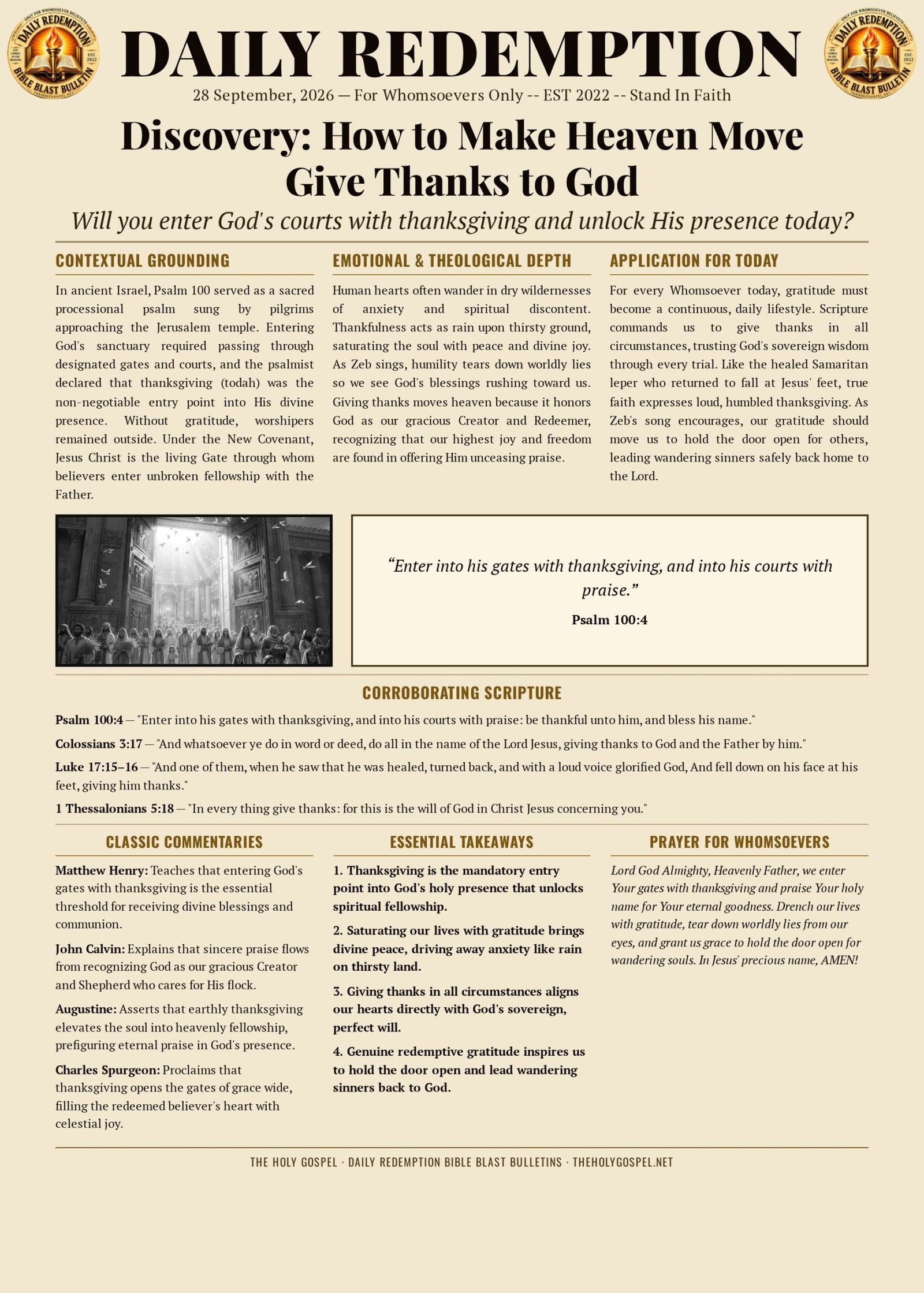
Thankfulness is not merely a polite religious sentiment, but the sacred entry point into God’s holy presence that moves the heart of heaven. As the psalmist proclaims in Psalm 100:4, we enter His gates with thanksgiving and His courts with praise, unlocking divine communion with the Father. When we drench every word, deed, and circumstance in gratitude through the Lord Jesus Christ, His presence saturates our souls like gentle rain upon thirsty ground. For every Whomsoever, choosing a lifestyle of continuous thanksgiving transforms our earthly trials, lifts our spirits in joyful freedom, and leads lost sinners home to the feet of the Savior. Contextual Grounding In ancient Israel’s worship, entering the sanctuary of Yahweh was a structured, sacred journey. Psalm 100 serves as a majestic liturgical Psalm of Thanksgiving (Hebrew Todah), sung by pilgrims as they ascended Mount Zion and approached the sacred temple grounds. The psalmist gives a direct, divine directive: “Enter into his gates with thanksgiving, and into his courts with praise: be thankful unto him, and bless his name” (Psalm 100:4). In the Old Testament tabernacle and temple, the outer gates and inner courts separated the common world from the holy dwelling place of God’s presence. Passing through those gates required an intentional spiritual posture. Gratitude was not an afterthought following an encounter with God; it was the required key that unlocked the gate itself. Without thanksgiving, a worshiper remained outside in the wilderness, distant from the Shekinah glory residing above the mercy seat. The Hebrew concept of thanksgiving (todah) denotes an open-handed confession of God’s sovereign goodness, righteous character, and unshakeable covenant faithfulness. It is an act of public acclaim and sacrificial devotion that acknowledges Yahweh as the Creator, Shepherd, and Redeemer of His people. The psalm reminds us that “he hath made us, and not we ourselves; we are his people, and the sheep of his pasture” (Psalm 100:3). Thus, thanksgiving is rooted in creaturely dependence upon the Creator and covenantal trust in the Good Shepherd. To give thanks is to surrender the delusion of self-sufficiency, recognizing that every breath, every physical healing, and every spiritual blessing flows exclusively from God’s unmerited favor. In the New Testament, this Old Testament temple imagery finds its ultimate Christological fulfillment in Jesus Christ. Jesus is the true Temple and the living Gate through whom we draw near unto God (John 10:9). Through His sacrificial death upon the cross and His glorious resurrection, Christ tore the veil of separation and granted redeemed believers direct access into the Holiest of All. Apostle Paul expands this psalm’s directive into the daily walk of the Church, commanding in Colossians 3:17 that “whatsoever ye do in word or deed, do all in the name of the Lord Jesus, giving thanks to God and the Father by him.” Under the New Covenant, thanksgiving is no longer confined to physical temple courts in Jerusalem; it becomes the continuous spiritual sanctuary where every Whomsoever abides in unbroken fellowship with the Father through the Son. Emotional & Theological Depth On an emotional level, human souls frequently wander in dry, parched wildernesses of anxiety, discontent, and spiritual fatigue. In a world full of noise, deception, and relentless pressure, we easily fixate on what we lack or what troubles us, allowing bitterness to build walls around our hearts. Yet, thankfulness is the divine remedy that saturates the soul like rain on thirsty ground. When you turn your heart toward God in genuine gratitude, His holy presence saturates your life with unshakeable peace, divine provision, and unceasing praise.