Psalm 22: Bones Out Of Joint, When The Pain Is Too Specific To Pretend
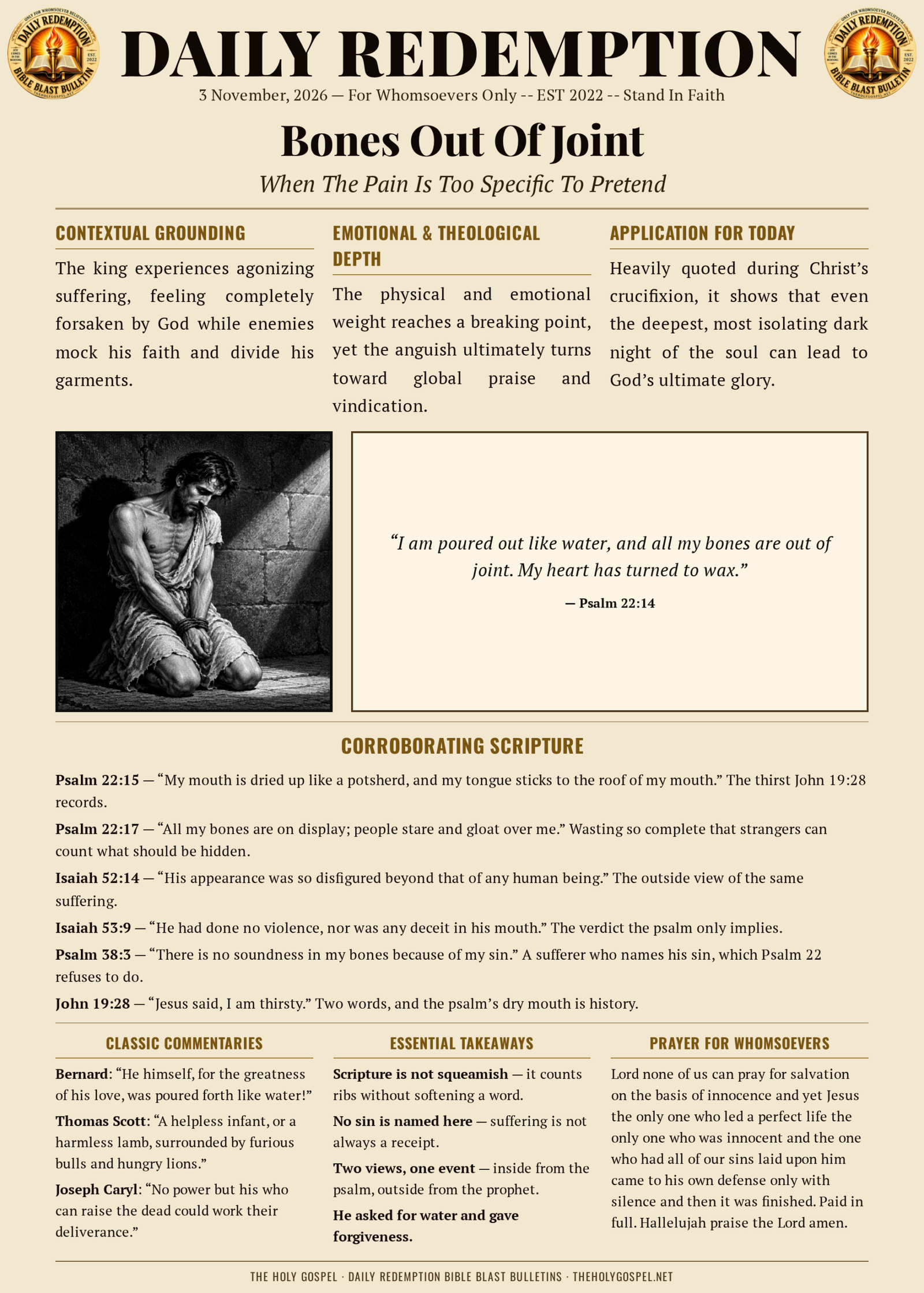
Somewhere in the middle of Psalm 22 the poetry stops and the anatomy starts. Bones out of joint, heart melted like wax, strength dried up like a potsherd, tongue stuck to the roof of the mouth, so wasted he can count his own ribs. He names no disease and confesses no sin, unlike Job and unlike Psalms 38 and 51, and that silence is the argument for his innocence, which Isaiah 53:9 then speaks out loud. Isaiah 52:14 supplies the face for this interior, disfigured past human likeness. The psalm tells you what it felt like, the prophet tells you what the crowd saw, and John 19:28 files the receipt with two words from the cross, I am thirsty. Even then, separated from the face and love of the Father, he was asking forgiveness for the men who did it, and their only defense was that they did not know what they were doing.
Here the psalm stops being devotional and becomes physical. Bones out of joint, heart melted like wax, strength dried up like a potsherd, tongue stuck to the roof of the mouth, so wasted he can count his own ribs. He names no disease, unlike Job, and confesses no sin, unlike Psalms 38 and 51. That silence about sin is the whole argument for his innocence, and Isaiah 53:9 speaks the verdict out loud, that there was no deceit in his mouth. Isaiah 52:14 supplies the face for this interior, so disfigured it appalled nations. Psalm 22 gives you what it felt like, and Isaiah gives you what the crowd saw. John 19:28 finishes it with two words from the cross, I am thirsty. And again let us be reminded that even while Jesus was separated from the face and love of the Father, he pleaded for forgiveness for his tormentors, and their only defense was their ignorance of the significance of their actions.
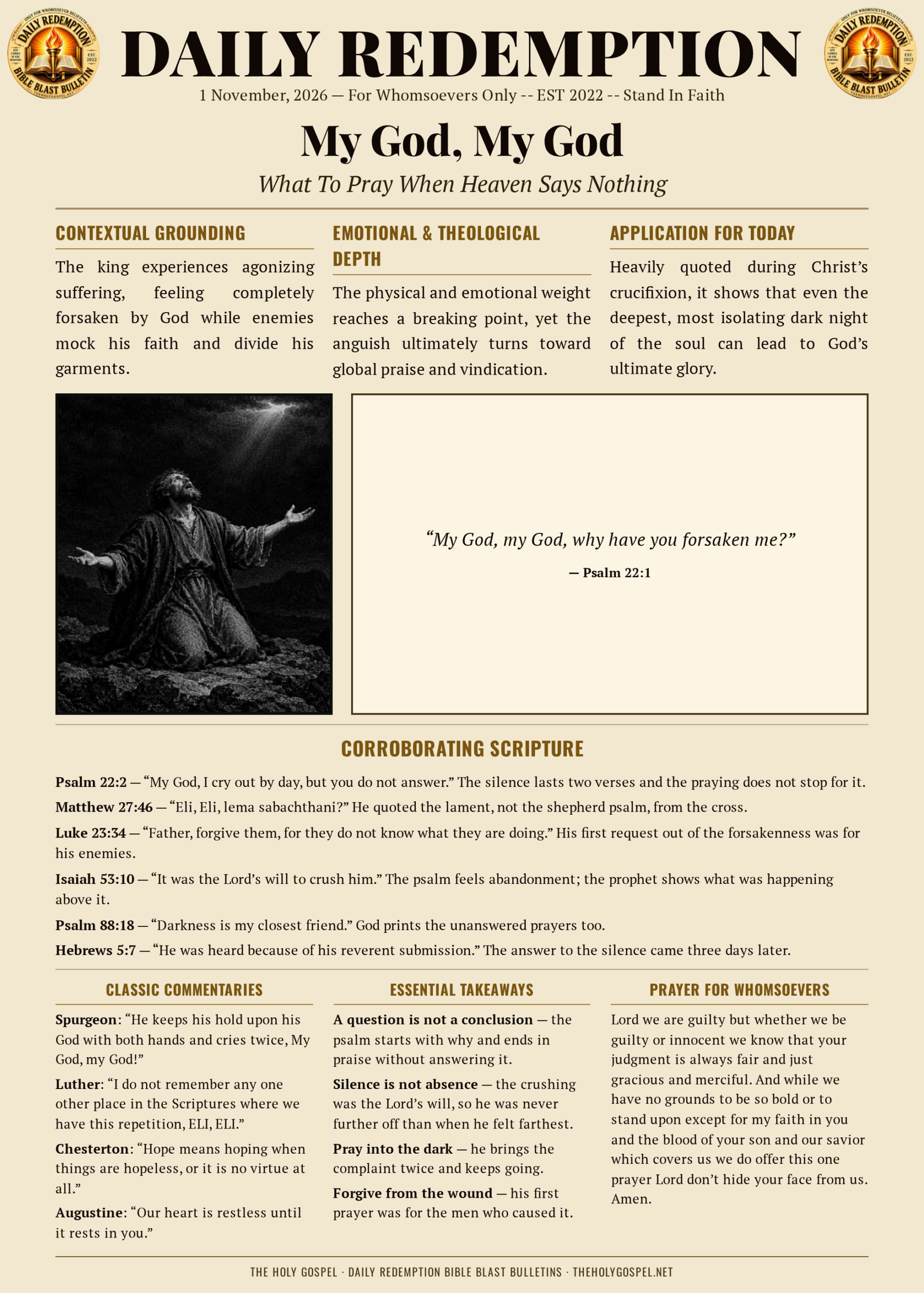
Contextual Grounding
The king experiences agonizing suffering, feeling completely forsaken by God while enemies mock his faith and divide his garments.
Emotional & Theological Depth
The physical and emotional weight reaches a breaking point, yet the anguish ultimately turns toward global praise and vindication.
Application
Heavily quoted during Christ’s crucifixion, it shows that even the deepest, most isolating dark night of the soul can lead to God’s ultimate glory.
Classic Commentaries Corner
Bernard of Clairvaux on the melting heart, as quoted by J.M. Neale: “What marvel that the name of the Bridegroom should be as ointment poured forth, when he himself, for the greatness of his love, was poured forth like water!” The psalm says he is poured out like water. Bernard asks what else could pour a man out that far except love.
Thomas Scott on the picture in one line: “A helpless infant, or a harmless lamb, surrounded by furious bulls, and hungry lions, aptly represented the Saviour encompassed by his insulting and bloody persecutors.” Notice what Scott does not say. He does not call him a fighter. He calls him a lamb.
Joseph Caryl on how low the low places go: “to show how low, that no power but his who can raise the dead, could work their deliverance.” The dust of death is not a metaphor for a bad week. It is the place where only resurrection works.
J.M. Neale on the same verse: “in the thought of my enemies I am utterly destroyed.” He is describing how the sufferer believes he looks from the outside, which is often the cruelest part of pain.
Corroborating Scripture & Christological Connections
Psalm 22:14–15 — “I am poured out like water, and all my bones are out of joint. My heart has turned to wax; it has melted within me. My mouth is dried up like a potsherd, and my tongue sticks to the roof of my mouth; you lay me in the dust of death.” No diagnosis, no confession, just a body failing in full view.
Psalm 22:17 — “All my bones are on display; people stare and gloat over me.” Wasting so complete that strangers can count what should be hidden.
Isaiah 52:14 — “Just as there were many who were appalled at him—his appearance was so disfigured beyond that of any human being and his form marred beyond human likeness.” The outside view of the same suffering.
Isaiah 53:9 — “He had done no violence, nor was any deceit in his mouth.” The verdict the psalm implies and the prophet states.
Psalm 38:3 — “Because of your wrath there is no health in my body; there is no soundness in my bones because of my sin.” The deliberate contrast: a sufferer who names his sin, which Psalm 22 refuses to do.
John 19:28 — “Later, knowing that everything had now been finished, and so that Scripture would be fulfilled, Jesus said, ‘I am thirsty.’” Two words, and the psalm’s dry mouth is history.
Essential Takeaways
Scripture is not squeamish about pain. It counts ribs and describes a melted heart without softening a word.
No sin is named here. Suffering is not always a receipt for something you did, which is exactly why the innocent one could stand in it.
Two views, one event. The psalm gives the inside, Isaiah gives the outside, and both are needed to see him.
He asked for water and gave forgiveness. The thirst was real and so was the prayer for the men who caused it.
Prayer For Whomsoevers
Lord none of us can pray for salvation on the basis of innocence and yet Jesus the only one who led a perfect life the only one who was innocent and the one who had all of our sins laid upon him came to his own defense only with silence and then it was finished. Paid in full. Hallelujah praise the Lord amen.