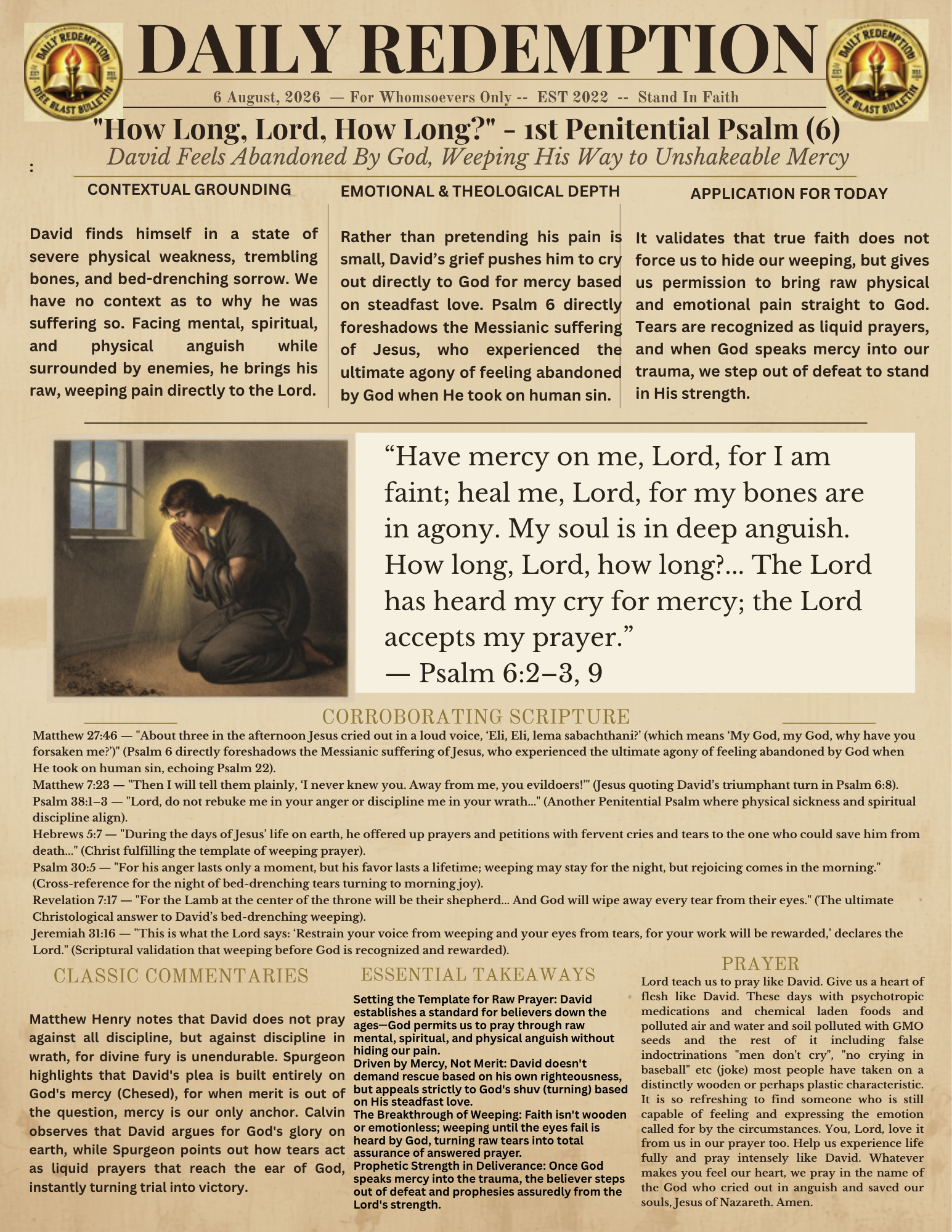
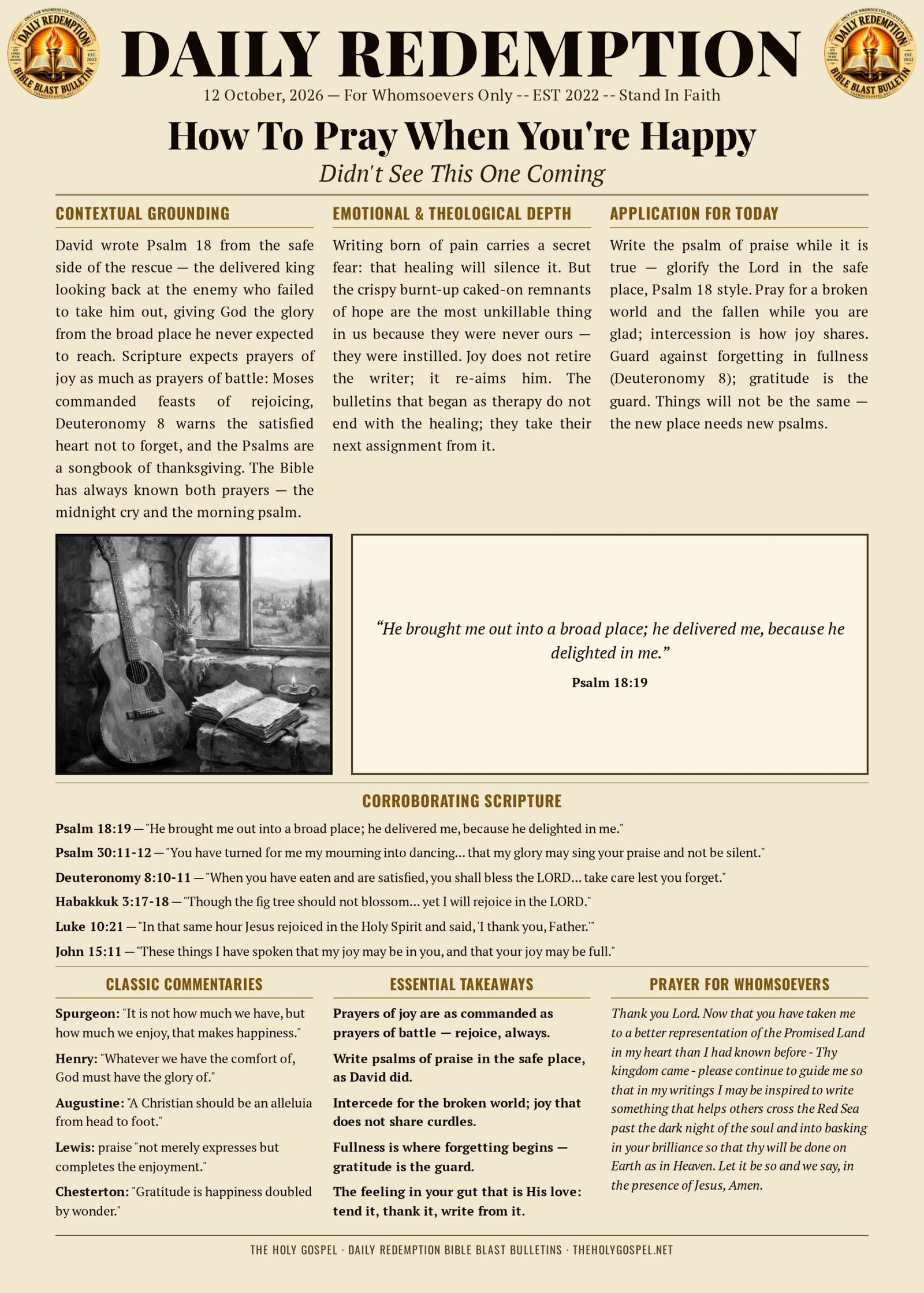
These bulletins began as therapy — the overflow of a heart working through its wounds — which raises a question nobody warns you about: what happens when the patient starts to heal? The answer is David’s, from the safe side of Psalm 18: turn the writing into praise, turn the happiness into intercession for a broken world, and refuse to believe the joy is fragile just because the road ahead is hard. Prayers of joy are not less faithful than prayers of battle — they are the same faith with the sun out. The redeemed have a whole vocabulary for being glad in the Lord, and this is the day to use it. If you are one of the precious few who has been faithfully reading these redemption bulletins then it comes to no secret to you that it has served different purposes but a great deal of the composition of the mojo that spawned them daily was that it has been working as a kind of therapy. So what happens when the patient is healed? When he feels the love of the Lord? God forbid that the answer to that comes in the form of some calamity to struggle through. Although I know our adversary has tried recently. I woke up in the middle of the night with a blood sugar of 38 a bit over a week ago. Almost set fire to the house yesterday morning. Yet the Lord has stepped in and turned it into yet another reason to be grateful, happy and even more certain that the feeling in my gut is His love not the abdominal misfires that come from being 62. Sorry my humor will out. In truth though how does one write faithfully when the writing was spawned by the residue of self loathing (which is only the internalizing of the loathing from others) and the crispy burnt up caked on remnants of hope which are the most unkillable thing in us? Hey look, I am still very much alone. I only have me, my mom and my cats. But my cats are better cats than I had a year ago. My guitar playing still needs improvement but leaving the guitar alone for a few months gave me a fresh approach so even that has improved. I always believed I was in the Lord’s favor because there was no good reason why I would still be here after death had tried so many times to take me out but failed miserably in the attempt. It is just that, as I mentioned earlier in another bulletin, the overwhelming feeling is like David in Psalm 18 now in a safe place and reflecting; or Benjamin and Elaine at the end of The Graduate, victoriously united and now reflecting but knowing the road won’t be easy but still feeling the glow; or even God resting on the 7th day and seeing all the good that He had created but in my case I see all the good that He has instilled in me. The answers seem to be in: 1 David wrote many a Psalm in praise glorifying the Lord so I can write some psalms of praise and glorification magnifying the Lord. 2 Pray for a broken world and all the fallen. That seems to be essential now. Spread the love of the Lord to all those who are still engulfed.
Category: Spiritual Warfare
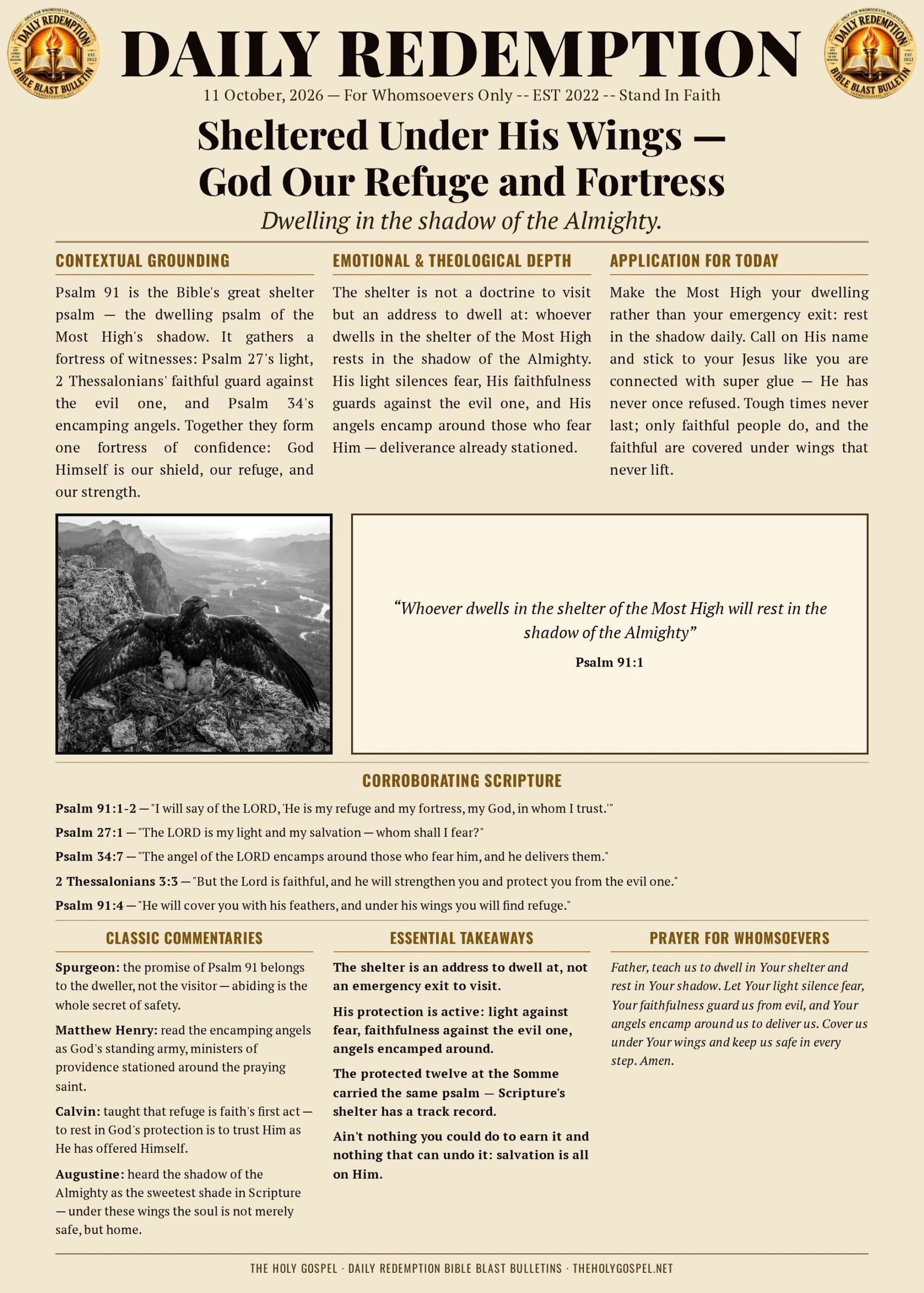
Sheltered Under His Wings — God Our Refuge and Fortress
Psalm 91 is the Bible’s great shelter psalm: whoever dwells in the shelter of the Most High rests in the shadow of the Almighty. Its fortress is fourfold — His light silences fear, His faithfulness guards against the evil one, His angels encamp around those who fear Him, and His wings cover His own. The promise is not for visitors but dwellers: God Himself is our refuge, our fortress, and our shield. From the “protected twelve” at the Somme to every whomsoever who calls His name today, the shelter holds because the Shelterer is faithful. Contextual Grounding Psalm 91 is the Bible’s great shelter psalm — the dwelling psalm of the Most High’s shadow. It gathers a fortress of corroborating witnesses: Psalm 27 declares that His light drives out fear, 2 Thessalonians confirms His faithfulness as active protection against the evil one, and Psalm 34 adds the assurance that His angels encamp around those who fear Him, delivering them in times of danger. Together these verses form one fortress of confidence: God Himself is our shield, our refuge, and our strength. Emotional & Theological Depth The shelter is not a doctrine to visit but an address to dwell at: whoever dwells in the shelter of the Most High rests in the shadow of the Almighty. His light silences fear, His faithfulness guards against the evil one, and His angels encamp around those who fear Him — deliverance already stationed, not summoned in a panic. If heaven is the fullness of God’s love, the shadow of the Almighty is its near edge, and the door to it stands open all day. Scripture’s shelter has a track record, too. Psalm 91 has been called the most powerful prayer of protection ever written, and history keeps furnishing footnotes. During World War One, a young British soldier named Private William Hopwood carried a small card with Psalm 91 written on it — a parting gift from his mother — into the Battle of the Somme, the deadliest day in British military history, with over 60,000 casualties. Shell after shell exploded around his position and machine-gun fire raked no man’s land, yet William walked through it all without a scratch. After the battle he discovered that eleven other men in his unit were carrying copies of the same psalm — and every single one of them survived. The men started calling them “the protected twelve,” and the story survives in the regiment’s war records. Whatever the mysteries of providence, the shelter of the Most High is not a rumor. Zeb has sung the shelter from the guitar side, from his song “I Ain’t Perfect But I’m Saved”: ain’t nothin I could do, my salvation Lord is all on you… let me tell ya, I ain’t perfect but I’m saved. And from “When The Troubles Come”: tough times never last, only faithful people do; that’s why I am stickin to my Jesus like we’re connected with super glue; I call his name and I am saved — he has never once refused; that’s why this ol’ guitar man ain’t singin the lonesome blues. Application For Today Make the Most High your dwelling rather than your emergency exit. Rest in the shadow daily — not only when the shells find your stretch of the line. Call on His name and stick to your Jesus like you are connected with super glue, because He has never once refused. Tough times never last; only faithful people do, and the faithful do not merely survive — they dwell, covered under wings that never lift.
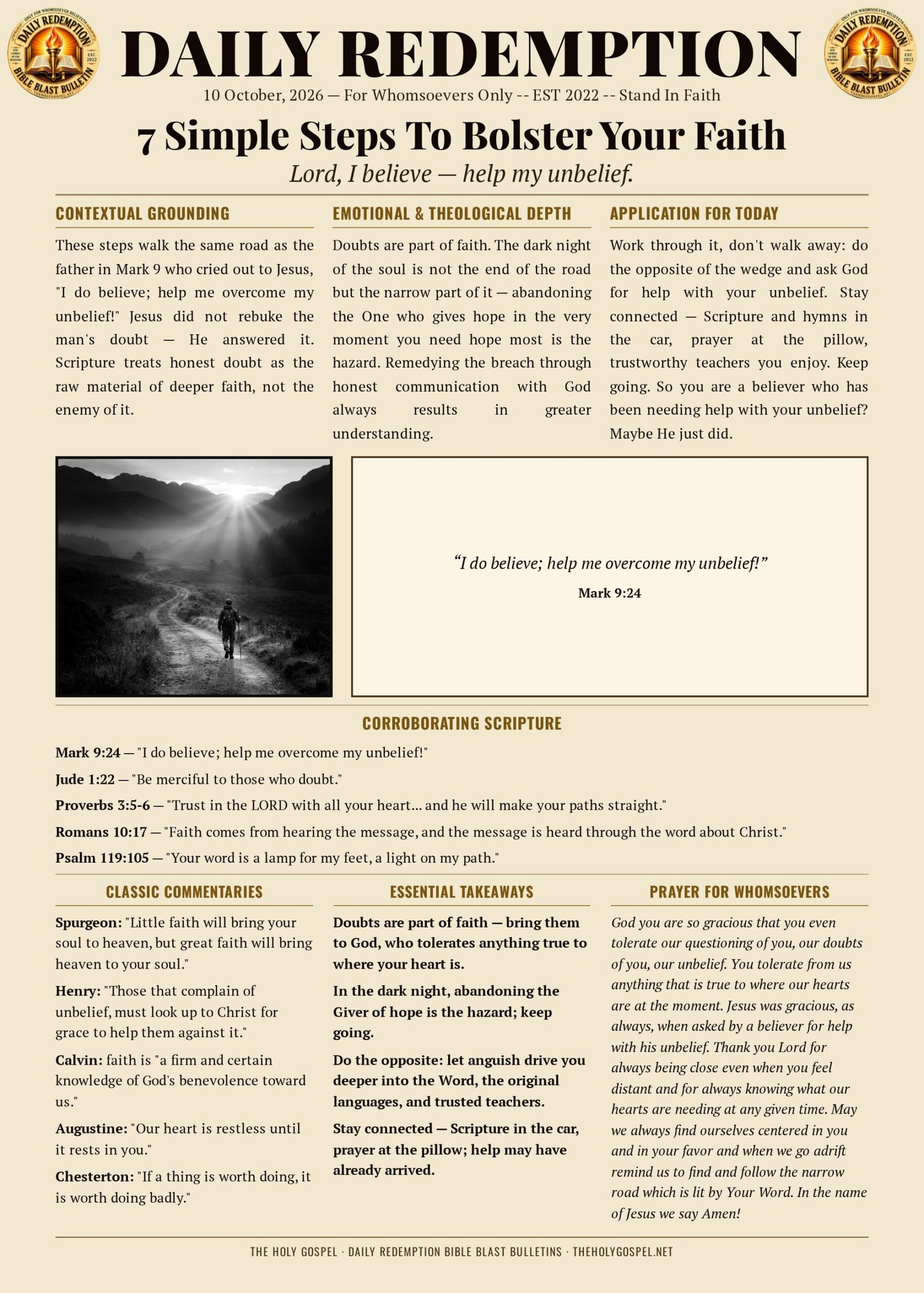
7 Simple Steps To Bolster Your Faith
Doubts are part of faith, and the Bible’s answer is not to hide them but to bring them to a God who is the most cheerful giver — He invented the idea — and who tolerates anything true from an honest heart. These seven steps are field-tested counsel: work through the doubt instead of abandoning the One who gives hope, do the opposite of the wedge by diving deeper into the Word, stay connected with Scripture and song in the ordinary hours, and keep going through the valley. The father in Mark 9 prayed the way these steps teach — “I do believe; help me overcome my unbelief!” — and Jesus answered him. So if you are a believer who has been needing help with your unbelief, how is God going to help you? Maybe He just did. 1 Has God led you through tests to a better place you never conceived of either before or during the test? Remember that we have a God who is a cheerful giver – the most cheerful, the most giving: he invented the idea. Next He commanded us to love one another as much as ourselves and this can only be done by loving Him. Are you doubting that it was God that was involved in guiding your steps and leading you to, if not the promised land, at least a land where promises were fulfilled? Doubts are part of faith. The remedying of a breech between you and God in terms of trusting in Him and His Word always results in greater understanding. Understanding is always a composite of a toleration of closeness with agreements on the matter facilitated through communication. 2 Work through the doubt – abandoning your faith is very hazardous. In such a dark night of the soul are you sure the solution is to abandon the One that can give you hope? 3 If something in the Bible seems ungodly but is meant to represent God then do a deeper dive, perhaps using Logos software or such, into the original language and make sure it has been translated faithfully and correctly. 4 Do the opposite – instead of letting your doubts, your anguish, etc drive a wedge between you and God, ask God for help with your unbelief and dive deeper into His Word and commentaries. If nothing else, find 2-3 influencers who are not about clickbait and who have not sold out but who help you discern the scripture and who you enjoy their content (so you will keep with it) and hold on tight. 5 Don’t let life circumstances drive you away. For instance, when you are driving you can listen to the Bible on CD or Christian talk radio or Christian music. Make it a project to find old time hymn gospel-jazz or country gospel or others who can listen to while you are driving or even contemporary Christian corporate worship. Stay connected. Spend a few minutes in prayer when you hit the sack or in prayer and/or the Bible for a few minutes every morning. I find Wise Disciple YouTube channel to be very helpful. Also the deliverance prayers just go on and on and I have never heard them slip. There are also very dramatic Bible-story-based big production numbers, yes usually constructed by AI, but still very powerful stuff that can help make the Bible come to life. 6 In the valley of the shadow of death or tribulation or just chaos in your life do as Churchill was said to have said, “If you are going through hell, keep going”.
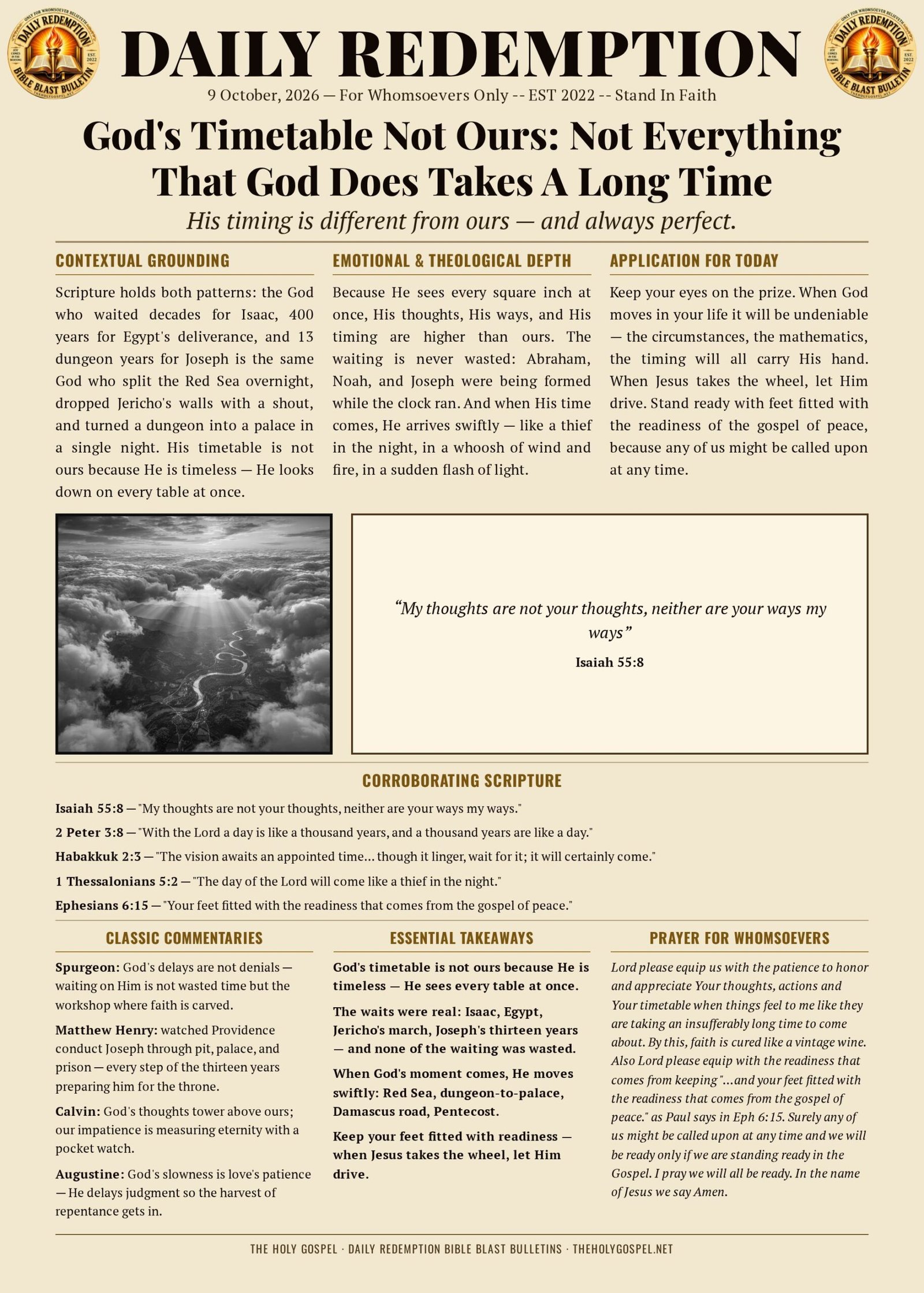
God’s Timetable Not Ours: Not Everything That God Does Takes A Long Time
God’s timetable is not ours, because He is timeless: He looks down on every war, every battle, and every engagement at once, while we watch one train at a time. Scripture holds both patterns — Abraham waiting decades for Isaac and Joseph thirteen years in a dungeon on one side, and the Red Sea splitting overnight, Jericho’s walls falling with a shout, and Pentecost arriving in a whoosh on the other. When God’s moment comes, He arrives swiftly, and the movement is undeniable: circumstances, mathematics, and timing all carrying His handprint. Until then, keep your eyes on the prize and your feet fitted with the readiness of the gospel — when Jesus takes the wheel, let Him drive. Yes it may seem that everything we pray for, even if ultimately, it comes to pass in God’s sweet time. In other words – according to His timetable. Not ours. See? This is easy for God because He is timeless. It is a creation or an illusion that he created our brains in such a way as to perceive but He sees all the wars, all the battles in a single war and every engagement between two opposing soldiers, as an example, at the same moment looking down from above. He doesn’t walk around the extensive elaborate train set to take it all in. He looks down on all the tables that it is on an looks in on every square inch at once. So, of course, His thoughts, His ways and His timing are different from ours. Let’s look at what Jesus said about when He would return as the perfect example. He said that He would come swiftly. That doesn’t mean He is 2000 years late it means that when His time to return comes He will arrive swiftly (“like a thief in the night”) and at a time that only the Father knows (as per ancient wedding ceremonies in Nazareth and Galilee and elsewhere where the Jews followed their customs and traditions). Now ask Abraham – the father of faith and he will tell you how long that he and Sarah had to wait for Isaac. The Jews had to endure slavery in Egypt for 400 years. Ask Noah how long he had to work on it with primitive tools to build a boat that was not a yacht and where the curvature of the wood itself was next to impossible. And how about Joseph? The one who is famous for being said that which man (his brothers) meant for evil, God used for good had to be, above all things, patient. He had to wait 13 years as a falsely accused prisoner before suddenly things changed for him. Not only was his accusation false but he was accused by one who wanted him to sin but he was too righteous and so he ended up in jail for 13 years. He spent 20 years separated from his family before his dream would be fulfilled. Ultimately God worked all things out for Joseph’s good and he never lost faith. Now let’s survey quickly some things in the Bible where God move swiftly and in a timely fashion. Red Sea – split the sea immediately after one night of fierce winds. Babel’s languages – instantly confused everyone as they were speaking different languages so as to thwart their plans of becoming like God Jericho’s walls – yes 7 days they marched around the city but then on the 7th day they marched around it 7 times and with a shout the walls came a-tumblin’ down.
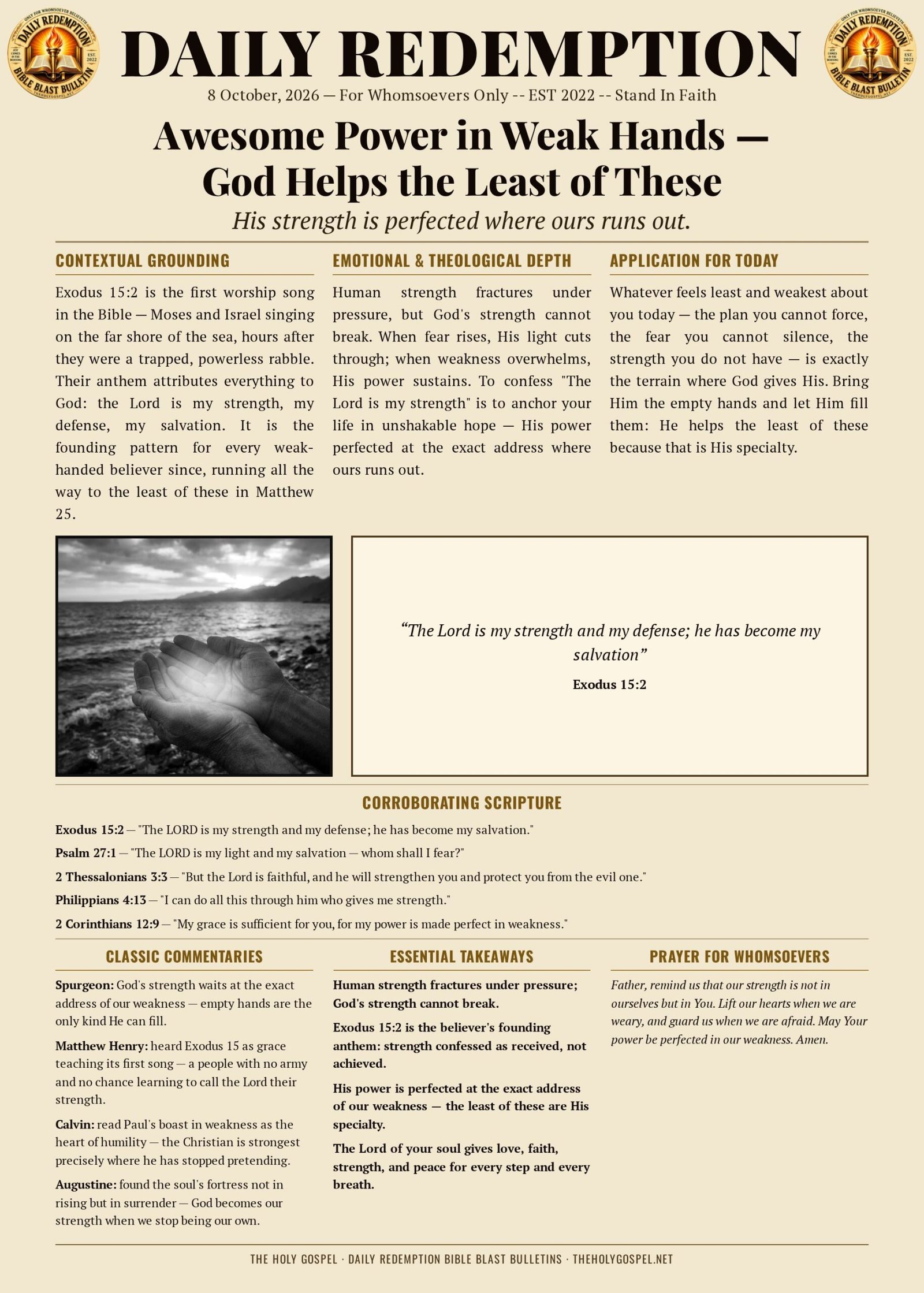
Awesome Power in Weak Hands — God Helps the Least of These
Human strength fractures under pressure, but God’s strength cannot break. From Moses’ song on the far shore of the Red Sea to the least of these in Matthew 25, Scripture keeps awarding the victory to the unlikely — empty hands are the only kind the Lord can fill. Paul found the pattern and made it his boast: God’s power is perfected at the exact address of our weakness. Whatever is least about you today is precisely the terrain where He gives His strength, with every step and every breath. Contextual Grounding Exodus 15:2 is the first worship song in the Bible. Moses and the children of Israel sing it on the far shore of the Red Sea, hours after they had been a trapped, powerless rabble — the sea in front of them, Pharaoh’s chariots behind them, and nothing at all in their own hands. The anthem they sing attributes everything to God and nothing to themselves: “The Lord is my strength and my defense; he has become my salvation.” It is the founding pattern for every weak-handed believer since: strength confessed as received, never achieved. And the pattern runs all the way to Matthew 25, where the King declares that He takes the treatment of the least of these personally. From the seashore to the judgment seat, Scripture keeps awarding the victory to the unlikely. Emotional & Theological Depth Human strength fractures under pressure, but God’s strength cannot break. When fear rises, His light cuts through. When weakness overwhelms, His power sustains. To confess “The Lord is my strength” is to anchor your life in unshakable hope — and Paul found the same anchor from the opposite direction: “My grace is sufficient for you, for my power is made perfect in weakness.” The apostle begged three times for his thorn to leave and heard instead that the thorn was load-bearing; God’s power shows up at the exact address where ours runs out. That is why the least of these are His specialty — the empty-handed are the only kind of hands He can fill. Zeb has sung the same confession in his own words, from his original song “Lord Of My Soul”: let Your love give us love, Lord of my soul… let Your strength give us strength… and when I’m walking out alone, remind me I am not alone; when I’m far from home, remind me I’m always at home in You. And from “With Every Step and Every Breath”: as we navigate this tumultuous life with our sins and our regrets, we hold on tight to Jesus with every step and every breath. Dear Jesus give us wisdom, Blessed Jesus give us strength, Jesus help us follow you with every step and every breath. Application For Today Whatever feels least and weakest about you today — the plan you cannot force, the fear you cannot silence, the strength you do not have — is exactly the terrain where God gives His. So bring Him the empty hands. Confess Exodus 15:2 out loud until it becomes your anthem too: The Lord is my strength. Stop measuring what you can hold and start marveling at what He holds. The One who taught a panicked, unarmed crowd to sing on the seashore can teach your weakness the same song today, with every step and every breath. Classic Commentaries Corner Charles Spurgeon delighted in the arithmetic of grace: our emptiness plus Christ’s fullness is the whole account.
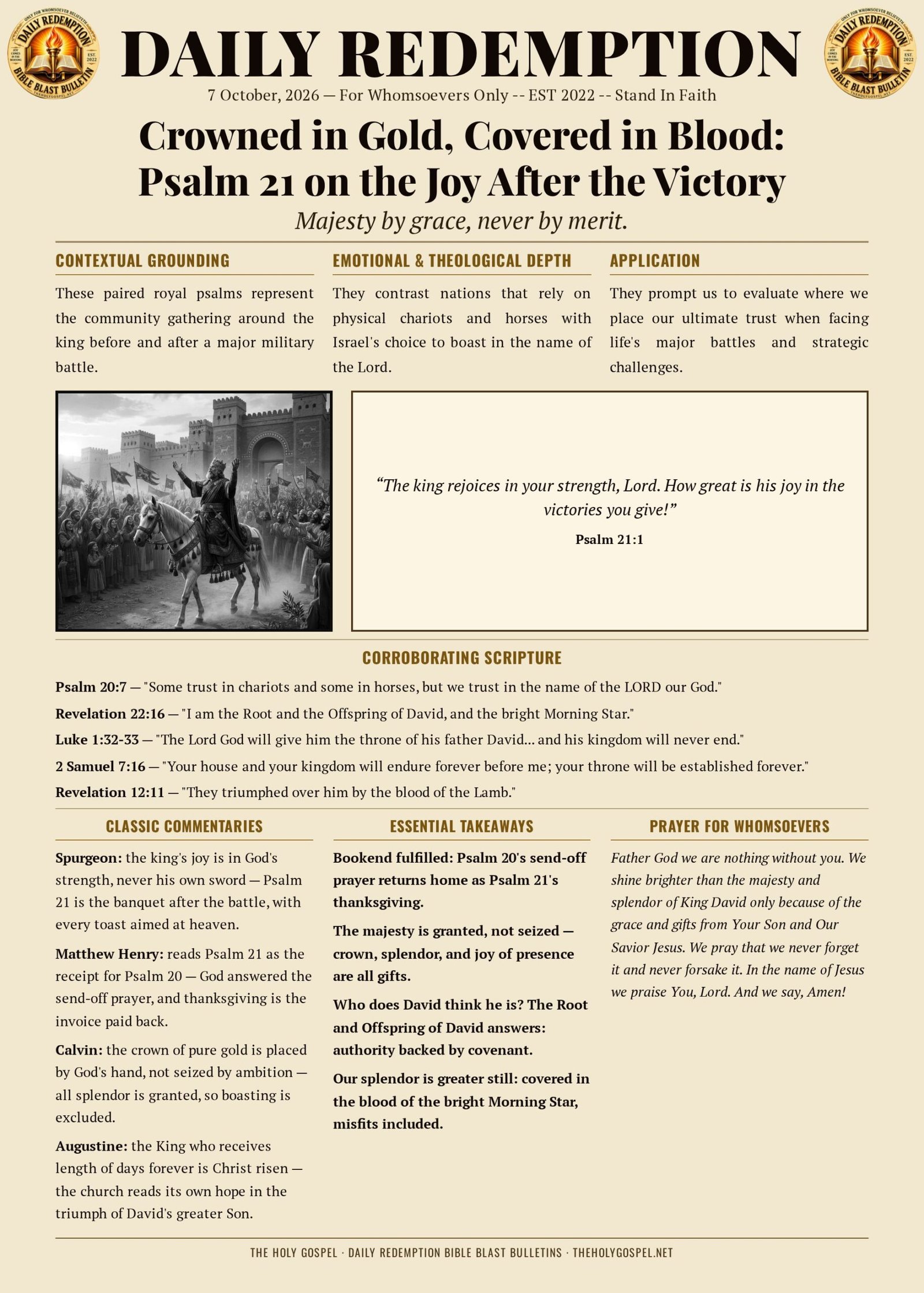
Crowned in Gold, Covered in Blood: Psalm 21 on the Joy After the Victory
Psalm 21 is the homecoming half of the royal pair: the king returns from the battle Psalm 20 sent him to, and the rejoicing attributes everything to the Lord — victories, crown, length of days, the joy of His presence. Who does this David guy think he is, telling the Lord He has bestowed splendor and majesty on him? Zeb lets the text answer: royal authority backed by God’s explicit covenant, the man after God’s own heart, ancestor of the Root and Offspring of David whose throne will never end. And ours is greater still: not through our own works, but because misfits covered in the blood of the bright Morning Star shine brighter than any majesty David ever claimed. Psalm 21 1 The king rejoices in your strength, Lord. How great is his joy in the victories you give! 2 You have granted him his heart’s desire and have not withheld the request of his lips. 3 You came to greet him with rich blessings and placed a crown of pure gold on his head. 4 He asked you for life, and you gave it to him — length of days, for ever and ever. 5 Through the victories you gave, his glory is great; you have bestowed on him splendor and majesty. 6 Surely you have granted him unending blessings and made him glad with the joy of your presence. 7 For the king trusts in the Lord; through the unfailing love of the Most High he will not be shaken. 8 Your hand will lay hold on all your enemies; your right hand will seize your foes. 9 When you appear for battle, you will burn them up as in a blazing furnace. The Lord will swallow them up in his wrath, and his fire will consume them. 10 You will destroy their descendants from the earth, their posterity from mankind. 11 Though they plot evil against you and devise wicked schemes, they cannot succeed. 12 You will make them turn their backs when you aim at them with drawn bow. 13 Be exalted in your strength, Lord; we will sing and praise your might. Who Does This David Guy Think He Is Anyway? Who does this David guy think he is anyway? Telling the Lord that He has bestowed on him splendor and majesty? Whoa!? Well, remember these things… Jesus says “I am the Root and the Offspring of David, and the bright Morning Star” — Revelation 22:16 The angel Gabriel tells Mary that God will give Jesus “the throne of his father David,” and His kingdom will never end — Luke 1:32-33 Yahweh called him a “man of His own heart” His royal authority was backed by God’s explicit covenant and choosing, not self-promotion — and usually we find David demonstrating great humility and honoring the Lord for his blessings, in battle and otherwise. And What Does This Have to Do With Us? Not at all through our own works do we receive and are we blessed with everything that David claims here, but only through the undeserved grace of God’s gift — and because putting on the full armor of God means only this: remembering and giving attributes to that we are covered in the blood of Jesus. We are righteous because Yahweh looks at us and sees His Son. It only helps if we follow in David’s path by glorifying and exalting the glory and righteousness of God. Woe be to the backslider who chooses Hell over the Heavenly riches of God.
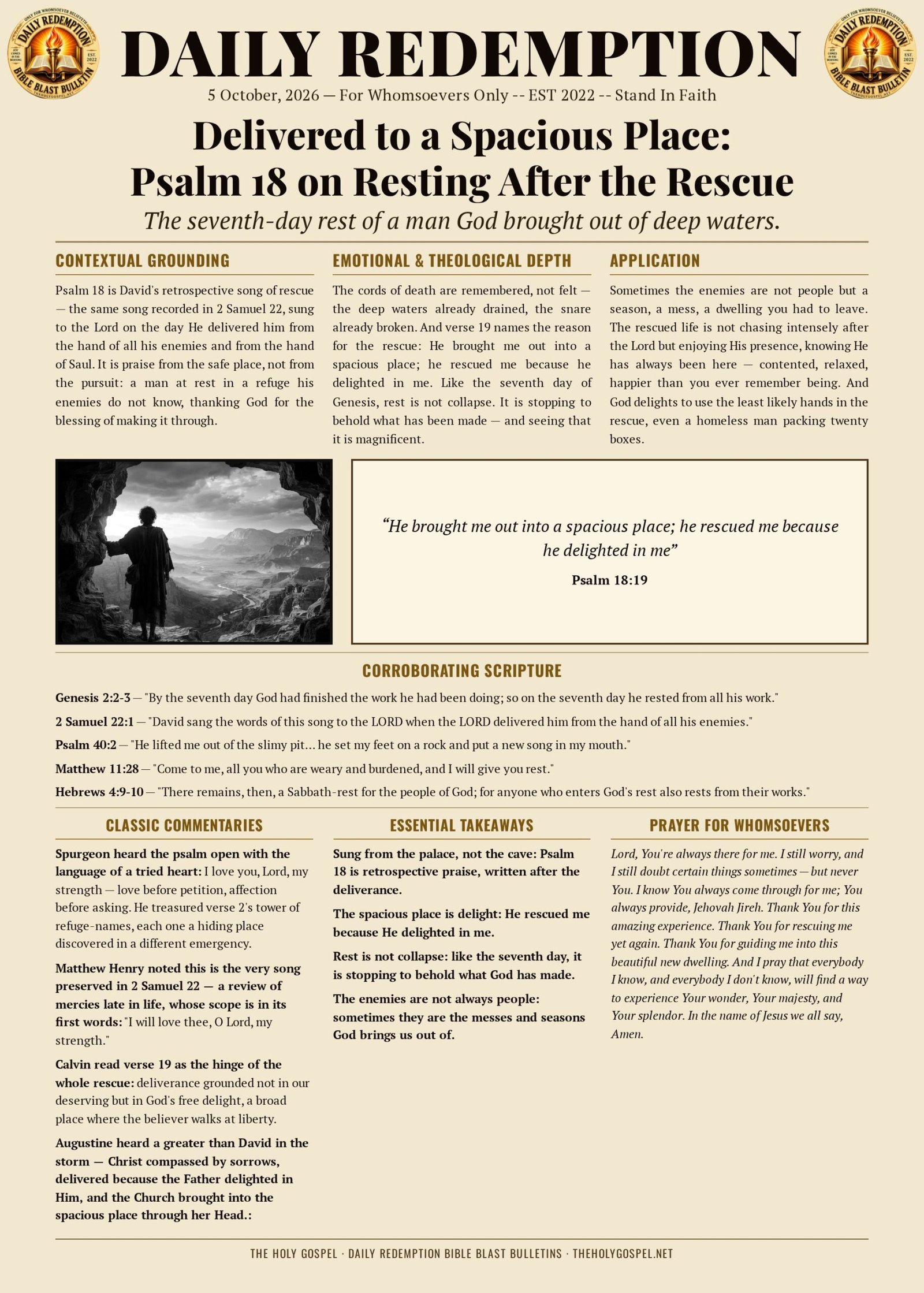
Delivered to a Spacious Place: Psalm 18 on Resting After the Rescue
Psalm 18 is David’s song from the other side of the rescue — the same song preserved in 2 Samuel 22, sung after the Lord delivered him from all his enemies and from the hand of Saul. Zeb reads it from the far side of a hellacious moving season: the old dwelling’s chaos left behind like an enemy in pursuit, and the new place standing as the “spacious place” of verse 19 — “He brought me out into a spacious place; he rescued me because he delighted in me.” Like the Lord who rested on the seventh day, the delivered soul stops striving and simply beholds what God has made — and calls it good. Praise does not always need angst; sometimes the deepest thanksgiving comes from standing in the finished rescue, contented, at rest, and happier than you have ever been. Psalm 18 For the director of music. Of David the servant of the LORD. He sang to the LORD the words of this song when the LORD delivered him from the hand of all his enemies and from the hand of Saul. He said: 1 I love you, LORD, my strength. 2 The LORD is my rock, my fortress and my deliverer; my God is my rock, in whom I take refuge, my shield and the horn of my salvation, my stronghold. 3 I called to the LORD, who is worthy of praise, and I have been saved from my enemies. 4 The cords of death entangled me; the torrents of destruction overwhelmed me. 5 The cords of the grave coiled around me; the snares of death confronted me. 6 In my distress I called to the LORD; I cried to my God for help. From his temple he heard my voice; my cry came before him, into his ears. 7 The earth trembled and quaked, and the foundations of the mountains shook; they trembled because he was angry. 8 Smoke rose from his nostrils; consuming fire came from his mouth, burning coals blazed out of it. 9 He parted the heavens and came down; dark clouds were under his feet. 10 He mounted the cherubim and flew; he soared on the wings of the wind. 11 He made darkness his covering, his canopy around him— the dark rain clouds of the sky. 12 Out of the brightness of his presence clouds advanced, with hailstones and bolts of lightning. 13 The LORD thundered from heaven; the voice of the Most High resounded. 14 He shot his arrows and scattered the enemy, with great bolts of lightning he routed them. 15 The valleys of the sea were exposed and the foundations of the earth laid bare at your rebuke, LORD, at the blast of breath from your nostrils. 16 He reached down from on high and took hold of me; he drew me out of deep waters. 17 He rescued me from my powerful enemy, from my foes, who were too strong for me. 18 They confronted me in the day of my disaster, but the LORD was my support. 19 He brought me out into a spacious place; he rescued me because he delighted in me. 20 The LORD has dealt with me according to my righteousness; according to the cleanness of my hands he has rewarded me. 21 For I have kept the ways of the LORD; I am not guilty of turning from my God. 22 All his laws are before me; I have not turned away from his decrees. 23 I have been blameless before him and have kept myself from sin.
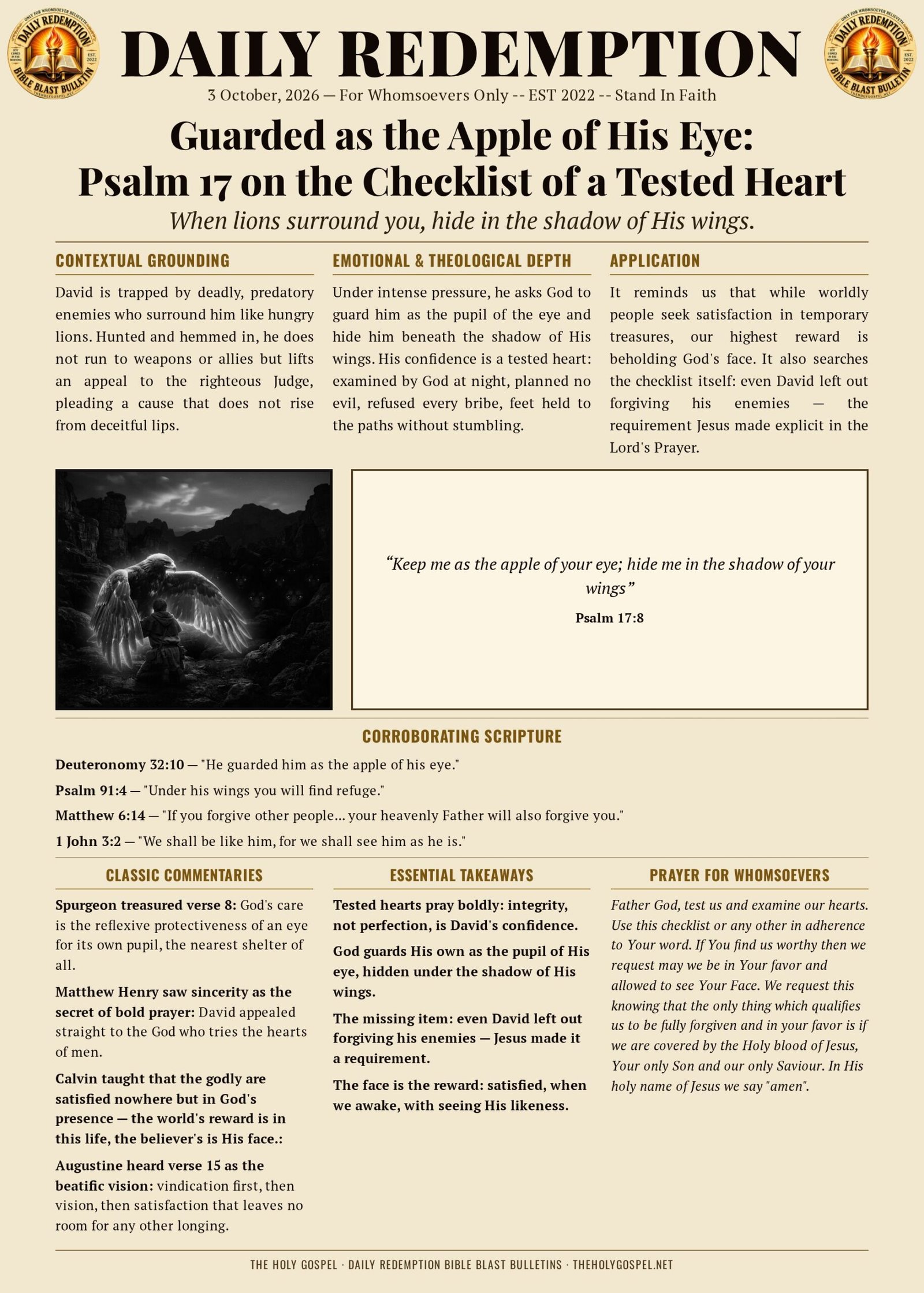
Guarded as the Apple of His Eye: Psalm 17 on the Checklist of a Tested Heart
David, hunted by predatory enemies who surround him like hungry lions, appeals to God as the righteous Judge with a tested heart: lips without deceit, hands free of bribes, feet held to God’s paths. He asks to be kept as the apple of God’s eye, hidden in the shadow of His wings — yet even David’s checklist of favor is missing the one thing Jesus made explicit: forgiving our enemies so that we may be forgiven. And the psalm ends not with rescue from lions but with the reward of the tested heart: “When I awake, I will be satisfied with seeing your likeness.” A prayer of David. 1 Hear me, Lord, my plea is just; listen to my cry. Hear my prayer— it does not rise from deceitful lips. 2 Let my vindication come from you; may your eyes see what is right. 3 Though you probe my heart, though you examine me at night and test me, you will find that I have planned no evil; my mouth has not transgressed. 4 Though people tried to bribe me, I have kept myself from the ways of the violent through what your lips have commanded. 5 My steps have held to your paths; my feet have not stumbled. 6 I call on you, my God, for you will answer me; turn your ear to me and hear my prayer. 7 Show me the wonders of your great love, you who save by your right hand those who take refuge in you from their foes. 8 Keep me as the apple of your eye; hide me in the shadow of your wings 9 from the wicked who are out to destroy me, from my mortal enemies who surround me. 10 They close up their callous hearts, and their mouths speak with arrogance. 11 They have tracked me down, they now surround me, with eyes alert, to throw me to the ground. 12 They are like a lion hungry for prey, like a fierce lion crouching in cover. 13 Rise up, Lord, confront them, bring them down; with your sword rescue me from the wicked. 14 By your hand save me from such people, Lord, from those of this world whose reward is in this life. May what you have stored up for the wicked fill their bellies; may their children gorge themselves on it, and may there be leftovers for their little ones. 15 As for me, I will be vindicated and will see your face; when I awake, I will be satisfied with seeing your likeness. Recently I called someone in the church out because they were not praying with the rest of us prior to worship team rehearsal. I said “does this not involve you”? He was not in the worship team but he was present. I apologized to him for my harshness some days later. He said “don’t worry, you’re ok (with him)”. A couple of weeks later I was reminded what Jesus responded to him when someone called him “good” – only the Father in Heaven is truly good. So I started thinking along this line “wow with that endorsement and $5 I can get a small Starbucks coffee”. Here though, in Psalm 17 prayer, David asks God for protection for himself, vindication against the charges and accusations of his enemies and lays out a kind of checklist to establish if one is in God’s favor. Something like this: My heart, in prayer to You, Lord, is true, not deceitful. You have eyes that see and with Your righteous observation I stand vindicated against all charges.
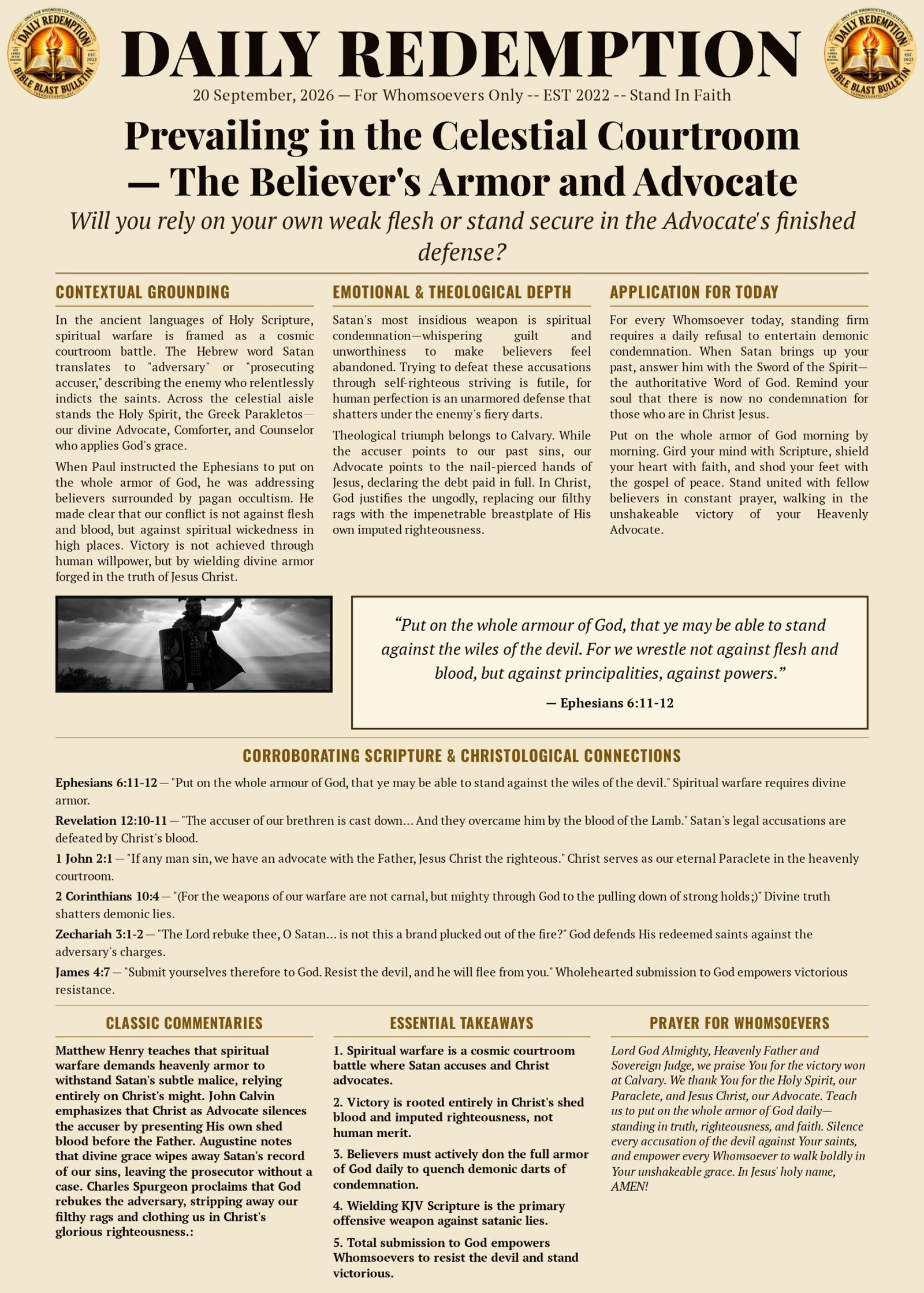
Prevailing in the Celestial Courtroom — The Believer’s Armor and Advocate
Spiritual warfare is not a flesh-and-blood conflict of physical force, but a cosmic courtroom battle where Satan acts as the relentless accuser (Satan) and the Holy Spirit serves as our divine advocate (Parakletos). True victory is never found in our own human merit or self-righteousness, but in standing securely upon the shed blood and imputed righteousness of Jesus Christ. By putting on the whole armor of God—girding ourselves with truth, wielding the sword of the Spirit, and taking up the shield of faith—we render every indictment of the enemy powerless. As Whomsoevers anchor their souls in the advocate’s plea, the accusations of the adversary are forever silenced in the triumphant light of Calvary. Contextual Grounding In the linguistic tapestry of Holy Scripture, the battlefield of spiritual warfare is framed through the solemn legal imagery of a celestial courtroom. In ancient Hebrew, the proper noun Satan literally translates to “adversary” or “prosecuting accuser”—a chilling description of the fallen archangel who day and night accuses the saints before the throne of God (Revelation 12:10, Zechariah 3:1). Across the celestial aisle stands our divine defense: the Holy Spirit, designated in ancient Greek as the Parakletos—the Advocate, Comforter, and Counselor summoned alongside us to plead our cause and apply divine grace (John 14:16, 1 John 2:1). To understand spiritual warfare is to recognize that Satan does not merely attack us with temporal circumstances; he attacks us in the courtroom of conscience, hurling indictments of guilt, past failures, and spiritual unworthiness. When the Apostle Paul wrote his epistle to the believers in Ephesus, he was addressing a congregation surrounded by a pagan culture steeped in witchcraft, occult practices, and demonic territorial influence. Paul did not instruct the Ephesians to engage in physical violence or earthly political maneuvers, declaring, “For we wrestle not against flesh and blood, but against principalities, against powers, against the rulers of the darkness of this world, against spiritual wickedness in high places” (Ephesians 6:12). In the Greco-Roman world, where Roman soldiers marched in heavy, interconnected armor to defend the Empire, Paul borrowed the imagery of the Roman legionnaire’s battle gear to illustrate how a Christian stands firm in the heavenly realm against demonic stratagems. This biblical context exposes the fatal flaw of modern self-help philosophy and carnal religion. Spiritual warfare cannot be waged with human willpower, intellectual debate, or superficial moral reforms. Satan, as an experienced prosecutor, knows the perfection of God’s holy law and gladly exposes human transgression to breed despair. However, the Gospel reveals that our defense does not rest upon our inherent goodness or human perfection. Our Great High Priest, Jesus Christ, entered the Holy Place with His own blood, obtaining eternal redemption and securing our legal justification before the Father (Hebrews 9:12). The war is ultimately fought and won in the realm of divine truth versus satanic lies. Emotional & Theological Depth On an emotional level, the enemy’s most destructive weapon is not physical persecution, but the heavy, suffocating weight of spiritual condemnation. Satan whispers insidious lies into the ears of struggling believers, pointing to past sins, secret flaws, and lingering weaknesses to convince them that God has abandoned them or that their faith is futile. When a soul is under demonic accusation, prayer feels blocked, worship feels empty, and fear grips the heart. Many Whomsoevers attempt to silence these accusations by striving harder in their own strength, hoping that extra religious effort or self-flagellation will satisfy the divine standard. Yet self-righteousness is an unarmored breastplate; it shatters the moment the enemy launches his fiery darts.
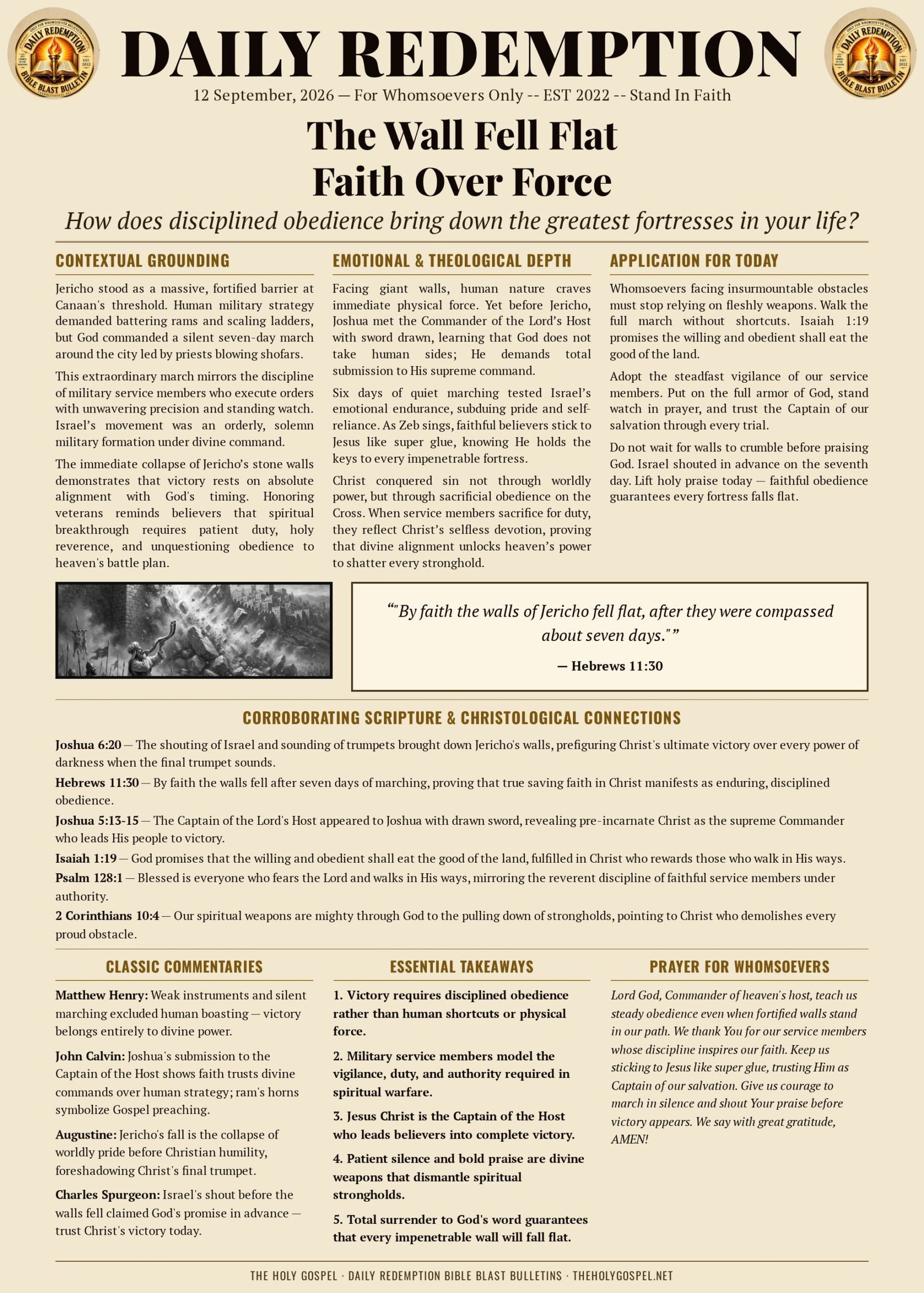
When The Wall Falls Flat — Honoring Service Members Through Jericho’s Lesson of Disciplined Faith
The formidable stone walls of Jericho crumbled not under the assault of battering rams or military force, but through steady, disciplined obedience to divine instructions. Honoring our nation’s service members and veterans reminds us of the profound spiritual value of tactical discipline, steadfast duty, and standing watch under orders. When Whomsoevers march in complete surrender behind the true Captain of the Lord’s Host—Jesus Christ—even the most impenetrable strongholds in our lives are brought down flat by faith.
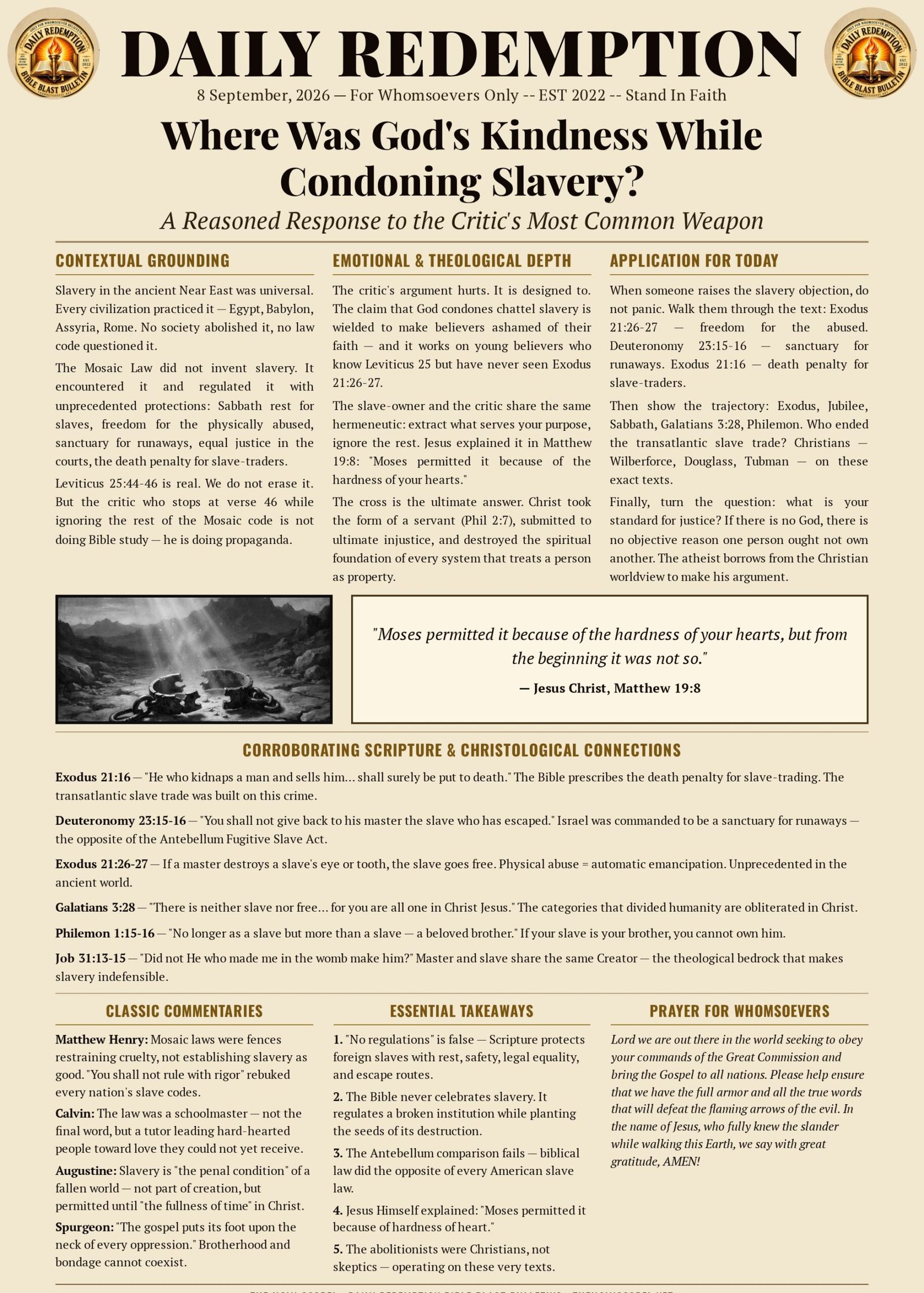
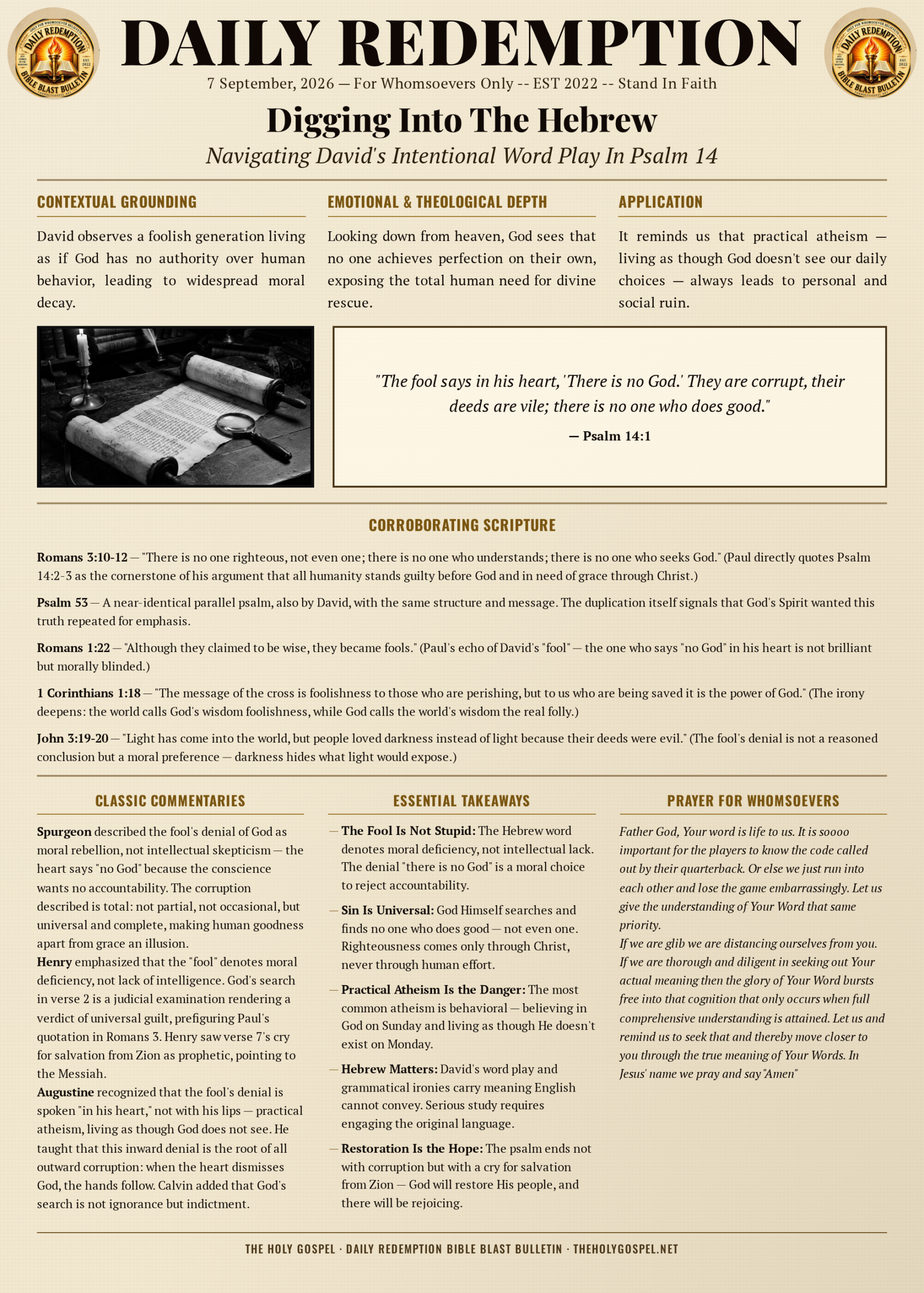
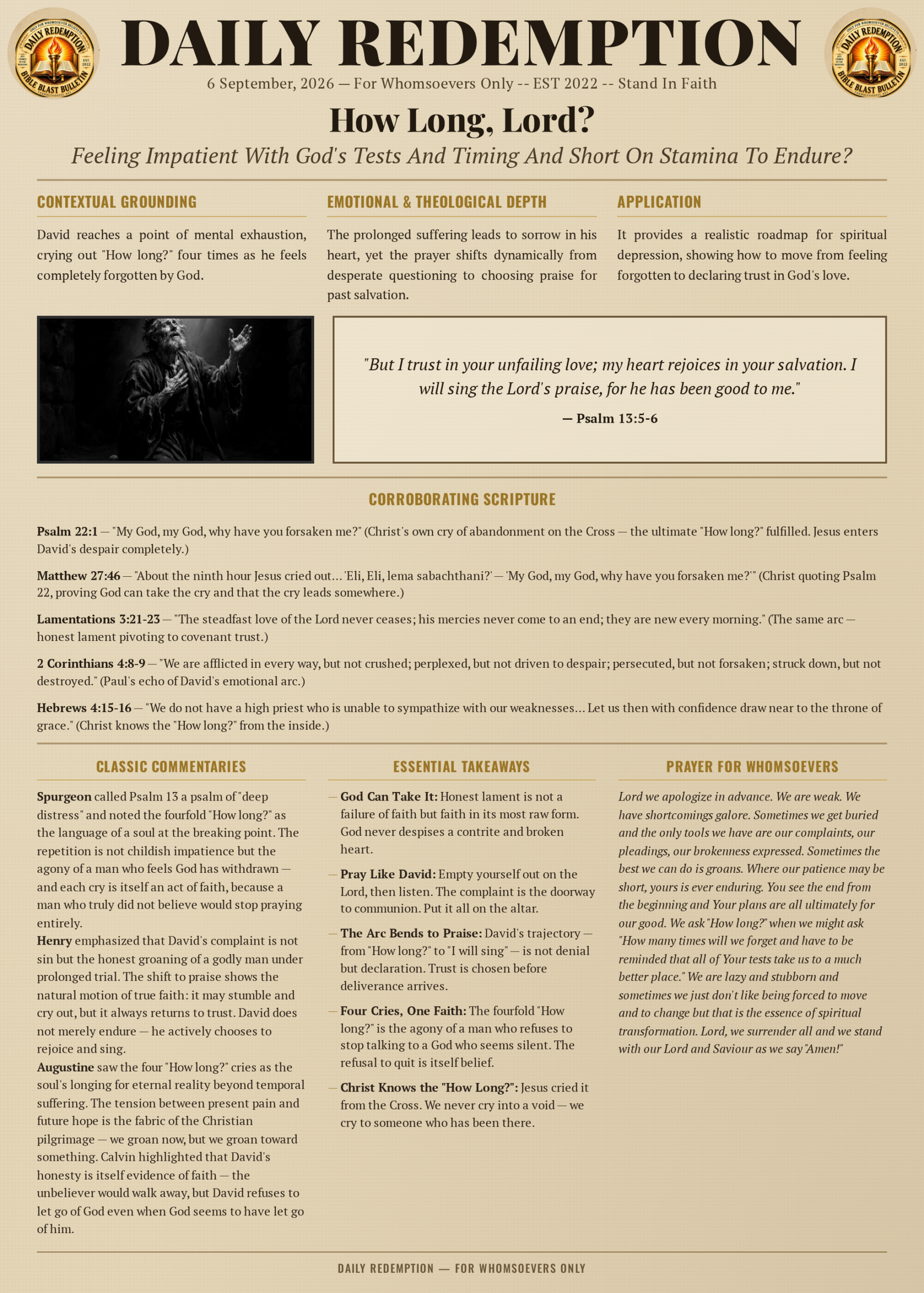
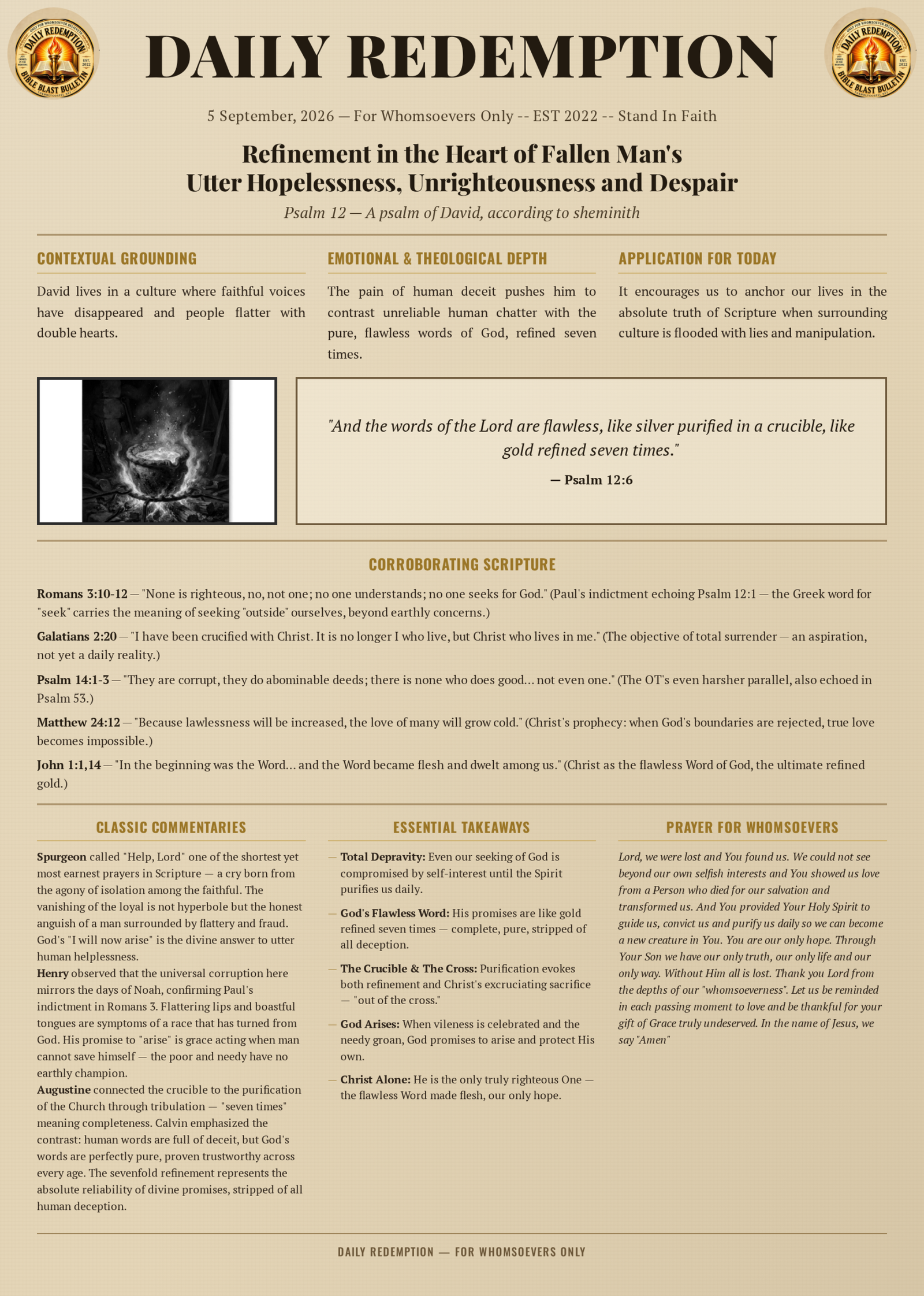
- A Better Life Through Faith
- Book Of Galatians
- Church
- Do Not Fear
- Drawing Nearer To God The Father
- Faith
- forgiveness
- Gratefulness - Gratitude - Thankfulness
- Heaven
- Holy Gospel
- Holy Spirit
- Jesus The Comforter
- LIFE
- Lord's Prayer
- New Testament
- Old Testament - Messianic Perspective
- Practicing Christian Faith
- Prayer
- Restoration And Renewal
- Salvation
- Spiritual Warfare
- The Daily Redemption
- Understanding Scripture
- VICTORY
- Worldly Injustice
- Your Connection To God
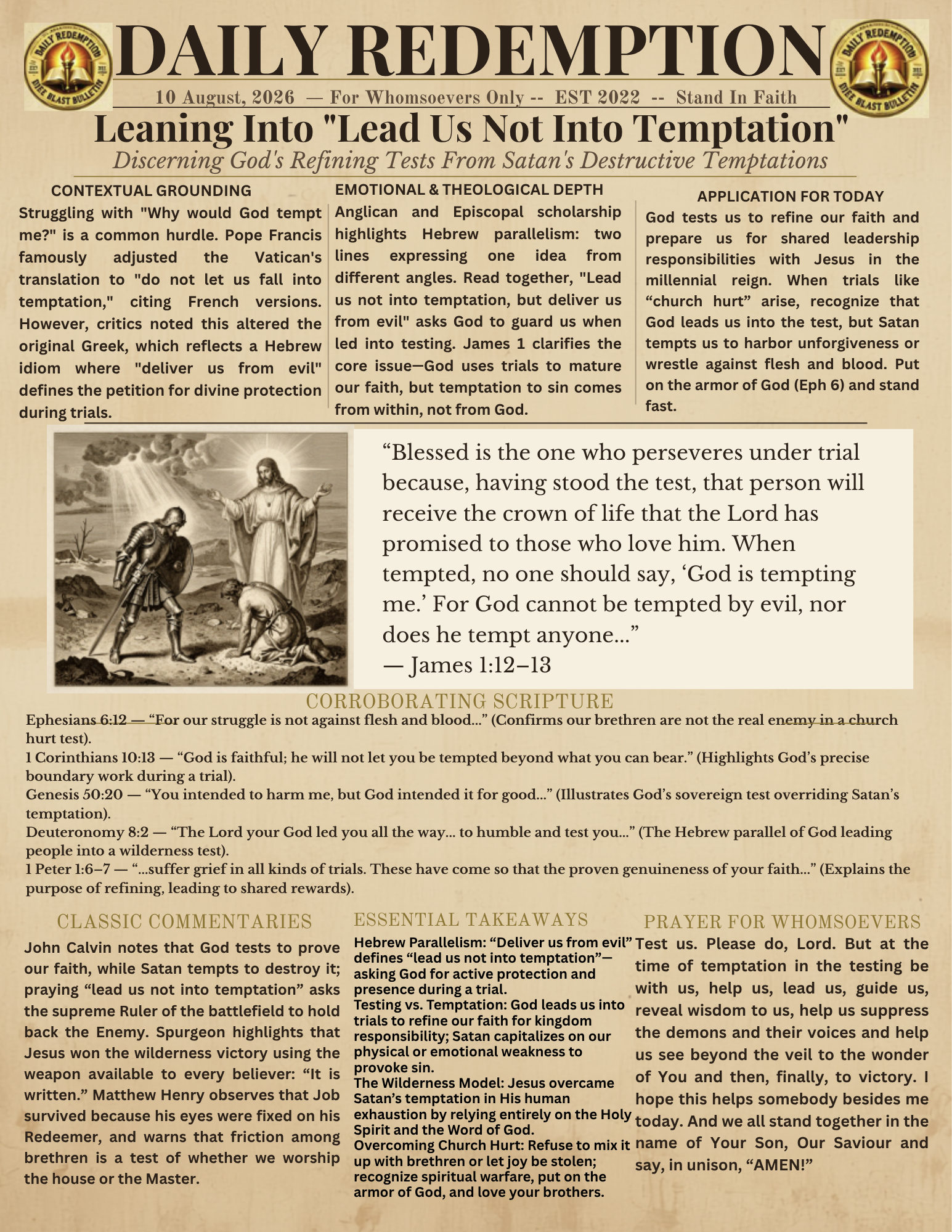
Why I Love Church Hurt And You Should Too
- Book Of James
- Church
- Drawing Nearer To God The Father
- Fear Of God
- Holy Gospel
- Holy Spirit
- Humility
- Jesus The Comforter
- LIFE
- Lord's Prayer
- Love
- Musings On Spiritual Warfare
- New Testament
- Practicing Christian Faith
- Restoration And Renewal
- Salvation
- Spiritual Warfare
- Taking The Devil Down
- Tribulation
- Understanding Scripture
- VICTORY
- Worldly Injustice
- Worship
Leaning Into “Lead Us Not Into Temptation”
- Do Not Fear
- Drawing Nearer To God The Father
- Faith
- Faithful God
- Holy Gospel
- Holy Spirit
- Jesus The Comforter
- King David
- LIFE
- Musings On Spiritual Warfare
- Practicing Christian Faith
- Psalms
- Psalms
- Restoration And Renewal
- Salvation
- Spiritual Warfare
- Taking The Devil Down
- The Daily Redemption
- Truth And Integrity
- Understanding Scripture
- VICTORY
- Your Connection To God