Where Was God’s Kindness While Condoning Slavery?
There is no shortage of God-haters on the internet who will extract, spin and even alter God’s word to push people off the narrow road. Such is their rejection of and resistance to a godly lifestyle. A favorite assertion is that of God and His Word condones slavery. What can you say to someone like this in defense of our Lord (not that He needs defending, ever, but that it will put your mind at ease and possibly the mind and hearts of other believers)?
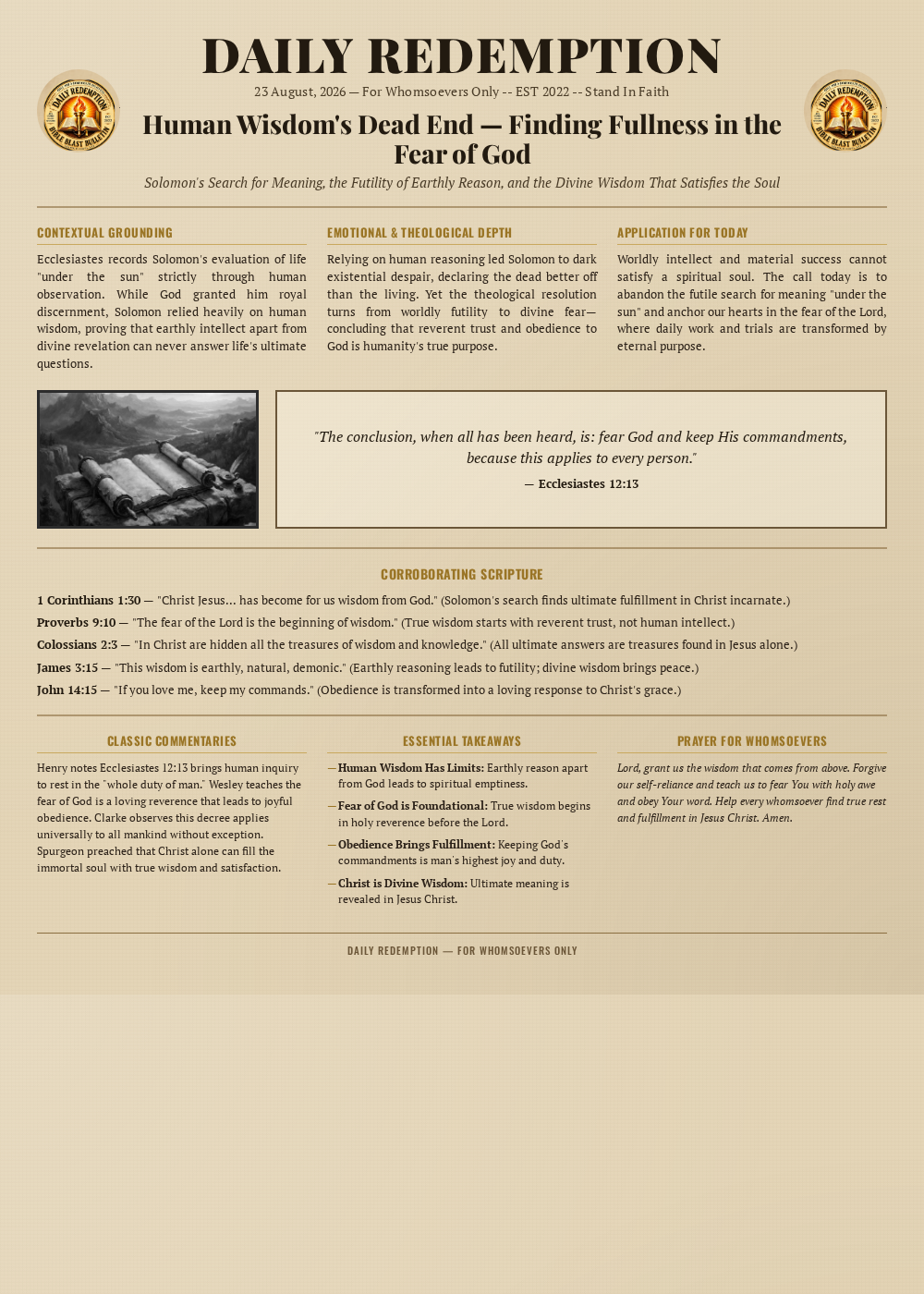
Contextual Grounding
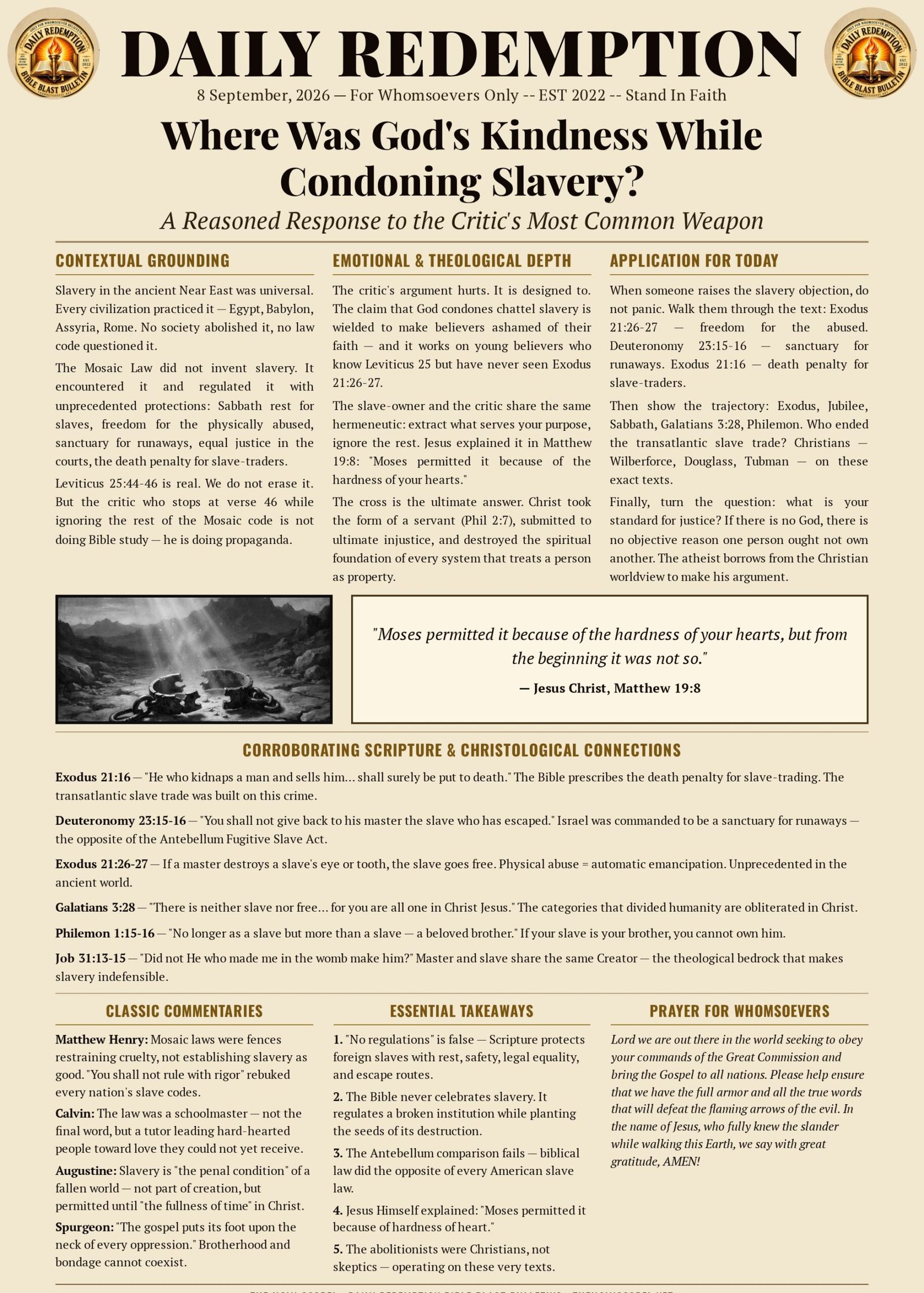
Slavery in the ancient Near East was a universal institution. Every civilization practiced it — Egypt, Babylon, Assyria, Canaan, Rome. There was no society without it, no law code that abolished it, no philosophical movement that questioned it. It was the assumed backdrop of human civilization. When critics attack the Bible for “condoning” slavery, they impose a modern abolitionist standard onto an ancient world where no such standard existed anywhere — and they ignore the fact that the modern abolitionist standard was built BY Christians FROM the Bible.
The Mosaic Law did not invent slavery. It encountered it. And rather than issuing an impossible decree that no ancient society could have absorbed, God’s law regulated an existing institution while imposing protections that were entirely unprecedented. Sabbath rest for slaves. Freedom for the physically abused. Sanctuary for runaways. Equal justice in the courts. The death penalty for slave-traders. These were not “no regulations” — they were revolutionary constraints on a universal institution that no other law code in the ancient world matched.
Leviticus 25:44-46 is real. It permits the holding of foreign slaves as property, distinct from Hebrew debt servants who were released at Jubilee. This is uncomfortable, and we do not erase it. But the critic who stops at verse 46 while ignoring the rest of the Mosaic code is not doing Bible study — he is doing propaganda. The question is not whether the Bible permitted something we find repugnant. The question is what the Bible actually said about how those slaves were to be treated, what protections they had, and where the trajectory of Scripture was pointing.
Emotional & Theological Depth
The critic’s argument hurts. It is designed to hurt. The claim that God condones chattel slavery is not raised as a historical curiosity — it is wielded as a weapon to make believers ashamed of their faith, to make the Bible look like a tool of oppression rather than liberation, and to push people off the narrow road. And it works. Young believers encounter this argument online and have no response, because they have never been taught what the Bible actually says about the treatment of slaves. They know Leviticus 25:44-46 because the critic quoted it. They do not know Exodus 21:26-27 because no one ever showed them.
The emotional weight here is real for another reason: the transatlantic slave trade was justified by people who claimed the Bible. Slave-owners in the Antebellum South cited Leviticus 25 to defend hereditary chattel slavery while ignoring Deuteronomy 23:15-16, Exodus 21:16, and the entire trajectory of the New Testament. The critic and the slave-owner share the same hermeneutic: extract the verses that serve your purpose and ignore the rest. The difference is that the slave-owner used it to enslave, and the critic uses it to discredit God.
But here is where it gets personal. Jesus explained this exact dynamic in Matthew 19:8: “Moses permitted it because of the hardness of your hearts.” God’s law met a broken world where it was, not where it should have been. This is not a defense of slavery — it is an explanation for why a perfect God would permit an imperfect system in an imperfect world. The same principle applies to divorce, to polygamy, to warfare. God did not give humanity the law they deserved. He gave them the law they could receive — and then spent the rest of redemptive history pulling them toward the law they were made for.
The cross is the ultimate answer. Christ did not abolish slavery by decree. He abolished it by dying. He took on the form of a servant Himself (Philippians 2:7), submitted to the ultimate injustice, and in doing so, destroyed the spiritual foundation of every system that treats a person as property. The blood of Christ is the blood of the ultimate slave — and the ultimate liberator.
Application For Today
When someone raises the slavery objection, do not panic. Do not apologize for the Bible. And do not counter with a single verse as if it were a debate trick. The objection is layered, and the response should be too. Walk them through the actual text. Show them Exodus 21:26-27 — freedom for the abused slave. Show them Deuteronomy 23:15-16 — sanctuary for the runaway. Show them Exodus 21:16 — the death penalty for slave-traders. Ask them: does this sound like a God who celebrates slavery, or a God who is dismantling it from the inside out?
Then show them the trajectory. The Exodus. The Jubilee. The Sabbath. Galatians 3:28 — “neither slave nor free.” Philemon — “no longer as a slave but as a beloved brother.” Ask them: who ended the transatlantic slave trade? It was not the skeptics. It was Christians — Wilberforce, Douglass, Tubman, the Quakers — operating on these exact texts. The abolitionist movement was a Christian movement before it was a secular one. That is not a coincidence. That is the fruit of a Book that never celebrated slavery but planted the seeds of its destruction.
And finally, turn the question back on them with gentleness. Ask: what is your standard for justice? Where does it come from? If there is no God, there is no objective reason why one person ought not own another. The atheist who condemns biblical slavery is borrowing from the Christian worldview to make his argument. He is using the currency of a theology he rejects to purchase a condemnation he cannot justify on his own terms. That is not a rebuttal. It is a confession.
Classic Commentaries Corner
Matthew Henry observed that the Mosaic regulations on servitude were never designed to establish slavery as a permanent good, but to restrain existing cruelty in a world that knew nothing else. The laws protecting slaves from violence, mandating rest, and providing release were fences around an institution that the Fall had created and grace was slowly dismantling. Henry noted that the principle “you shall not rule one over another with rigor” (Leviticus 25:46) was a direct rebuke to the harshness that characterized every other nation’s slave codes.
John Calvin emphasized that the Mosaic Law never endorsed slavery as ideal but governed it as a reality. He saw the Sabbath law’s inclusion of servants and the runaway slave law as evidence that God’s heart was always toward the dignity of the person, even within an imperfect system. Calvin argued that the law was a “schoolmaster” (Galatians 3:24) — not the final word on human relations, but a tutor leading a hard-hearted people toward an ethic of love that they were not yet ready to receive in full.
Augustine wrote in The City of God that slavery is not part of God’s original creation order but a consequence of sin — “the penal condition” of a fallen world. He argued that the master-slave relationship would not exist in a world untouched by the Fall, and that God’s permission of slavery was not approval of it but a temporary accommodation within His providential governance, “until the fullness of time should come” when Christ would declare the equal dignity of all persons before God.
Charles Spurgeon preached that the spirit of the New Testament is the death of slavery. “The gospel puts its foot upon the neck of every oppression.” He pointed to Philemon as the knockout blow — Paul did not command abolition, but he commanded brotherhood, and brotherhood and bondage cannot long coexist. Spurgeon was himself a passionate supporter of the American abolitionist cause, seeing it as the direct fruit of New Testament theology.
Corroborating Scripture & Christological Connections
Exodus 21:16 — “He who kidnaps a man and sells him, or if he is found in his hand, shall surely be put to death.” The Bible prescribes the death penalty for slave-trading. The transatlantic slave trade was built entirely on this crime — a crime the Bible punished with execution.
Deuteronomy 23:15-16 — “You shall not give back to his master the slave who has escaped from his master to you. He may dwell with you in your midst… you shall not oppress him.” Israel was commanded to be a sanctuary for runaway slaves — the polar opposite of the Antebellum Fugitive Slave Act.
Exodus 21:26-27 — “If a man strikes the eye of his male or female servant, so that it perishes, he shall let him go free for the sake of his eye. And if he knocks out the tooth of his male or female servant, he shall let him go free for the sake of his tooth.” Physical abuse of a slave = automatic emancipation. No other ancient law code came close to this.
Matthew 19:8 — “Moses permitted it because of the hardness of your hearts, but from the beginning it was not so.” Jesus explicitly frames the Mosaic regulations as divine concession to human stubbornness, not divine ideal.
Galatians 3:28 — “There is neither Jew nor Greek, there is neither slave nor free, there is neither male nor female; for you are all one in Christ Jesus.” Paul declares the categories that divided humanity spiritually irrelevant in Christ.
Philemon 1:15-16 — “For perhaps he departed for a while for this reason, that you might receive him forever, no longer as a slave but more than a slave — a beloved brother.” If your slave is your brother, you cannot own him. This is the logic that ends slavery without a single political decree.
Job 31:13-15 — “If I have despised the claim of my male or female slaves when they filed a complaint against me, what then could I do when God arises? And when He calls me to account, what will I answer Him? Did not He who made me in the womb make him, and the same one fashion us in the womb?” Master and slave share the same Creator and the same womb — the theological bedrock that ultimately makes slavery indefensible.
Essential Takeaways
1. The critic’s claim is built on false premises. The assertion that the Bible placed “no regulations” on the treatment of foreign slaves is factually wrong. Exodus 20:10, 21:20-21, 21:26-27, Deuteronomy 23:15-16, Leviticus 24:22, and Numbers 15:15-16 all explicitly protect foreign slaves with rest, physical safety, legal equality, and escape routes.
2. The Bible never celebrates slavery. It regulates an existing institution in a broken world while imposing unprecedented protections, and it prescribes the death penalty for slave-trading (Exodus 21:16). The trajectory of Scripture is consistently toward liberation — from the Exodus, to the Jubilee, to the Sabbath, to Galatians 3:28, to Philemon.
3. The Antebellum comparison is indefensible. American chattel slavery denied legal personhood, forbade literacy, mandated return of runaways, and permitted masters to kill without consequence. Biblical law did the opposite of every one of these.
4. Jesus explained the principle Himself. “Moses permitted it because of the hardness of your hearts” (Matthew 19:8). God’s law met a brutal world where it was, not where it should have been — while planting the seeds of slavery’s destruction through equal dignity, Sabbath rest, escape routes, and ultimately, the declaration that in Christ “there is neither slave nor free.”
5. The abolitionists were the Christians, not the skeptics. The movement that ended the transatlantic slave trade was built by believers operating squarely on these very texts. The skeptic’s narrative conveniently erases the fact that abolition was a Christian movement before it was a secular one.
Prayer For Whomsoevers
Lord we are out there in the world seeking to obey your commands of the Great Commission and bring the Gospel to all nations. Please help ensure that we have the full armor and all the true words that will defeat the flaming arrows of the evil. In the name of Jesus, who fully knew the slander while walking this Earth, we say with great gratitude, AMEN!