Psalm 23: The One Word That Changes The Valley
The first three verses of Psalm 23 talk about God in the third person, he makes me lie down, he leads me, he restores me. Then the valley arrives and the grammar turns, and suddenly it is you are with me. Theology becomes address precisely in the dark. The same Hebrew word for the shadow of death appears in both psalms, and the verbs are opposite: in Psalm 22 he is laid in the dust of death, and in Psalm 23 he is carried through it. Isaiah 53 shows the thing this psalm promises and the Servant never received, despised and rejected, one from whom people hide their faces, entering that valley alone. That gap is why the cross is mercy rather than abandonment.
The first three verses talk about God in the third person, he makes me lie down, he leads me, he restores me. Then the valley arrives and the grammar turns, and suddenly it is you are with me. Theology becomes address precisely in the dark. The same Hebrew word for the shadow of death appears in both psalms, and the verbs are opposite. In Psalm 22 he is laid in the dust of death. In Psalm 23 he is carried through. And this is where Isaiah 53 gives you the thing Psalm 23 promises and the suffering servant never receives, because he is despised and rejected, one from whom people hide their faces, and he enters that valley alone. That gap is why the cross is mercy rather than abandonment, and John 10:11 closes it with Jesus saying he is the good shepherd. And then there was some resurrection, praise the Lord.
Contextual Grounding
David reflects on his life while walking through dangerous terrain, drawing on his personal background as a shepherd.
Emotional & Theological Depth
The threat of dark valleys and nearby enemies cannot destroy his peace because the Shepherd’s presence, rod, and staff offer constant comfort.
Application
It serves as the ultimate anthem of comfort, proving that God does not just watch from afar, but walks directly beside us in hard times.
Classic Commentaries Corner
Spurgeon on the verse: “This unspeakably delightful verse has been sung on many a dying bed, and has helped to make the dark valley bright times out of mind.” And on the walking itself: “the steady advance of a soul which knows its road, knows its end, resolves to follow the path, feels quite safe, and is therefore perfectly calm and composed.” The believer does not quicken his pace when he comes to the shadow.
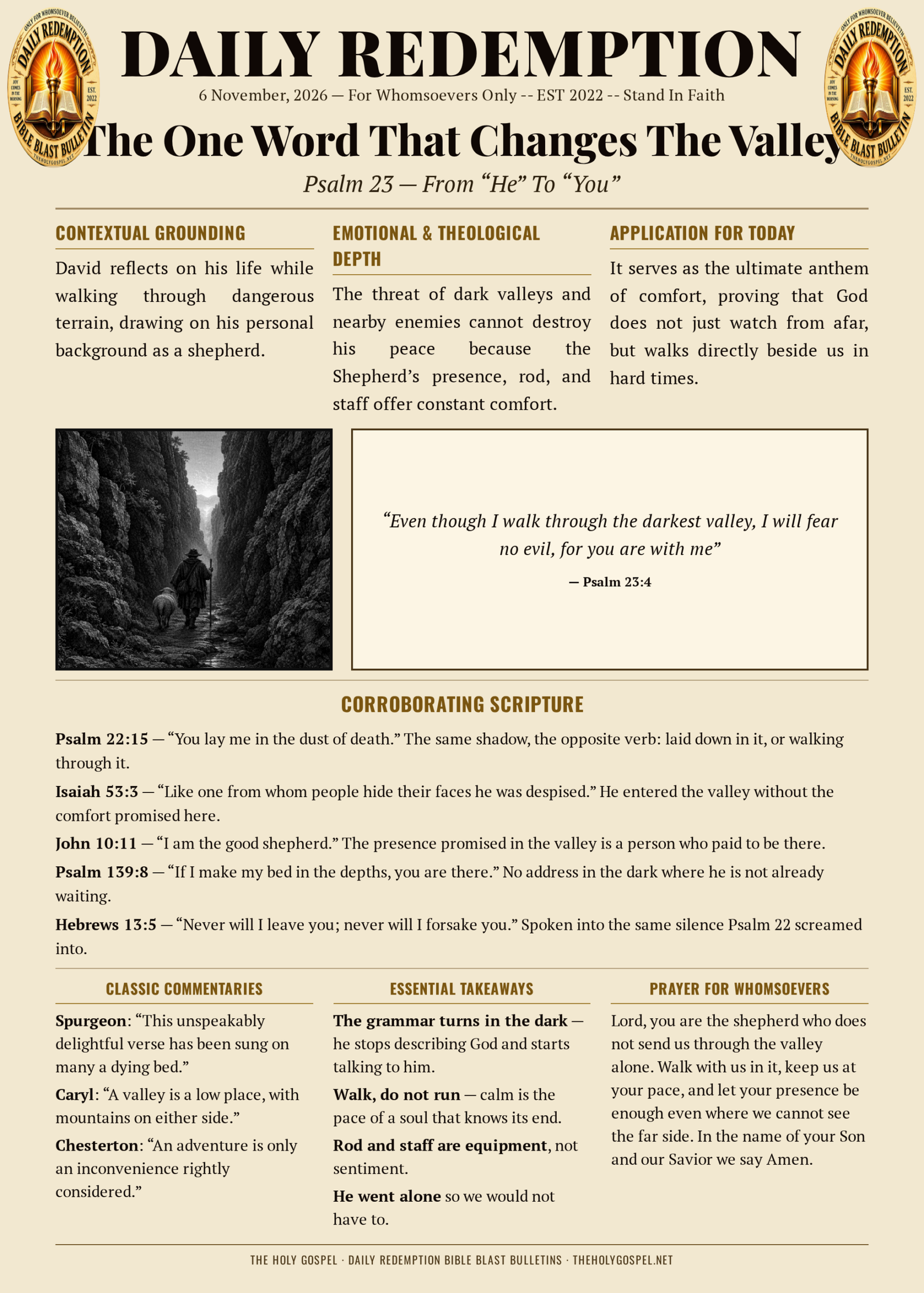
Joseph Caryl on what a valley actually is: “A valley is a low place, with mountains on either side.” He notes that enemies may be posted on those mountains, and still concludes, under “so many appearances and probabilities of extreme danger” that “yet I will not fear.” The danger was real. The fear was refused.
G.K. Chesterton on walking through rather than panicking: “An adventure is only an inconvenience rightly considered.” A valley is not a detour from the journey. It is part of the road the Shepherd chose.
Corroborating Scripture & Christological Connections
Psalm 23:4 — “Even though I walk through the darkest valley, I will fear no evil, for you are with me; your rod and your staff, they comfort me.” The address changes mid-verse because the need changed.
Psalm 22:15 — “You lay me in the dust of death.” The same shadow, and the opposite verb. One is laid down in it, the other walks through it.
Isaiah 53:3 — “He was despised and rejected by mankind, a man of suffering, and familiar with pain. Like one from whom people hide their faces he was despised, and we held him in low esteem.” Here is the one who entered the valley without the comfort this psalm promises.
John 10:11 — “I am the good shepherd. The good shepherd lays down his life for the sheep.” The presence promised in the valley is a person, and he paid for the right to be there.
Psalm 139:8 — “If I go up to the heavens, you are there; if I make my bed in the depths, you are there.” There is no address in the dark where he is not already waiting.
Hebrews 13:5 — “Never will I leave you; never will I forsake you.” Spoken into the same silence Psalm 22 screamed into.
Essential Takeaways
The grammar turns in the dark. He stops describing God and starts talking to him, and the valley is what makes the difference.
Walk, do not run. The pace of a soul that knows its destination looks like calm, even here.
The rod and staff are for the road. Comfort in this psalm is equipment, not sentiment.
He went through it alone so we would not have to. The valley is the one place the Servant had no company, and the reason we always do.
Prayer For Whomsoevers
Lord, you are the shepherd who does not send us through the valley alone. Walk with us in it, keep us at your pace, and let your presence be enough even where we cannot see the far side. In the name of your Son and our Savior we say Amen.