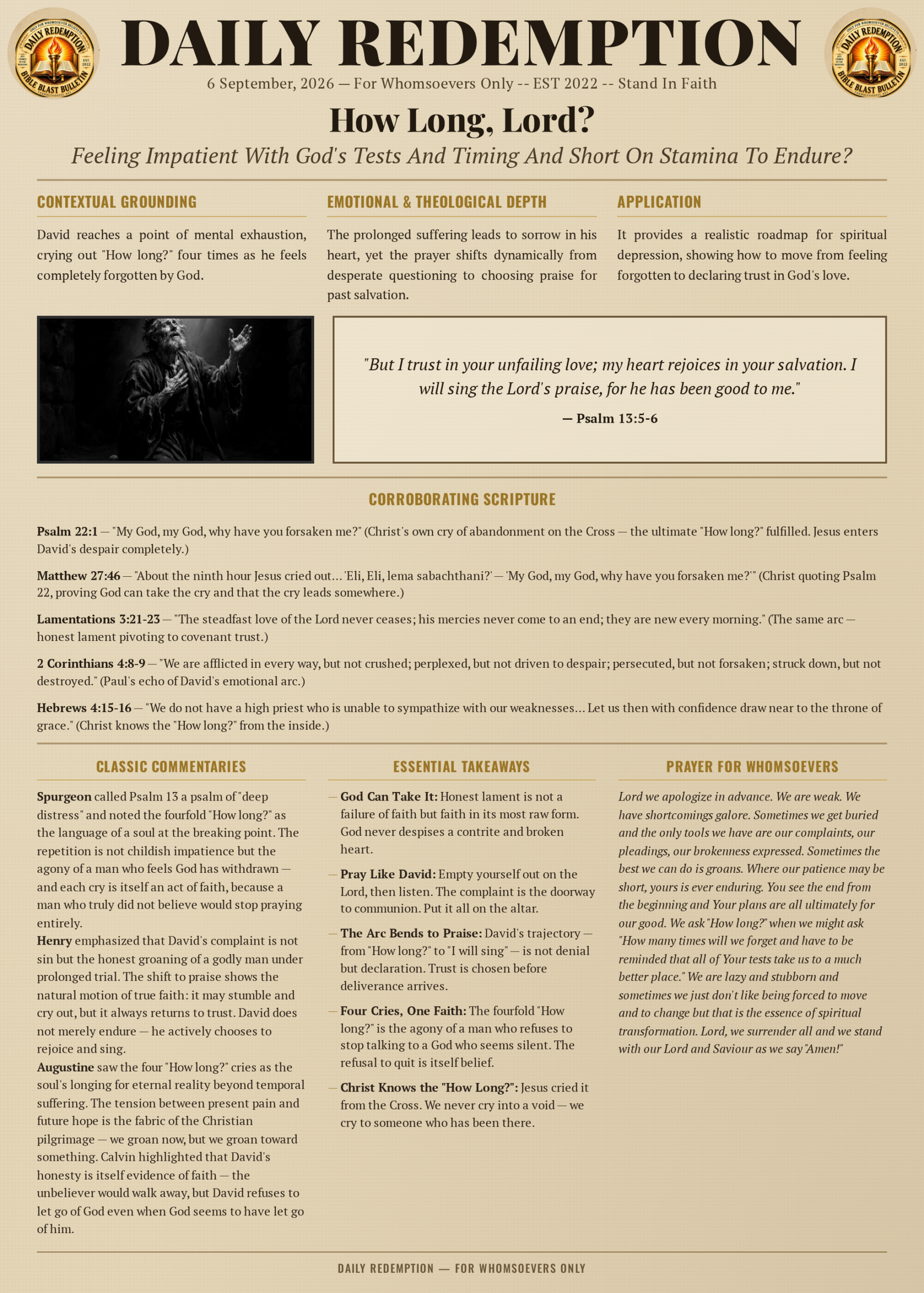
Psalm 13 captures the most concentrated burst of “How long?” cries in all of Scripture — four times in two verses, David empties his anguish before God with raw, unfiltered honesty. He feels forgotten, abandoned, and mentally exhausted, yet in the span of six short verses his prayer arcs dramatically from despair to praise. The psalm teaches us that God can handle our doubts and frustrations, that honest lament is not a failure of faith but the pathway through it, and that pressing through spiritual depression leads us to the place of trusting God’s unfailing love and singing His praise once again.
Psalm 13
For the director of music. A psalm of David.
1 How long, Lord? Will you forget me forever? How long will you hide your face from me?
2 How long must I wrestle with my thoughts and day after day have sorrow in my heart?
How long will my enemy triumph over me?
3 Look on me and answer, Lord my God. Give light to my eyes, or I will sleep in death,
4 and my enemy will say, “I have overcome him,” and my foes will rejoice when I fall.
5 But I trust in your unfailing love; my heart rejoices in your salvation.
6 I will sing the Lord’s praise, for he has been good to me.
Historical & Theological Analysis
OK now this is structured in a conventional contemporary structure of song lyrics. The title of the song would be “How long, Lord?”. In fact this Psalm is recognized as having the most dense, rapid-fire concentration of “How long, O Lord?” cries in the entire Bible. Suffice to say David was feeling a wee bit impatient with the Divine providence and grace that he was praying for.
Then, suddenly, David shifts and his arch takes him to trusting God’s unfailing love, rejoicing in His salvation and singing His praise for the grace he has received.
What we can learn from this short and dramatically emotionally bipolar arch of a Psalm?
1 God can take it. If you need to dump on God, go ahead. God will not despise a contrite and broken heart. Of course by dumping on God I mean hit Him with your doubts, your disappointments, your sufferings, your frustrations, ya know? He knows your heart so you can’t say anything that will have Him saying “wow I didn’t know you felt that way. I didn’t see that one coming.” Sometimes if that is what your heart is heavily buried in then you have to excavate it in order to get into a more meaningful and deeply engaging dialogue.
2 Learn to pray like David. There are numerous Psalms where David has to empty himself out on the Lord, then he hears from Him and everything changes and the Psalm ends in praise and worship. If you are feeling put upon there is only one option which can take you to a higher place. Put it all on the altar.
Ultimately, make sure that no matter how long that it takes you will, for sure, come to a place of praise, worship and feeling God’s glory. Just keep pressing on.
Classic Commentaries Corner
Spurgeon called Psalm 13 “a psalm of David when he was in deep distress” and noted the fourfold “How long?” as the language of a soul at the breaking point. He observed that the repetition is not childish impatience but the agony of a man who feels that God has withdrawn — and that each cry is itself an act of faith, because a man who truly did not believe would stop praying entirely.
Matthew Henry emphasized that David’s complaint is not sin but the honest groaning of a godly man under prolonged trial. The shift from lament to praise in verses 5-6 shows the natural motion of true faith: it may stumble and cry out, but it always returns to trust. Henry noted that David does not merely endure — he actively chooses to rejoice and sing, exercising faith even when circumstances have not yet changed.
Augustine saw in the four “How long?” cries the soul’s longing for eternal reality beyond temporal suffering. He taught that the tension between present pain and future hope is the very fabric of the Christian pilgrimage — we groan now, but we groan toward something. The “unfailing love” David clings to is not a feeling but a covenant fact.
Calvin highlighted that David’s honesty in lament is itself evidence of faith — the unbeliever would simply walk away, but David refuses to let go of God even when God seems to have let go of him. The pivot to praise in verse 5 is not denial but declaration: trust declared ahead of deliverance.
Corroborating Scripture & Christological Connections
Psalm 22:1 — “My God, my God, why have you forsaken me?” (Christ’s own cry of abandonment on the Cross — the ultimate “How long?” fulfilled. Jesus enters David’s despair completely and carries it through to resurrection.)
Matthew 27:46 — “About the ninth hour Jesus cried out with a loud voice… ‘Eli, Eli, lema sabachthani?’ that is, ‘My God, my God, why have you forsaken me?'” (Christ quoting Psalm 22 in His darkest moment, proving God can take the cry and that the cry leads somewhere.)
Lamentations 3:21-23 — “But this I call to mind, and therefore I have hope: The steadfast love of the Lord never ceases; his mercies never come to an end; they are new every morning.” (The same arc as Psalm 13 — honest lament pivoting to covenant trust.)
2 Corinthians 4:8-9 — “We are afflicted in every way, but not crushed; perplexed, but not driven to despair; persecuted, but not forsaken; struck down, but not destroyed.” (Paul’s echo of David’s emotional arc — suffering without final abandonment.)
Hebrews 4:15-16 — “For we do not have a high priest who is unable to sympathize with our weaknesses… Let us then with confidence draw near to the throne of grace.” (Christ as the one who knows the “How long?” from the inside and invites us to bring ours.)
Essential Takeaways
- God Can Take It: Honest lament is not a failure of faith — it is faith in its most raw form. God never despises a contrite and broken heart. He already knows what’s in there; excavating it is for our sake, not His surprise.
- Learn to Pray Like David: The pattern is consistent across the Psalms — empty yourself out on the Lord, then listen. The complaint is the doorway to communion. Put it all on the altar.
- The Arc Always Bends Toward Praise: David’s emotional trajectory — from “How long?” to “I will sing” — is not denial but declaration. Trust is chosen before deliverance arrives.
- Four Cries, One Faith: The fourfold “How long?” is not childish impatience but the agony of a man who refuses to stop talking to a God who seems silent. The refusal to quit is itself evidence of belief.
- Christ Knows the “How Long?”: Jesus cried it from the Cross. He entered David’s despair completely and carried it through to resurrection. We never cry into a void — we cry to someone who has been there.
Prayer For Whomsoevers
Lord we apologize in advance. We are weak. We have shortcomings galore. We can’t just easily slide by sometimes. Sometimes we get buried and the only shovels and heavy duty garden or archaeological tools that we have are our complaints, our pleadings, our brokenness expressed. Sometimes the best we can do is groans. So we apologize and we thank you. Where our patience may be short, yours is ever enduring. You see the end from the beginning and Your plans are all ultimately for our good. We ask of you “How long?” when we might ask ourselves “How many times will we forget and have to be reminded that all of Your tests take us to a much better place than we envision. We are lazy and stubborn and sometimes we just don’t like being forced to move and to change but that is the essence of spiritual transformation and of turning ourselves over to You. Lord, we surrender all and we stand with our Lord and Saviour as we say “Amen!”