Radical Grace on the Damascus Road — From Violent Persecutor to Apostle of Christ
The dramatic conversion of Saul of Tarsus on the road to Damascus stands as an eternal monument to the invincible power and sovereign grace of the Lord Jesus Christ. No human heart is too hardened, no past too deeply stained, and no rebel too far gone for the invading light of God’s redemptive love. When Christ apprehends a violent persecutor and transforms him into the premier apostle of grace, He proves that salvation is not a gradual human re-education but a radical divine resurrection. If you have fought against the conviction of the Holy Spirit or believed your past disqualified you from divine mercy, surrender your self-will today and step into the brand-new creation that only the Savior can perform.
Contextual Grounding
Saul of Tarsus was a zealous Pharisee, a prized scholar under Gamaliel, and a man fiercely breathing out threatenings and slaughter against the early Church (Acts 9:1–2). Armed with official extradition papers from the high priest, his relentless mission to Damascus was to stamp out “the Way,” drag believers in chains to Jerusalem, and dismantle the Gospel of the crucified Nazarene. To the early Christians, Saul was their fiercest tormentor—a man of iron religious will, impeccably self-righteous in his legalism, and utterly committed to destroying Christ’s followers. He believed with every fiber of his being that in persecuting believers, he was doing God service.
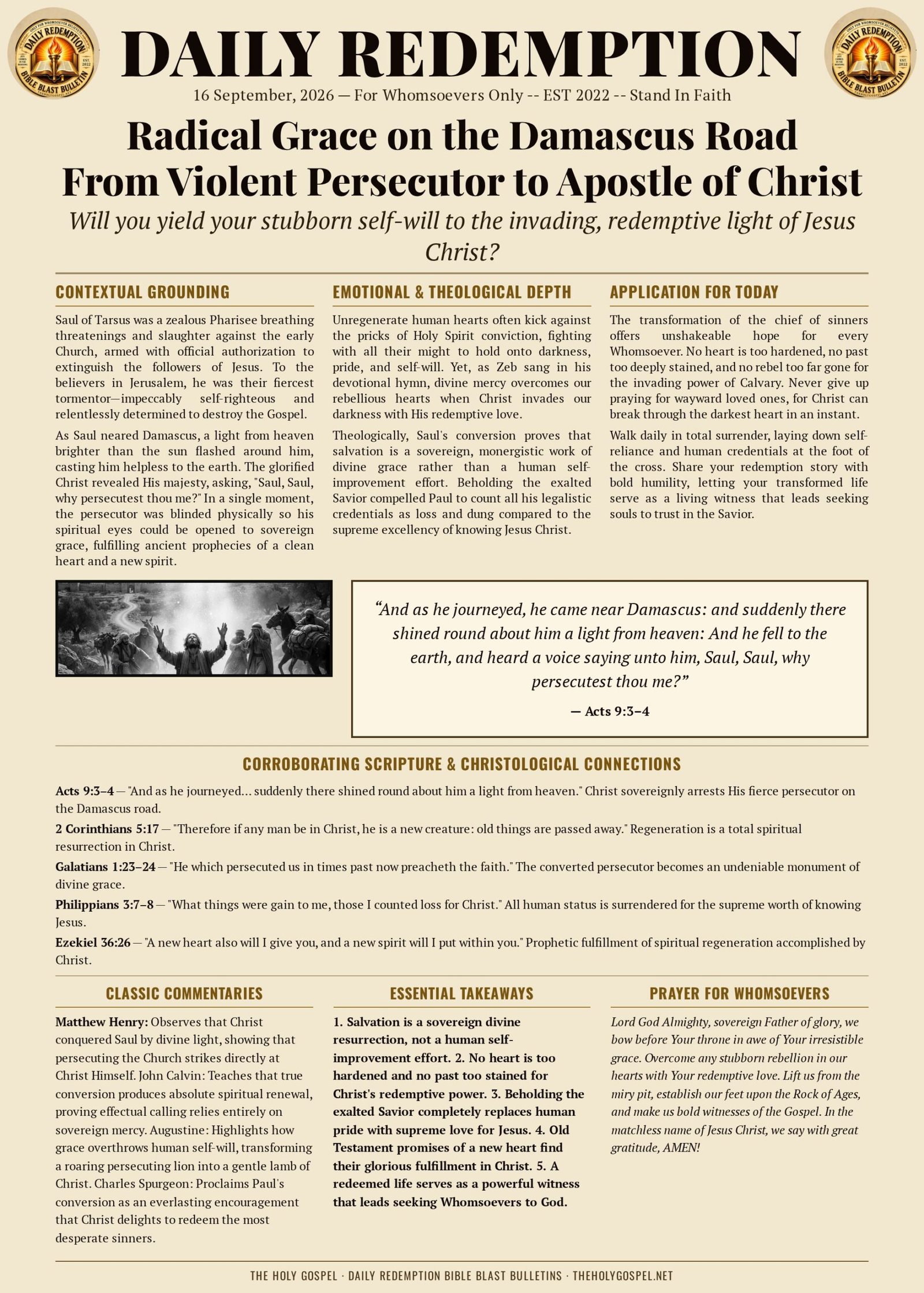
As Saul neared Damascus, human religiosity collided with divine sovereignty. Suddenly, a blinding light from heaven, far surpassing the brightness of the midday sun, flashed around him, casting him helpless to the dusty earth (Acts 9:3–4). The glorified Lord Jesus Christ did not send an angel or negotiate terms; He revealed His celestial majesty and asked, “Saul, Saul, why persecutest thou me?” In striking Saul down, Christ revealed a profound covenantal mystery: to persecute the Church is to strike at the Lord Himself. The self-righteous persecutor was instantly struck blind physically so that his spiritual eyes might be opened to the glory of God in the face of Jesus Christ.
This Damascus encounter is the living fulfillment of ancient Old Testament promises. For centuries, the Hebrew prophets foresaw a sovereign work of grace that would replace stony hearts with living flesh. King David pleaded in Psalm 51:10, “Create in me a clean heart, O God; and renew a right spirit within me.” Ezekiel prophesied that God would bestow a new heart and put a new spirit within His people (Ezekiel 36:26), while Isaiah declared that God would do a brand-new thing in the wilderness (Isaiah 43:19). On the dusty road to Damascus, these ancient prophetic threads converged. Saul did not merely reform his behavior; God shattered his stony heart, lifted him from the miry clay, and began writing the Gospel upon his soul.
Emotional & Theological Depth
On an emotional level, many Whomsoevers battle the subtle, stubborn temptation to resist God’s holy light. Like Saul before his conversion, the unregenerate heart often kicks against the pricks of divine conviction, clinging to self-righteousness, religious heritage, or hidden rebellion because surrender feels terrifying. We battle with all our might to preserve our darkness, fearing that yielding to Christ will cost us our identity, our pride, or our autonomy. Yet, as Zeb of Virginia Beach Church sang in his heartfelt hymn, “Your Redemptive Love,” we struggle in vain until divine mercy overcomes our stubborn hearts: “Lord I struggled and I fought with all of my might to hold to my darkness and eschew your holy light… but then you overcame my rebellious heart with your redemptive love.”
Theologically, Saul’s transformation reveals that salvation is an unmerited, sovereign invasion of divine grace. Saul was not seeking Jesus on the road to Damascus; he was seeking to imprison His disciples. Yet Christ sovereignly apprehended him, demonstrating that regeneration is not a synergistic human improvement project but a monergistic act of Almighty God. As Paul would later write under the inspiration of the Holy Spirit, “Therefore if any man be in Christ, he is a new creature: old things are passed away; behold, all things are become new” (2 Corinthians 5:17). Salvation is not polishing the old man; it is putting the old man to death and raising up a brand-new creation through union with the crucified and risen Lord.
Furthermore, Paul’s conversion fundamentally reoriented his entire value system. Before Damascus, Saul boasted in his pure lineage, his Pharisaic rigor, and his blameless obedience to the law. Yet after beholding the exalted Christ, he considered all those former earthly gains as mere loss and dung compared to the infinite worth of Jesus. As he declared in Philippians 3:7–8, “But what things were gain to me, those I counted loss for Christ. Yea doubtless, and I count all things but loss for the excellency of the knowledge of Christ Jesus my Lord.” When the beauty of Christ captivates the soul, human pride dissolves, and the former persecutor gladly surrenders his life to magnify the Savior he once tried to destroy.
Application For Today
For every Whomsoever seeking to walk faithfully in a confused and hostile world, the transformation of Saul provides an unshakeable anchor of hope. The enemy loves to whisper that your past sins are too severe, your rebellion too prolonged, or your heart too callous for God to save you. But look at Paul! If the chief of sinners—a man who consented to the murder of Stephen and dragged families into prison—could be redeemed and transformed into the premier apostle of grace, then no soul is beyond the reach of Calvary. Never write off a wayward child, a hardened spouse, or an antagonistic coworker, for the God who commanded light to shine out of darkness can break through the darkest heart in a single moment.
Practically, living as a new creation in Christ requires a daily, deliberate surrender of our former self-reliance. Just as Saul was led by the hand into Damascus in total dependence upon God, we must lay down our pride, human credentials, and self-made agendas at the foot of the cross. When the world entices you to return to former shadows, or when guilt attempts to drag you back into condemnation, anchor your soul in the testimony of the early Church regarding Paul: “That he which persecuted us in times past now preacheth the faith which once he destroyed. And they glorified God in me” (Galatians 1:23–24). Let your life be an undeniable testimony that Jesus transforms sinners into saints.
Finally, embrace your identity as a redeemed minister of reconciliation. You were not saved merely to enjoy a quiet spiritual comfort, but to bear witness to the power of the Gospel. Share your story with bold humility, not exalting your past sins, but magnifying the infinite mercy of the Savior who rescued you. Stand fast in the joy of your salvation, sing the new song He has placed in your mouth, and walk as a living monument to the redemptive love of Jesus Christ.
Classic Commentaries Corner
Matthew Henry observed on Acts 9:3–4 that Saul’s arrest on the Damascus road was a glorious instance of sovereign, victorious grace, wherein Christ conquered a stubborn enemy not by destroying his body, but by captivating his soul with heavenly light. Henry noted that when Christ asks, “Why persecutest thou me?”, He reveals the tender union between Himself and His Church, showing that every injury inflicted upon His saints is felt directly by the Lord in heaven.
John Calvin emphasized on 2 Corinthians 5:17 that true conversion produces an absolute renewal of the entire man, wherein the Holy Spirit eradicates the old nature of sin and fashions a new heart devoted to righteousness. Calvin argued that Paul’s sudden transformation from a fierce persecutor into an humble servant of Christ is incontrovertible proof that divine election and effectual calling depend solely upon God’s free mercy rather than human merit or preparation.
Augustine reflected deeply on Paul’s conversion throughout his writings, highlighting how divine grace overthrows human self-will to conquer the proudest heart. Augustine noted that he who was once a roaring lion breathing out threatenings became a gentle lamb willing to suffer all things for the Gospel, demonstrating that God’s grace does not destroy human freedom, but heals and liberates the fallen will to delight in eternal truth.
Charles Spurgeon preached with passionate power on Galatians 1:23–24, exalting the miracle of Paul’s conversion as an everlasting encouragement for the most desperate sinners. Spurgeon declared that the Lord delights to pick up the most ruined, hostile rebel, wash him in the precious blood of the Lamb, and make him a shining trophy of grace, so that all who behold the change are compelled to glorify God for His miraculous power.
Corroborating Scripture & Christological Connections
Acts 9:3–4 — “And as he journeyed, he came near Damascus: and suddenly there shined round about him a light from heaven: And he fell to the earth, and heard a voice saying unto him, Saul, Saul, why persecutest thou me?” Christ personally intervenes from heaven to apprehend His fierce persecutor, demonstrating that salvation originates in the sovereign initiative of the exalted Savior.
2 Corinthians 5:17 — “Therefore if any man be in Christ, he is a new creature: old things are passed away; behold, all things are become new.” Paul testifies from personal experience that union with Jesus Christ results in a total spiritual resurrection, replacing the old life of sin with a brand-new nature created in righteousness.
Galatians 1:23–24 — “But they had heard only, That he which persecuted us in times past now preacheth the faith which once he destroyed. And they glorified God in me.” The radical transformation of a persecutor into a preacher serves as an undeniable monument of divine grace that causes the Church to magnify God.
Philippians 3:7–8 — “But what things were gain to me, those I counted loss for Christ. Yea doubtless, and I count all things but loss for the excellency of the knowledge of Christ Jesus my Lord: for whom I have suffered the loss of all things, and do count them but dung, that I may win Christ,” Paul’s encounter with Christ completely shattered his reliance on legalistic self-righteousness, compelling him to exchange all worldly status for the supreme worth of knowing Jesus.
Ezekiel 36:26 — “A new heart also will I give you, and a new spirit will I put within you: and I will take away the stony heart out of your flesh, and I will give you an heart of flesh.” The Old Testament prophetic promise of spiritual regeneration is gloriously fulfilled on the Damascus road as God removes Saul’s hardened heart of persecution and implants a living heart of faith.
Psalm 40:2–3 — “He brought me up also out of an horrible pit, out of the miry clay, and set my feet upon a rock, and established my goings. And he hath put a new song in my mouth, even praise unto our God: many shall see it, and fear, and shall trust in the LORD.” David’s song of divine rescue captures the trajectory of every redeemed soul, as Christ lifts us from spiritual ruin to set our feet upon the unshakeable Rock of Ages.
Essential Takeaways
1. Salvation is a sovereign divine intervention, not a human self-improvement effort. Saul was not seeking Christ on the road to Damascus, yet Jesus apprehended him by grace. Regeneration is a radical resurrection that transforms a dead, rebellious sinner into a living child of God.
2. No heart is too hardened and no past too stained for Christ to redeem. The conversion of the Church’s chief persecutor proves that divine mercy can reach any rebel. Never lose hope for wayward souls, for the power of the cross can shatter the strongest stronghold of sin.
3. Beholding Christ completely reorients our value system. When Saul encountered the exalted Savior, he counted all his former Pharisaic gains, religious status, and pride as worthless dung. True faith gladly surrenders everything to win the supreme treasure of Jesus Christ.
4. God’s ancient promises of a new heart find their fulfillment in Jesus. The prophecies of Ezekiel, Isaiah, and David were materialized on the Damascus road. In Christ, the stony heart of rebellion is removed, and a new spirit of holy love is implanted within us.
5. A transformed life becomes a powerful testimony that glorifies God. When the persecutor became the apostle of grace, believers praised God for His miraculous work. Your redeemed life is called to be a living witness that leads seeking Whomsoevers to trust in the Savior.
Prayer For Whomsoevers
Lord God Almighty, sovereign Father of glory, we bow before Your throne in humble awe of Your irresistible grace. We thank You that no heart is too hard for Your Holy Spirit to soften, and no past is too dark for the blinding light of Jesus Christ to redeem. Lord, if there be any part of our hearts kicking against Your conviction, overcome our stubborn self-will today with Your redemptive love. Lift us out of the miry pit of self-righteousness, establish our feet upon the Rock of Ages, and put a new song of praise in our mouths. Transform us into bold, faithful witnesses of the Gospel, so that through our lives, seeking Whomsoevers may see Your glory and trust in the Savior. In the matchless and exalted name of Jesus Christ, we say with great gratitude, AMEN!