Submitting to Divine Wisdom — Holy Fear and Saving Obedience
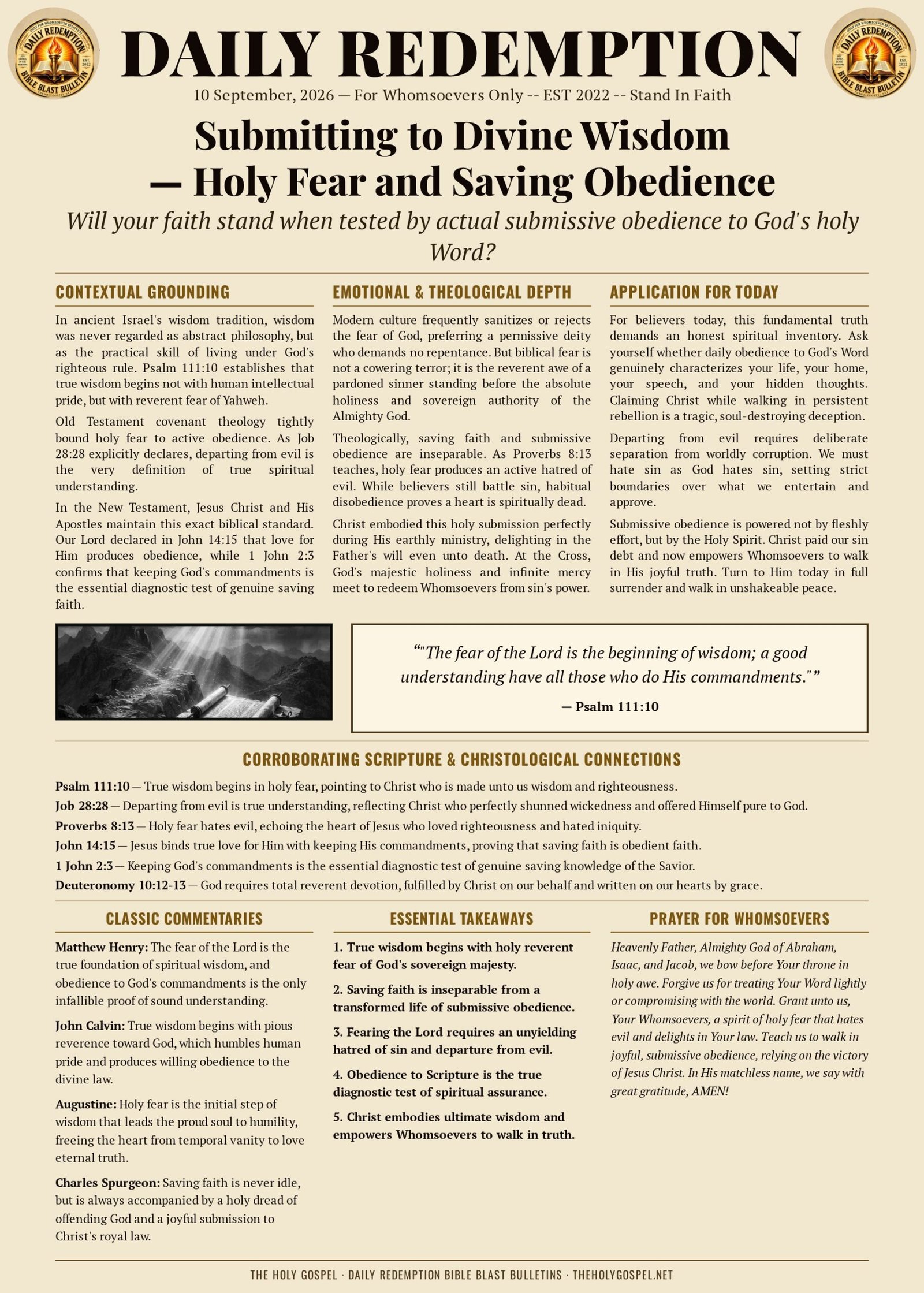
True saving faith is never a mere intellectual assent or an emotional flicker; it is a life revolutionized by submissive obedience to the holy Word of God. When the awe-inspiring fear of the Lord takes root in the human soul, human pride collapses and divine wisdom begins to govern every step and thought. Scripture is unapologetically clear: to claim fellowship with Jesus Christ while living in habitual, unrepentant rebellion is a fatal self-deception. We are called to depart from evil, hate unrighteousness, and walk in loving submission to our Redeemer, who surrendered His life to rescue Whomsoevers from the penalty and power of sin.
Contextual Grounding
In the wisdom literature of ancient Israel, wisdom (chokmah) was never viewed as abstract philosophy or clever academic debate. It was the practical, skill-filled art of living in alignment with the moral order established by the Creator. In a fallen world dominated by human self-reliance and pagan autonomy, Psalm 111 stands as a temple hymn exalting God’s mighty works of redemption and eternal covenant. Within this sacred liturgical context, verse 10 issues a striking verdict: “The fear of the Lord is the beginning of wisdom; a good understanding have all those who do His commandments.” True wisdom does not originate in human intellect or cultural sophistication, but in reverent, awe-filled submission to the holy Yahweh.
Old Testament theology tightly binds the fear of God to the keeping of His covenant law. In Deuteronomy 6 and 10, Moses repeatedly instructed the redeemed community that fearing Yahweh and walking in His commandments were inseparable dynamics of genuine covenant life. Job 28:28 reinforces this exact dual principle: “Behold, the fear of the Lord, that is wisdom; and to depart from evil is understanding.” To the Hebrew mind, wisdom was tested and validated by moral conduct. A person who claimed understanding while walking in wickedness was considered spiritually foolish, regardless of their status or intellectual pride.
When we transition to the New Testament, Jesus Christ and the Apostles do not lower this ancient standard; they unveil its fullest expression in the Gospel. Our Lord declared in John 14:15, “If ye love me, keep my commandments,” linking covenant love directly to joyful submission. Likewise, the Apostle John insisted in 1 John 2:3 that obedience is the ultimate diagnostic test of genuine saving knowledge: “And hereby we do know that we know him, if we keep his commandments.” Biblical wisdom is thus not a passive sentiment, but the active, fruit-bearing result of a heart transformed by sovereign grace.
Emotional & Theological Depth
In our contemporary culture, the phrase “the fear of the Lord” is frequently misunderstood, sanitized, or rejected altogether. Modern man prefers a domestic deity—a cosmic therapist who demands no repentance and tolerates perpetual rebellion. But true biblical fear is not a cowering, servile terror of unpredictable wrath; it is the reverent awe of a pardoned sinner standing before the absolute majesty, holiness, and righteous authority of the living God. It is the trembling gratitude of a soul that beholds both the terrifying heights of divine justice and the overwhelming depths of divine mercy at the Cross.
Theologically, saving faith and submissive obedience are two sides of the same redemptive coin. We are not justified by our works or earned merit, but genuine justification inevitably produces a transformed heart that delights in God’s law. The pattern of a true believer’s life turns decisively from lawlessness to submissive obedience. While believers still battle remaining sin and fall short of perfection, habitual disobedience and an unrepentant lifestyle reveal a heart that remains dead in trespasses. A confession of faith that produces no surrender to God’s authority is a dead faith, offering a false security that will fail on Judgment Day.
Furthermore, Proverbs 8:13 provides the negative dynamic of this holy wisdom: “The fear of the Lord is to hate evil.” True fear does not flirt with sin or negotiate with temptation; it views unrighteousness through the holy eyes of God. It grieves over sin because sin nailed our Savior to the tree. Christ Himself exemplified perfect reverent submission during His earthly ministry, delighting to do the Father’s will even unto the death of the cross (Philippians 2:8, Hebrews 5:7). In Christ, holy fear and radical obedience meet in breathtaking harmony.
Application For Today
For the ‘Whomsoevers’ striving to walk the narrow path in a compromised world, this truth demands an immediate and honest spiritual inventory. Ask yourself plainly: Does radical obedience to God’s Word characterize your daily decisions, your home, your speech, and your hidden private thoughts? Or have you compromised with the worldly consensus, adopting a superficial Christianity that demands no sacrifice? Examine your life not against the relaxed standards of nominal religion, but against the holy mirror of God’s Word. Where disobedience has crept in, turn back to the Lord with immediate repentance and renewed resolve.
Practicing holy fear requires a decisive departure from the evil surrounding us. Job 28:28 connects wisdom with the active choice “to depart from evil.” In an age saturating our minds with moral relativism, lust, and worldly pride, departing from evil means setting strict boundaries over what we watch, listen to, approve, and entertain. It means hating evil as God hates it—refusing to call light darkness or evil good. When holy fear governs the soul, temptation loses its attractive power because the majesty and presence of God outweigh the fleeting pleasures of sin.
Finally, remember that submissive obedience is not performed in human strength, but through the empowering grace of the Holy Spirit. Christ did not merely command us to obey; He paid the infinite price for our sins on Calvary and placed His Spirit within us to write His law upon our hearts. Take refuge in His finished work today. Pray for a heart that trembles at His Word, yields joyfully to His lordship, and proclaims His praises in a dark world. When we submit to His wisdom, we walk in absolute security, unshakeable peace, and eternal joy.
Classic Commentaries Corner
Matthew Henry observed that the fear of the Lord is the true foundation of all sound learning and spiritual wisdom, noting that no man can be truly wise who does not know and reverence his Creator. He emphasized that obedience to God’s commandments is the only infallible proof of a good understanding, asserting that those who know God’s will but do not perform it prove themselves to be foolish and deceived, while those who yield their lives to God’s law possess true heavenly prudence.
John Calvin emphasized that true wisdom begins with the fear of God because a sinner can never properly understand his own creaturely dependence until he beholds the terrifying majesty and righteousness of the Lord. Calvin argued that the fear of God is not a paralyzing terror, but a pious reverence that produces willing obedience and a sincere desire to honor God’s holy law. He noted that where there is no fear of God, human intelligence is merely vanity and spiritual blindness leading to destruction.
Augustine wrote in his expositions on the Psalms that the fear of the Lord is the initial step of wisdom that leads the proud soul to humility, turning it away from self-exaltation toward divine truth. He argued that worldly wisdom relies on temporal vanity, but holy fear grounds the believer in eternal reality, purging the heart of carnal desires so that it may receive the love of God. For Augustine, true understanding is manifested when a believer’s love for God’s righteousness overcomes the love of sin.
Charles Spurgeon preached passionately that saving faith is never idle, but is always accompanied by a holy dread of offending God and a joyful submission to Christ’s royal law. Spurgeon declared that to claim salvation while continuing in deliberate disobedience is to wear the uniform of Christ while serving the devil. He insisted that the fear of the Lord sweetens the soul, protects the believer from the snares of temptation, and produces an unwavering obedience that honors the Redeemer before a watching world.
Corroborating Scripture & Christological Connections
Psalm 111:10 — “The fear of the Lord is the beginning of wisdom: a good understanding have all they that do his commandments: his praise endureth for ever.” True wisdom originates not in human philosophy but in reverent awe of God, pointing to Christ who is made unto us wisdom, righteousness, and sanctification (1 Corinthians 1:30).
Job 28:28 — “And unto man he said, Behold, the fear of the Lord, that is wisdom; and to depart from evil is understanding.” True spiritual intelligence is validated by departing from unrighteousness, reflecting Jesus Christ who perfectly departed from all evil and offered Himself without spot to God.
Proverbs 8:13 — “The fear of the Lord is to hate evil: pride, and arrogancy, and the evil way, and the froward mouth, do I hate.” Holy fear produces an active hatred of sin, echoing the heart of Christ who loved righteousness and hated iniquity, earning the anointed crown of joy above His fellows (Hebrews 1:9).
John 14:15 — “If ye love me, keep my commandments.” Jesus directly connects saving love for Him with visible covenant obedience, revealing that true discipleship is anchored in joyful submission to the Savior’s voice.
1 John 2:3 — “And hereby we do know that we know him, if we keep his commandments.” The Apostle John presents obedience as the essential diagnostic assurance of saving faith, pointing to Christ whose obedient life is reproduced in His redeemed people through the Holy Spirit.
Deuteronomy 10:12-13 — “And now, Israel, what doth the Lord thy God require of thee, but to fear the Lord thy God, to walk in all his ways, and to love him, and to serve the Lord thy God with all thy heart and with all thy soul, To keep the commandments of the Lord, and his statutes, which I command thee this day for thy good?” God requires total devotion and obedience, which was fulfilled perfectly by Jesus Christ on our behalf and is now written on the hearts of Whomsoevers by grace.
Essential Takeaways
1. True wisdom begins with holy reverent fear. Biblical wisdom is not academic knowledge or worldly shrewdness; it is the awe-filled recognition of God’s sovereign majesty that bows the human heart in total submission.
2. Saving faith is inseparable from active obedience. A profession of faith that produces no transformation of life or desire to keep God’s commandments is dead and hypocritical; genuine salvation turns the soul toward submissive obedience.
3. Fearing God requires an unyielding hatred of evil. Holy fear is not merely an internal emotion; it demonstrates itself by departing from unrighteousness, shunning worldly pride, and actively hating sin as God hates sin.
4. Obedience is the true test of spiritual assurance. We know that we truly know Christ when His Word governs our daily conduct, proving that His Spirit lives within us and works His righteous will.
5. Christ is the ultimate embodiment and source of wisdom. Jesus lived in perfect reverent submission to the Father, paying our sin debt and granting Whomsoevers the grace and Spirit needed to walk in faithful obedience today.
Prayer For Whomsoevers
Heavenly Father, Almighty God of Abraham, Isaac, and Jacob, we bow before Your sovereign throne in deep awe and holy reverence. Forgive us for the moments we have treated Your holy Word lightly or compromised with the fleeting pleasures of this dark world. Grant unto us, Your Whomsoevers, a Spirit of wisdom and holy fear that hates evil and delights in Your commandments. Teach us to walk in joyful, submissive obedience every day, relying not on our own fragile strength but on the victory of Jesus Christ, our great High Priest and King. In His matchless and holy name, we say with great gratitude, AMEN!