God Shows No Partiality: Acts 10-11 and the Vision That Settled It
Cornelius was devout, feared God, gave alms and prayed continually, and all of it before Peter ever knocked on the door. If a man has to be born again before he can seek God, the text has a problem. Peter’s own conclusion is that God shows no partiality, and in every nation anyone who fears him and does what is right is acceptable to him. Nobody was predestined out of this. We all got the same one decision to get right.
Greetings! Hope you’re having a great day — and let’s see if we can put just a little bit more God into it with the close of Acts 10 through 12. This is where the two voices get their verdict, and where the door of grace turns out to be wider than anyone in that room expected.
Does Acts 10 and 11 Rebuke Calvinism?
I know I’ve been harping on this thing about rebuking Calvinism, but here it is again. I don’t make this up, folks. I just follow orders.
While the immediate historical focus of Acts 10 and 11 is God expanding the gospel to the Gentiles — and you can read that anywhere, people will talk about that — I’m trying to give you something different. The narrative provides a massive theological battleground for debating Calvinism.
If you look closely at Cornelius, before Peter even preaches to him, the text challenges two core pillars of Reformed theology, which is what they call that idea of predestination. Certain people are selected to go to heaven, and the rest, sorry Charlie.
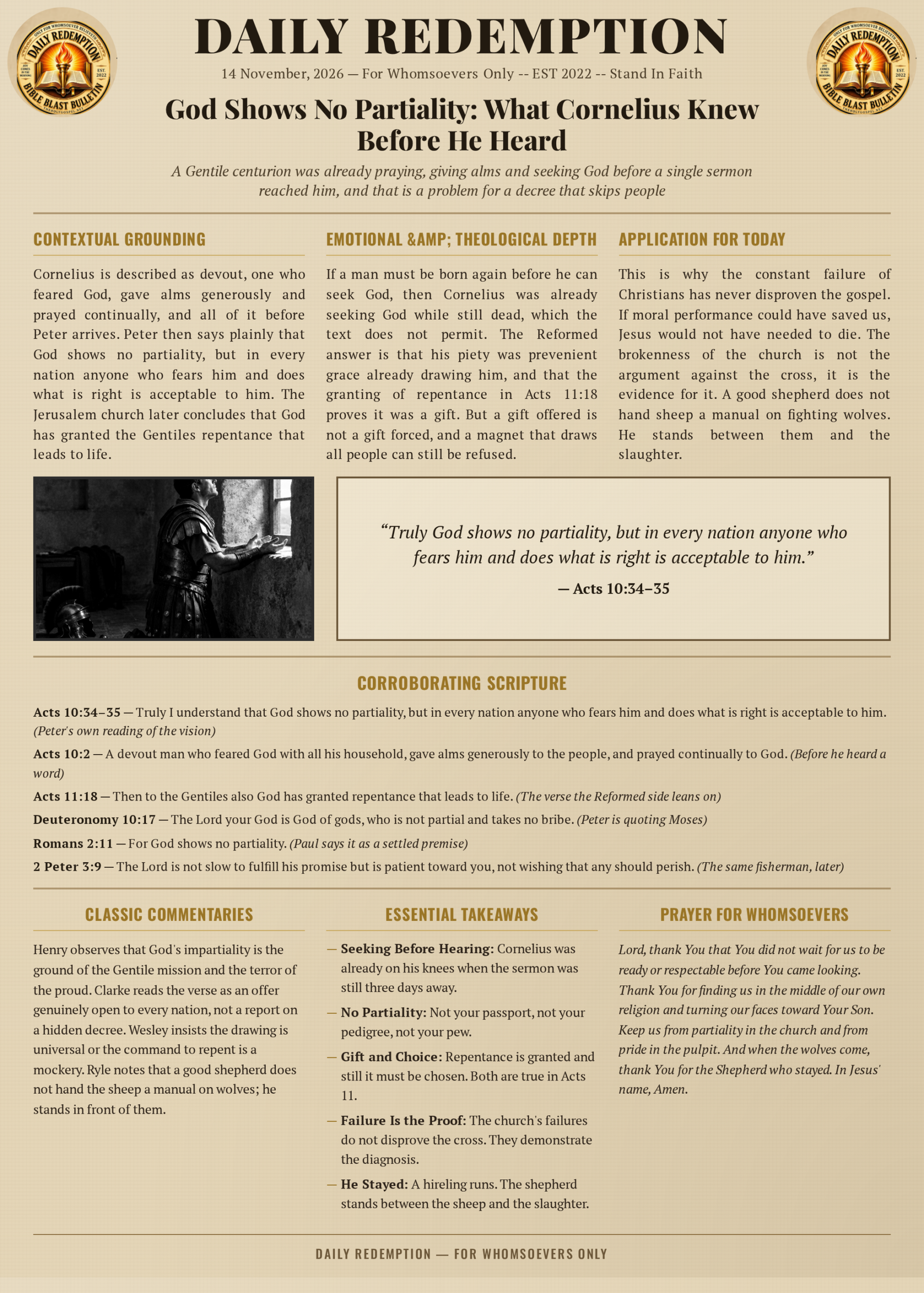
Cornelius is described as a devout man who feared God, gave alms, and prayed continually before he heard the gospel, and was explicitly visited by an angel. This suggests an unregenerate person can still seek God and respond to spiritual light. Anybody can. That counters the strict Calvinist view that a person is completely spiritually dead — you, me, that person sitting next to you — and incapable of seeking God prior to irresistible regeneration. If our spirit and soul is completely dead, and it’s only God acting in us, and he assigned that from the beginning, then there’s not a whole lot of hope there.
Then in Acts 10, 34 and 35 there is a challenge to unconditional election and limited atonement. Peter explicitly declares, God shows no partiality, but in every nation anyone who fears him and does what is right is acceptable to him. That is a universal, conditional opportunity for salvation, rather than an exclusive predetermined election of specific individuals. Okay, you — no, not you, you, yeah that one. Okay, no, not you, put your hand down.
The Counter Perspective
Now let me be fair to my commentary, so here is how a Reformed thinker might read this text. They argue that Cornelius’s early piety wasn’t independent human free will, but the result of God’s sovereign prevenient grace already drawing him.
They point to Acts 11, 18, where the Jerusalem church concludes that to the Gentiles also God has granted repentance that leads to life. To a Calvinist, repentance is a gift sovereignly granted by God, not a choice manufactured by man. So even our giving up of our identity in this world, even our surrender, I surrender all, is predestined. We didn’t have anything to say about it, and our contribution isn’t worth much. That is what Calvinists believe.
But a gift offered is not a gift forced. A magnet that draws all people can still be walked away from.
The Tapestry
So Acts 10 through 12 presents a beautiful tapestry. It shows a God who shows no partiality, opening the doors of grace to anyone who fears him, while fiercely judging tyrants like Herod, who tried to steal his glory.
When we approach God’s grace, we must come with the humility of Peter. That is really one of the things I love about the Daily Office. If you guys haven’t dug into that yet, it is twenty minutes at the start of the day, and there are two more versions of it later in the day, where you can really focus on your relationship with the Lord, on being humble, and on thanking God for his grace and mercy.
All those books, all of those books, they’re valuable, but it comes down really to that. Are we humble in the presence of the Lord, and do we thank him for his mercy and grace? If we’re doing that, we’re golden, I’m telling you.
There are no people who are predestined. We all have the same shot at getting one decision right in this whole life. One decision, which is to give our hearts, and our lives, and our everything we’ve got to God, to Jesus. But we are all capable of that. God didn’t deprive anybody of that when he gave us free will. It was for that.
Thank you for spending a few moments with me. Peace.
Classic Commentaries Corner
Henry observes that God’s impartiality is the ground of the Gentile mission and the terror of the proud. Clarke reads the verse as an offer genuinely open to every nation, not a report on a hidden decree. Wesley insists the drawing is universal or the command to repent is a mockery. Ryle notes that a good shepherd does not hand the sheep a manual on wolves; he stands in front of them.
Corroborating Scripture & Christological Connections
Acts 10:34–35 — “Truly I understand that God shows no partiality, but in every nation anyone who fears him and does what is right is acceptable to him.” Peter’s own reading of the vision.
Acts 10:2 — “A devout man who feared God with all his household, gave alms generously to the people, and prayed continually to God.” Before he heard a word.
Acts 11:18 — “Then to the Gentiles also God has granted repentance that leads to life.” The verse the Reformed side leans on.
Deuteronomy 10:17 — “The Lord your God is God of gods, who is not partial and takes no bribe.” Peter is quoting Moses.
Romans 2:11 — “For God shows no partiality.” Paul says it as a settled premise.
2 Peter 3:9 — “The Lord is not slow to fulfill his promise but is patient toward you, not wishing that any should perish.” The same fisherman, later.
Essential Takeaways
Seeking Before Hearing: Cornelius was already on his knees when the sermon was still three days away.
No Partiality: Not your passport, not your pedigree, not your pew.
Gift and Choice: Repentance is granted and still it must be chosen. Both are true in Acts 11.
Failure Is the Proof: The church’s failures do not disprove the cross. They demonstrate the diagnosis.
He Stayed: A hireling runs. The shepherd stands between the sheep and the slaughter.
Prayer For Whomsoevers
Lord, thank You that You did not wait for us to be ready or respectable before You came looking. Thank You for finding us in the middle of our own religion and turning our faces toward Your Son. Keep us from partiality in the church and from pride in the pulpit. And when the wolves come, thank You for the Shepherd who stayed. In Jesus’ name, Amen.