What Adam Really Needed Rescuing From
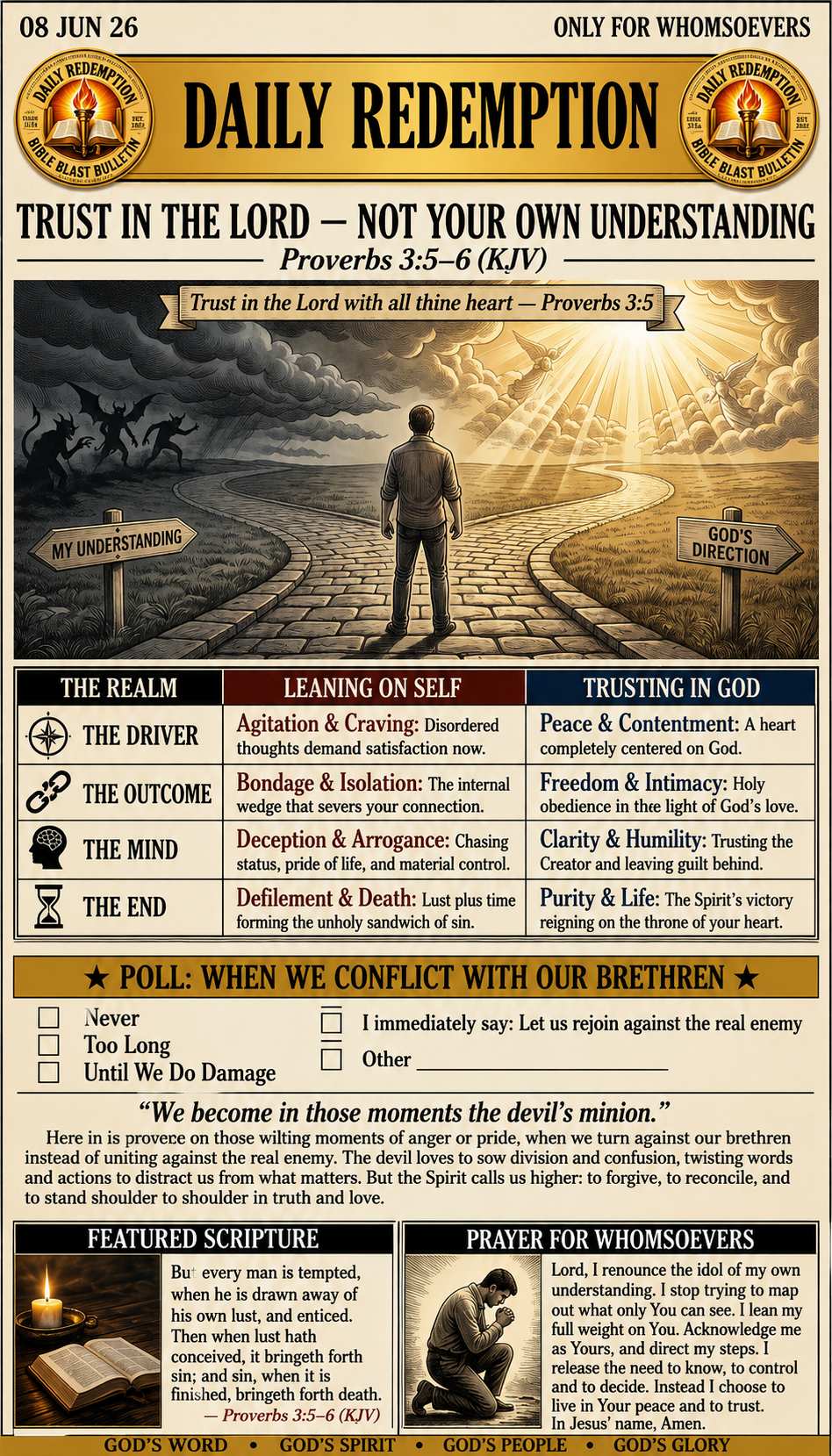
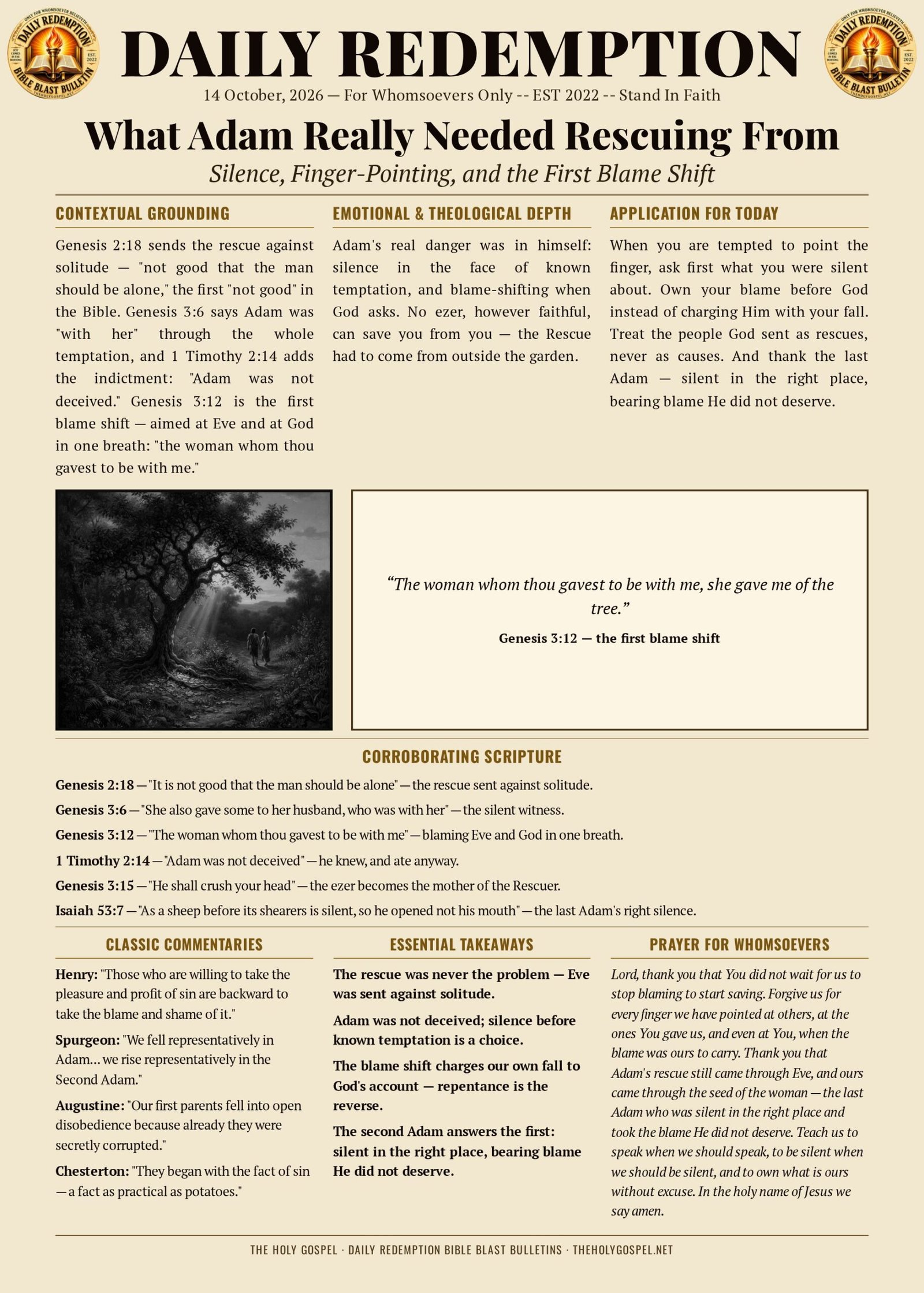
Yesterday we learned that Eve was no assistant — ezer kenegdo, a rescue, the same word that names God Himself in Psalm 121. Which forces the question: rescued from what, in a garden with no bills, no traffic, and no politics? The answer Scripture gives is not Eve. Adam was “with her” the whole temptation and said nothing; “Adam was not deceived,” says 1 Timothy 2:14 — he knew. And when God came asking, Adam produced history’s first blame shift: “The woman whom thou gavest to be with me” — blaming Eve and God in a single breath. Adam needed rescuing from himself. The grace note is that his rescue still came through Eve, mother of the Seed, while the last Adam reversed the first: silent in the right place, and taking blame He didn’t deserve. That is the gospel in one sentence, free of charge.
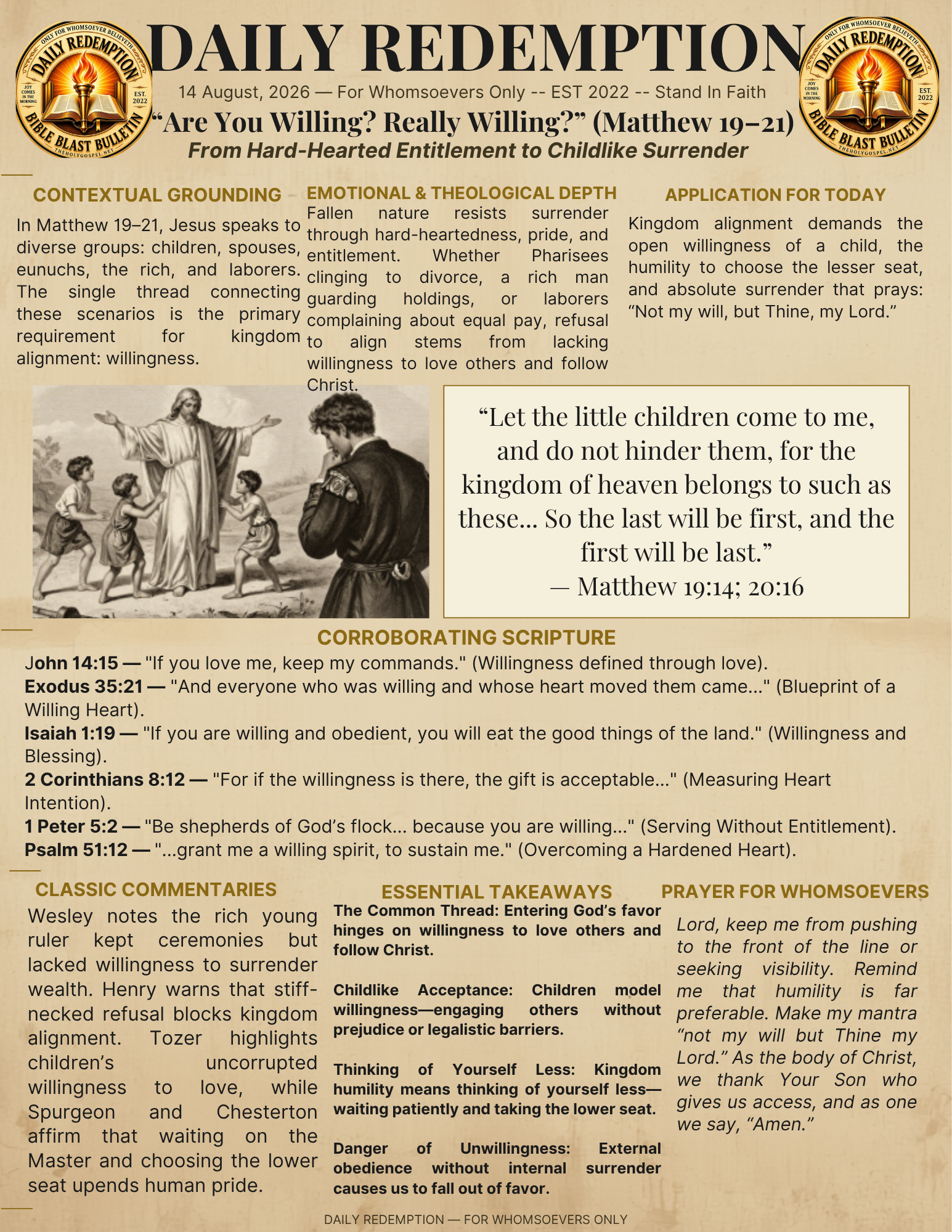
So yesterday we learned that Eve was no assistant. She was a rescue — ezer kenegdo, a rescue corresponding to him, the same noun that names God Himself in Psalm 121:2. Which brings up the question a few of you were already asking (okay, me, at 4 AM, with the coffee): rescued from what? The garden had no bills, no traffic on Princess Anne Road, no worship team politics. What did Adam need saving from in paradise?
The answer is in the verse itself: “It is not good that the man should be alone.” The rescue was sent against solitude — the first “not good” in the whole Bibl
Now here is the detail everybody skips. Genesis 3:6 says she took of the fruit “and gave also unto her husband with her; and he did eat.” With her. Adam was standing right there the whole time. No serpent ever spoke a single word to Adam — every temptation in the chapter is aimed at her. The one man in the history of the world with a front-row seat to the temptation, and his recorded contribution to the whole affair is silence. But 1 Timothy 2:14 says it plain: “Adam was not deceived.” He was not tricked. He watched, he knew, and he ate anyway.
And when God comes asking, Adam produces the first recorded case of passing the buck: “The woman whom thou gavest to be with me, she gave me of the tree.” Do you see what he did there? He blames Eve and God in the same breath. Whom thou gavest me — translation: this is really on You, Lord. That is not a man who needed rescuing from Eve. That is a man who needed rescuing from his own silence and his own finger-pointing, and no wife, however good an ezer, can save you from you.
Even my cats know better. Shayna and Rocky have never once blamed each other over the food dish, which puts them ahead of the first man in the theology department.
But here is the grace note I cannot get past, and it closes yesterday’s loop better than I could have planned: the ezer who became the occasion of the fall became the mother of the Rescuer. Genesis 3:15 — the seed of the woman crushes the serpent’s head. Adam’s rescue came through Eve. And the second Adam, where Adam spoke up to dodge, was silent in exactly the right place: “as a sheep before her shearers is dumb, so he openeth not his mouth” (Isaiah 53:7). Adam shifted blame he deserved; the last Adam took blame He didn’t. That is the whole gospel in one sentence and you can have it for free.
So what did Adam really need rescuing from? Aloneness was the first danger, and God named it Himself — “It is not good that the man should be alone” — and the rescue He sent answered that one. But even with the rescue standing right beside him, Adam found two more dangers all by himself: silence when God asks, and finger-pointing when the blame is ours. Eve was never the problem. This is turning into a series, and I pray you stay with me.
Classic Commentaries Corner
Matthew Henry, watching the same exchange in the garden, saw the pattern that has run in every human heart since: “Those who are willing to take the pleasure and profit of sin, are backward to take the blame and shame of it.” Adam wanted the fruit and then wanted the innocence too; Henry names that trade for what it is. Worse, Henry observes, there is “a strange proneness in those that are tempted, to say, they are tempted of God; as if our abuse of God’s gifts would excuse our breaking God’s laws” — the very move of “the woman whom thou gavest me,” and the very move we still make when we charge our own choices to the God who gave us everything good.
Charles Spurgeon saw the two-Adam structure of salvation run straight through the fall: “We fell representatively in Adam, it prepared the way for us to rise representatively in the Second Adam, Christ Jesus our Lord and Saviour!” The doctrine is not an embarrassment to be managed but the architecture of redemption — one man’s silence brought the ruin, and one Man’s obedience brought the rescue. The second Adam does not merely cancel the first; He answers him point for point, wrong silence with right silence.
Augustine traced the fall deeper than the fruit, to the will behind it: “Our first parents fell into open disobedience because already they were secretly corrupted.” The bite was only the eruption; the corruption was already in the heart — which is why God’s question “where art thou?” was never about geography. Adam needed rescuing from the Adam no one else could see. That is why the Rescue had to come from outside the garden entirely.
G.K. Chesterton, defending the church’s oldest doctrine against the modern temper that finds sin passé, wrote that the ancient masters of religion “began with the fact of sin — a fact as practical as potatoes.” Genesis 3 is that fact’s first press conference, and nothing could be more empirical than Adam blaming his wife and God within minutes of eating the fruit. Start where the Bible starts — with the fact — and grace starts making sense immediately.
Corroborating Scripture & Christological Connections
Genesis 2:18 — “It is not good that the man should be alone… I will make a helper suitable for him.” The rescue was sent against solitude — the first “not good” in creation. Eve was the answer, never the problem.
Genesis 3:6 — “She also gave some to her husband, who was with her, and he ate.” With her — the silent witness with the front-row seat; the temptation was never addressed to him.
Genesis 3:12 — “The woman whom thou gavest to be with me, she gave me of the tree.” The first blame shift, aimed at Eve and God in one breath — the old sin of charging our own fall to the Giver of every good gift.
1 Timothy 2:14 — “Adam was not deceived.” He was not tricked — he knew, and he ate. Silence before known temptation is not an absence; it is a choice.
Genesis 3:15 — “He shall crush your head, and you shall strike his heel.” The ezer who became the occasion of the fall becomes the mother of the Rescuer — Adam’s rescue comes through Eve’s line.
Isaiah 53:7 & Romans 5:19 — “As a sheep before its shearers is silent, so he opened not his mouth… as by one man’s disobedience many were made sinners, so by the obedience of one shall many be made righteous.” The last Adam reverses the first: silent where Adam spoke to dodge, obedient where Adam shifted blame, taking the punishment He didn’t deserve to rescue the ones who did.
Essential Takeaways
- The Rescue Was Never the Problem: Eve was sent against solitude; sin — not she — turned the rescue into rivalry. Treat the people God sends as rescues, not causes.
- Adam Was Not Deceived: He watched, he knew, he ate. Silence in the face of known temptation is a decision dressed up as an absence.
- The Blame Shift Is the Oldest Sin in the Book: “The woman whom thou gavest” charges our own choices to God’s account — repentance is the exact reverse.
- The Second Adam Answers the First: Where Adam spoke up to dodge, Christ was silent in the right place and bore blame He didn’t deserve — the gospel in one sentence.
- Ask the Question Before You Point: The next time a finger starts rising, ask first what you were silent about when God was asking where you were.
Prayer For Whomsoevers
Lord, thank you that You did not wait for us to stop blaming to start saving. Forgive us for every finger we have pointed at others, at the ones You gave us, and even at You, when the blame was ours to carry. Thank you that Adam’s rescue still came through Eve, and ours came through the seed of the woman — the last Adam who was silent in the right place and took the blame He did not deserve. Teach us to speak when we should speak, to be silent when we should be silent, and to own what is ours without excuse. In the holy name of Jesus we say amen.