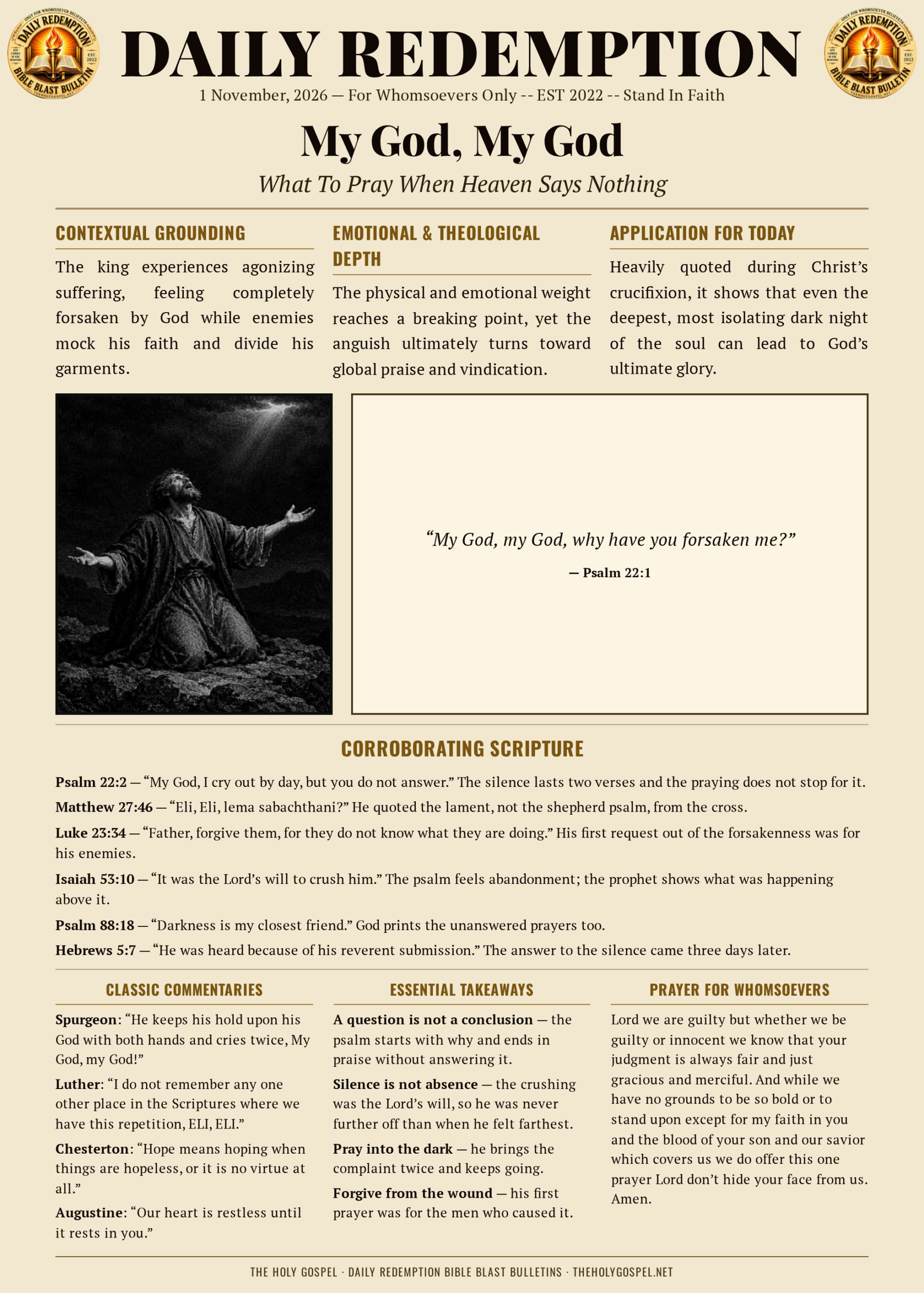
Psalm 22: My God, My God, What To Pray When Heaven Says Nothing
The cry of Psalm 22 opens the psalm rather than closing it, a question and not a conclusion, and the man keeps praying into the silence for two full verses before anything shifts. Isaiah 53 tells us what was happening above him the whole time, that it was the Lord’s will to crush him and cause him to suffer, so the agony was never evidence that God had left the room. Jesus prayed this same verse in Aramaic at the ninth hour, the hour of the evening sacrifice, and in the same breath asked forgiveness for the men who put him there. The silence of heaven is not the absence of God; it is where the prayer of the forsaken one becomes the mercy the rest of us receive.
If you are a Christian and you have been around for a little while and you don’t feel that what is called the Old Testament has anything to do with you and your faith, then Psalm 22 probably doesn’t mean very much to you either. If you are Jewish, you may completely miss its significance, along with the significance of a great many other things in the early testament. That being said, there are certain scriptures in the early testament which stand way, way above the others as regards Messianic significance, and Psalm 22 is way, way up there on the top of the mountain along with Isaiah 53. So I am dedicating the next week and every bulletin that comes out to Psalm 22, Psalm 23, Isaiah 53, and the related corroborating early testament scripture.
Seven posts, one thread pulling through all of them. Psalm 22 is the wound, Isaiah 53 is the reason. The psalm is a man speaking from inside his own suffering, in first person, and he never explains what his agony accomplished. Maybe for this reason the Jewish people, the rabbis, and their leaders can be forgiven. But the best reason to forgive is that if we don’t forgive, we don’t get forgiven, and the Lord Jesus said so in the Beatitudes. The other reason is that forgiving others is one of the most healing things any of us can do. So let’s continue. The prophet speaks from outside, after the fact, and tells you exactly what it bought, that he was wounded for our transgressions and it brought us peace, but he never quotes the sufferer. Each one is missing what the other has, so the series carries both from the first post instead of saving the prophet for a finale.
This is the silence, the desperate cry, and it is where Isaiah enters first. The cry opens the psalm rather than closing it, a question and not a conclusion, and the man keeps praying into the dark for two full verses. Isaiah tells you what was happening above him the whole time, that it was the Lord’s will to crush him and cause him to suffer. We all know about God’s wrath, God’s vengeance, and God’s justice, all of which equal God’s mercy. But why was this particular individual tormented? Isaiah answers the question in the same chapter, that he was pierced for our transgressions and crushed for our iniquities. Same event, opposite vantage points, and the prophet never once puts words in the sufferer’s mouth. Psalm 88 stands beside this post as the one lament in the book that resolves nothing at all, and Job 3 alongside it, the other man who wished he had never been born. Jesus quotes this verse in Aramaic at the ninth hour, the hour of the evening sacrifice, and in the same agony he pleads with the Lord to forgive his tormentors, for they know not what they do.
Contextual Grounding
The king experiences agonizing suffering, feeling completely forsaken by God while enemies mock his faith and divide his garments.
Emotional & Theological Depth
The physical and emotional weight reaches a breaking point, yet the anguish ultimately turns toward global praise and vindication.
Application
Heavily quoted during Christ’s crucifixion, it shows that even the deepest, most isolating dark night of the soul can lead to God’s ultimate glory.
Classic Commentaries Corner
Spurgeon on the cry itself: “Our Lord’s faith beams forth and deserves our reverent imitation; he keeps his hold upon his God with both hands and cries twice, My God, my God!” He goes on to say that the sufferer “appeals to him in the agony of grief, but not in the misery of doubt.” The forsakenness was real. The faith was realer.
Martin Luther on why the words are repeated: “I do not remember any one other place in the Scriptures where we have this repetition, ELI, ELI.” Twice over, because a man in that condition does not make a speech. He cries out.
G.K. Chesterton on the kind of hope that survives a silent heaven: “Hope means hoping when things are hopeless, or it is no virtue at all.” A hope that only works while things are going well was never hope to begin with.
Augustine on what the silence is actually for: “You have made us for yourself, and our heart is restless until it rests in you.” The restlessness in Psalm 22 is not unbelief leaking out. It is a heart refusing to rest anywhere else.
Corroborating Scripture & Christological Connections
Psalm 22:1–2 — “My God, my God, why have you forsaken me? Why are you so far from saving me, so far from my cries of anguish? My God, I cry out by day, but you do not answer, and by night, but I find no rest.” The psalm opens in the silence and stays there for two verses without apologizing for it.
Matthew 27:46 — “About three in the afternoon Jesus cried out in a loud voice, ‘Eli, Eli, lema sabachthani?’ which means ‘My God, my God, why have you forsaken me?’” He did not quote Psalm 23 in the valley. He quoted the lament.
Luke 23:34 — “Father, forgive them, for they do not know what they are doing.” The first request out of the forsakenness was not for himself.
Isaiah 53:10 — “Yet it was the Lord’s will to crush him and cause him to suffer.” The psalm gives you the feeling of abandonment; the prophet gives you what was happening above it.
Psalm 88:18 — “You have taken from me friend and neighbor—darkness is my closest friend.” The one psalm that never resolves, standing beside this one as proof that God prints the unanswered prayers too.
Hebrews 5:7 — “During the days of Jesus’ life on earth, he offered up prayers and petitions with fervent cries and tears to the one who could save him from death, and he was heard because of his reverent submission.” He was heard. That is the answer to the silence, and it came three days later.
Essential Takeaways
A question is not a conclusion. The psalm begins with “why” and ends in praise without ever answering the why.
Silence is not absence. Isaiah says the crushing was the Lord’s will, which means God was never further away than in the moment he felt farthest.
Pray into the dark, not around it. He does not tidy up his complaint before bringing it. He brings it, twice, and keeps going.
Forgive from the wound, not after it heals. His first prayer out of the abandonment was for the men who caused it.
Prayer For Whomsoevers
Lord we are guilty but whether we be guilty or innocent we know that your judgment is always fair and just gracious and merciful. And while we have no grounds to be so bold or to stand upon except for my faith in you and the blood of your son and our savior which covers us we do offer this one prayer Lord don’t hide your face from us. Amen.