I Will Draw All People: John 12:32 and the Word Calvinism Can’t Answer
Jesus says that when he is lifted up he will draw all people to himself, and the word is pantos, all without exception. Not a pre-selected group. A universal, cosmic, magnetic pull on every human soul, which is the only thing that explains how a teacher who never wrote a word and walked twelve miles of a backwater province ended up at the center of world history. If the atonement is that wide, then the weight falls where Scripture puts it: whether a man resists or yields. And the constant failure of humanity is not the argument against the cross. It is the evidence for it.
Greetings! Hope you’re having a great day — and let’s see if we can put just a little bit more God into it with the close of John 10 through 12. This is the part where Jesus tells us exactly why he was going, and how far the reach of it would be.
The Death Blow to Predestination
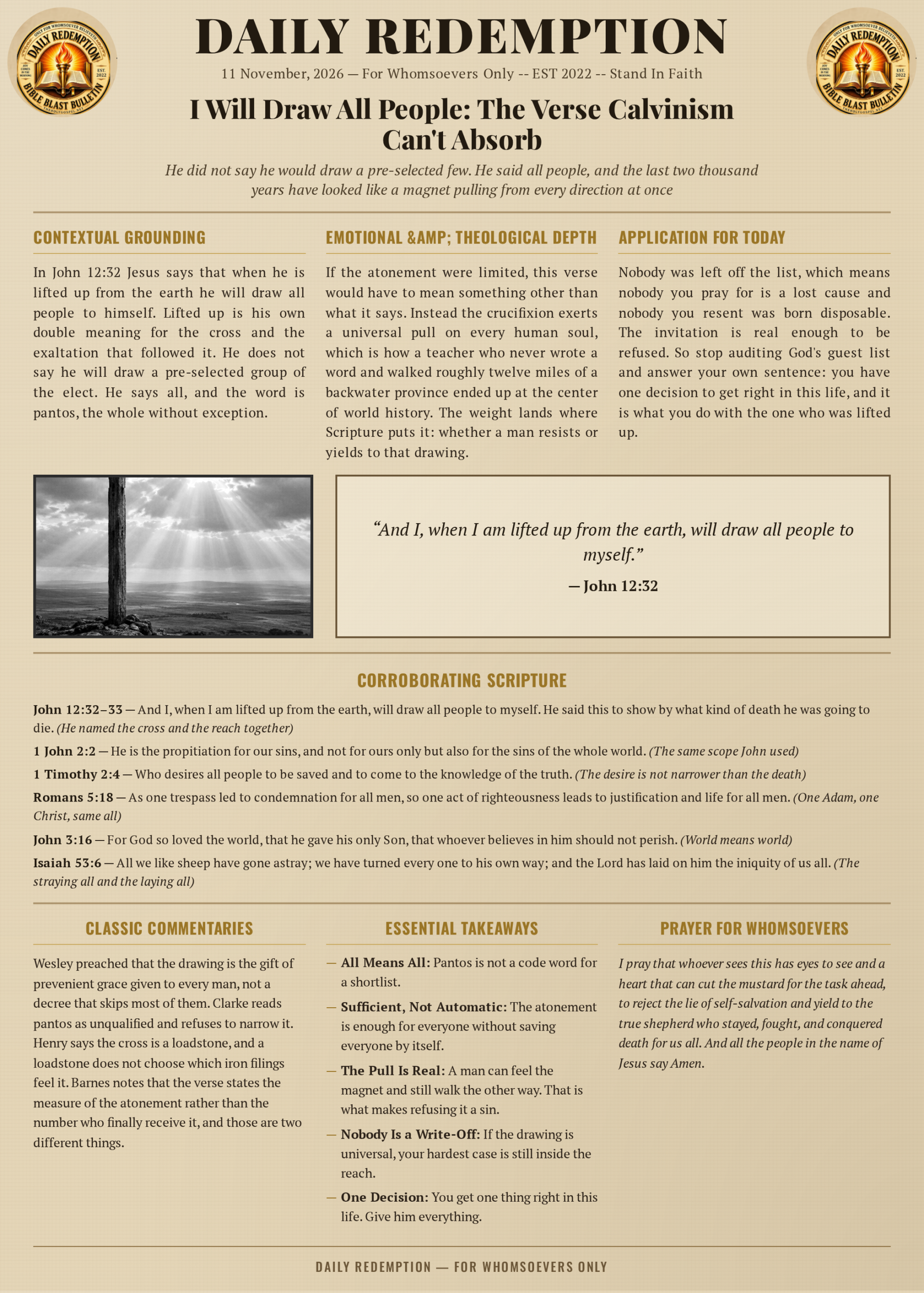
And why did he do it? Jesus tells us plainly in John 12:32: “And I, when I am lifted up from the earth, will draw all people to myself.”
Here’s Calvinism again, like a TKO of Calvinism. This single verse delivers a structural death blow to strict Calvinist predestination and the doctrine of limited atonement. Jesus does not say he will draw a pre-selected, exclusive group of the elect. He uses the word pantos, which means all people.
The crucifixion exerts a universal, cosmic, magnetic pull on every single human soul. And that is part of the reason why a man who never wrote a word, who outside of the Bible only Josephus even mentions in historical text, who went about maybe twelve miles in total in the Middle East, not the center of the population at that time — is now at the center of history. And why the Romans went from persecuting the Christians to becoming Christian in a very short period of time. Because of this exact thing. A universal cosmic magnetic pull on every single human soul.
The atonement is not literally magnetic, but it acts as if it were. The atonement is sufficient for all. Salvation is not locked away behind an arbitrary divine decree. The weight is placed directly on human responsibility, whether you will resist or yield to the universal drawing of the Savior.
The Vindication
People often look at the failures, the hypocrisy, and the corruption of human beings throughout history, even those who claim to follow Christ, and they say, look, Christianity has failed.
No. The constant failure of humanity is the absolute, undeniable proof of why the cross was necessary. If we could save ourselves by following the advice of a physician or a good teacher, Jesus wouldn’t have had to die.
You know how C.S. Lewis says it: the one thing you cannot say about Jesus is that he was just a good teacher, because either he was insane, a liar, or God, when he said that he was God. Very clear. Jesus wouldn’t have had to die. Our brokenness vindicates the gospel.
A good shepherd doesn’t hand the sheep a manual on how to fight wolves. He doesn’t give them pointers on detaching themselves from the things they love, like Buddha, who abandoned his wife and children and was celebrated by his followers for it. He doesn’t give them meditation to calm their spirits so they can be free from suffering when the cause of suffering is in us, and then just walk away. He stands between the helpless sheep and the slaughter.
He boldly proclaims that while the kingdom of God is within them, so is the sin nature, which drives a wedge and establishes an introversible breach between us and God — and that he has taken our punishment so we can come back home to the Father in heaven, through the punishment that he received for us, paid in full.
Classic Commentaries Corner
Wesley preached that the drawing is the gift of prevenient grace given to every man, not a decree that skips most of them. Clarke reads pantos as unqualified and refuses to narrow it. Henry says the cross is a loadstone, and a loadstone does not choose which iron filings feel it. Barnes notes that the verse states the measure of the atonement rather than the number who finally receive it, and those are two different things.
Corroborating Scripture & Christological Connections
John 12:32–33 — “And I, when I am lifted up from the earth, will draw all people to myself. He said this to show by what kind of death he was going to die.” He named the cross and the reach together.
1 John 2:2 — “He is the propitiation for our sins, and not for ours only but also for the sins of the whole world.” The same scope John used.
1 Timothy 2:4 — “Who desires all people to be saved and to come to the knowledge of the truth.” The desire is not narrower than the death.
Romans 5:18 — “As one trespass led to condemnation for all men, so one act of righteousness leads to justification and life for all men.” One Adam, one Christ, same all.
John 3:16 — “For God so loved the world, that he gave his only Son, that whoever believes in him should not perish.” World means world.
Isaiah 53:6 — “All we like sheep have gone astray; we have turned every one to his own way; and the Lord has laid on him the iniquity of us all.” The straying all and the laying all.
Essential Takeaways
All Means All: Pantos is not a code word for a shortlist.
Sufficient, Not Automatic: The atonement is enough for everyone without saving everyone by itself.
The Pull Is Real: A man can feel the magnet and still walk the other way. That is what makes refusing it a sin.
Nobody Is a Write-Off: If the drawing is universal, your hardest case is still inside the reach.
One Decision: You get one thing right in this life. Give him everything.
Prayer For Whomsoevers
I pray that whoever sees this has eyes to see and a heart that can cut the mustard for the task ahead, to reject the lie of self-salvation and yield to the true shepherd who stayed, fought, and conquered death for us all. And all the people in the name of Jesus say Amen.