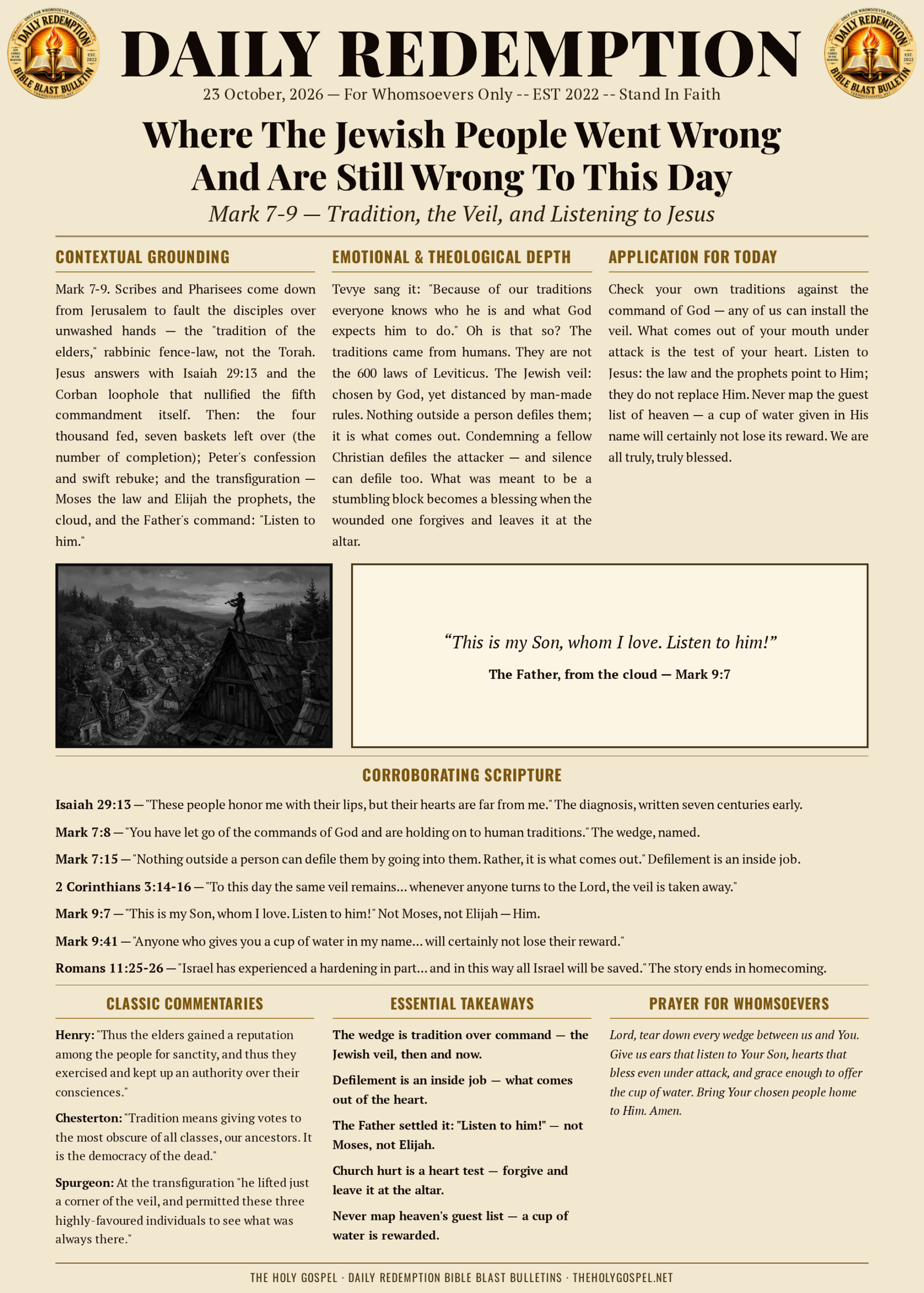
The Jewish people are still God’s chosen — and the wedge they installed between themselves and the Lord is man-made tradition elevated above the command of God, the very “Jewish veil” Jesus confronted in Mark 7. Nothing outside a person defiles them; it is what comes out of a person that defiles them. And when Moses and Elijah stood with Jesus on the mountain, the Father settled the whole question with three words: “Listen to him.” Salvation could be just a cup of water away — delivered with a heart that belongs to Jesus. Contextual Grounding We are in Mark 7 through 9. The Pharisees and scribes come down from Jerusalem — fourscore or a hundred miles — to pick a quarrel over unwashed hands: not a commandment of God, but the “tradition of the elders,” the fence-laws the rabbis built around the Torah. Jesus answers them with Isaiah 29:13 and the Corban loophole — a tradition that nullified the fifth commandment itself. From there: the feeding of the four thousand with seven baskets left over (the Lord’s perfect number of completion), Peter’s great confession and his swift rebuke, and finally the transfiguration on the high mountain, where Moses (the law) and Elijah (the prophets) stand talking with Jesus and the voice of the Father commands: “This is my Son, whom I love. Listen to him.” Emotional & Theological Depth As one of the Jewish tribe of Levite descendants, this holds special meaning for me. If you want to know about the Jewish people of antiquity and even the most faithful of today — which is not very faithful, because most Jews do not read the Bible; they read the Talmud and things like that if they read anything at all — you can’t do better than to watch Fiddler on the Roof . Don’t read the Talmud; it’s awful in many aspects, and it only tells you how rabbis live, not how your average Jewish person lives. Here is Tevye’s prologue, and you’ll see how it fits into the song “Tradition”: “In our little village of Anatevka, you might say every one of us is a fiddler on the roof, trying to scratch out a pleasant simple tune without breaking his neck. It isn’t easy. You may ask, why do we stay up there if it’s so dangerous? We stay because Anatevka is our home. And how do we keep our balance? That I can tell you in one word: Tradition. Here in Anatevka we have traditions for everything. How to eat, how to sleep, how to wear clothes. For instance, we always keep our heads covered and we always wear a little prayer shawl. This shows our constant devotion to God. Now you may ask, how did this tradition start? And Tevye says, I’ll tell you. I don’t know. But it’s a tradition. Because of our traditions everyone knows who he is and what God expects him to do.” Oh is that so? Really? So at the beginning of Mark 7, the Pharisees are all up in the Lord’s face about his followers not doing ritual cleaning before eating — which is a tradition. Jesus replied, “Isaiah was right when he prophesied about you hypocrites. As it is written, these people honor me with their lips, but their hearts are far from me. They worship me in vain. Their teachings are merely human rules. You have let go of the commands of God and are holding on to human traditions.” So where did these traditions come from? Humans. They’re not in the Bible.