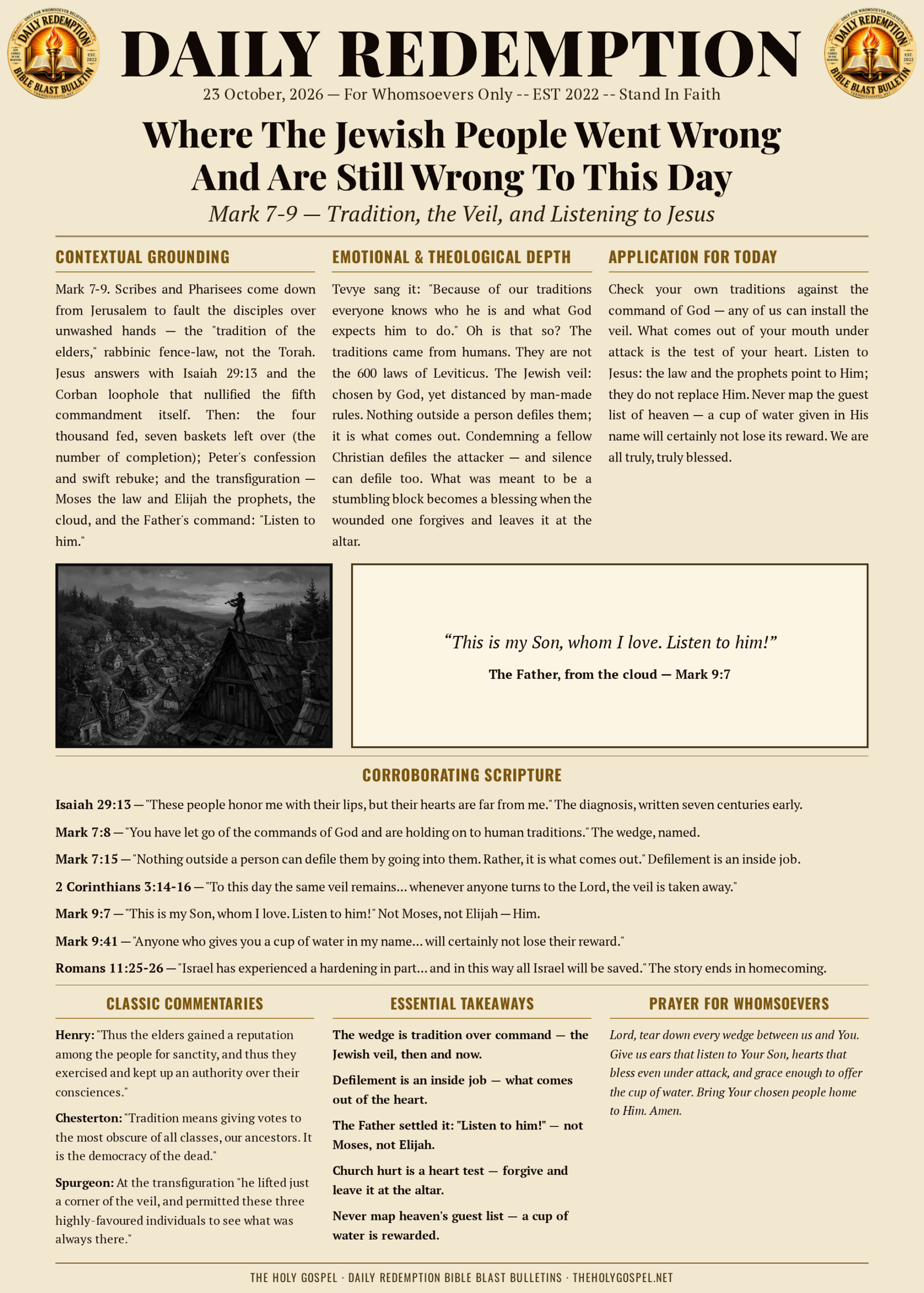
Where The Jewish People Went Wrong And Are Still Wrong To This Day
The Jewish people are still God’s chosen — and the wedge they installed between themselves and the Lord is man-made tradition elevated above the command of God, the very “Jewish veil” Jesus confronted in Mark 7. Nothing outside a person defiles them; it is what comes out of a person that defiles them. And when Moses and Elijah stood with Jesus on the mountain, the Father settled the whole question with three words: “Listen to him.” Salvation could be just a cup of water away — delivered with a heart that belongs to Jesus.
Contextual Grounding
We are in Mark 7 through 9. The Pharisees and scribes come down from Jerusalem — fourscore or a hundred miles — to pick a quarrel over unwashed hands: not a commandment of God, but the “tradition of the elders,” the fence-laws the rabbis built around the Torah. Jesus answers them with Isaiah 29:13 and the Corban loophole — a tradition that nullified the fifth commandment itself. From there: the feeding of the four thousand with seven baskets left over (the Lord’s perfect number of completion), Peter’s great confession and his swift rebuke, and finally the transfiguration on the high mountain, where Moses (the law) and Elijah (the prophets) stand talking with Jesus and the voice of the Father commands: “This is my Son, whom I love. Listen to him.”
Emotional & Theological Depth
As one of the Jewish tribe of Levite descendants, this holds special meaning for me. If you want to know about the Jewish people of antiquity and even the most faithful of today — which is not very faithful, because most Jews do not read the Bible; they read the Talmud and things like that if they read anything at all — you can’t do better than to watch Fiddler on the Roof. Don’t read the Talmud; it’s awful in many aspects, and it only tells you how rabbis live, not how your average Jewish person lives.
Here is Tevye’s prologue, and you’ll see how it fits into the song “Tradition”:
“In our little village of Anatevka, you might say every one of us is a fiddler on the roof, trying to scratch out a pleasant simple tune without breaking his neck. It isn’t easy. You may ask, why do we stay up there if it’s so dangerous? We stay because Anatevka is our home. And how do we keep our balance? That I can tell you in one word: Tradition. Here in Anatevka we have traditions for everything. How to eat, how to sleep, how to wear clothes. For instance, we always keep our heads covered and we always wear a little prayer shawl. This shows our constant devotion to God. Now you may ask, how did this tradition start? And Tevye says, I’ll tell you. I don’t know. But it’s a tradition. Because of our traditions everyone knows who he is and what God expects him to do.”
Oh is that so? Really?
So at the beginning of Mark 7, the Pharisees are all up in the Lord’s face about his followers not doing ritual cleaning before eating — which is a tradition. Jesus replied, “Isaiah was right when he prophesied about you hypocrites. As it is written, these people honor me with their lips, but their hearts are far from me. They worship me in vain. Their teachings are merely human rules. You have let go of the commands of God and are holding on to human traditions.”
So where did these traditions come from? Humans. They’re not in the Bible. They are not the 600 laws of Leviticus. And Jesus continues: “You have a fine way of setting aside the commands of God in order to observe your own traditions.” The Jewish veil. This is the problem, and it has always been the problem. The Jews, of course, had one other problem: they are chosen by God to be God’s people, but not always acting as such, because they are following their own man-made traditions.
Then Jesus makes it clear how bass-ackwards the Jewish leaders and followers had it: “Listen to me, everyone, and understand this. Nothing outside a person can defile them by going into them. Rather, it is what comes out of a person that defiles them.” So just because you didn’t do the specific worship of ritualizing how you wash before you eat, that doesn’t defile you. Rather, it’s what comes out of a person that defiles them.
Condemning a fellow Christian to anyone — especially their pastor — that defiles the person, not the one being attacked, the one that’s attacking. If the person can forgive them, then they are blessed, and what was meant to be a stumbling block has become a blessing, and the Lord sees and the Lord knows. Sometimes silence can defile a person: if the individual failed to bless, or at least show some grace or mercy, or even just an acknowledgement to the other, then their ungodly act of omission defiles them. If anyone has experienced church hurt because of what a fellow in that church said or failed to say, then realize that you’re being tested so the Lord can see your heart — whether you react in a way that defiles you, or whether you take it and leave it at the altar of the Lord. And if you can do that and forgive the one who is manifesting the wickedness of their heart, then you are building up your treasures in heaven.
Next, in Mark 7, Jesus is doing all sorts of miracles, including the feeding of the thousands with a combination of fish and seven loaves of bread. When the loaves were broken and the disciples collected them in the baskets, it totaled the Lord’s perfect number of completion: seven baskets. Chapter 8 is key to the relationship of Peter with Jesus, as Peter confesses that Jesus is Lord and Messiah. In other Gospels, Jesus blesses Peter, saying that he knew this because the Father had put the knowledge in him. It then says in this Gospel, as with the others, that Jesus tells Peter, “Get behind me, Satan” — as a response to Peter saying that he would protect him from the fate that he was headed towards. Because Jesus had just told him how the Son of Man would suffer a terrible fate. Jesus rode into Jerusalem on a cross, remember? The cross was the mane on the back of the donkey. So I’m just saying that right here, in a very short period of time, Jesus went from commending and blessing Peter, because he knew who Jesus was and he could only have gotten that information from the Father, to telling Peter, “Get behind me, Satan” — because Peter was trying to get himself in the way of what he thought was best for the Israelis. But actually, it was the Lord’s plan: the crucifixion, the resurrection. And Peter was getting himself in the middle of all that.
Chapter 9 starts with a statement from Jesus which has confused many, and that confusion confuses me: “Truly I tell you, some who are standing here will not taste death before they see that the kingdom of God has come with power.” People take that to mean Jesus is talking about his second coming — actually his third, as the resurrection can be said to be the second. But the next thing that happens fits the billing: the transfiguration. Jewish people take another hit in Mark 9 at the transfiguration, because as you will recall, Jesus stands on a high mountain and he is with Moses and Elijah. Actually, come to think of it, Jesus was flanked with two others getting crucified at Mount Calvary — but I don’t see the connection. It is a curious parallel. It just says Moses and Elijah were talking with Jesus, not necessarily flanking him one on each side.
So anyway, the voice of the Lord booms out from a cloud which covers the three of them and says, as before at the River Jordan at the time of the baptism of Jesus, “This is my Son, whom I love. Listen to him.” But the Father adds: “Listen to him.” So Moses, representing the law, and Elijah, representing the prophets, were not called out in such a fashion. Our Father who is in heaven said to listen to Jesus. That should make everything very clear — but for some, it has not. The curious thing about this passage for me, despite its amazing supernatural quality, is: how did the Jewish disciples of Jesus recognize Moses and Elijah? It says not. In fact, even today we only recognize them from paintings and so forth.
There is so much more towards the end of chapter 9: the whole first-and-last thing, which here means to put yourself last and the Lord first — which Paul had a lot to say about later in Galatians 2:20. Jesus’ appreciation of children, and forbiddance of great consequence for rejecting them. The whole “whoever is not against us is for us” thing, including this very hopeful passage which shows what folly it is for us to judge who we might see in heaven and whom we will not: “Truly I tell you, anyone who gives you a cup of water in my name because you belong to the Messiah will certainly not lose their reward.” But think about that. Salvation could be just a cup of water away — as long as it’s delivered with a heart that belongs to Jesus.
To me this section, Mark 7 through 9, is essential, because while the Jews are still God’s people, the wedge that they have installed to distance themselves from the Lord — what we might call the Jewish veil — is profound and deep and real, and much will have to be done, as we read in Revelation, to enable the Jewish people to come home to the Lord. And again, I say in light of all this that we are all truly, truly blessed.
Classic Commentaries Corner
Matthew Henry, in his commentary on Mark 7, saw exactly what the traditions were built for: the elders “placed religion in it,” and “thus the elders gained a reputation among the people for sanctity, and thus they exercised and kept up an authority over their consciences.” The veil was never about holiness — it was about control dressed as holiness.
G.K. Chesterton, in Orthodoxy, gave tradition its proper honor — and in doing so exposed the counterfeit: “Tradition means giving votes to the most obscure of all classes, our ancestors. It is the democracy of the dead.” The rabbis’ fence-laws claimed the authority of the dead; in truth they were the living outvoting God Himself.
Charles Spurgeon, preaching on the transfiguration in Christ’s Transfigured Face, saw the veil lifted for a moment: “on this occasion, he took off the veil; — nay, perhaps it would be more correct to say that he lifted just a corner of it, and permitted these three highly-favoured individuals to see what was always there, though usually concealed from their eyes.” The glory was never absent. The veil — theirs and ours — is what hides it.
Corroborating Scripture & Christological Connections
Isaiah 29:13 — “These people come near to me with their mouth and honor me with their lips, but their hearts are far from me. Their worship of me is based on merely human rules they have been taught.” The prophecy Jesus quoted — the diagnosis was written seven centuries before the quarrel over unwashed hands.
Mark 7:8, 13 — “You have let go of the commands of God and are holding on to human traditions… Thus you nullify the word of God by your tradition.” The wedge, named twice.
Mark 7:15, 21-23 — “Nothing outside a person can defile them by going into them. Rather, it is what comes out of a person that defiles them… For it is from within, out of a person’s heart, that evil thoughts come.” Defilement is an inside job.
Colossians 2:8 — “See to it that no one takes you captive through hollow and deceptive philosophy, which depends on human tradition and the elemental spiritual forces of this world rather than on Christ.” Tradition that replaces Christ is not neutral — it is captivity.
2 Corinthians 3:14-16 — “To this day the same veil remains when the old covenant is read… But whenever anyone turns to the Lord, the veil is taken away.” The veil has a remedy, and the remedy is a Person.
Mark 9:7 — “This is my Son, whom I love. Listen to him!” The Father’s verdict on the whole matter: not Moses, not Elijah, not the elders — Him.
Galatians 2:20 — “I have been crucified with Christ and I no longer live, but Christ lives in me.” The first-and-last life Paul lived, foretold in the Lord’s “first shall be last” teaching.
Mark 9:41 — “Truly I tell you, anyone who gives you a cup of water in my name because you belong to the Messiah will certainly not lose their reward.” Salvation could be just a cup of water away.
Romans 11:25-26 — “Israel has experienced a hardening in part until the full number of the Gentiles has come in, and in this way all Israel will be saved.” The chosen people’s story does not end with the veil — it ends with homecoming.
Essential Takeaways
- The Wedge Is Tradition Over Command: the “Jewish veil” was and is man-made rules held above God’s word — and any people, including church people, can install the same wedge.
- Defilement Is an Inside Job: not unwashed hands, but what comes out of the heart — including condemning a fellow Christian, and even the silence that withholds grace.
- The Father Settled It: Moses and Elijah were honored guests; only Jesus received “Listen to him.” The law and the prophets point to Him — they do not replace Him.
- Church Hurt Is a Test of the Heart: forgive the one manifesting the wickedness of their heart, leave it at the altar, and what was meant to be a stumbling block becomes treasure in heaven.
- Never Map the Guest List of Heaven: a cup of water given in His name is rewarded. Stop judging who’s in and who’s out — that judgment belongs to the Lord alone.
Prayer For Whomsoevers
Lord, tear down every wedge we have built between You and us — the traditions we love more than Your word, and the words that come out of us that defile us. Give us ears that listen to Your Son, hearts that bless even under attack, and grace enough to offer the cup of water. And bring Your chosen people home to Him. In Jesus’ name, Amen.