Don’t Just Do Something: Stand There and Pray
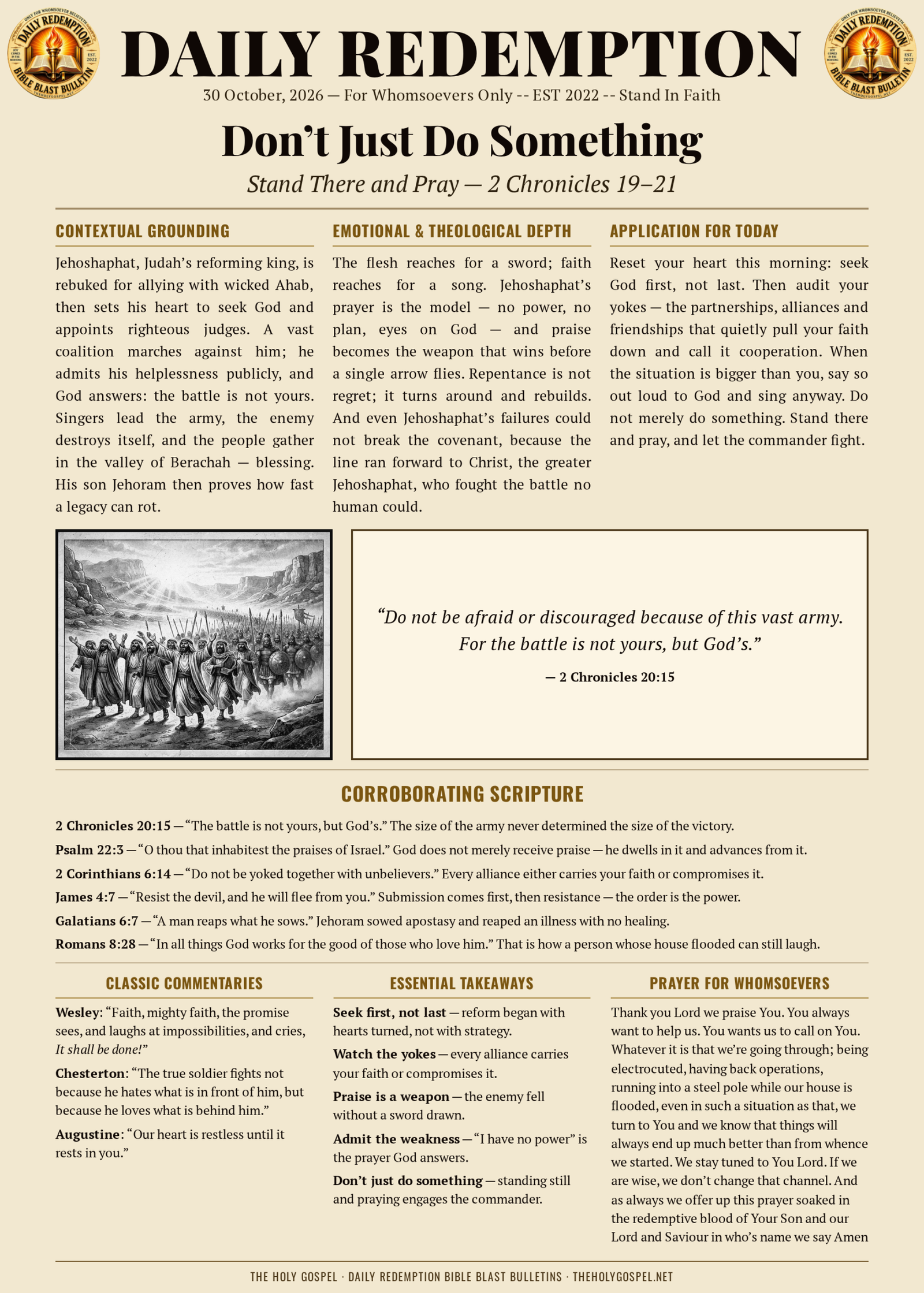
Jehoshaphat did almost everything right and still needed rebuking: he allied himself with wicked Ahab, got corrected, repented, and led a revival. Then a coalition army came to wipe him out, and he did the one thing that actually works — he admitted he had no power and sent singers out ahead of the troops. God turned the enemies on each other. The lesson runs through all three chapters: seek God with your whole heart, refuse alliances that compromise your faith, and let praise do the fighting. His failures still could not cancel God’s covenant, because the line ran to Christ — the greater Jehoshaphat, the righteous judge, the one who fought the battle we could never fight and won the valley of blessing for us.
Greetings! Hope you’re having a great day — and let’s see if we can put just a little bit more God into it with the word from 2 Chronicles 19–21. We’ll look at what it means for our lives and what it might mean in terms of messianic significance.
2 Chronicles 19–21 gives us a detailed look at the reign of King Jehoshaphat: intense moments of spiritual correction — oh my Lord — miraculous deliverance, and the dangers of compromise. These chapters offer profound lessons on seeking God, the necessity of godly associations (such as you guys), and the battle between relying on human strength versus divine power. You know, when somebody says “I got this,” maybe they should say, “I’m not concerned, because God’s got this.” That would be better.
The Danger of Unequally Yoked Alliances
We start in chapter 19, verse 2. Jehoshaphat is rebuked for helping the wicked king Ahab, which highlights that Christians should not enter into partnerships that compromise their faith. Partnerships, alliances, friendships — sometimes in life we have to associate with such people, but do we compromise our faith in doing so? A lot of times, no. But if we do, that needs to be reviewed. We must love God more than we love popularity or earthly cooperation.
Repentance Bringing Reform
Chapter 19, verse 4. Jehoshaphat didn’t just apologize to God for his transgressions — he actively led a revival. Now, we are saved by grace through faith, not by works. But repentance actually requires a turning around, so at least that much is works. Demonstration of works. Faith without works is dead, as it says in the book of James. We need to demonstrate that our repentance means something in order for our faith to be genuine, seen by God and in our own hearts. Jehoshaphat actively led a revival, bringing the people back to God and establishing righteous judges. Good for him — a lot better than a lot of other Old Testament kings. True repentance involves correcting our mistakes and turning back to God.
When the Army Is Too Big
When faced with a massive, overwhelming army, what would you do? Jehoshaphat didn’t rely on his own army, but on God. He sent singers. He sent singers ahead of the army to praise God. Can you sing? It doesn’t matter. Sing, you children. Sing, you children, sing. It’s so important. It’s not the only form of worship, but it is one that’s in the Old Testament and the New Testament, and God loves our hearts singing to him.
So he sent singers ahead of the army to praise God, resulting in a miraculous victory where the enemies destroyed each other. Reminds me of Idiocracy, when the dude is escaping from the jail and there are two mechanical cameras with guns on them, and they turn toward each other and shoot each other. Yeah, well, probably you don’t know that reference — but that was modern-day prophecy, Idiocracy. Anyway, he sent singers ahead, and then the enemies destroyed each other. Maybe they just couldn’t stand the sound. That reminds me of how they defeated the Martians in Mars Attacks by playing Slim Whitman music through every PA system and the Martians’ heads exploded.
Our praise is a powerful weapon in spiritual battles. And what does James say? Going back to James again: submit to God, resist the devil, and he will flee.
When we have no power against our problems, we should just admit our weakness. “Lord, Lord, I’m done. I’ve got nothing else. I don’t have any solution here. I have no power.” We should admit our weakness in such a fashion and turn our focus entirely to God. This prayer is a model for handling overwhelming life circumstances. And how many of us could have been overwhelmed recently, with so much going on in the world, in our neighborhood, with our own lives and families and so forth?
I’ll tell you, there’s one person in the church recently — their house was flooded. They had two surgeries on their back in one week. They got electrocuted and other things. And then the last that I heard, they had walked into a steel rod. I told her, could you please stay out of trouble? But aside from that, I prayed for her. But she just kept going. And when I said, can’t you please stay out of trouble? she laughed. That’s faith. That’s faith that enables us to laugh in that kind of a situation. We know everything is being done for our good, even when it’s just completely being piled on top of us.
Discipline and Consequences
And then lastly, in terms of meaning for our lives: the story of Jehoshaphat’s son, Jehoram. When I saw that name, I said, that one was one of the worst kings in all of the Old Testament, of all the Israelite kings. It illustrates a severe consequence of wickedness and failure to follow the God of Israel, serving as a warning to pursue righteous living. And oh my goodness — the Lord told him, you are going to have an affliction of the bowels which will not heal. It will actually just make it so that your bowels fall out. We’re talking about severe consequences.
So I don’t want that to happen to you. I know I don’t want it to happen to me. I’m going to follow God. I’m going to pursue righteous living and seek to help others to do the same.
Messianic Significance of This Scripture
Despite Jehoshaphat’s mistakes, God preserved him because he was in the Davidic line from which Jesus would come. God is faithful to his covenant promises, even when his people are weak or evil.
The greater Jehoshaphat. The name Jehoshaphat does not mean “help me, I’m fat.” It means “Yahweh has judged.” Jesus is the ultimate righteous judge who judges without partiality and provides salvation, fulfilling the ideal of righteous judgment that Jehoshaphat was trying to establish in 2 Chronicles 19.
The ultimate deliverer. Chapter 20, verse 15: the message — the battle is not yours but God’s — finds its ultimate fulfillment in Jesus. Jesus fought the ultimate battle against sin and death on the cross, a battle that humans could not fight. Our blood would not save a squirrel, as I heard somebody say, but Jesus’ blood saved all of us. He achieved victory for us. Victory in Jesus, la la la. You know — that was some terrible singing. Maybe I should have joined that army.
The true valley of blessing. Jehoshaphat and his people celebrated their victory in the valley of Berachah — blessing, that’s what that means. This foreshadows the ultimate eternal blessing of salvation won by Christ for all believers. Praise the Lord. And thank you Jesus.
In summary, these chapters encourage us to set our hearts to seek God — and that’s actually in 19:3, right at the beginning of this section. We are called upon to set our hearts to seek God. Have you reset your heart? That’s what becoming a new creature in Christ and repenting is all about: being baptized of one’s sins and coming out of the water as a new creature in Christ.
In summary, these chapters encourage us to set our hearts to seek God and trust him to fight our battles, while pointing forward to the ultimate sinless king who brings permanent victory and righteous peace. We can only mess things up, ultimately. I mean, sometimes we get it right — with God’s grace, with God’s help. More often it would have been better just to pray rather than doing something. “Don’t just sit there and pray, do something”? No. That turns out to be wrong. Don’t just do something — stand there and pray. Get God involved.
Classic Commentaries Corner
Charles Wesley on the faith that faces an army: “Faith, mighty faith, the promise sees, and looks at that alone; laughs at impossibilities, and cries, It shall be done!” That is the song Jehoshaphat’s choir was singing before the battle started.
G.K. Chesterton on the fight and what we are fighting for: “The true soldier fights not because he hates what is in front of him, but because he loves what is behind him.” Judah’s army loved what was behind them — their children, their city, the covenant. So the singers went forward first.
Augustine on the heart that will not rest until it is pointed at God: “You have made us for yourself, and our heart is restless until it rests in you.” Jehoshaphat set his heart to seek God — that is the only restlessness that ever finds rest.
Thomas à Kempis on the plans of men and the providence of God: “For the resolutions of the just depend rather on the grace of God than on their own wisdom; and in him they place their hope.” Man proposes, but God disposes — and God had already disposed of the army coming against Judah.
Corroborating Scripture & Christological Connections
2 Chronicles 20:15 — “Do not be afraid or discouraged because of this vast army. For the battle is not yours, but God’s.” The size of the army never determined the size of the victory.
Psalm 22:3 (KJV) — “But thou art holy, O thou that inhabitest the praises of Israel.” God does not merely receive the praise of his people — he dwells in it, and advances from it.
2 Corinthians 6:14 — “Do not be yoked together with unbelievers. For what do righteousness and wickedness have in common?” Jehoshaphat’s alliance with Ahab nearly cost him everything; grace rebuked him and he turned.
James 4:7 — “Submit yourselves, then, to God. Resist the devil, and he will flee from you.” Submission first, then resistance — the order matters, and Jehoshaphat kept it.
Galatians 6:7 — “Do not be deceived: God cannot be mocked. A man reaps what he sows.” Jehoram sowed apostasy and reaped a disease that had no healing.
Romans 8:28 — “And we know that in all things God works for the good of those who love him, who have been called according to his purpose.” That is how a person whose house flooded can still laugh.
Essential Takeaways
Seek first, not last. Jehoshaphat’s reform started with hearts turned toward God, not with strategy.
Watch the yokes. Every alliance either carries your faith or compromises it. Review the ones you are in right now.
Praise is a weapon. Singers went out ahead of the soldiers, and the enemy fell without a single Israelite swinging a sword.
Admit the weakness. “I have no power” is not unbelief — it is the prayer God answers.
Don’t just do something. Standing still and praying is not passivity; it is engaging the commander.
Prayer For Whomsoevers
Thank you Lord we praise You. You always want to help us. You wants us to call on You. Whatever it is that we’re going through; being electrocuted, having back operations, running into a steel pole while our house is flooded, even in such a situation as that, we turn to You and we know that things will always end up much better than from whence we started. We stay tuned to You Lord. If we are wise, we don’t change that channel. And as always we offer up this prayer soaked in the redemptive blood of Your Son and our Lord and Saviour in who’s name we say Amen