Welcome to today’s DRBBB: This could be a short discussion today. Because Jesus in Matthew makes it so very clear:
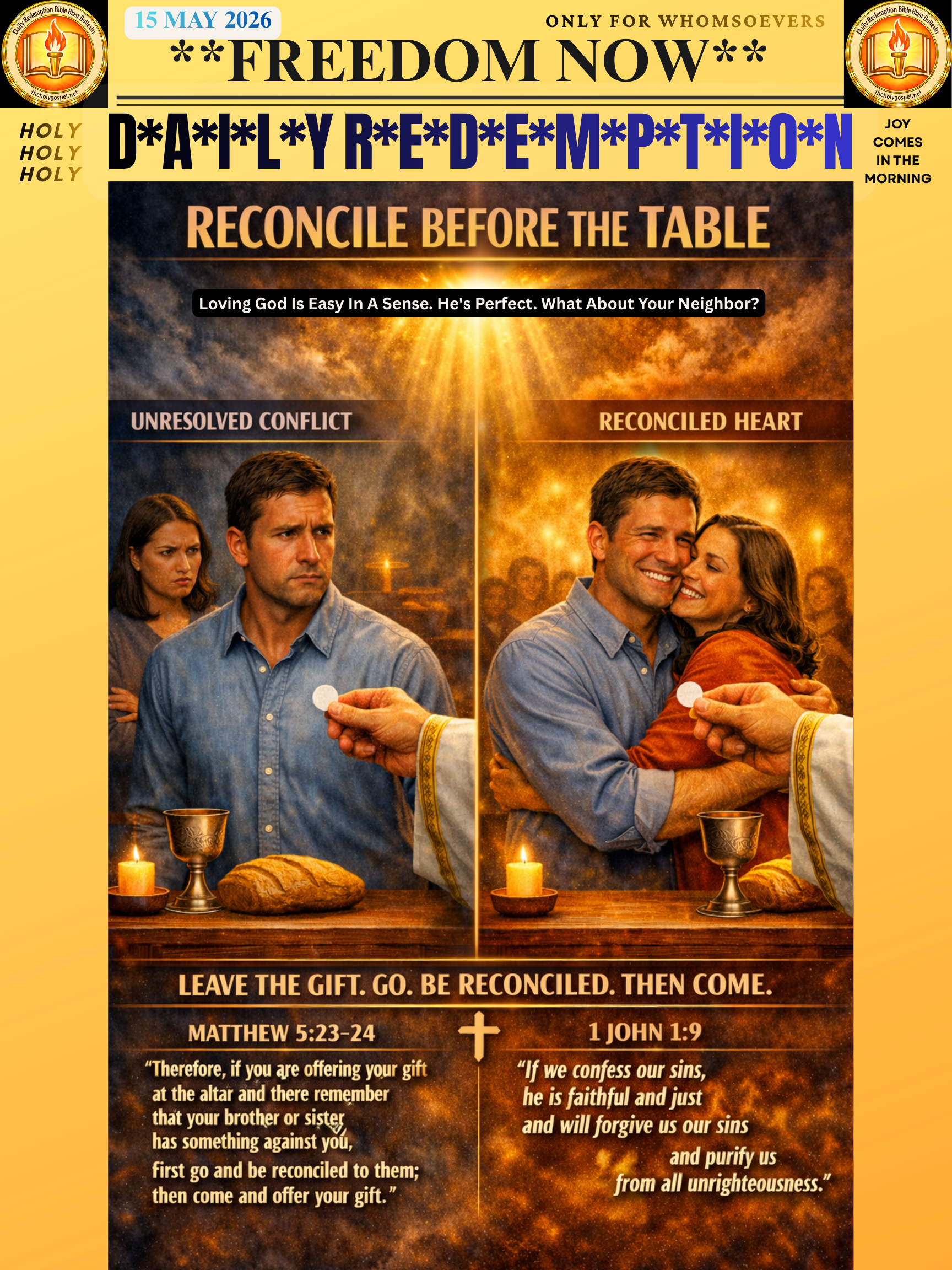
Matthew 5:23–24 (HG):
“Therefore if thou bring thy gift to the altar, and there rememberest that thy brother hath ought against thee; Leave there thy gift before the altar, and go thy way; first be reconciled to thy brother, and then come and offer thy gift.”
This is not only very clear it might be more difficult than first glance allows. This quote is from Jesus. So there was no ritual taking of the bread and wine representing his body. Instead the Jews brought gifts to the altar instead of imbibing of something holy. Animal sacrifices, grain sacrifices and the like. Also it doesn’t say “if you remember a conflict you have with a brother, purge it from your soul before going forward.” There is that but what Jesus says is you have to fix the matter with your brother – his heart has to change. Do you understand? This means that you have to be clean of any animosity or enmity from your brother of which you are aware before you approach the table because to rectify the matter might hold everybody up and could even result in a scene which distracts one and all from holy Communion. This requirement to engage in ritual worship then does not start with Jesus but is from the Tanakh. The sacrificial system required:
Cleansing before approach (Leviticus 15:31: “Thus shall ye separate the children of Israel from their uncleanness; that they die not in their uncleanness, when they defile my tabernacle that is among them.”) So, not just a minor issue – God could strike you down if you defiled his tabernacle by being unclean when appearing for ritual worship and that uncleanliness includes enmity with a fellow worshipper.
Isaiah is very clear about God’s refusal of your offering under certain circumstances Isaiah 1:11–17: God rejects sacrifices when hands are “full of blood” — injustice, unresolved conflict. The Torah does offer how to make it right with God – Confession and restitution before offering (Leviticus 5:5–6, Numbers 5:6–7)
When this does not apply – two situations
1. if somebody is harboring bad feelings towards you but it is not fixable by you but is something they need to resolve in their own heart. You are not responsible for what you honestly don’t know. You are not responsible for friction towards you in the heart of another which they have chosen to keep quiet about. If you are not aware of the situation in their heart then you can’t “remember it” before communion.
2. if there is a personality clash but nothing that can be brought to peaceful resolution in the moment then that is a matter of prayer and meditation, possibly both parties getting to know each other, other ways to resolve but may not stop a person from taking communion if there has been no actual falling out because of an incident or such.
Ultimately, Jesus doesn’t say, “Finish your worship, then fix it.” He says: Stop. Go. Reconcile. Then return. Worship interrupted by reconciliation is still worship. How can you take remembrances of the blood and body of Jesus and accept it will assimilate properly if you are not in accord with Him.
Ideally, on or before Sunday morning: If you remember unresolved conflict, pause. Make it right before you take the elements. That’s the “examination” Paul meant in 1 Corinthians 11:27–29 (examine, don’t despise)
More relevant scripture:
Matthew 5:23–24 (reconcile before altar)
1 John 1:9 (confess → cleanse → come)
Hebrews 10:22 (draw near with true heart)
Acts 2:46 (house-to-house breaking of bread)
1 Corinthians 11:27–29 (examine, don’t despise)
Guard Against Two Extremes:
Over-responsibility: Assuming you must fix every relational tension (leads to burnout, people-pleasing)
Under-responsibility: Ignoring clear offenses because “it’s their problem” (leads to hard hearts)
Weekday at home: Same principle applies. If your heart is holding bitterness, unforgiveness, or unconfessed sin — reconcile first (with God, with others), then break bread.
Practical Flow for “Worthy” Communion:
Pause — Before the Table, ask: “Is there anyone I’m at odds with?”
Confess — To God first (1 John 1:9)
Reconcile — If possible, make it right with the person (Matt 5:24)
Come — Not perfect, but repentant; not clean by merit, but cleansed by blood
Matthew 5:23–24 (KJV)
“Therefore if thou bring thy gift to the altar, and there rememberest that thy brother hath ought against thee; Leave there thy gift before the altar, and go thy way; first be reconciled to thy brother, and then come and offer thy gift.”
1 John 1:9 (KJV)
“If we confess our sins, he is faithful and just to forgive us our sins, and to cleanse us from all unrighteousness.”
Hebrews 10:22 (KJV)
“Let us draw near with a true heart in full assurance of faith, having our hearts sprinkled from an evil conscience, and our bodies washed with pure water.”
Acts 2:46 (KJV)
“And they, continuing daily with one accord in the temple, and breaking bread from house to house, did eat their meat with gladness and singleness of heart,”
And to whomsoever may consider that this is not a serious matter, to God the Father, the Son, the Holy Spirit and your eternal Sonshine…
1 Corinthians 11:27–29 (KJV)
“Wherefore whosoever shall eat this bread, and drink this cup of the Lord, unworthily, shall be guilty of the body and blood of the Lord. But let a man examine himself, and so let him eat of that bread, and drink of that cup. For he that eateth and drinketh unworthily, eateth and drinketh damnation to himself, not discerning the Lord’s body.”
I have a question – do you have things you have prayed for and not received even though they are godly things and you feel in accordance with the will of the Lord? Try cleaning yourself up before you come to the altar.