What David Teaches Us Today
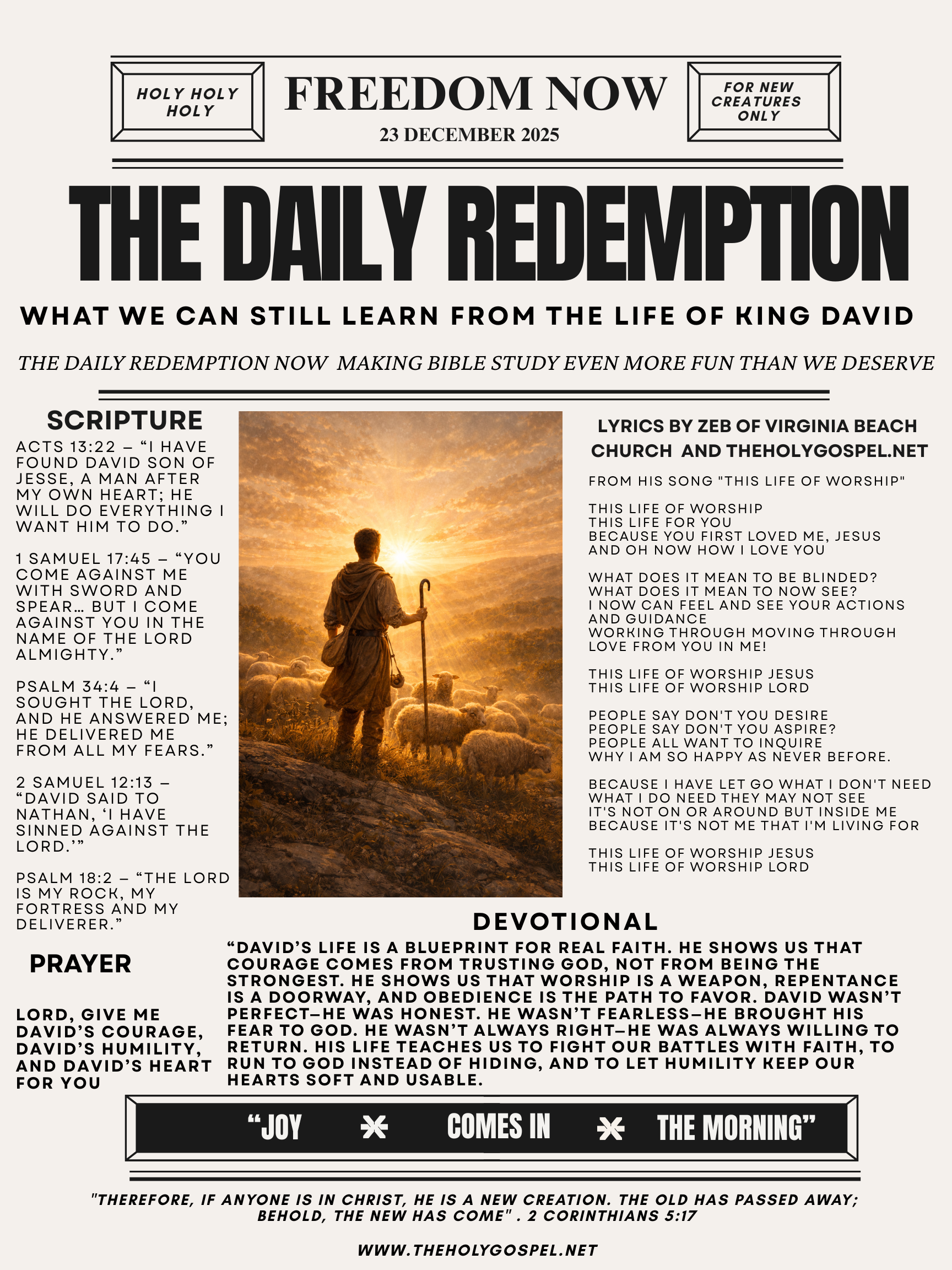
Acts 13:22 — “I have found David son of Jesse, a man after my own heart; he will do everything I want him to do.”
1 Samuel 17:45 — “You come against me with sword and spear… but I come against you in the name of the Lord Almighty.”
Psalm 34:4 — “I sought the Lord, and he answered me; he delivered me from all my fears.” Wrote King David the psalmist.
2 Samuel 12:13 — “David said to Nathan, ‘I have sinned against the Lord.’”
Psalm 18:2 — “The Lord is my rock, my fortress and my deliverer.”
David’s life is a blueprint for real faith. He shows us that courage comes from trusting God, not from being the strongest. He shows us that worship is a weapon, repentance is a doorway, and obedience is the path to favor. David wasn’t perfect—he was honest. He wasn’t fearless—he brought his fear to God. He wasn’t always right—he was always willing to return. His life teaches us to fight our battles with faith, to run to God instead of hiding, and to let humility keep our hearts soft and usable.
“Lord, give me David’s courage, David’s humility, and David’s heart for You.”
Painterly graphic: a young shepherd silhouette facing a vast horizon, sling at his side, warm gold light breaking over distant hills; mood courageous, humble, God‑dependent.
Upload Tags: DR, David, Acts 13:22, Faith, Courage, Repentance
Discoverability Hashtags: #DailyRedemption #David #HeartAfterGod #FaithWalk #BibleTruth
“What David Teaches Us Today”
(~65 seconds – No Director’s Cues)
JAMAL, early 30s, paces a hospital hallway. His brother’s in surgery. Bills overdue. He reaches for a dangerous phone number.
Voice, tense:
“I thought faith meant being strong. But I’m just scared.”
Then he remembers: “I sought the Lord… and He answered me.” (Psalm 34:4)
He walks outside. Kneels on cold concrete.
“Deliver me.”
No lightning. Just clarity.
He calls his pastor instead—confesses his fear, his near-mistake, his shame.
Like David to Nathan: “I have sinned.”
And in that honesty? Peace. Not because the crisis ended—but because God met him as rock, fortress, deliverer (Psalm 18:2).
Weeks later: Jamal’s still stretched thin—but now he’s mentoring teens, teaching them to trust God in the battle, not after.
Voice, calm:
“David didn’t win with a sword. He won by naming the Lord Almighty. That’s my weapon too.”
Final shot: Jamal strums a quiet chord on his guitar—worship, not performance.
Text on screen:
“A man after God’s own heart… because he always ran back.”
—Acts 13:22
If you enjoyed that, don't miss these...
Understanding Genuine Repentance: Insights from King David's Life The biblical account of King David offers a powerful illustration of what authentic repentance looks like, especially in light of his serious failings. David's Failures and God's Perspective Even though David committed severe offenses—adultery with Bathsheba and arranging the murder of her husband Uriah—the Scriptures describe him as "a man after God's own heart" (Acts 13:22). This designation isn't due to perfection, but stems from his response when confronted with wrongdoing. The Heart of Authentic Confession True repentance goes beyond merely reciting a catalog of specific misdeeds, such as naming adultery or murder. In Psalm 51, David's prayer emphasizes a profound recognition of his deeper condition: "Surely I was sinful at birth, sinful from the time my mother conceived me" (Psalm 51:5, NIV). This admission of an innate sinful disposition from conception sets genuine repentance apart from superficial apologies focused only on isolated acts. Pitfalls in Contemporary Approaches to Repentance A common mistake today is to treat repentance as a checklist of individual transgressions—praying, for instance, "Forgive me for this specific habit or thought." While God is fully aware of every detail, He seeks a more profound humility: an honest confrontation with our core human brokenness and separation from His holiness. The Impossibility of Self-Generated Righteousness Scripture reinforces this in Job 14:4: "Who can bring what is pure from the impure? No one!" Humanity, tainted by sin from the beginning, cannot produce true goodness through willpower alone. Consider the example of a permanent black marker—it can only produce black lines, never blue. Similarly, without divine intervention, our efforts yield nothing eternally pure. The Path to Transformation: Complete Dependence on God Real change doesn't come from striving harder to reform ourselves or minimizing flaws through self-improvement. Such attempts are ultimately ineffective, like trying to refine something fundamentally flawed. Instead, the key is to abandon confidence in personal strength, fully surrendering self-reliance, and trusting God to impart His own righteousness. This shift—from self-trust to God-dependence—opens the door to lasting renewal and freedom.Understanding Genuine Repentance: Insights from King David's Life The biblical account of King David offers a powerful illustration of what authentic repentance looks like, especially…