Human Wisdom’s Dead End — Finding Fullness in the Fear of God
The Daily Redemption Bible Blast Bulletin — 23 August 2026 — For Whomsoevers Only — EST 2022 — Stand In Faith
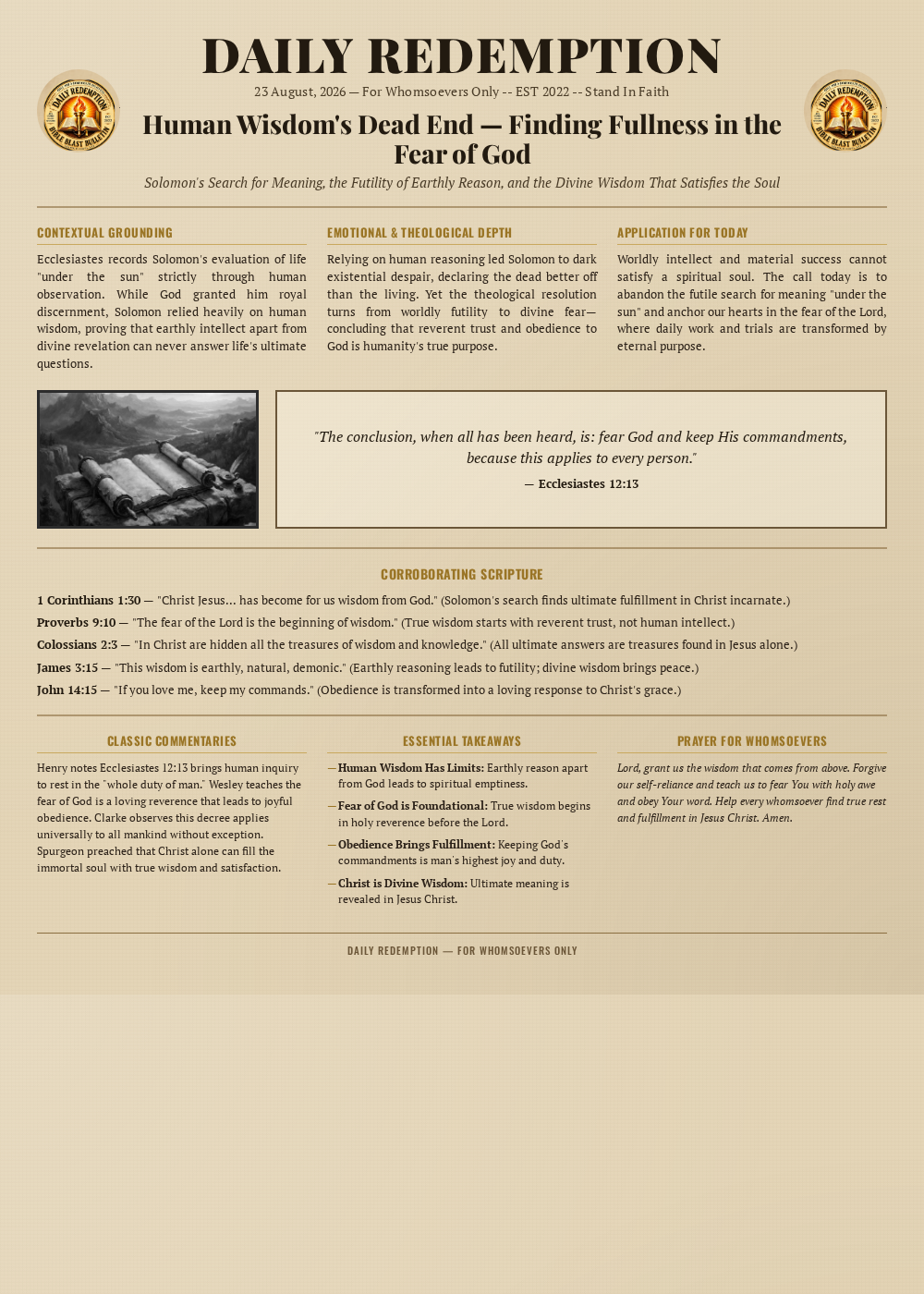
Living life apart from God is an exercise in utter futility, no matter how much human wisdom, wealth, or status one accumulates. King Solomon searched the depths of earthly reason only to find that human wisdom leads to despair and dead ends. True fulfillment is found not under the sun by human intellect, but in surrendering to God—fearing Him and keeping His commandments. Divine wisdom alone satisfies the restless human heart and gives eternal purpose to our daily existence.
Section I — Scripture Passage
Primary Scripture: Ecclesiastes 12:13 — “The conclusion, when all has been heard, is: fear God and keep His commandments, because this applies to every person.”
Supporting Scriptures:
James 3:15 — “This wisdom is not that which comes down from above, but is earthly, natural, demonic.”
Proverbs 3:13-14 — “How blessed is the man who finds wisdom and the man who gains understanding. For her profit is better than the profit of silver and her gain better than fine gold.”
Ecclesiastes 1:16 — “I said to myself, ‘Behold, I have magnified and increased wisdom more than all who were over Jerusalem before me; and my mind has observed a wealth of wisdom and knowledge.'”
Ecclesiastes 4:2-3 — “So I congratulated the dead who are already dead more than the living who are still living. But better off than both of them is the one who has never existed.”
Section II — Historical-Redemptive Analysis
Contextual Grounding
Ecclesiastes stands as one of the most unique and provocative books in Old Testament wisdom literature. Authored by King Solomon—the wealthiest and wisest earthly monarch of his era—the book records a searching philosophical experiment. Solomon sought to evaluate life “under the sun” strictly through the lens of human observation, empirical reason, and worldly wisdom. While God had granted Solomon extraordinary administrative discernment to rule Israel, Solomon spent a large portion of his life relying on human wisdom rather than divine revelation. The book of Ecclesiastes reflects this candid, honest exploration of human experience, demonstrating that human wisdom, detached from God, can never solve the ultimate mysteries of existence or satisfy the human soul.
Emotional & Theological Depth
The emotional arc of Ecclesiastes moves from disillusionment to reverent trust. Relying purely on earthly reasoning, Solomon reached a dark, existential dead end, declaring in Ecclesiastes 4:2-3 that the dead were better off than the living, and that those never born were better off still. This profound cynicism represents the logical terminus of worldly philosophy—what James 3:15 describes as “earthly, natural, demonic” wisdom. Without God, human life is reduced to meaningless repetition, frustration, and eventual despair. Yet, the theological resolution arrives at the climax of the book. Solomon turns from human speculation to divine revelation, concluding that reverent fear of God and obedience to His commandments is the whole duty and true fulfillment of humanity.
Application For Today
In a modern culture obsessed with self-actualization, academic achievements, career status, and material success, Ecclesiastes serves as a stark warning. You can possess all the human intellect, wealth, and acclaim the world offers and still end up spiritually bankrupt and emotionally desolate. Human wisdom promises satisfaction but delivers futility. The call for believers today is to abandon the futile search for meaning “under the sun” and anchor their hearts in the fear of the Lord. When we reorient our lives around God’s Word and bow in reverent obedience, our daily work, relationships, and trials are transformed with eternal purpose and lasting joy.
Section III — Core Commentary
Living life apart from God is futile.
The Book of Ecclesiastes is greatly misunderstood. It is a difficult book to read simply because it is hard to understand. Everything in it appears wrong and as if it doesn’t fit with the rest of Scripture. But it is part of the Old Testament wisdom literature because it is a statement of human wisdom. Ecclesiastes tells us how man perceives his world, God, and the realities of life.
Most scholars believe Ecclesiastes was penned by Solomon. They debate whether he wrote it before he was a true believer or after. He may have written it in retrospect, or he may have penned it sometime before he had a full understanding of the life-changing truth of God.
Ecclesiastes is a fascinating book because it reveals the folly, uselessness, senselessness, and frustration of human wisdom—that which James calls “earthly, natural, demonic” (James 3:15). In Ecclesiastes 1:16 Solomon says to himself, “Behold, I have magnified and increased wisdom more than all who were over Jerusalem before me.” That verse shows us that when God initially gave Solomon wisdom, He gave it to him on a human level. He gave Solomon wisdom to make successful decisions and judgments as king. But although divine wisdom was available to him, Solomon opted for human wisdom the greater portion of his life. And that wisdom was never able to answer his ultimate questions.
The sum of Solomon’s perspective on human wisdom is in Ecclesiastes 4:2-3: “I congratulated the dead who are already dead more than the living who are still living. But better off than both of them is the one who has never existed.” That’s a death wish and is the logical end of worldly wisdom—futility.
Fortunately, Solomon did eventually embrace true wisdom. At the end of his book, he said, “The conclusion, when all has been heard, is: fear God and keep His commandments, because this applies to every person” (Ecclesiastes 12:13). What then can satisfy your heart and make life worth living? The wisdom of God alone.
Section IV — Classic Commentaries Corner
Matthew Henry notes that the conclusion in Ecclesiastes 12:13 brings all human inquiries to their proper resting place. Henry emphasizes that fearing God and keeping His commandments is the “whole duty of man”—the total purpose for which human beings were created. He remarks that while human learning and worldly philosophy breed perplexity and weariness, true religion brings clarity, peace, and eternal order to the soul.
John Wesley teaches that the fear of God spoken of by Solomon is not a paralyzing terror, but a loving, holy reverence that leads to joyful obedience. Wesley highlights that God’s commandments are not burdensome constraints but merciful guardrails designed for human flourishing. He insists that this holy fear is offered freely to every soul who will seek God, providing a divine cure for the vanity and emptiness of worldly pursuits.
Adam Clarke observes that Solomon’s ultimate decree applies universally to all mankind without exception. Clarke writes that whether a person is rich or poor, learned or unlearned, the fundamental obligation and supreme happiness of human life consist in honoring God and obeying His revealed will. He notes that earthly wisdom reaches its limit at the grave, whereas divine wisdom prepares the soul for eternity.
Charles Spurgeon preached that Ecclesiastes shows the utter bankruptcy of the world to satisfy an immortal soul. Spurgeon declared, “You may fill your chests with gold and your heads with knowledge, but until you possess the fear of God, you are empty.” He urged every hearer to turn from the phantom promises of earthly wisdom and embrace Christ, in whom are hidden all the treasures of wisdom and true satisfaction.
Section V — Corroborating Scripture & Christological Connections
1 Corinthians 1:30 — “It is because of him that you are in Christ Jesus, who has become for us wisdom from God—that is, our righteousness, holiness and redemption.” (Solomon’s search for ultimate wisdom finds its personal fulfillment in Jesus Christ, who is God’s wisdom incarnate.)
Colossians 2:2-3 — “In order that they may know the mystery of God, namely, Christ, in whom are hidden all the treasures of wisdom and knowledge.” (Human wisdom is finite and frustrating, but all ultimate answers and spiritual treasures are found in Christ alone.)
Proverbs 9:10 — “The fear of the Lord is the beginning of wisdom, and knowledge of the Holy One is understanding.” (True wisdom does not originate in human intellect or earthly observation, but in a heart bowed in reverent awe before the Creator.)
Matthew 12:42 — “The Queen of the South will rise at the judgment with this generation and condemn it; for she came from the ends of the earth to listen to Solomon’s wisdom, and now something greater than Solomon is here.” (Solomon pointed to the limits of human wisdom, but Christ came as the Greater Solomon to bestow eternal salvation upon all who believe.)
John 14:15 — “If you love me, keep my commands.” (The Old Covenant obligation of Ecclesiastes 12:13 is transformed in the New Covenant into a joyful, loving response to the redeeming grace of Jesus.)
Section VI — Additional Corroborating Scripture
Psalm 111:10 — “The fear of the Lord is the beginning of wisdom; all who follow his precepts have good understanding. To him belongs eternal praise.” (Obedience to God’s precepts yields lasting understanding that worldly philosophy can never supply.)
Ecclesiastes 2:26 — “To the person who pleases him, God gives wisdom, knowledge and happiness, but to the sinner he gives the task of gathering and storing up wealth to hand it over to the one who pleases God.” (True joy and divine wisdom are gracious gifts bestowed upon those who walk in fellowship with God.)
Proverbs 3:13-15 — “Blessed are those who find wisdom, those who gain understanding, for she is more profitable than silver and yields better returns than gold. She is more precious than rubies; nothing you desire can compare with her.” (Divine wisdom far surpasses all earthly riches, status, and human acclaim.)
Psalm 19:7-8 — “The law of the Lord is perfect, refreshing the soul. The statutes of the Lord are trustworthy, making wise the simple. The precepts of the Lord are right, giving joy to the heart.” (God’s commandments do not restrict life; they enlighten, refresh, and satisfy the soul.)
Section VII — Essential Takeaways
— Human Wisdom Has Limits: Relying purely on earthly reason apart from divine revelation leads to existential frustration and spiritual emptiness.
— The Fear of God is Foundational: True wisdom begins when we acknowledge God’s sovereignty and bow before Him in holy reverence and trust.
— Obedience Brings True Fulfillment: Keeping God’s commandments is not a legalistic burden, but the whole duty and highest joy of every human life.
— Christ is the Fullness of Wisdom: Solomon searched for answers under the sun, but ultimate meaning and eternal salvation are revealed in Jesus Christ.
— A Message for Whomsoevers: Divine wisdom and eternal life are freely offered to anyone who will turn from worldly futility and embrace God’s truth.
Section VIII — Prayer for Whomsoevers
Heavenly Father, we confess how easy it is to be enticed by the world’s wisdom and to seek satisfaction in things under the sun. Forgive us for times when we rely on our own intellect and strength rather than bowing in reverent fear before You. Grant us the wisdom that comes from above—pure, peaceable, and full of good fruits. Teach us to fear You with holy awe and to keep Your commandments with joyful hearts. Help every whomsoever reading this to turn from worldly futility, find rest in Jesus Christ, and walk in the fullness of Your divine wisdom every day of our lives. In Jesus’ precious name, Amen.
Daily Redemption — For Whomsoevers Only — Stand In Faith