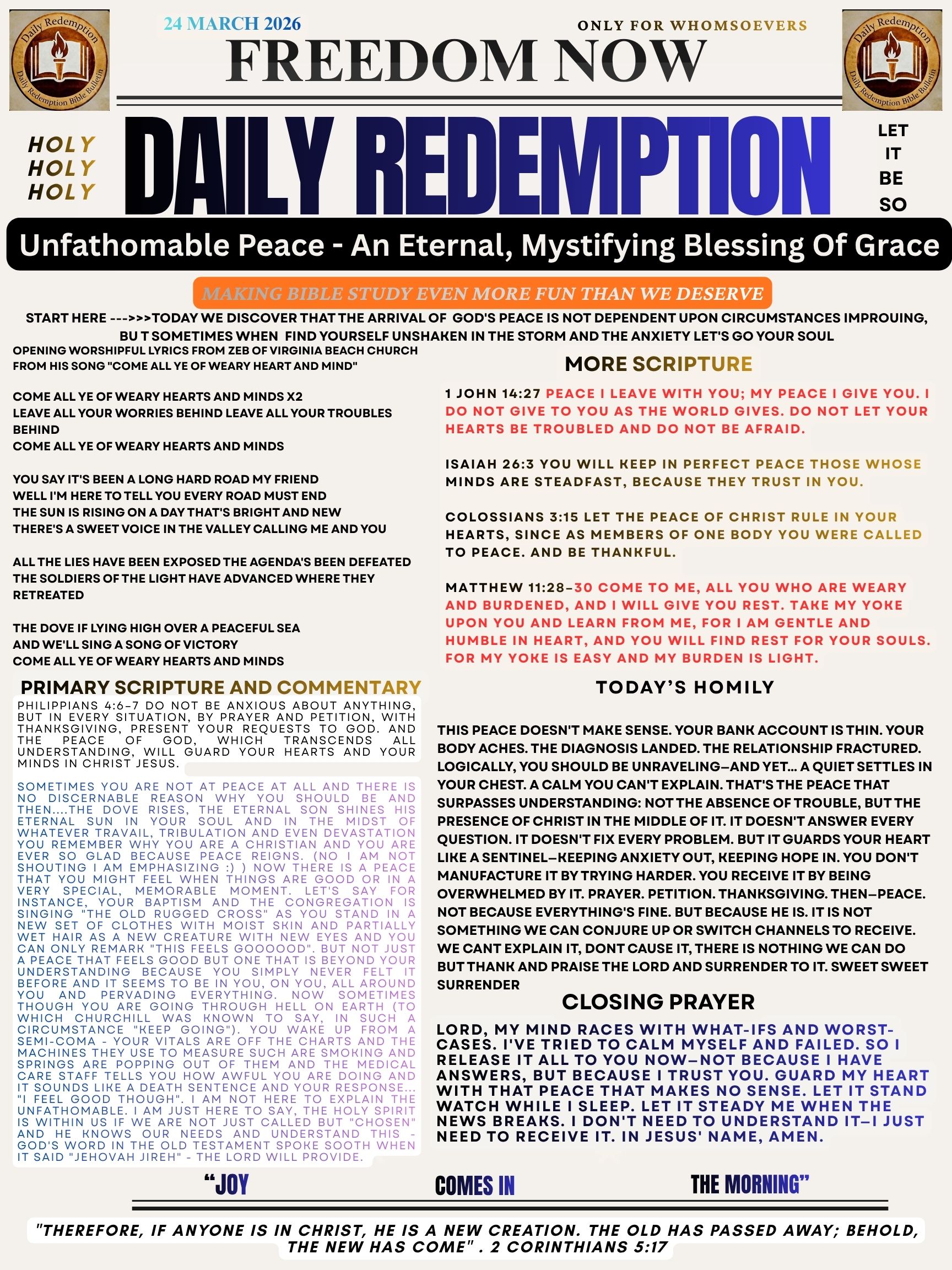
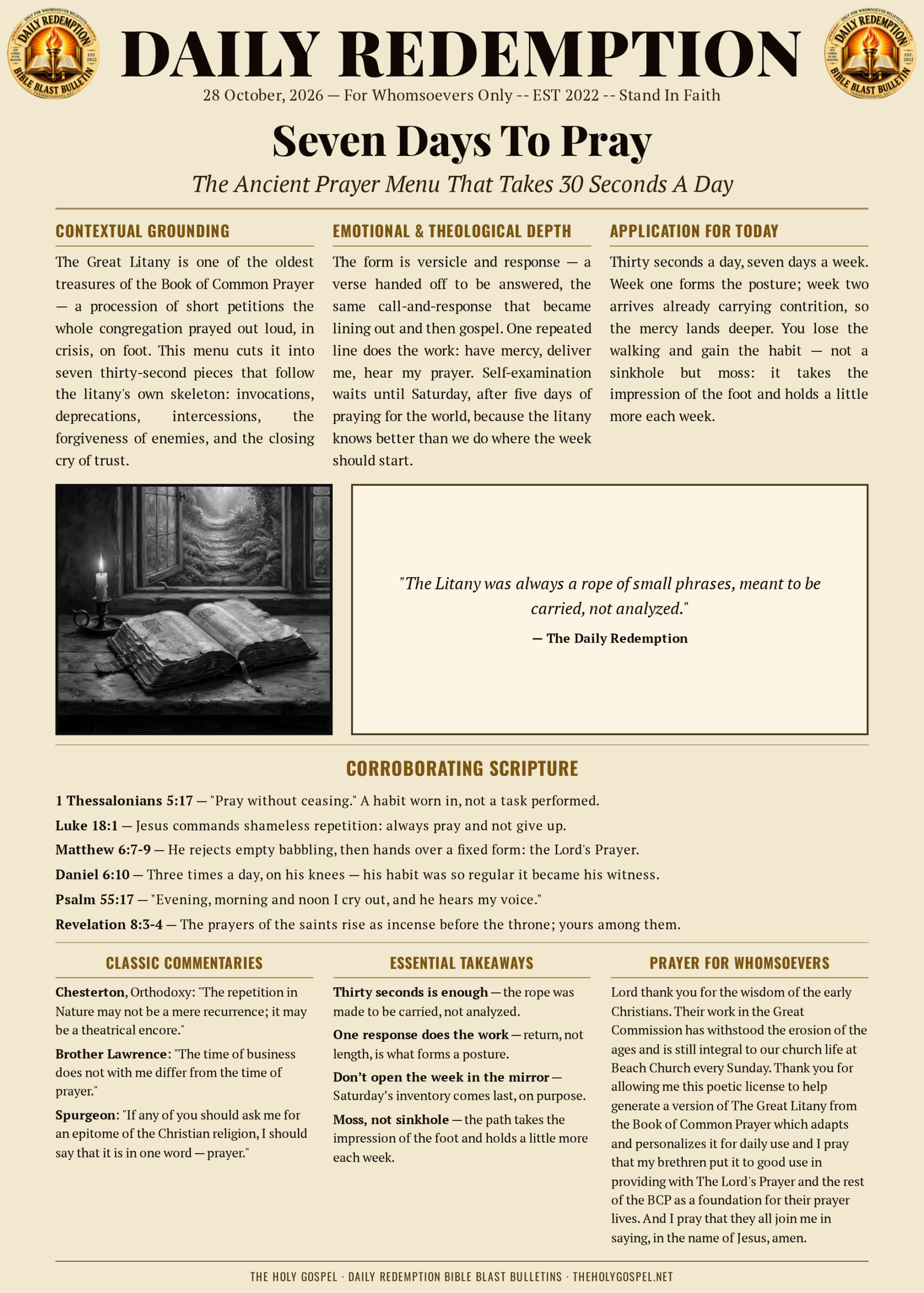
Seven Days To Pray: The Ancient Prayer Menu That Takes 30 Seconds A Day
The Great Litany has been prayed in procession for nearly five hundred years — one long rope of small phrases, carried by a whole congregation out loud. Cut into seven thirty-second pieces, it becomes a daily menu: stand before God on Monday, ask for deliverance Tuesday and Wednesday, turn toward the world Thursday and Friday, clear the slate Saturday, and end where the liturgy itself ends, in trust. One repeated response does all the work. The wisdom is in the order — self-examination arrives late, on purpose, after five days of praying for other people. Repetition isn’t redundancy; it’s how a posture gets into the bones.
A Gentle, Bite-Sized Guide To The Great Litany — Take Just 30 Seconds Each Day
Monday: The Grounding
Focus: Centering yourself in God’s presence at the start of the week.
O God the Father, Creator of heaven and earth;
⇒ Have mercy upon me.
O God the Son, Redeemer of the world;
⇒ Have mercy upon me.
O God the Holy Spirit, Sanctifier of the faithful;
⇒ Have mercy upon me.
Tuesday: Protection & Peace
Focus: Asking for defense against the subtle stresses of life.
From all blindness of heart; from pride, vanity, and hypocrisy; from envy, hatred, and malice; and from all lack of charity,
⇒ Good Lord, deliver me.
From all disordered and sinful affections; and from all the deceits of the world, the flesh, and the devil,
⇒ Good Lord, deliver me.
Wednesday: Strength in Hard Times
Focus: Handing over your anxieties and difficult moments.
In all times of my tribulation; in all times of my prosperity; in the hour of death, and in the day of judgment,
⇒ Good Lord, deliver me.
O Christ, hear me. Lord, have mercy upon me. Christ, have mercy upon me.
⇒ Lord, have mercy upon me.
Thursday: Praying for the World
Focus: Lifting up community leaders and global peace.
Guide and govern your holy Church throughout the world. Fill it with truth and peace, and grant it unity.
⇒ Lord, hear my prayer.
Bless and keep all who hold authority in the government of this and every nation. Direct them in the ways of justice, truth, and peace.
⇒ Lord, hear my prayer.
Friday: Healing for the Hurting
Focus: Standing in prayer for those going through dark times.
Help, comfort, and protect all who are in danger, necessity, and tribulation. Defend and provide for the fatherless, the widowed, the lonely, and the oppressed.
⇒ Lord, hear my prayer.
Heal and support the sick, the suffering, and the dying.
⇒ Lord, hear my prayer.
Saturday: Fresh Beginnings
Focus: Clearing the slate and asking for a refreshed heart.
Forgive my enemies, persecutors, and slanderers, and turn their hearts.
⇒ Lord, hear my prayer.
Grant me true repentance; forgive me all my sins, negligences, and ignorances; and endue me with the grace of your Holy Spirit to amend my life according to your holy Word.
⇒ Lord, hear my prayer.
Sunday: Rest & Trust
Focus: A brief, powerful cry of pure trust to finish the week.
With pity behold the sorrows of my heart; mercifully forgive the sins of your people.
⇒ With favor hear my prayers, O Son of David.
Let your mercy be shewed upon me;
⇒ As I do put my trust in you.
The Rhythm Of The Litany
It’s the Great Litany, from the Book of Common Prayer, cut into seven bite-size pieces. The sequence follows the litany’s actual skeleton almost exactly.
Monday is the opening invocations (Father, Son, Spirit, with their roles — Creator, Redeemer, Sanctifier — the gospel in three lines).
Tuesday and Wednesday are the old deprecations (“from all blindness of heart… from all deceits of the world, the flesh, and the devil”), split into inward habits and outward hardship.
Thursday and Friday are the intercessions — Church and rulers, then the sick, the widow, the oppressed.
Saturday is the litany’s hardest petition (“forgive my enemies, persecutors, and slanderers; turn their hearts”), which asks for their conversion, not their comeuppance.
Sunday is the litany’s actual closing versicle (a “versicle”? It is a beautiful word — not a verse on three wheels but it is the heart of the call back aspect in our Sunday morning liturgy at Beach Church and it is also the origin story of the call back in gospel music): “Let thy mercy be shewed (shown in contemporary English but my preference is read it as “showered”) upon us; As we do put our trust in thee” — we end on the BCP’s own last line, with only “Son of David” added to aim it at Messianic and to age it properly.
Two things make the rhythm work. First, the response changes with the posture: “have mercy upon me” while standing before God, “good Lord, deliver me” while in danger, “Lord, hear my prayer” once the week turns outward and stops being about your own safety. The pivot is Thursday — the voice goes from self to world, and self-examination deliberately arrives late (Saturday), after five days of praying for other people. That’s the litany’s wisdom: don’t open the week in the mirror. Second, one repeated response does all the work, which is why 30 seconds suffices — the Litany was always a rope of small phrases, meant to be carried, not analyzed. Then when you are in your second week you have already established contrition and humility. Repetition isn’t redundancy; it’s how a posture gets into the bones.
The honest trade: the original was prayed in procession, publicly, in crisis — a whole congregation walking and chanting. This version makes it private and gentle. You lose the walking, you gain the habit and it sinks in more and more every week. Not like a sink hole more like moss — it takes the impression of the foot, and each week it holds more; every week you walk that path it holds a little more water, thickens a little more, and grows back fuller right where the weight falls.
Classic Commentaries Corner
G.K. Chesterton, in Orthodoxy, on why a repeated act is not a dead one: “The repetition in Nature may not be a mere recurrence; it may be a theatrical encore.” Heaven may encore the bird who laid an egg — and heaven may encore a prayer said for the four hundredth Tuesday. What looks like a rut from the outside is delight from the inside.
Brother Lawrence, the seventeenth-century Carmelite cook who turned a kitchen into a chapel, on why thirty seconds in an ordinary life is enough: “The time of business does not with me differ from the time of prayer; and in the noise and clatter of my kitchen, while several persons are at the same time calling for different things, I possess God in as great tranquility as if I were upon my knees at the blessed sacrament.”
Charles Spurgeon, asked to name the whole of the Christian religion in a single word: “If any of you should ask me for an epitome of the Christian religion, I should say that it is in one word — prayer.” The Litany is simply that one word, spelled out across seven days in thirty-second pieces.
Corroborating Scripture & Christological Connections
1 Thessalonians 5:17 — “Pray without ceasing.” Paul does not mean never doing anything else; he means a habit so worn in that prayer keeps running under everything else.
Luke 18:1 — “Then Jesus told his disciples a parable to show them that they should always pray and not give up.” The point of the persistent widow is shameless repetition — Jesus commands it.
Matthew 6:7-9 — “And when you pray, do not keep on babbling like pagans, for they think they will be heard because of their many words… This, then, is how you should pray: Our Father in heaven…” Jesus condemns empty volume, then immediately hands over a fixed form to repeat — the Lord’s Prayer, the original liturgy.
Daniel 6:10 — “Three times a day he got down on his knees and prayed, giving thanks to his God, just as he had done before.” Daniel’s danger came because his habit was so regular the enemies knew where to aim. A scheduled prayer life is a witness before it is a discipline.
Psalm 55:17 — “Evening, morning and noon I cry out in distress, and he hears my voice.” The psalmist kept hours. Fixed times are not a lack of faith — they are faith with a calendar.
Revelation 8:3-4 — the prayers of all the saints rise as incense before the throne. Every thirty-second prayer said in a kitchen joins the same rising smoke that reaches the altar in heaven.
Essential Takeaways
Thirty Seconds Is Enough: The Litany was always a rope of small phrases, meant to be carried, not analyzed. Length was never the point; return is.
One Response Does The Work: The same line, said a thousand times, finally answers itself — have mercy, deliver me, hear my prayer, in that order, and the posture learns itself.
Don’t Open The Week In The Mirror: Self-examination arrives Saturday, after five days of praying for other people. The litany puts the world before your own inventory on purpose.
Repetition Isn’t Redundancy: Week one forms the posture, week two deepens it — and each Saturday lands heavier than the last, because you bring fresh failure to a familiar mercy.
Moss, Not Sinkhole: You lose the walking, you gain the habit. Not a cave-in but a path that takes the impression of the foot, holding a little more each week, growing back fuller right where the weight falls.
Prayer For Whomsoevers
Lord thank you for the wisdom of the early Christians. Their work in the Great Commission has withstood the erosion of the ages and is still integral to our church life at Beach Church every Sunday. Thank you for allowing me this poetic license to help generate a version of The Great Litany from the Book of Common Prayer which adapts and personalizes it for daily use and I pray that my brethren put it to good use in providing with The Lord’s Prayer and the rest of the BCP as a foundation for their prayer lives. And I pray that they all join me in saying, in the name of Jesus, amen.