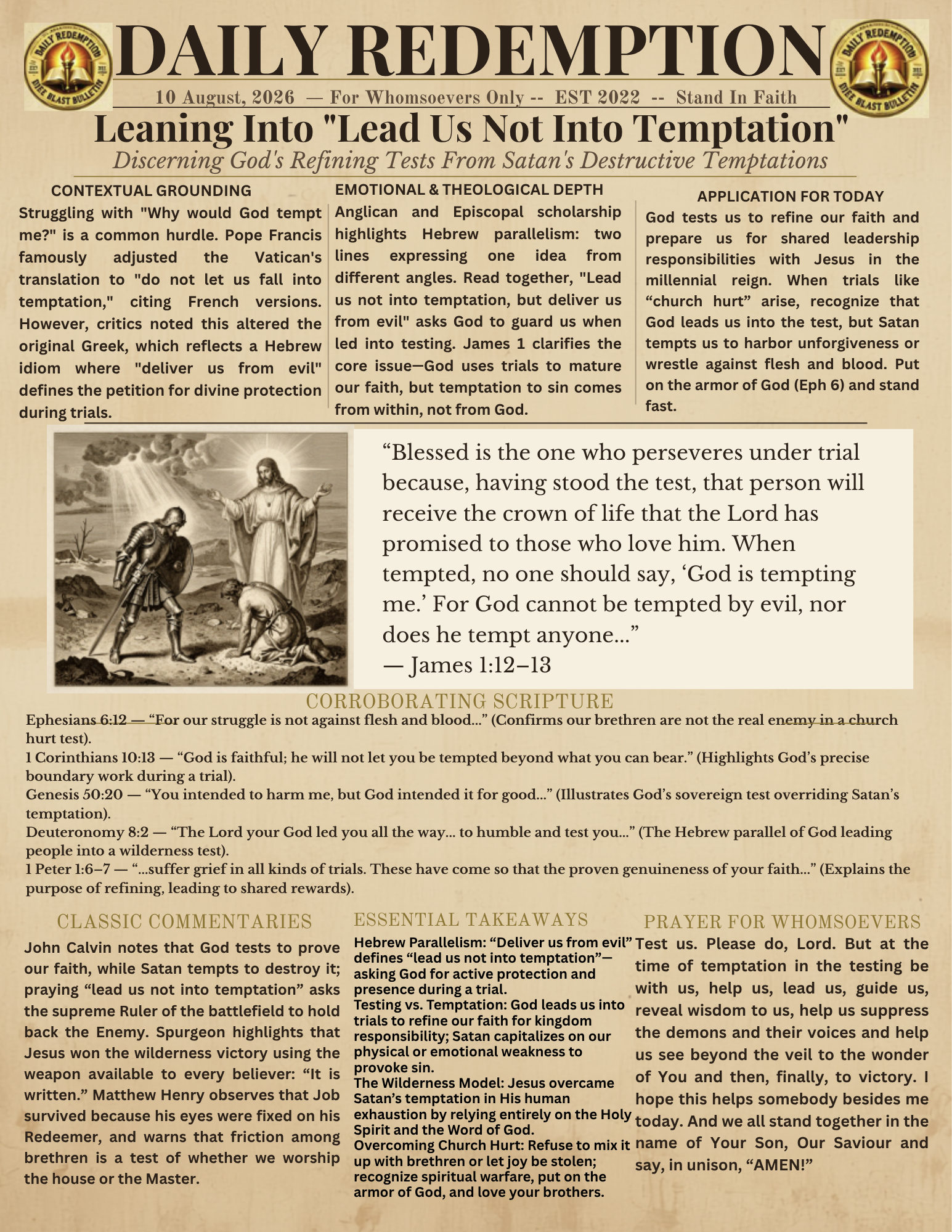
Leaning Into “Lead Us Not Into Temptation”
My original exposition:
Don’t feel alone if you have struggled with understanding this one. Why would God ever tempt me? Isn’t that what the other guy does?
Well don’t feel alone because even Pope Francis struggled with this. Of course, Pope Francis and all Popes have the unfortunate position of being Roman Catholic and they get a lot of things wrong… a lot… worshipping of saints, considering the Virgin Mary the intercessor between us and God because, after all, Mary had substance – soft, warm, feminine even virginal and Jesus is intimidating right? Well, no to all of the above. However the point that it resonated with many people when he decided to change the official adaptation of the Vatican to “do not let us fall into temptation” and that he justified the stance by pointing out that other languages such as French had already done such a translation. Those who stood with the original more commonly recognized Engish translation as in the subject line above did not praise the “clarification” citing that the original Greek reflected a Hebrew idiom.
So let us dig into what it might mean if understood correctly and NOT altered from the Greek. And while I had already come to this understanding recently myself I just did a quick research on what different denominations interpret it to mean. As it turns out, and I am so happy to say, the Anglicans have it right. I attend Beach Church in Virginia Beach and we are Anglican so I am quite pleased and admiring of the discernment and Biblical understanding of the church leadership.
Hebrew Parallelism: Anglican and Episcopal scholars frequently teach that the phrase should be read as a single, combined petition with the next line: “Lead us not into temptation, but deliver us from evil”. In ancient Hebrew poetry, two lines often express a single idea from different angles. Therefore, “deliver us from evil” defines exactly what “lead us not into temptation” means—asking God for protection from the enemy during a trial.
God does test us! God does put us through trials. How else would he know who gets what rewards and responsibilities in Heaven? Oh yes, during the millennial reign Jesus will have responsibilities of leadership in the new Jerusalem, the new Earth but we will share responsibilities with Him. Let us turn to James for clarification on the core issue here.
1. Affirming that God tests us (James 1:12)”Blessed is the one who perseveres under trial because, having stood the test, that person will receive the crown of life that the Lord has promised to those who love him.”
2. Refuting that God tempts us (James 1:13)”When tempted, no one should say, ‘God is tempting me.’ For God cannot be tempted by evil, nor does he tempt anyone…”These verses (James 1:12-14) clarify that while God uses trials to test and mature faith, temptation to sin originates from within an individual, not from God
Now let us look at the clearest, greatest, most epic example of how this all played out in the Bible.
God’s Test: The Holy Spirit actively leads Jesus into the desert to fast and prove His reliance on God’s Word before starting His ministry.
The Devil’s Temptation: Satan capitalizes on Jesus’ physical hunger, enticing Him to abuse His power and worship him.
The “Emmanuel” Victory: As God incarnate, Jesus overcomes the enemy using Scripture, remaining “God with us” in the lowest human suffering.
You see? God tested us. The testing weakened but did not break Jesus (of course) but it did make him subsceptible to Satan’s temptation but “Emmanuel” – God with us – the Holy Spirit with us. Certainly Jesus is, always has been and always will be God but at this time of testing and temptation his 100% human self was in a highly weakened state. Satan tried to take advantage of that. He lost. He always does, ultimately.
What else demonstrates the point in the Bible? How about Job?
God’s Test: God points out Job’s righteousness and allows his hedge of protection to be lifted to prove the sincerity of Job’s faith.
The Devil’s Temptation: Satan destroys Job’s wealth, children, and health to entice Job to curse God and die.
The “Emmanuel” Victory: Job refuses to sin, declaring, “I know that my Redeemer lives”—foreshadowing God’s eventual presence standing with him in the dust to restore him.
So how may this play out in our lives? Let us say that we have some kind of church hurt situation going on. I love church hurt – receiving, not inflicting. It let’s me know the Lord knows that I am a big boy and I can suck it up and that He has bigger plans for me. It wasn’t always that way but after many failed tests I finally understood it as a blessing. But do we always remember what Paul says in Eph 6:10-14 about who the ones we wrestle with are not flesh and blood or do we mix it up with our brethren because that hurt needs to go somewhere and justice must be done? (yes it must be but not by us).
So we get tested with church hurt. We are led by God into the test. Satan seeks to provoke us with various mechanics of spiritual warfare to struggle and wrestle with our brothers, maybe leave the church (God forbid!), maybe just harbor unforgivenesses. He tempts us to act towards our brothers in a way that makes matters worse allowing Satan to drive a wedge and not making the situation at all better. Emmanuel! God with us! We read Ephesians, we understand that the fundamental error was putting ourselves in a situation where our joy can be taken away, our contributions curtailed, controversy to exist and we remember that it was and is God that we are there to worship not our fellows. We are there to love them. AND JESUS NEVER SAID THAT THIS WOULD BE EASY. So the question is do we grow in the Lord or do we keep falling for the temptation? “Lead us not into temptation but deliver us from evil”.
Prayer for Whomsoevers: Test us. Please do, Lord. But at the time of temptation in the testing be with us, help us, lead us, guide us, reveal wisdom to us, help us suppress the demons and their voices and help us see beyond the veil to the wonder of You and then, finally, to victory. I hope this helps somebody besides me today. And we all stand together in the name of Your Son, Our Saviour and say, in unison, “AMEN!”
The AI Reformatting:
LEANING INTO “LEAD US NOT INTO TEMPTATION”
DAILY REDEMPTION MODULE
I. SCRIPTURE PASSAGE
“And lead us not into temptation, but deliver us from evil…”
“Blessed is the one who perseveres under trial because, having stood the test, that person will receive the crown of life that the Lord has promised to those who love him. When tempted, no one should say, ‘God is tempting me.’ For God cannot be tempted by evil, nor does he tempt anyone…”
II. HISTORICAL-REDEMPTIVE ANALYSIS
- Contextual Grounding: Don’t feel alone if you have struggled with understanding this one. Why would God ever tempt me? Isn’t that what the other guy does? Well don’t feel alone because even Pope Francis struggled with this. Of course, Pope Francis and all Popes have the unfortunate position of being Roman Catholic and they get a lot of things wrong… a lot… worshipping of saints, considering the Virgin Mary the intercessor between us and God because, after all, Mary had substance – soft, warm, feminine even virginal and Jesus is intimidating right? Well, no to all of the above. However the point that it resonated with many people when he decided to change the official adaptation of the Vatican to “do not let us fall into temptation” and that he justified the stance by pointing out that other languages such as French had already done such a translation. Those who stood with the original more commonly recognized Engish translation as in the subject line above did not praise the “clarification” citing that the original Greek reflected a Hebrew idiom.
- Emotional & Theological Depth: So let us dig into what it might mean if understood correctly and NOT altered from the Greek. And while I had already come to this understanding recently myself I just did a quick research on what different denominations interpret it to mean. As it turns out, and I am so happy to say, the Anglicans have it right. I attend Beach Church in Virginia Beach and we are Anglican so I am quite pleased and admiring of the discernment and Biblical understanding of the church leadership.
- Hebrew Parallelism: Anglican and Episcopal scholars frequently teach that the phrase should be read as a single, combined petition with the next line: “Lead us not into temptation, but deliver us from evil”. In ancient Hebrew poetry, two lines often express a single idea from different angles. Therefore, “deliver us from evil” defines exactly what “lead us not into temptation” means—asking God for protection from the enemy during a trial.
- Application: God does test us! God does put us through trials. How else would he know who gets what rewards and responsibilities in Heaven? Oh yes, during the millennial reign Jesus will have responsibilities of leadership in the new Jerusalem, the new Earth but we will share responsibilities with Him. Let us turn to James for clarification on the core issue here.
III. CORE COMMENTARY
The Core Distinction: Testing vs. Temptation (James 1:12-13)
- Affirming that God tests us (James 1:12) “Blessed is the one who perseveres under trial because, having stood the test, that person will receive the crown of life that the Lord has promised to those who love him.”
- Refuting that God tempts us (James 1:13) “When tempted, no one should say, ‘God is tempting me.’ For God cannot be tempted by evil, nor does he tempt anyone…”
- [CLASSIC COMMENTARY]: John Calvin (Institutes) aligns perfectly with this grammatical and Hebrew structural reality: “There is a great difference between being tested by God and being tempted by Satan. God tests to search, prove, and map out the reality of our faith. Satan tempts to destroy, ruin, and subvert. When we pray ‘lead us not into temptation,’ we are recognizing that God is the supreme ruler of the battlefield. We are begging the Father that when He leads us into a territory of testing, He will simultaneously hold back the Enemy so that our human weakness does not collapse under Satan’s traps.”
Model 1: The Wilderness Blueprint (Matthew 4:1-11)
- God’s Test: The Holy Spirit actively leads Jesus into the desert to fast and prove His reliance on God’s Word before starting His ministry.
- The Devil’s Temptation: Satan capitalizes on Jesus’ physical hunger, enticing Him to abuse His power and worship him.
- The “Emmanuel” Victory: As God incarnate, Jesus overcomes the enemy using Scripture, remaining “God with us” in the lowest human suffering.
- [CLASSIC COMMENTARY]: Charles Spurgeon (Treasury of the New Testament) notes the divine setup: “Mark the order of the narrative! The Spirit led Jesus into the wilderness to be tested. The test was divine design; the temptation was satanic malice. Christ’s physical frame was brought low to demonstrate that the Word of God is our only true substance. Emmanuel wins the victory not by brandishing cosmic lightning, but by using the exact same weapon available to every ordinary believer: ‘It is written.'”
Model 2: The Cosmic Hedge (Job 1-2; 19:25)
- God’s Test: God points out Job’s righteousness and allows his hedge of protection to be lifted to prove the sincerity of Job’s faith.
- The Devil’s Temptation: Satan destroys Job’s wealth, children, and health to entice Job to curse God and die.
- The “Emmanuel” Victory: Job refuses to sin, declaring, “I know that my Redeemer lives”—foreshadowing God’s eventual presence standing with him in the dust to restore him.
- [CLASSIC COMMENTARY]: Matthew Henry exposes the boundary lines of the trial: “Satan could not touch a single sheep belonging to Job until God granted permission. God’s design was to showcase a faith that could not be bought; Satan’s design was to provoke a curse. Job survives the trauma because his eyes are fixed beyond his temporary circumstances—he sees his Redeemer standing at the end of the story to vindicate him.”
Model 3: The Sanctuary Test (Church Hurt & Ephesians 6)
- [CLASSIC COMMENTARY]: Matthew Henry warns on internal division: “The deadliest arrows of the Enemy are those shot from inside the camp. When friction occurs among the brethren, God is testing our foundation to see if we worship the house or the Master of the house. Satan instantly capitalizes on the emotional pain, tempting us to seek personal vengeance or harbor bitter malice. True victory means putting on the whole armor of God, letting justice stay in God’s hands, and choosing to love the difficult brethren because Christ loved us when we were His enemies.”
IV. THE STRUCTURAL ALIGNMENT MATRIX
| Scene | God’s Test (Refinement) | Satan’s Temptation (Enticement) | The “Emmanuel” Victory | ||||||||||||||||||||||||||||||||||||||||||||||||||||||||||||
|---|---|---|---|---|---|---|---|---|---|---|---|---|---|---|---|---|---|---|---|---|---|---|---|---|---|---|---|---|---|---|---|---|---|---|---|---|---|---|---|---|---|---|---|---|---|---|---|---|---|---|---|---|---|---|---|---|---|---|---|---|---|---|---|
| Jesus in the Wilderness | Spirit leads Him into the desert to fast and establish His total reliance on the Word. | Satan targets His physical weakness to incite self-reliance and the abuse of power. | Victorious through Scripture; relies entirely on the Holy Spirit. | ||||||||||||||||||||||||||||||||||||||||||||||||||||||||||||
| Satan strips away family, wealth, and health to provoke Job into cursing God. | Refuses to sin; holds fast to the Redeemer standing with him in the dust. | ||||||||||||||||||||||||||||||||||||||||||||||||||||||||||||||
| Satan utilizes the emotional pain to tempt us toward unforgiveness, division, or retreat. | Refuses to wrestle against flesh and blood; puts on the armor of God (Eph 6) to love anyway. |
V. CORROBORATING SCRIPTURE & CHRISTOLOGICAL CONNECTIONS
- Ephesians 6:12 — “For our struggle is not against flesh and blood…” (Confirms our brethren are not the real enemy in a church hurt test).
- 1 Corinthians 10:13 — “God is faithful; he will not let you be tempted beyond what you can bear.” (Highlights God’s precise boundary work during a trial).
- Genesis 50:20 — “You intended to harm me, but God intended it for good…” (Illustrates God’s sovereign test overriding Satan’s temptation).
- Deuteronomy 8:2 — “The Lord your God led you all the way… to humble and test you…” (The Hebrew parallel of God leading people into a wilderness test).
- 1 Peter 1:6–7 — “…suffer grief in all kinds of trials. These have come so that the proven genuineness of your faith…” (Explains the purpose of refining, leading to shared rewards).