I. SCRIPTURE PASSAGE
Isaiah 43:1–3, 11, 14, 18–19, 22, 25; 44:1–6, 9–10, 15, 17, 21–23; 45:9–12, 22–25
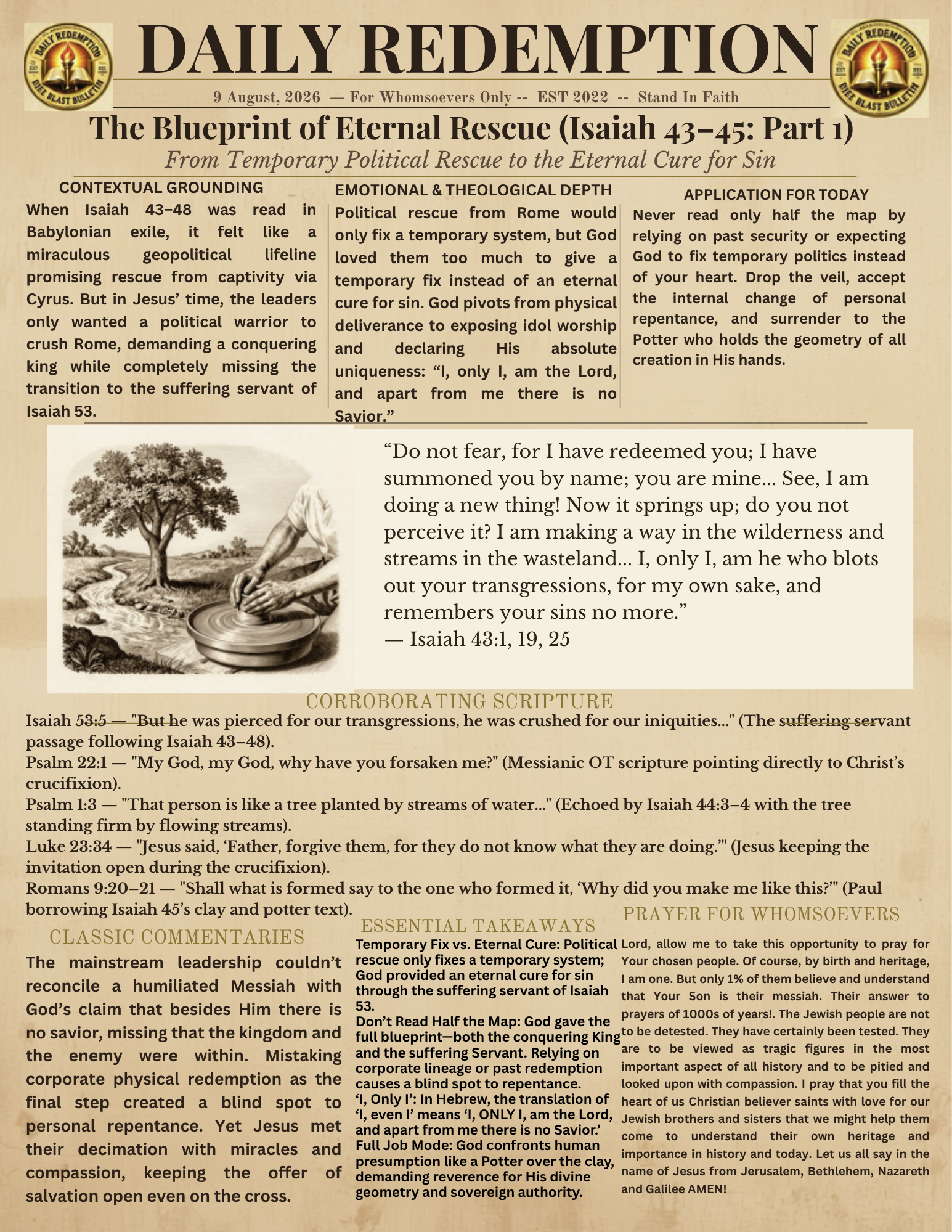
But now, this is what the Lord says—he who created you, Jacob, he who formed you, Israel: “Do not fear, for I have redeemed you; I have summoned you by name; you are mine. When you pass through the waters, I will be with you; and when you pass through the rivers, they will not sweep over you. When you walk through the fire, you will not be burned; the flames will not set you ablaze. For I am the Lord your God, the Holy One of Israel, your Savior…”“I, even I, am the Lord, and apart from me there is no savior…”“Forget the former things; do not dwell on the past. See, I am doing a new thing! Now it springs up; do you not perceive it? I am making a way in the wilderness and streams in the wasteland…”“I, even I, am he who blots out your transgressions, for my own sake, and remembers your sins no more…”“Woe to those who quarrel with their Maker, those who are nothing but potsherds among the potsherds on the ground. Does the clay say to the potter, ‘What are you making?’…”
II. HISTORICAL-REDEMPTIVE ANALYSIS
- Contextual Grounding: When Isaiah 43–48 was read by Jews in the Babylon exile, they were crushed, defeated people living in captivity. When God promised to smash Babylon, bring them home, and use Cyrus to rebuild Jerusalem, it felt like a miraculous geopolitical lifeline to the Jewish people. In Isaiah 43–48, salvation meant physical rescue from Babylon.
- Emotional & Theological Depth: By Jesus’ time, the Jews only wanted a political warrior to crush their new, oppressive Rome—a false security. They believed they needed a king to fix their politics, not a savior to fix their sins. They demanded a conquering king like Cyrus, and completely missed the transition to the suffering servant of Isaiah 53.
- Application: They wanted an immediate political rescue, so they completely missed the eternal, spiritual savior. Political rescue from Rome would only fix a temporary system. God loved them too much to give them a temporary fix, instead of an eternal cure for sin.
III. CORE COMMENTARY
Thematic Introduction
This encompasses the video for today, Sunday, and tomorrow, Monday. These sections come just prior to the most Messianic passages in the Old Testament, notably Isaiah 53—”He was pierced for our transgressions, crushed for our iniquities,” and so forth. And they themselves are as encouraging and reassuring as any consistent passage in the Old Testament.
It seems that the Jewish people had gotten stuck in this, and they never moved on to accepting Jesus as the Messiah, which is covered in detail hundreds of years before in Isaiah 53 and thereabouts. So let’s get into them, and I’ll treat today’s and tomorrow’s commentaries pretty much as Part 1 and Part 2, because they are one block thematically.
When Isaiah transitioned from talking about a political rescue to a servant who would be pierced for our transgressions and crushed for our iniquities, the mainstream Jewish leadership struggled to apply that to the Messiah. The disconnect being that when Jesus arrived as a humble teacher, telling people to love their enemies, the Romans, rather than destroy them, and ended up crucified, it looked like a total failure to them. A misunderstanding. They could not reconcile a humiliated, apparently dying Messiah with the powerful God who claimed in Isaiah 43, “I am the Lord, and besides me there is no savior.”
The last thing they were ready to accept was being told that the kingdom of God was within them, after they had failed miserably against the Babylonians, but that so was the enemy and the source of all of their problems. They just didn’t want to hear it. Their sin nature, our sin nature, and all that we have to do is to surrender after they had been all but annihilated. Note, I am not putting this forth as accurate theology, but as a partial explanation as to why 99% of Bible-reading Jews stop in the middle of the story and still reject Christ Jesus as their Messiah, when they could simply drop that, open the veil which is still before them, and accept salvation.
So how does this section read? Actually, this which the Lord is saying is true for those who accepted his Son as Lord and Savior and did not have the Jewish veil to drop or to see through or to rip from the top to the bottom.
Isaiah 43:11, 22, 25
“I, even I, am the Lord, and apart from me there is no savior…”
“Yet you have not called on me, Jacob. You have not wearied yourselves for me, Israel. But you have burdened me with your sins and wearied me with your offenses…”
“I, even I, am he who blots out your transgressions, for my own sake, and remembers your sins no more…”
- Now by the way, when you see a word and it just doesn’t seem to fit—why would God be saying, “I, even I”? Look it up in the Hebrew. What does he mean, “I, even I, am the Lord”? It means “only.” The translation is wrong. “I, only I, am the Lord, and apart from me there is no Savior.” Doesn’t that sound better?
- We’ll talk more about how Isaiah, especially this section, 43–48, pivots back and forth. “I, only I, am He who blots out your transgressions for my own sake and remembers your sins no more.”
- [CLASSIC COMMENTARY]: Charles Spurgeon (Treasury of the Old Testament) on “for my own sake” marvels at this divine pivot: “God finds the motive for mercy not in the sinner, but entirely within Himself. He does not say, ‘I blot out your sins because you have repented or wearied yourself for Me,’ for Israel had done the opposite. He blots them out for His own glory, proving that grace is absolutely unconditional and sovereign.”
Isaiah 44:3–4
“For I will pour water on the thirsty land and streams on the dry ground; I will pour out my Spirit on your offspring, and my blessing on your descendants. They will spring up like grass in a meadow, like poplar trees by flowing streams.”
- Echoic of Psalm 1, right? The tree by the water. Remember that? By the forked road and there’s the water going by. And the tree that’s just standing there in its faith. It’s not going to move.
- And this reminds me of a truism. God created man in his own image, and man has ever since been trying to return the favor. So, who then is like me? Let him proclaim it.
- [CLASSIC COMMENTARY]: Matthew Henry connects the water to the Spirit: “The thirsty land is the human soul parched by the curse of sin. When God pours out His Spirit, it is not a mere trickle but ‘floods upon the dry ground.’ It turns a desert of legalism into a meadow of grace, making believers stand firm like trees planted by the rivers of water.”
Isaiah 44:9, 15, 17
“All who make idols are nothing, and the things they treasure are worthless… It is man’s fuel for burning; some of it he takes and warms himself, he kindles a fire and bakes bread. But he also fashions a god and worships it… He bows down to it in worship. He prays to it and says, ‘Save me, you are my God.’”
- Here now God leans in on idolaters and their stone and copper and wooden idols. I always thought that the idol was a representation of this other god, Baal, whoever that was on the spiritual side, being represented by this thing. But that’s not what God’s saying here. He says they’re actually worshiping the wood and the copper and the stone that they used for other things. He bows down to it in worship. He prays to it and says, “Save me, you are my God.” I mean, it’s crazy.
- [CLASSIC COMMENTARY]: John Calvin on the madness of idolatry notes: “Isaiah exposes the blind infatuation of the human mind. A man takes a single block of wood; half of it he throws into the furnace to cook his meat, and the other half he calls his savior. It shows that when man drops God, his intellect becomes so darkened that he expects eternal deliverance from the very material he burns as refuse.”
Isaiah 44:21–22
“Remember these things, Jacob, for you are my servant, Israel… I have swept away your offenses like a cloud, your sins like the morning mist. Return to me, for I have redeemed you.”
- And then, towards the end of 44, we have this massive paradox. The confusion is that Isaiah 44 speaks in past tense—”I have redeemed you”—meaning God had already cleared their legal record and paid their debt to bring them home from Babylon. The conflict is that when Jesus arrived centuries later, commanding them to repent for the kingdom of heaven is at hand, it offended their security, the blind spot. They assumed Isaiah’s corporate physical redemption was all they ever needed. They did not realize that Isaiah’s prophecy pointed to reality, that Jesus was now calling them to personally accept through an internal change of heart. They thought that the work was already finished, so they didn’t think they needed to repent, so they could just do whatever they want.
- So, what do we say to the Jewish people if we’re playing part of the advocate for our Lord, our God? The blueprint was complete. There was no shortage of Messianic Old Testament scripture to draw upon, so they could have had a better understanding. They could have read Psalm 22, “My God, my God, why hast thou forsaken me?” That’s what comes to mind first. God gave them the full picture, both the conquering king and the suffering servant. They chose to read only half of the map.
- Symptoms versus the disease. Political rescue from Rome would only fix a temporary system. God loved them too much to give them a temporary fix, instead of an eternal cure for sin. And Jesus met them in trauma. He did not demand intellectual perfection. He met their decimation with miracles, healing in tears, proving his identity through compassion. The offer stayed open even during the crucifixion. Jesus prayed, “Father, forgive them, for they know not what they do.” He never withdrew the invitation.
Isaiah 45:9–11
“Woe to those who quarrel with their Maker, those who are nothing but potsherds among the potsherds on the ground. Does the clay say to the potter, ‘What are you making?’ Does your work say, ‘The potter has no hands’? … Do you question me about my children, or give me orders about the work of my hands?”
- Here God goes full Job mode. Just the tone of it, the poetic prose of it, the syntax of it. Do you question me about my children, or give me orders about the work of my hands? Where were you when I was stretching—
- [CLASSIC COMMENTARY]: Matthew Henry captures this majestic checkmate: “The potsherd is but a broken fragment of earth, yet it dares to contend with the Architect of the cosmos. When God goes into ‘Job mode,’ He shatters all human entitlement. The clay has no right to cross-examine the Potter’s hands or demand a different design. God’s blueprint is sovereign, and true peace only begins when the clay surrenders to the Potter’s layout.”
IV. CORROBORATING SCRIPTURE & CHRISTOLOGICAL CONNECTIONS
- Psalm 1:3 — “He is like a tree planted by streams of water, which yields its fruit in season and whose leaf does not wither…” (Mirroring the unwavering tree by the meadow in Isaiah 44:4)
- Psalm 22:1 — “My God, my God, why have you forsaken me?” (The unmistakable suffering servant blueprint that should have opened the Jewish veil)
- Romans 9:20–21 — “But who are you, a human being, to talk back to God? ‘Shall what is formed say to the one who formed it, “Why did you make me like this?”‘ Does not the potter have the right to make out of the same lump of clay some pottery for special purposes…” (Paul quoting Isaiah 45 verbatim to dismantle human arrogance)
- John 7:37–38 — “Jesus stood and said in a loud voice, ‘Let anyone who is thirsty come to me and drink. Whoever believes in me, as Scripture has said, rivers of living water will flow from within them.'” (Jesus explicitly fulfilling the Isaiah 44:3 flood on thirsty land)
- 2 Corinthians 3:14–16 — “But their minds were made dull, for to this day the same veil remains when the old covenant is read… Even to this day when Moses is read, a veil covers their hearts. But whenever anyone turns to the Lord, the veil is taken away.” (Direct biblical confirmation of the Jewish veil mentioned in the commentary)
- Luke 23:34 — “Jesus said, ‘Father, forgive them, for they do not know what they do.'” (Jesus maintaining the open invitation in the midst of trauma and crucifixion)
V. ESSENTIAL TAKEAWAYS
- The Translation Shift: Recognize that when God states “I, even I,” the structural Hebrew depth translates to “I, only I”—demanding exclusive, singular reliance on Him as Savior.
- The Root Over the Symptom: Stop begging God for a temporary political or circumstantial rescue. Understand that He loves you too much to give you a quick fix; He wants to apply the eternal cure to the sin nature within.
- The Error of Half the Map: Avoid the blind spot of stopping in the middle of the story. Do not weaponize past blessings (“I have redeemed you”) to excuse a cold heart today; accept the personal, daily call to internal repentance.
- Surrender to the Potter: Drop the legal quarreling and demands for explanations. Step into full “Job mode” submission, trusting that the Potter’s hands know exactly what they are shaping, even when passing through fire and water.
Prayer For Whomsoevers:
Lord, allow me to take this opportunity to pray for Your chosen people. Of course, by birth and heritage, I am one. But only 1% of them believe and understand that Your Son is their messiah. Their answer to prayers of 1000s of years!. The Jewish people are not to be detested. They have certainly been tested. They are to be viewed as tragic figures in the most important aspect of all history and to be pitied and looked upon with compassion. I pray that you fill the heart of us Christian believer saints with love for our Jewish brothers and sisters that we might help them come to understand their own heritage and importance in history and today. Let us all say in the name of Jesus from J