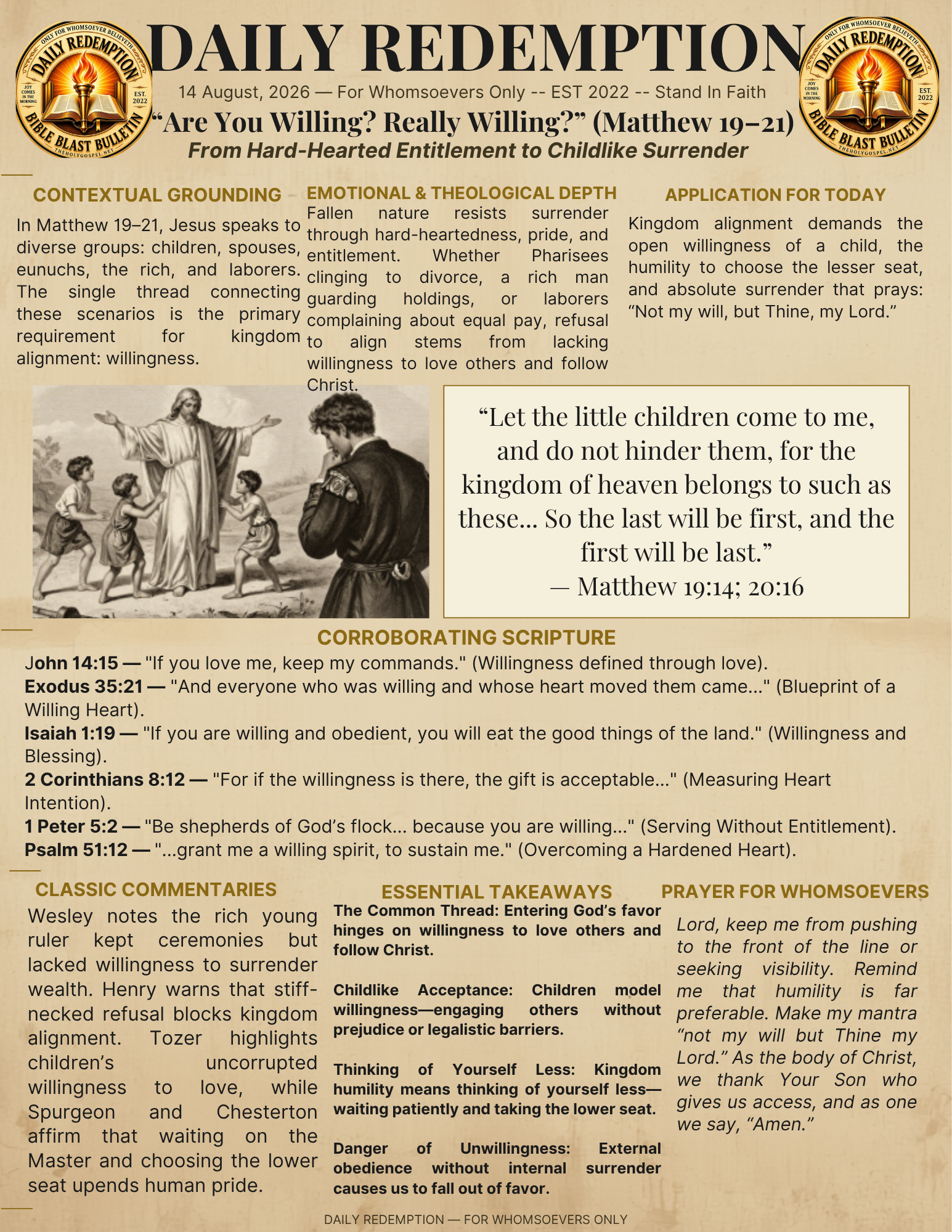
Then people brought little children to Jesus for him to place his hands on them and pray for them, but the disciples rebuked them. Jesus said, “Let the little children come to me, and do not hinder them, for the kingdom of heaven belongs to such as these.”
— Matthew 19:13–14
Jesus answered, “If you want to be perfect, go, sell your possessions and give to the poor, and you will have treasure in heaven. Then come, follow me.” When the young man heard this, he went away sad, because he had great wealth.
— Matthew 19:21–22
“‘These who were hired last worked only one hour,’ they said, ‘and you have made them equal to us who have borne the burden of the work and the heat of the day.’ … So the last will be first, and the first will be last.”
— Matthew 20:12, 16
——————————
II. HISTORICAL-REDEMPTIVE ANALYSIS
* Contextual Grounding: Taking Matthew 19–21 in one big gulp, Jesus addresses an array of people and situations—children, divorce, eunuchs, the rich young ruler, workers in the vineyard, and seat positioning. The thread connecting all these diverse scenarios is the fundamental requirement for kingdom alignment: willingness.
* Emotional & Theological Depth: Fallen human nature resists surrender through hard-heartedness, rigid pride (“stiff-necked”), and self-interested entitlement. Whether it is hard-hearted Pharisees clinging to divorce, a rich man unable to part with his holdings, or early vineyard workers complaining about equal pay, refusal to align with Christ stems from a lack of willingness to love others and follow His commands.
* Application: True kingdom identity requires the open willingness of a child who accepts others without prejudice, the humility to sit in the lesser seat rather than lining up first for the church grub, and the absolute surrender that declares, “Not my will, but Thine, my Lord.”
——————————
III. CORE COMMENTARY
My approach to discussing Matthew 19–21 in one big gulp was to find what the different things that Jesus is talking about—different people, different situations and so forth—what do they all have in common? What is the primary message? What is Jesus telling us about who we are and who we need to be in order to be in God’s favor?
And I think it all comes down to willingness, willingness, willingness to love one another and willingness to follow the commands of Jesus. Remember when Jesus said, if you love me, then follow my commands. In other words, willingness.
So Jesus talks about a number of different people, types of people: children, eunuchs, rich people, poor people. So let’s pick this apart a little bit. Children—you know, if children are playing and another child comes by that they’ve never seen before in their lives, do they say, “You’re an illegal alien”? No. “You don’t look like me”? No. “You have a handicap, so we don’t want to play with you”? No, they love each other. They will accept whoever comes along and find some way to play with them and engage with them. And, you know, it doesn’t always end well, but the intention and the willingness to get along and love each other is always there in children. That’s a beautiful thing.
All right. There’s the whole thing about divorce and the Mosaic covenant and so forth regarding divorce. God sets you up with a partner and you are to love that partner and to work things out. God has given you that playing field to work things out in the direction of love. And then you’re just going to say, “No, God, I don’t want to do this anymore. I don’t like this person anymore. I don’t want to play with them anymore.” And yet there were a lot of Jews that were hard-hearted, Jesus said to the Pharisees. So God was willing to make concession, to give them a purchase on a first step on the rung of a ladder so that they can climb up from there. It’s not that God all of a sudden changed His mind about divorce. He’s like, “OK, well, how am I going to work with these Jewish people who are hard-hearted?” And the Lord used the term “stiff-necked”—basically rigidly stubborn, which is the opposite of willingness. So how do I bring about willingness in these people? God was willing to make arrangements for them in such a way so that it would keep the purity of what He was trying to do, but make it more accessible. So, again, that has to do with willingness.
And then the eunuchs—you know, some people are that way because of choice. More people are that way because of physical handicap. You may have some amongst you; you will never know. Some people are that way for whatever reason, but it’s a matter of choice or of lifestyle, let’s say. Now, as long as the lifestyle is not a sinful lifestyle, then God is willing to work with them as long as they are willing to adhere to Him and follow His commandments and so forth in whatever lifestyle that they want to live in.
Then you have the last shall be first and the first shall be last. You know, I would have been one of the ones—you know, I’m not trying to say anything by doing these videos, I’m not saying I’m smarter than anybody—but I’m telling you that I would have been one of the ones that said, “Hey, how come you’re giving them a denarius and they worked one hour and I worked 10 hours?” and I’m sure that I would have been not so happy about that. But, you know, it comes down to what C.S. Lewis said about humility—not thinking less of yourself, it’s thinking of yourself less. There you go, I got that one.
So these people were saying, well, look at it this way: those guys that were out there wanting to be hired, they were out there the whole day, faithfully waiting for somebody to come and hire them. Okay. So they may not have worked for that individual in his fields and so forth the same amount of hours, but they were out there the same amount of hours wanting to be hired. And they were demonstrating willingness to have faith that somebody would come along and give them a job. Then that’s a matter of the last shall be first and the first shall be last. And pride comes before a fall, but the person who has humility—I mean, how many places in the Bible does it talk about that: don’t walk into the room and take the best chair in the best place, take something lesser than that. Don’t line up first for the church grub in fellowship hall. I am being convicted right here! And then you’ll be elevated by your fellows who see that you were humble and that you weren’t trying to put yourself ahead of them.
So, we’re basically seeing here, and it talks about giving to the poor and the rich man who followed all the commandments since the day he was born—he said something like that—but now he can’t give up all of his holdings as Jesus instructs him and all of what makes him a rich man. Jesus rebukes that one, because he didn’t have the willingness to do what was needed when it was asked of him by God and fell out of God’s favor. However, there are some scholars and theologians who feel the same one, reluctant to part with his riches, may have ended up being part of the team in the Book of Acts.
So this is the best way that I can take all of those different situations, all of those things that Jesus said that are so beautiful and so wise and so thought-provoking, and say: what do all of these different things have in common? And what does this mean for my life and my relationship with God? It’s willingness. Think about it, read it yourself, Matthew 19 through 21, and see if I’m right or wrong and have a conversation with me. I’d love to do that with you. I’m blessed to be a part of the team. God’s Peace be with you.
——————————
IV. CLASSIC COMMENTARIES CORNER
* “The rich young ruler proved that a man may keep every outward ceremony of religion while his heart completely lacks the willingness to surrender to Christ. He went away sorrowful because he loved his worldly holdings more than the heavenly treasure offered by the Savior.” — John Wesley
* “Hard-heartedness and a stiff-necked refusal to yield are the ultimate barriers to kingdom alignment. God made concessions to human weakness in the law, but His true desire remains a heart that is completely supple and willing to follow His commands.” — Matthew Henry
* “The early vineyard workers grumbled because their proud hearts measured divine grace by their own industry and sweat. True humility does not bargain with the Master for a first-row seat, but stands entirely satisfied with whatever reward His sovereign generosity bestows.” — Adam Clarke
* “Children accept one another without the artificial prejudices of the adult world because they possess an uncorrupted willingness to love. To enter the kingdom, we must forsake our haughty adult pride and receive the gospel with the simple, open-hearted trust of a little child.” — A.W. Tozer
* “The last who were hired stood in the marketplace all day long, demonstrating a patient willingness to wait on the master’s providence. They were rewarded not for the hours they labored, but because their hearts were ready the moment the call finally came.” — Charles Spurgeon
* “There is a grand, satisfying riddle in taking the lesser seat at the table only to be elevated to a position of honor. The world insists on pushing to the front of the line, but the citizens of heaven find their highest joy in thinking of themselves less.” — G.K. Chesterton
——————————
V. CORROBORATING SCRIPTURE & CHRISTOLOGICAL CONNECTIONS
* John 14:15 — “If you love me, keep my commands.” (Direct scriptural foundation defining willingness through love).
* Exodus 35:21 — “And everyone who was willing and whose heart moved them came and brought an offering to the Lord for the work on the tent of meeting…” (The Old Testament Blueprint of a Willing Heart)
* Isaiah 1:19 — “If you are willing and obedient, you will eat the good things of the land.” (The Direct Link Between Willingness and Blessing)
* Psalm 110:3 — “Your troops will be willing on your day of battle. Arrayed in holy splendor, your young men will come to you like dew from the morning’s womb.” (The Army of Ready Deliverers)
* 1 Chronicles 29:17 — “I know, my God, that you test the heart and are pleased with integrity. All these things I have given willingly and with honest intent, and now I have seen with joy how willingly your people who are here have given to you.” (The Test of Genuine Heart Alignment)
* 2 Corinthians 8:12 — “For if the willingness is there, the gift is acceptable according to what one has, not according to what one does not have.” (God Measuring the Heart Intention)
* 1 Peter 5:2 — “Be shepherds of God’s flock that is under your care, watching over them—not because you must, but because you are willing, as God wants you to be…” (Serving Apart from Entitlement or Compulsion)
* Psalm 51:12 — “Restore to me the joy of your salvation and grant me a willing spirit, to sustain me.” (David’s Cry to Overcome a Hardened and Stiff-Necked Heart)
——————————
VI. PRAYER FOR WHOMSOEVERS
Lord may I stop being first in the chow line, may I never select the customer’s seat at our Sunday night service (conducted in a beauty salon). May I never accept a function on Sunday mornings because it make me more visible. If that is in my heart. Lord remind me that invisibility in that circumstance is holier and far more preferable. Lord, above all, make my holy “mantra” be “not my will but Thine my Lord”. Everyone that thinks they know me says Amen for sure. As corpus Christi (body of Christ, not here in Eucharistic sense), though, all of us thank Your Son and our Saviour who gives us access and we all say, as one, “Amen”