### **I. SCRIPTURE PASSAGE**
**2 Kings 7:3–4, 8–9; 9:31; Mark 16:15**
> *Now there were four men with leprosy at the entrance of the city gate. They said to each other… “Let’s go over to the camp of the Arameans and surrender. If they spare us, we live; if they kill us, then we die.”*
> — **2 Kings 7:3–4**
> *The men who had leprosy reached the edge of the camp, entered one of the tents and ate and drank… Then they said to each other, “What we’re doing is not right. This is a day of good news and we are keeping it to ourselves. If we wait until daylight, punishment will overtake us. Let’s go at once and report this to the royal palace.”*
> — **2 Kings 7:8–9**
> *He said, “Look, you will see it with your own eyes, but you will not eat any of it!”*
> — **2 Kings 7:19b**
> *Then Jesus said to them, “Go into all the world and preach the gospel to all creation.”*
> — **Mark 16:15**
—
### **II. HISTORICAL-REDEMPTIVE ANALYSIS**
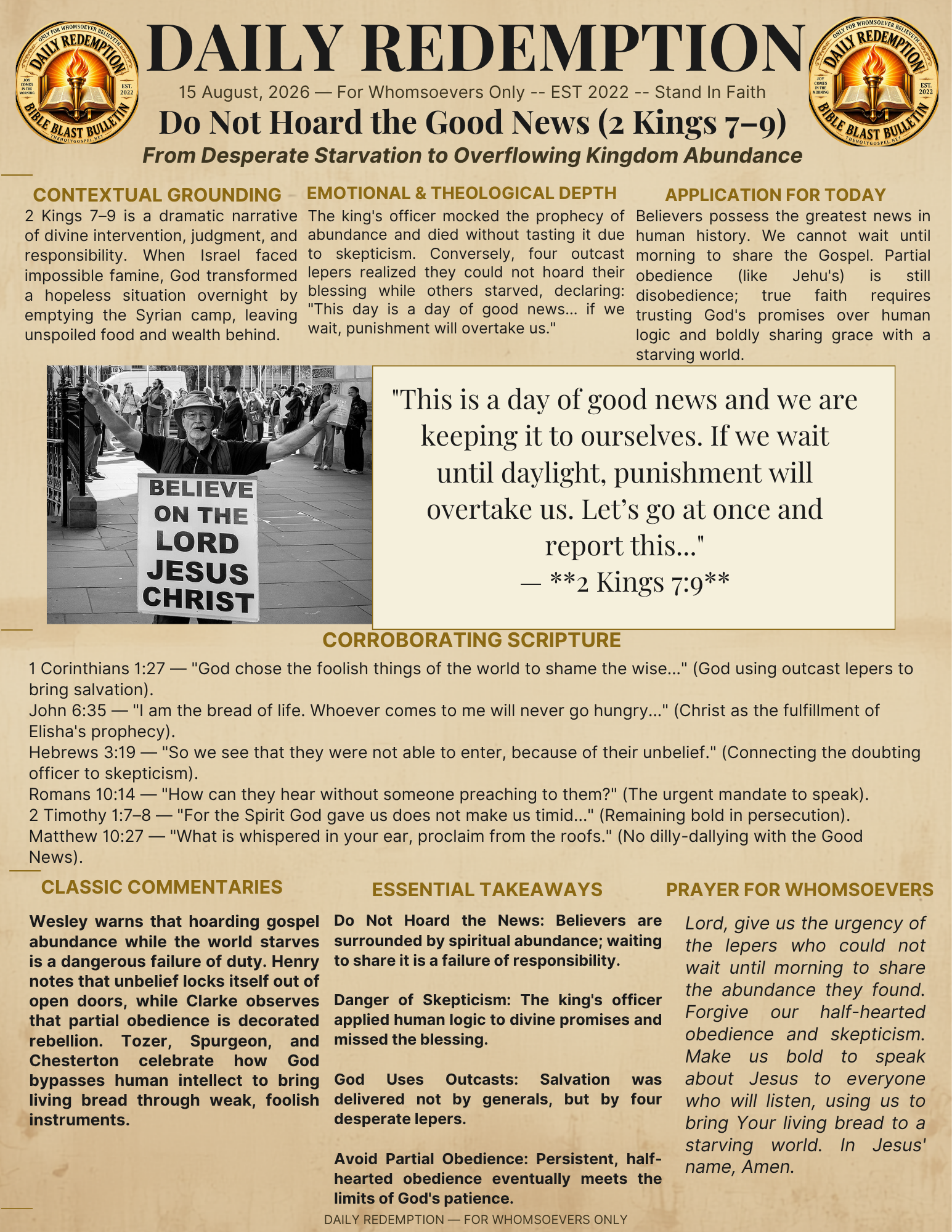
* **Contextual Grounding:** Reading 2 Kings 7–9 isn’t about studying ancient people in robes; it is a dramatic narrative of divine intervention and judgment directly applicable to us today. When Israel faced impossible famine, God transformed a hopeless situation overnight by emptying the Syrian camp, leaving unspoiled food and wealth behind.
* **Emotional & Theological Depth:** The king’s officer, a skeptic who underestimated God, mocked the prophecy of abundance and died without tasting it. Conversely, the four lepers—social outcasts who were physically and culturally broken—became the unlikely bearers of salvation to a starving city.
* **Application:** Believers possess the greatest news in human history. Like the lepers realizing they could not hoard the food, we cannot wait until morning to share the Gospel. Partial obedience (like Jehu’s) is still disobedience; true faith requires trusting God’s promises over human logic and boldly sharing the abundance of grace with a starving world.
—
### **III. CORE COMMENTARY**
Thank you for spending some time with me as we dive into the Bible, and specifically 2 Kings 7-9. And it’s kind of a big deal, and it’s kind of hefty, so let’s get through it quickly. Do not hoard the Good News. Ok that’s the message. Bye! kidding. Let’s dig in.
As always, I divide these commentaries into two sections. One is, what can we do with this information as far as today’s life is concerned? And I’m going to tell you right now, if you read the Bible like it’s a bunch of people from long ago, yesterday, and in a different time, a different place, a different style of living instead of maybe your next-door neighbor who dresses in robes or whatever, then you are missing out.
But 2 Kings 7-9 is a big deal. It’s a dramatic narrative of divine intervention, the judgment of evil, and the responsibility of those who have received good news. That means you. You are in possession of the best news that mankind has ever had, even if it’s been available for 2,000 years. People today still ignore it, still choose other things. You have the good news. So there’s a responsibility in that.
The overarching message for today is that God can transform hopeless situations overnight, and those who have experienced His salvation have a duty to share it with a starving world.
Here’s a breakdown for today’s life. The urgency of sharing the good news. It starts off with four lepers who discovered the abandoned Syrian camp and realized that keeping the food and spoils to themselves… they realized, well, you know, yeah, we’ve had a tough life. We’re going through pain and agony and suffering, but we can’t just keep all this stuff to ourselves. We are blessed right now with this incredible abundance. Their conclusion: *this day is a day of good news. If we wait until morning light, punishment will overtake us.*
You can’t even wait until morning. You got to go tell somebody right now about Jesus. I mean it. Go tell somebody on the internet or somewhere else about Jesus and about the abundance of mercy and grace and love. It’s a direct parallel for believers today to share the gospel and not dilly-dally. Go do it.
G.K. Chesterton said that God’s paradoxical riddles are more satisfying than the answers of man. Something to be said for that sentiment. Trust in God’s promise over human logic. I mean, human logic would say you cannot cross the Red Sea. You’re going to drown. When famine made survival seem impossible, Elisha prophesied abundance within 24 hours. The king’s officer doubted. He was a skeptic at heart, saying it couldn’t happen even if the Lord opened the windows of heaven. So he wasn’t totally agnostic, just skeptical and underestimating God. He believed in heaven. He believed it had windows. He died without eating the food.
So because of his doubt, he did not gain access to the abundance that was there before him. So the lesson is to trust God’s word even when circumstances seem impossible or you may miss the blessing.
Now, skipping ahead here to 2 Kings 8 and 9. God is shown to be sovereign over history, directing kings to execute judgment on the wicked house of Ahab. It warns that persistent wickedness will face judgment. You might get away with one or two things, but if you’re continuously sinful, continuing acting in ways that’s not in God’s favor, God’s going to lose His patience with you as He did with the Israelis in Exodus.
God is shown to be the danger of half-hearted obedience. Jehu executed God’s judgment but failed to turn from the sins of Jeroboam, demonstrating that partial obedience is still disobedience. You can’t have your cake and eat it too. You can’t get married, have a wonderful wife, and then go cheat on her and watch certain videos online that none of us have any business going anywhere near.
Let’s now discuss messianic significance. Elisha’s promise of massive provision in the midst of utter starvation serves as a type of Christ who brings spiritual life and living bread to a world starving due to sin. In the Elisha story, the unlikely saviors, the four lepers, social outcasts, are the ones who bring the good news of salvation to the city. This parallels how God uses the foolish and weak things of the world to bring the message of Jesus. Oh brother, is that ever true? I have been foolish and weak. The Lord has used me.
Ultimately, the message, if you take something away from this video, here it goes. Do not hoard the good news. Just as the lepers could not keep the news of the abandoned camp to themselves, believers are called to share the salvation found in Jesus Christ regardless of personal cost or fear. I mean, there’s tens of thousands of people in Nigeria that are being slaughtered, massacred, just because they stand up and say that they’re Christian and they believe in Jesus. It’s not that it’s necessarily always safe to express your faith. There’s talk about Canada trying to make speaking references from the Bible a hate crime. We live in interesting times where lawlessness and persecution are all around us.
But if you let that keep you from spreading the good word, you lose, the person who you might have talked to about Jesus or sang a song about Jesus to… they lose. Be brave. Be bold. Get out there. Speak about Jesus to anybody and everybody that will listen. And speak about Him twice to those who won’t.
——————————
## IV. CLASSIC COMMENTARIES CORNER
* “The four lepers realized that hoarding the abundance of the Syrian camp while their city starved would bring swift punishment upon their heads. For a believer to possess the gospel and fail to share it instantly is a dangerous failure of spiritual duty.” — John Wesley
* “The king’s officer saw the windows of heaven with his eyes but never tasted the grain because he applied human logic to a divine promise. Unbelief stands right in front of an open door of blessing and locks itself out through skepticism.” — Matthew Henry
* “Jehu carried out God’s judgment with furious zeal, yet his heart remained entirely wedded to the false golden calves of Jeroboam. Partial obedience is nothing but a decorated form of rebellion, proving the heart wants the benefits of grace without the absolute surrender of holiness.” — Adam Clarke
* “God deliberately chose four outcast lepers at the city gate to be the heralds of salvation to a desperate, starving nation. The Lord routinely bypasses the proud palaces of human intellect to deliver the bread of life through the weak and foolish instruments of this world.” — A.W. Tozer
* “Elisha’s prophecy of abundant food in the midst of a catastrophic famine serves as a magnificent shadow of the Lord Jesus Christ. He enters our deep spiritual starvation, breaks the legal siege of sin and death, and freely offers the living bread to all creation.” — Charles Spurgeon
* “There is a grand, satisfying riddle in a starving city being rescued by four broken men who simply stumbled into an abandoned camp. God’s paradoxes completely confound the calculated answers of worldly strategists, showing that our survival depends entirely on believing the impossible word of the Prophet.” — G.K. Chesterton
——————————
## V. CORROBORATING SCRIPTURE & CHRISTOLOGICAL CONNECTIONS
* 1 Corinthians 1:27 — “But God chose the foolish things of the world to shame the wise; God chose the weak things of the world to shame the strong.” (Directly connecting to God using four outcast lepers to bring salvation to the city).
* John 6:35 — “Then Jesus declared, ‘I am the bread of life. Whoever comes to me will never go hungry, and whoever believes in me will never be thirsty.'” (Christ as the fulfillment of Elisha’s prophecy of abundant bread).
* Hebrews 3:19 — “So we see that they were not able to enter, because of their unbelief.” (Connecting the king’s doubting officer to those who miss God’s abundance due to skepticism).
* Revelation 3:16 — “So, because you are lukewarm—neither hot nor cold—I am about to spit you out of my mouth.” (Echoing the danger of Jehu’s half-hearted, partial obedience).
——————————
## VI. ADDITIONAL CORROBORATING SCRIPTURE
* Romans 10:14 — “How, then, can they call on the one they have not believed in? And how can they believe in the one of whom they have not heard? And how can they hear without someone preaching to them?” (The Urgent Mandate to Speak)
* Psalm 50:16–17 — “But to the wicked God says: ‘What right have you to recite my laws or take my covenant on your lips? You hate my instruction and cast my words behind you.'” (Confronting the Hidden Double Life)
* Proverbs 3:5–6 — “Trust in the Lord with all your heart and lean not on your own understanding; in all your ways submit to him, and he will make your paths straight.” (Overcoming Human Logic in Impossible Circumstances)
* 2 Timothy 1:7–8 — “For the Spirit God gave us does not make us timid, but gives us power, love and a sound mind. So do not be ashamed of the testimony about our Lord…” (Remaining Brave and Bold in Persecution)
* Hosea 10:2 — “Their heart is deceitful, and now they must bear their guilt. The Lord will demolish their altars and destroy their sacred stones.” (The Danger of Persistent, Continuous Sin)
* Amos 8:11 — “‘The days are coming,’ declares the Sovereign Lord, ‘when I will send a famine through the land—not a famine of food or a thirst for water, but a famine of hearing the words of the Lord.'” (The Starving World Surrounding the Church)
* Matthew 10:27 — “What I tell you in the dark, speak in the daylight; what is whispered in your ear, proclaim from the roofs.” (No Dilly-Dallying with the Good News)
——————————
## VII. ESSENTIAL TAKEAWAYS
* Do Not Hoard the Good News: Like the lepers in the Syrian camp, believers are surrounded by spiritual abundance. Waiting to share it while the world starves is a failure of responsibility.
* The Danger of Skepticism: The king’s officer underestimated God by applying human logic to a divine promise. He saw the blessing but died without tasting it. Trust God’s word when circumstances seem impossible.
* God Uses the Outcasts: Salvation was brought to the city not by kings or generals, but by four desperate lepers. God continues to use the foolish and weak things of the world to deliver the message of Jesus.
* Partial Obedience is Disobedience: Jehu executed judgment but kept the sins of Jeroboam. Persistent, half-hearted obedience eventually meets the limits of God’s patience.
——————————
## VIII. PRAYER FOR WHOMSOEVERS
Lord, help us not to hoard the good news. Give us the urgency of the lepers who realized they could not wait until morning to share the abundance they had found. Forgive our half-hearted obedience and our tendency to underestimate Your power through human logic. Make us bold and brave in these interesting times to speak about Jesus to anyone and everyone who will listen. Use us, the weak and foolish things of the world, to bring Your living bread to a starving world. In Jesus’ name, Amen.