I. SCRIPTURE PASSAGE
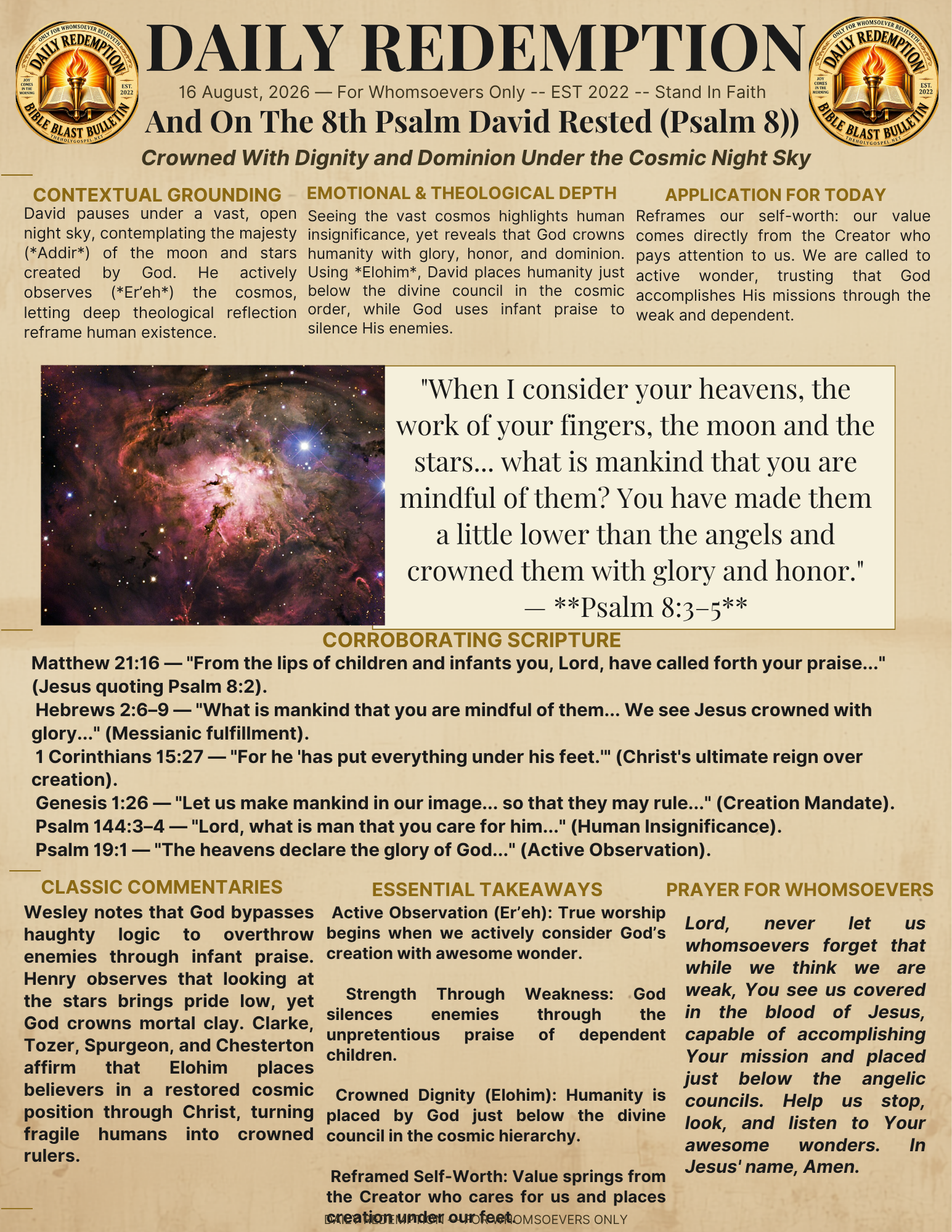
Psalm 8:1–9 (For the director of music. According to gittith. A psalm of David.)
1 Lord, our Lord, how majestic is your name in all the earth! You have set your glory in the heavens.
2 Through the praise of children and infants you have established a stronghold against your enemies, to silence the foe and the avenger.
3 When I consider your heavens, the work of your fingers, the moon and the stars, which you have set in place,
4 what is mankind that you are mindful of them, human beings that you care for them?
5 You have made them a little lower than the angels and crowned them with glory and honor.
6 You made them rulers over the works of your hands; you put everything under their feet:
7 all flocks and herds, and the animals of the wild,
8 the birds in the sky, and the fish in the sea, all that swim the paths of the seas.
9 Lord, our Lord, how majestic is your name in all the earth!
II. HISTORICAL-REDEMPTIVE ANALYSIS
- Contextual Grounding: David pauses under a vast, open night sky, contemplating the majesty of the moon and stars created by God.
- Emotional & Theological Depth: Seeing the vast cosmos highlights human insignificance, yet reveals the startling theological truth that God crowns humanity with dignity and dominion.
- Application: It reframes our perspective on self-worth, showing that our true value comes directly from the Creator who pays attention to us.
III. CORE COMMENTARY
1 Lord, our Lord, how majestic is your name in all the earth! You have set your glory in the heavens.
“Majestic” (Psalm 8:1): The Hebrew word used here is אַדִּיר (Addir). It roots from a word meaning wide, large, or powerful. In this context, it carries the weight of eminent greatness, magnificent power, and glorious authority over all things.
2 Through the praise of children and infants you have established a stronghold against your enemies, to silence the foe and the avenger.
How do infants praise the Lord? Continue to consider that God uses the weakest, most dependent things in creation to silence proud, aggressive enemies. He often uses the least of these, the most improbable candidates to do remarkable things—both in the Bible and even today. Softening hearts is a remarkable thing.
Also, please be reminded and consider that centuries later, Jesus quoted this exact verse in Matthew 21:16. When the prideful religious leaders were furious that children were shouting praises to Him in the temple, Jesus pointed out that children possess an unpretentious, pure faith that instinctively recognizes divine truth far quicker than cynical adults.
So the Psalm as translated here says: Through the praise of children and infants you have established a stronghold against your enemies, to silence the foe and the avenger.
Comparing the words of the psalm to those of Jesus:
- The Hebrew Text reads: “Out of the mouth of babies and infants, you have established strength…”
- Jesus’ Quote (via the Greek Septuagint) reads: “Out of the mouth of infants and nursing babies you have prepared praise…”
3 When I consider your heavens, the work of your fingers, the moon and the stars, which you have set in place,
“Consider” (Psalm 8:3): The Hebrew word is אֶרְאֶה (Er’eh), which literally translates to “I see” or “I look at.” David is not just idly daydreaming; he is actively observing the intricate details of the night sky, which triggers deep theological reflection.
As a sidebar comment, the author of “How Great Thou Art” (a founding father song of contemporary worship) wrote the song after going face down in worship after seeing a vicious thunderstorm turn into peace, tranquility, and the sound of birds singing. And so he wrote: “O Lord my God, when I in awesome wonder, consider all the worlds thy hands have made. I SEE the stars, I HEAR the rolling thunder, thy power throughout the universe displayed.” So he was seeing and looking out at and in awesome wonder.
4 what is mankind that you are mindful of them, human beings that you care for them? 5 You have made them a little lower than the angels and crowned them with glory and honor.
Who arst thou angels? In the original Hebrew, David used the word Elohim. Because of the particularities of the Hebrew language, Elohim can be both single and plural. In plural it means the angelic counsels just under God in the cosmic hierarchy. For more on this, the reference that is both popular and considered by many as contemporary authoritative, one can look up Michael Heiser. He has many videos on YouTube based on his book The Unseen Realm, and he was one of the key figures behind Logos software. So is David saying that God made the humans just below the angelic councils that are just below God or was he just waxing poetic in invoking angels? Well, it is a strong statement in any context to use the word Elohim.
6 You made them rulers over the works of your hands; you put everything under their feet: 7 all flocks and herds, and the animals of the wild, 8 the birds in the sky, and the fish in the sea, all that swim the paths of the seas. 9 Lord, our Lord, how majestic is your name in all the earth!
IV. CLASSIC COMMENTARIES CORNER
- “The staggering contrast between the infinite heavens and finite man reveals the breathtaking extent of divine grace. God bypasses the haughty logic of the wise and uses the unpretentious praise of nursing babes to completely overthrow the strongholds of His enemies.” — John Wesley
- “When we look up at the moon and stars, human pride is instantly brought low into the dust. Yet the Creator who fashioned the cosmos with His fingers condescends to crown mortal clay with an inherited dignity that sits just below the divine council.” — Matthew Henry
- “The original use of the word Elohim indicates that man was stationed right below the heavenly hierarchies in the cosmic order. This glorious position was forfeited by sin, but it has been completely restored to the believer through the atoning work of Jesus Christ.” — Adam Clarke
- “True worship demands an active observation of the world our God has made, throwing us face-down in awesome wonder before His majestic Name. He chooses the weak and dependent things of this earth to act out His purposes, completely confounding the cynical adults of every generation.” — A.W. Tozer
- “David sees everything put under the feet of man, a dominion perfectly realized only when we look upon Jesus, who was made a little lower than the angels for the suffering of death. Through Him, the poorest and weakest of the whomsoevers are raised from their insignificance and crowned with eternal honor.” — Charles Spurgeon
- “There is a glorious, satisfying riddle in the Creator of the universe paying such meticulous attention to a fragile human being. The materialist looks at the night sky and sees only cold space, but the eye of faith beholds a cosmic theater built entirely to display the majesty of love.” — G.K. Chesterton
V. CORROBORATING SCRIPTURE & CHRISTOLOGICAL CONNECTIONS
- Matthew 21:16 — “Do you hear what these children are saying?” they asked. “Yes,” replied Jesus, “have you never read, ‘From the lips of children and infants you, Lord, have called forth your praise’?” (Jesus quoting Psalm 8:2 to confound cynical religious leaders).
- Hebrews 2:6–9 — “But there is a place where someone has testified: ‘What is mankind that you are mindful of them, a son of man that you care for him? You made them a little lower than the angels; you crowned them with glory and honor and put everything under their feet.’ … But we do see Jesus, who was made a little lower than the angels, now crowned with glory and honor because he suffered death…” (The ultimate Christological fulfillment of Psalm 8).
- 1 Corinthians 15:27 — “For he ‘has put everything under his feet.’ Now when it says that ‘everything’ has been put under him, it is clear that this does not include God himself, who put everything under Christ.” (Paul connecting human dominion in Psalm 8 to Christ’s ultimate reign).
- Genesis 1:26 — “Then God said, ‘Let us make mankind in our image, in our likeness, so that they may rule over the fish in the sea and the birds in the sky…'” (The Creation Mandate establishing the dominion crowned in Psalm 8).
VI. ADDITIONAL CORROBORATING SCRIPTURE (Random But On-Point)
- Psalm 144:3–4 — “Lord, what is man that you care for him, the son of man that you think of him? Man is like a breath; his days are like a fleeting shadow.” (The Blueprint of Human Insignificance)
- Job 7:17–18 — “What is mankind that you make so much of them, that you give them so much attention, that you examine them every morning and test them every moment?” (The Heavy Reality of God’s Attention)
- Psalm 19:1 — “The heavens declare the glory of God; the skies proclaim the work of his hands.” (Active Observation under the Night Sky)
VII. ESSENTIAL TAKEAWAYS
- Active Observation (Er’eh): True worship begins when we stop, look out, and actively consider God’s creation with awesome wonder rather than passing by idly.
- Strength Through Weakness: God establishes His stronghold and silences His proud enemies through the unpretentious, pure praise of dependent children and infants.
- Crowned Dignity (Elohim): Though small against the vast cosmos, humanity is crowned with glory and honor, placed by God just below the divine council in the cosmic order.
- Reframed Self-Worth: Our true value does not come from earthly achievement, but from the Creator of the universe who pays attention to us and places creation under our care.
VIII. PRAYER FOR WHOMSOEVERS
Lord, I pray that we whomsoevers never forget that while we think we are weak, maybe not so bright sometimes, and so forth—you on the other hand see us, covered in the blood of Jesus, as Your children, capable of doing whatever mission you set us out to accomplish and placed just below the angelic counsels. Let us never forget to stop, look and listen to your awesome works and wonders. In the majesty and grace of Your Son, Our Savior we say “Amen”