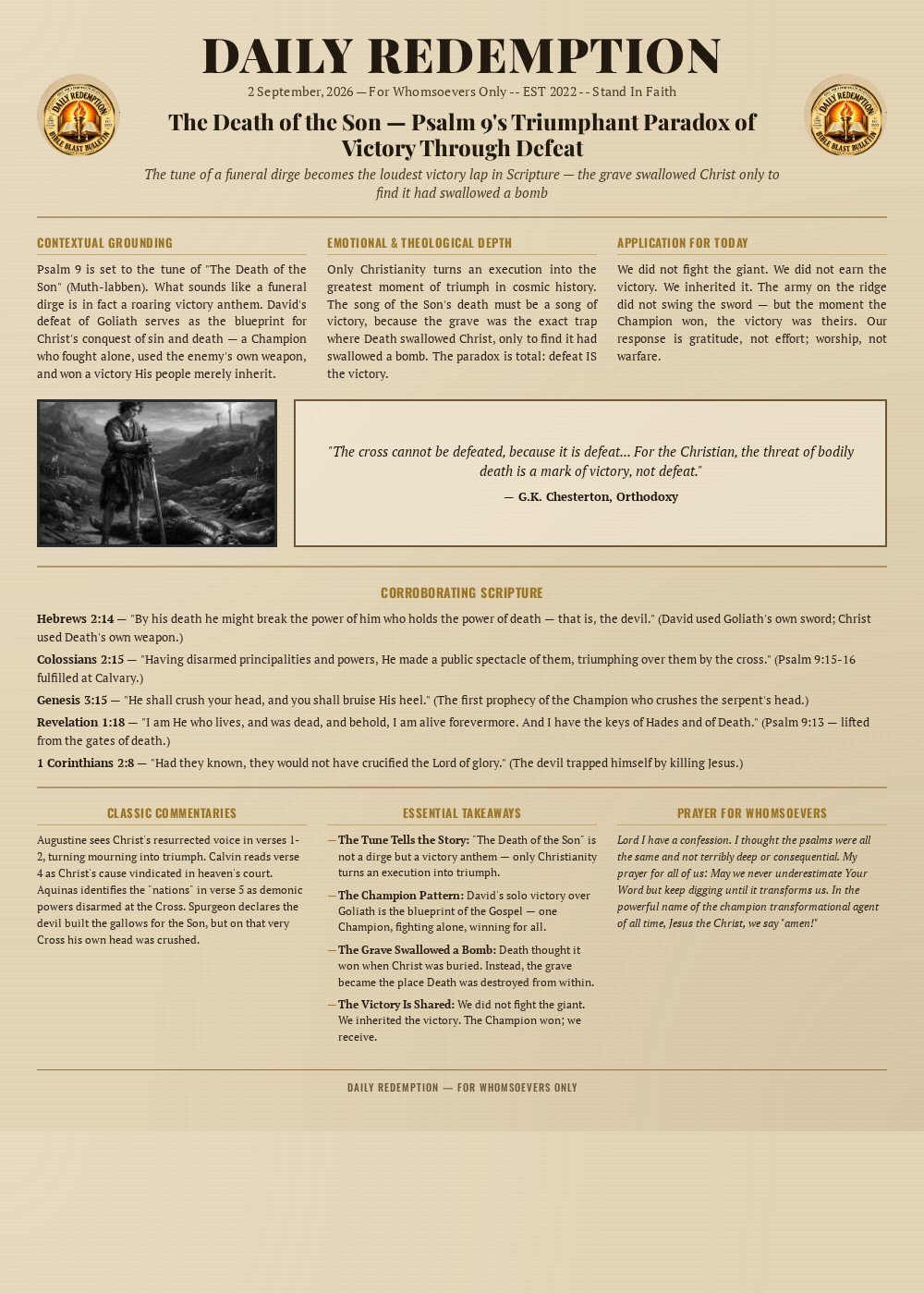
Psalm 9 is set to the tune of “The Death of the Son” — and what first appears to be a funeral dirge is in fact the loudest victory lap in all of Scripture. David’s defeat of Goliath serves as the blueprint for Christ’s conquest of sin and death: a Champion who fought alone, used the enemy’s own weapon, and won a victory His people merely inherit. From the Cross to the empty tomb, the song of the Son’s death is the anthem of resurrection triumph — the grave swallowed Christ only to find it had swallowed a bomb.
Psalm 9
For the director of music. To the tune of “The Death of the Son.” A psalm of David.
Zeb commentary: Folks I am absolutely floored! AND puddle-ized! “The Death of the Son.” WHAT?!!? No that isn’t Messianic.
No, not much! lol I mean just before 4:20 AM and I make it to my computer to start this work and in a second I can’t continue.
Absolutely stunning! But wait… there’s more! “The Death of the Son.” is just the melody that the psalm is supposed to be sung to.
What about David’s Psalm itself? Nowhere in Scripture is their a bigger, louder, more joyful and celebratory VICTORY LAP for our Lord Jesus dying on the cross and resurrecting so that in fact, he had “overcome the world” and even overcome death!
What would GK Chesterton (the great lover and theologian of the paradoxical nature of God and the Gospel) say about this paradox. Something like this. Chesterton loved the wild paradox that the King of the Universe won the cosmic war not by striking from a golden chariot, but by allowing Himself to be broken. If Chesterton were to analyze the title of Psalm 9 (Muth-labben), he would point out that only the Christian faith could look at a bloody cross, look at the brutal execution of the Son, and call that day “Good Friday.” The song of the Son’s death must be a song of victory, because the grave was the exact trap where Death swallowed Christ, only to find it had swallowed a bomb.
The tie-in and parallel to David’s defeat of Goliath and triumph for Israel.
The parallel between David slaying Goliath and Jesus destroying death is one of the most solid, foundational types in biblical history.
When David stepped into the Valley of Elah, he was not just a kid fighting a giant; he was acting as Israel’s covenant champion (a substitutionary representative).
Goliath challenged Israel to single combat: if the giant won, Israel became slaves; if the Israelite won, Israel was set free. The army of Israel stood paralyzed by fear—completely helpless on the ridge. David stepped down alone into the valley, struck the giant in the forehead, and used the giant’s own sword to decapitate him. The moment Goliath fell, the spell of fear broke, and the helpless Israelite army surged forward in total victory.
and
This is the exact blueprint of the Gospel:
The Helpless Army: Humanity stood paralyzed by the giant of Sin and Death, completely unable to fight back.
The Champion Steps In: Jesus stepped down into the valley of our world as our Champion. He fought the battle entirely alone while we watched from the ridges.
Conquered by His Own Weapon: Just as David used Goliath’s own sword to kill him, Jesus used Satan’s and Death’s ultimate weapon—the Cross and the Grave—to shatter their power. By dying, He destroyed him who holds the power of death (Hebrews 2:14). (note yes! Goliath was felled by David’s perfect aim of the slingshot hitting him squarely in the noggin. But the final breath of Goliath, David used Goliath’s own sword!) and an allusion inside a parallelogram (In Genesis 3:15, God gives the very first prophecy about Jesus, promising that the Savior would crush the head of the serpent. Goliath is described in the Bible almost like a human serpent—he wears scale armor, he taunts God’s people, and he stands as the ultimate enemy.)
ok…take a breath to come back into this or dry your eyes if need be.
The Shared Victory: The moment Christ rose, the giant was dead, and His people were given a victory they did not fight for, but get to entirely inherit.
So now let us dig into Psalm 9.
1 I will give thanks to you, Lord, with all my heart; I will tell of all your wonderful deeds.
2 I will be glad and rejoice in you; I will sing the praises of your name, O Most High. (a word for singing the praise of God=worship)
3 My enemies turn back; they stumble and perish before you.
4 For you have upheld my right and my cause, sitting enthroned as the righteous judge.
5 You have rebuked the nations and destroyed the wicked; you have blotted out their name for ever and ever.
6 Endless ruin has overtaken my enemies, you have uprooted their cities; even the memory of them has perished.
7 The Lord reigns forever; he has established his throne for judgment. (Messianic – John 5:22 states: “For the Father judges no one, but has given all judgment to the Son”.)
8 He rules the world in righteousness and judges the peoples with equity.
9 The Lord is a refuge for the oppressed, a stronghold in times of trouble.
10 Those who know your name trust in you, for you, Lord, have never forsaken those who seek you.
11 Sing the praises of the Lord, enthroned in Zion; proclaim among the nations what he has done.
12 For he who avenges blood remembers; he does not ignore the cries of the afflicted.
13 Lord, see how my enemies persecute me! Have mercy and lift me up from the gates of death,
14 that I may declare your praises in the gates of Daughter Zion, and there rejoice in your salvation.
15 The nations have fallen into the pit they have dug; their feet are caught in the net they have hidden.
16 The Lord is known by his acts of justice; the wicked are ensnared by the work of their hands. Messianic 15 and 16 – Colossians 2:15 says: “And having disarmed the powers and authorities, he made a public spectacle of them, triumphing over them by the cross.)
17 The wicked go down to the realm of the dead, all the nations that forget God.
18 But God will never forget the needy; the hope of the afflicted will never perish.
19 Arise, Lord, do not let mortals triumph; let the nations be judged in your presence.
20 Strike them with terror, Lord; let the nations know they are only mortal.
And now, if you have some extra time this morning let’s do an even deeper dig into the Messianic nature of Psalm 9, line by line inserting corroborating scripture and a classic commentary.
The Goliath Tie-In: The First Goliath & The Last Enemy
The parallel between David slaying Goliath and Jesus destroying death is one of the most solid, foundational types in biblical history.
When David stepped into the Valley of Elah, he was not just a kid fighting a giant; he was acting as Israel’s covenant champion (a representative). Goliath challenged Israel to single combat: if the giant won, Israel became slaves; if the Israelite won, Israel was set free. The army of Israel stood paralyzed by fear—completely helpless on the ridge. David stepped down alone into the valley, struck the giant in the forehead, and used the giant’s own sword to decapitate him. The moment Goliath fell, the spell of fear broke, and the helpless Israelite army surged forward in total victory.
This is the exact blueprint of the Gospel:
- The Helpless Army: Humanity stood paralyzed by the giant of Sin and Death, completely unable to fight back.
- The Champion Steps In: Jesus stepped down into the valley of our world as our Champion. He fought the battle entirely alone while we watched from the ridges.
- Conquered by His Own Weapon: Just as David used Goliath’s own sword to kill him, Jesus used Satan’s and Death’s ultimate weapon—the Cross and the Grave—to shatter their power. By dying, He destroyed him who holds the power of death (Hebrews 2:14).
- The Shared Victory: The moment Christ rose, the giant was dead, and His people were given a victory they did not fight for, but get to entirely inherit.
Chesterton on “The Victory in the Death of a Son”
The prince of Christian paradox, G.K. Chesterton, perfectly captured why a song titled “The Death of the Son” would be an anthem of roaring, ecstatic triumph rather than a funeral dirge. In his masterpiece Orthodoxy, Chesterton noted that Christianity’s most unique power is that its absolute highest point of joy and victory is entirely wrapped inside a tragedy:
“The cross cannot be defeated, because it is defeat… For the Christian, the threat of bodily death is a mark of victory, not defeat.”
Chesterton loved the wild paradox that the King of the Universe won the cosmic war not by striking from a golden chariot, but by allowing Himself to be broken. If Chesterton were to analyze the title of Psalm 9 (Muth-labben), he would point out that only the Christian faith could look at a bloody cross, look at the brutal execution of the Son, and call that day “Good Friday.” The song of the Son’s death must be a song of victory, because the grave was the exact trap where Death swallowed Christ, only to find it had swallowed a bomb.
Psalm 9: Line-by-Line Messianic Breakdowns & Classic Commentaries
Because Psalm 9 is quite long (20 verses), here are the most profoundly Messianic turning points of the psalm tracked through the eyes of the Church’s classic commentators (Saint Augustine, John Calvin, Charles Spurgeon, and Thomas Aquinas):
Verses 1–2
“I will praise You, O Lord, with my whole heart; I will tell of all Your marvelous works… I will sing praise to Your name, O Most High.”
- Messianic Citation: Hebrews 2:12 — “In the midst of the assembly I will sing Your praise.” (Jesus leading the Church in worship).
- The Classic Commentary: Saint Augustine notes that this is explicitly the voice of Christ’s resurrected body, the Church: “The whole heart he offers as a burnt-offering to God… to declare all the secrets of the Son (Muth-labben), who has turned our mourning into a song of triumph.”
Verse 4
“For You have maintained my right and my cause; You sat on the throne judging righteously.”
- Messianic Citation: Acts 17:31 — “He has appointed a day on which He will judge the world in righteousness by the Man whom He has ordained.”
- The Classic Commentary: John Calvin writes: “David speaks here in the person of Christ… Let us rest assured that however much the world rages, Christ’s cause has already been tried and vindicated in the court of heaven.”
Verse 5–6
“You have rebuked the nations, You have destroyed the wicked; You have blotted out their name forever… ruins are complete.”
- Messianic Citation: Colossians 2:15 — “Having disarmed principalities and powers, He made a public spectacle of them, triumphing over them in it.”
- The Classic Commentary: Thomas Aquinas explains: “The ‘nations’ are the demonic powers rebuked at the Cross. Christ blotted out their names when He stripped them of their dominion over human souls.”
Verse 7
“But the Lord shall endure forever; He has prepared His throne for judgment.”
- Messianic Citation: Hebrews 1:8 — “But to the Son He says: ‘Your throne, O God, is forever and ever; a scepter of righteousness is the scepter of Your kingdom.'”
- The Classic Commentary: Charles Spurgeon says in his Treasury of David: “Earthly empires fall like castles of sand, but the throne of our Lord Jesus is constructed upon His finished work, established forever.”
Verse 9
“The Lord also will be a refuge for the oppressed, a refuge in times of trouble.”
- Messianic Citation: Matthew 11:28 — “Come to Me, all you who labor and are heavy laden, and I will give you rest.”
- The Classic Commentary: John Trapp writes: “This ‘refuge’ is the wounds of Christ. As the dove hides in the clefts of the rock from the hawk, so the poor sinner runs into the open side of the Savior from the storms of justice.”
Verse 13
“Have mercy on me, O Lord!… You who lift me up from the gates of death.”
- Messianic Citation: Revelation 1:18 — “I am He who lives, and was dead, and behold, I am alive forevermore. Amen. And I have the keys of Hades and of Death.”
- The Classic Commentary: Saint Augustine writes: “The ‘gates of death’ are the heavy trials and the grave itself, out of which Christ was lifted first, so that His body might follow Him through the gates of the Heavenly Zion.”
Verse 15–16
“The nations have sunk down in the pit which they made; In the net which they hid, their own foot is caught. The Lord is known by the judgment He executes; The wicked is snared in the work of his own hands.”
- Messianic Citation: 1 Corinthians 2:8 — “For had they known, they would not have crucified the Lord of glory.” (The devil trapped himself by killing Jesus).
- The Classic Commentary: Charles Spurgeon exclaims: “This is the master-stroke of divine justice! The devil built the gallows for the Son, but on that very Cross, his own head was crushed. The weapon of our execution became the monument of our victory.”
If you want to keep drilling into this, we can look at Psalm 22 next (which is the ultimate crucifixion psalm) or map out how the “Goliath layout” repeats all over the Old Testament. What sounds best to you?
Prayer For Whomsoevers
Lord I have a confession. I thought the psalms were all the same and not terribly deep or consequential. My prayer for all of us: May we never underestimate Your Word but keep digging until it transforms us. In the powerful name of the champion transformational agent of all time, Jesus the Christ, we say “amen!”