The Mark of Divine Perfection — The Sacred Meaning of Seven in Christ
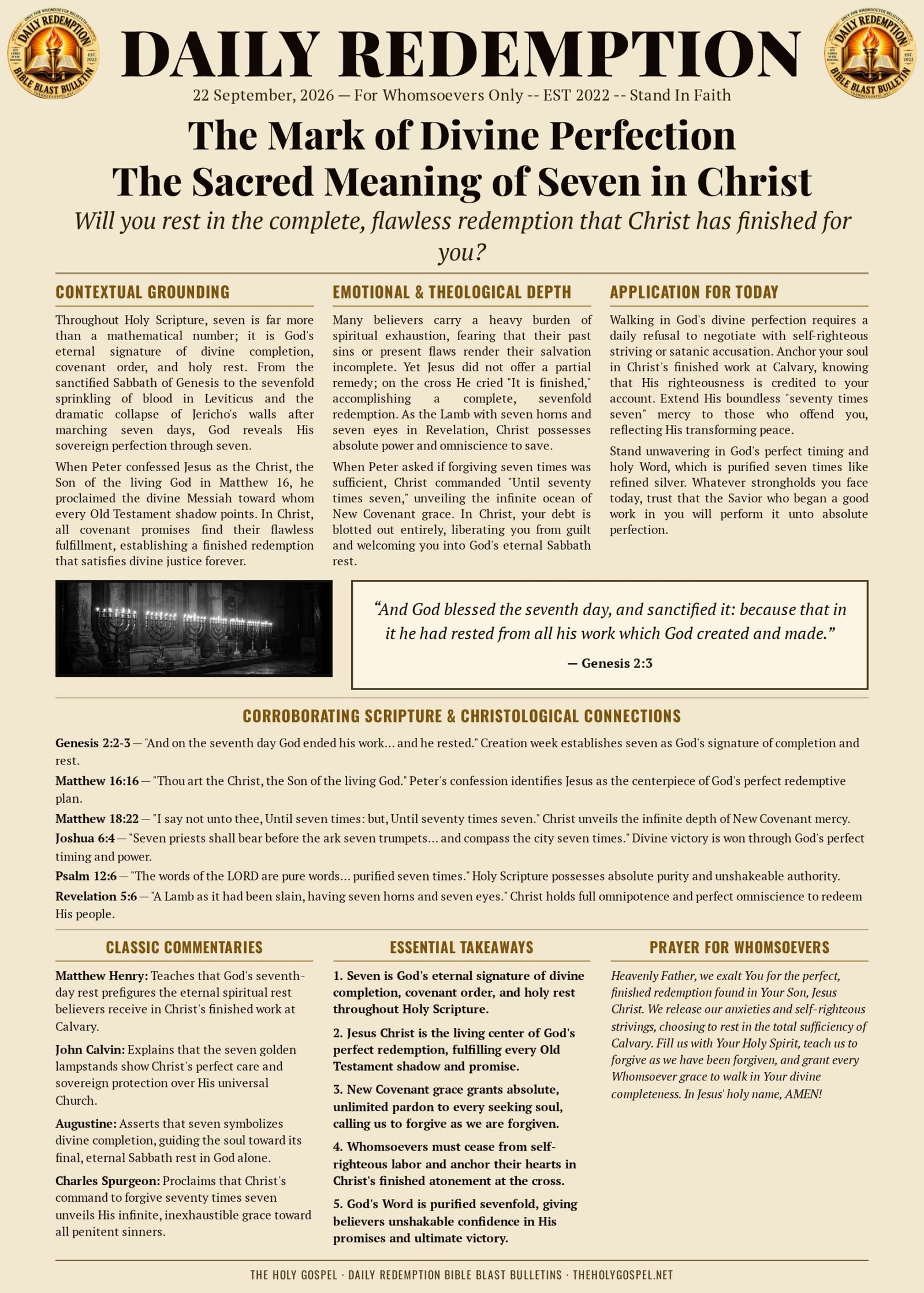
From the quiet rest of Creation Sabbath to the triumphant shouts at Jericho and the majestic visions of the Apocalypse, the number seven shines throughout Holy Scripture as God’s eternal signature of completion, covenant perfection, and divine fullness. When Peter confessed Jesus as the Christ, the Son of the living God in Matthew 16, he unlocked the ultimate reality toward which all biblical sevens point: that total spiritual completeness is found in the Savior alone. Jesus did not come to offer partial healing or incomplete grace, but a finished, perfect salvation that cleanses us entirely and invites us into eternal rest. For every Whomsoever seeking assurance today, resting in Christ means trusting that His redemptive work in your life is absolute, lacking nothing, and sealed forever by His sovereign power.
Contextual Grounding
In the ancient Hebrew mind and language, numbers were far more than neutral mathematical counters; they were rich, symbolic vehicles of divine revelation. The Hebrew root word for seven, sheba, is intimately tied to the verb shaba, which means to take an oath or to bind oneself in covenant fullness. When God completed the creation of the heavens and the earth in six days, Scripture records a monumental divine pause: “And on the seventh day God ended his work which he had made; and he rested on the seventh day from all his work which he had made. And God blessed the seventh day, and sanctified it: because that in it he had rested from all his work which God created and made” (Genesis 2:2-3). In this foundational ordinance, seven emerged as the divine stamp of finished perfection and sacred rest.
Throughout the Old Testament economy, this sevenfold pattern woven into the fabric of creation expanded into every aspect of Israel’s redemptive life. The liturgical calendar revolved around sevens: the seven-day Feast of Unleavened Bread, the seven-day Feast of Tabernacles, the Sabbatical Year observed every seventh year, and the grand Year of Jubilee arriving after a cycle of seven times seven years. In the sanctuary ritual, when the high priest made atonement for sin, he was commanded to sprinkle the sacrificial blood seven times before the veil of the sanctuary (Leviticus 4:6). When Israel confronted the mighty fortress of Jericho, God did not command human siege engines, but a sevenfold spiritual victory: seven priests bearing seven trumpets marched around the city for seven days, and on the seventh day they compassed the city seven times until the walls collapsed under divine power (Joshua 6:4-5).
When we examine the New Testament Gospel, this ancient shadow meets its glorious substance in the person of Jesus Christ. In Matthew 16:16, Simon Peter uttered the watershed declaration of human history: “Thou art the Christ, the Son of the living God.” Pointing out the providential harmony in Holy Scripture, where God’s hand weaves divine completion into the text itself, the numerical balance of Matthew 16:16—with digits on either side of the chapter and verse colon mirroring seven—beautifully underscores the perfect divine identity of the Messiah being proclaimed. Every Old Testament sabbath, every blood sprinkling, and every sevenfold promise pointed directly to the Lord Jesus, in whom all the fullness of the Godhead dwells bodily.
Emotional & Theological Depth
Why does the heart of a believer so often wrestle with spiritual fatigue, guilt, and lingering anxiety? The painful truth is that human life in a fallen world is defined by incompleteness. We struggle under the weight of unfinished goals, broken promises, and the tormenting fear that our repentance is never quite sincere enough or our righteousness never quite sufficient. Many Whomsoevers carry a secret, heavy burden, fearing that God’s grace toward them is conditional, partial, or on the verge of running out. They live in a perpetual state of spiritual exhaustion, striving to earn through self-righteous effort what can only be received through the finished work of Christ.
The sublime theological glory of the gospel is that Jesus Christ did not come to start a project and leave it half-done. When the Savior hung upon the cross at Calvary, enduring the full penalty for our transgressions, He cried out with His dying breath, “It is finished” (John 19:30). In the Book of Revelation, the glorified Christ is revealed as “a Lamb as it had been slain, having seven horns and seven eyes, which are the seven Spirits of God sent forth into all the earth” (Revelation 5:6). In biblical symbolism, horns represent power and eyes represent knowledge; thus, the seven horns and seven eyes declare that Christ possesses total omnipotence and absolute omniscience. His redemptive sacrifice is not a ninety-nine percent down payment requiring our feeble human works to complete; it is a total, flawless, sevenfold redemption that satisfies divine justice for all eternity.
This divine perfection transforms how we relate to God and to one another. When Peter asked Jesus in Matthew 18:21, “Lord, how oft shall my brother sin against me, and I forgive him? till seven times?”, Peter thought he was offering a lavish, extraordinary standard of mercy. But Jesus shattered human limitations by replying, “I say not unto thee, Until seven times: but, Until seventy times seven” (Matthew 18:22). Christ was not setting a mathematical limit of four hundred and ninety acts of pardon; He was revealing that New Covenant grace is unmeasurable, infinitely complete, and boundlessly abundant. Because Christ has forgiven us with a complete, everlasting pardon, whomsoevers who abide in Him are liberated from the prison of bitterness and brought into the eternal Sabbath of God’s favor.
Application For Today
For every Whomsoever striving to honor the Lord amidst the pressures and confusion of our modern world, applying the truth of divine completion begins with a conscious decision to stop bargaining with God. Cease from your self-righteous labors and enter into the spiritual rest that Christ has purchased for you. When Satan comes to accuse you of past failures or whisper that you are not worthy to be called a child of God, do not attempt to answer him with your own merits. Point him directly to the cross of Calvary and declare that your salvation is sealed, completed, and perfected in Jesus Christ. You do not walk in your own fragile strength; you stand securely in the finished righteousness of the Son of God.
Practically, living in the reality of God’s perfect seven means extending Christlike mercy to those who have offended or hurt you. If you are harboring resentment, bitterness, or an unforgiving spirit toward a family member, a friend, or a brother in Christ, recognize that you are clinging to a broken, incomplete standard. Christ has lavished upon you a “seventy times seven” forgiveness that wiped away a debt you could never repay. Release your grievances at the foot of the cross today. Forgiving others from the heart is not a surrender to injustice; it is the triumphant demonstration that the complete, transforming peace of Christ rules in your spirit.
Finally, rest with unwavering confidence in God’s sovereign timing and ultimate victory. Just as the walls of Jericho stood formidable until the seventh march on the seventh day, you may currently be facing spiritual strongholds that seem impossible to overcome. Do not despair or turn back in fear. Hold fast to the pure, flawless Word of God, which Psalm 12:6 describes as “silver tried in a furnace of earth, purified seven times.” Trust that the Lord who began a good work in you is faithful to bring it to perfect completion. Walk with holy bold courage, worship with passionate gratitude, and rejoice in the Savior whose victory in your life is absolute and eternal.
Classic Commentaries Corner
Matthew Henry observed on Genesis 2:2-3 that God rested on the seventh day not from weariness, but to signify the perfect completion of His creative work and to institute a holy Sabbath of spiritual delight. Henry noted that this seventh-day rest foreshadowed the eternal, unshakable rest that believers enjoy in Jesus Christ, who completed the greater work of the new creation at Calvary.
John Calvin emphasized on Revelation 1:12-20 that the seven golden candlesticks and seven stars represent the complete, universal Church preserved under the perpetual care and authority of Christ. Calvin asserted that the number seven signifies spiritual perfection and divine protection, assuring believers that despite earthly tribulations, the Savior walks in the midst of His churches and holds His ministers firmly in His sovereign right hand.
Augustine wrote in The City of God on the sacred symbolism of seven throughout Holy Scripture, explaining that seven represents the harmonious union of the divine and the created order. Augustine argued that human history and spiritual life culminate in a holy seventh day—an everlasting Sabbath wherein the redeemed find their ultimate rest, joyful contemplation, and eternal satisfaction in God alone.
Charles Spurgeon preached with burning zeal on Matthew 18:22, extolling the limitless, divine nature of Christ’s pardoning mercy. Spurgeon proclaimed that when Jesus commanded forgiveness until seventy times seven, He unveiled the vast, unmeasurable ocean of His own grace toward us; for if Christ requires His disciples to forgive infinitely, He Himself will never turn away a penitent sinner who seeks mercy at His feet.
Corroborating Scripture & Christological Connections
Genesis 2:2-3 — “And on the seventh day God ended his work which he had made; and he rested on the seventh day from all his work which he had made. And God blessed the seventh day, and sanctified it: because that in it he had rested from all his work which God created and made.” God’s creation week establishes seven as the eternal baseline of divine completion and sacred rest, anticipating the spiritual rest found in Christ.
Matthew 16:16 — “And Simon Peter answered and said, Thou art the Christ, the Son of the living God.” Peter’s inspired confession identifies Jesus as the divine Messiah, the centerpiece of God’s perfect redemptive plan whose very identity fulfills every Old Testament covenant shadow.
Matthew 18:21-22 — “Then came Peter to him, and said, Lord, how oft shall my brother sin against me, and I forgive him? till seven times? Jesus saith unto him, I say not unto thee, Until seven times: but, Until seventy times seven.” Christ elevates human forgiveness to mirror divine perfection, revealing that New Covenant grace is unmeasurable, complete, and endlessly abundant.
Joshua 6:4 — “And seven priests shall bear before the ark seven trumpets of rams’ horns: and the seventh day ye shall compass the city seven times, and the priests shall blow with the trumpets.” The dramatic fall of Jericho demonstrates that divine victory is achieved through sevenfold obedience and reliance on God’s perfect power rather than human weaponry.
Psalm 12:6 — “The words of the LORD are pure words: as silver tried in a furnace of earth, purified seven times.” David affirms the absolute perfection, flawless integrity, and divine authority of Holy Scripture, which stands completely uncorrupted across all generations.
Revelation 5:6 — “And I beheld, and, lo, in the midst of the throne and of the four beasts, and in the midst of the elders, stood a Lamb as it had been slain, having seven horns and seven eyes, which are the seven Spirits of God sent forth into all the earth.” John beholds the glorified Christ possessing the fullness of divine omnipotence and perfect omniscience to accomplish the total redemption of His people.
Essential Takeaways
1. Seven is God’s eternal signature of completion and covenant perfection. From the Sabbath rest of Genesis to the consummation of Revelation, Scripture uses seven to declare that God’s redemptive work is flawless, orderly, and entirely whole.
2. Jesus Christ is the living fulfillment of divine completeness. When Peter confessed Jesus as the Christ in Matthew 16, he proclaimed the Savior in whom all divine fullness dwells, offering a salvation that lacks nothing.
3. New Covenant grace provides complete, unlimited forgiveness. Christ’s command to forgive “seventy times seven” reveals the infinite depth of His own mercy at Calvary, where our sins were fully blotted out forever.
4. Believers are called to enter into Christ’s finished spiritual rest. Salvation is not a self-manufactured effort; Whomsoevers must cease from self-righteous labor and rest entirely in the completed atonement of the Son of God.
5. God’s Word and promises are purified sevenfold and totally reliable. Just as Psalm 12:6 declares God’s words purified seven times, believers can stand unshaken on the absolute purity and unfailing victory of Holy Scripture.
Prayer For Whomsoevers
Lord God Almighty, Heavenly Father of perfection and grace, we exalt Your holy name for the absolute completeness of Your redemptive plan in Jesus Christ. We thank You that our salvation is not a partial promise or an unfinished work, but a flawless, sevenfold redemption sealed by the precious blood of the Lamb. Forgive us for the times we have relied on our own self-righteous strivings or doubted Your perfect timing. We choose today to cease from our anxiety, lay down our burdens, and rest fully in the finished work of Calvary. Teach us to extend Your boundless “seventy times seven” mercy to others, reflecting Your pure love in a broken world. Strengthen every Whomsoever reading these words to stand firm in faith, knowing that the God who began a good work in us will perform it unto perfection. In the glorious and exalted name of Jesus Christ, our Lord and Redeemer, we say with joyful hearts, AMEN!