Refinement in the Heart of Fallen Man’s Utter Hopelessness, Unrighteousness and Despair
For the director of music. According to sheminith. A psalm of David.
Psalm 12 paints a grim portrait of humanity’s fallen condition — a world where faithfulness has vanished, lies flow freely, and the wicked strut openly when vileness is celebrated. Yet amid this despair, God promises to arise and protect the needy, and His words stand as silver purified in a crucible, like gold refined seven times. The crucible itself evokes both the fire of purification and the Cross, where Christ — the only truly righteous One — endured excruciating torment to refine a people for Himself. Even our seeking of God is compromised by self-interest until the Holy Spirit purifies us daily; our only hope is the flawless Word made flesh.
Psalm 12
1 Help, Lord, for no one is faithful anymore; those who are loyal have vanished from the human race.
2 Everyone lies to their neighbor; they flatter with their lips but harbor deception in their hearts.
3 May the Lord silence all flattering lips and every boastful tongue—
4 those who say, “By our tongues we will prevail; our own lips will defend us—who is lord over us?”
5 “Because the poor are plundered and the needy groan, I will now arise,” says the Lord. “I will protect them from those who malign them.”
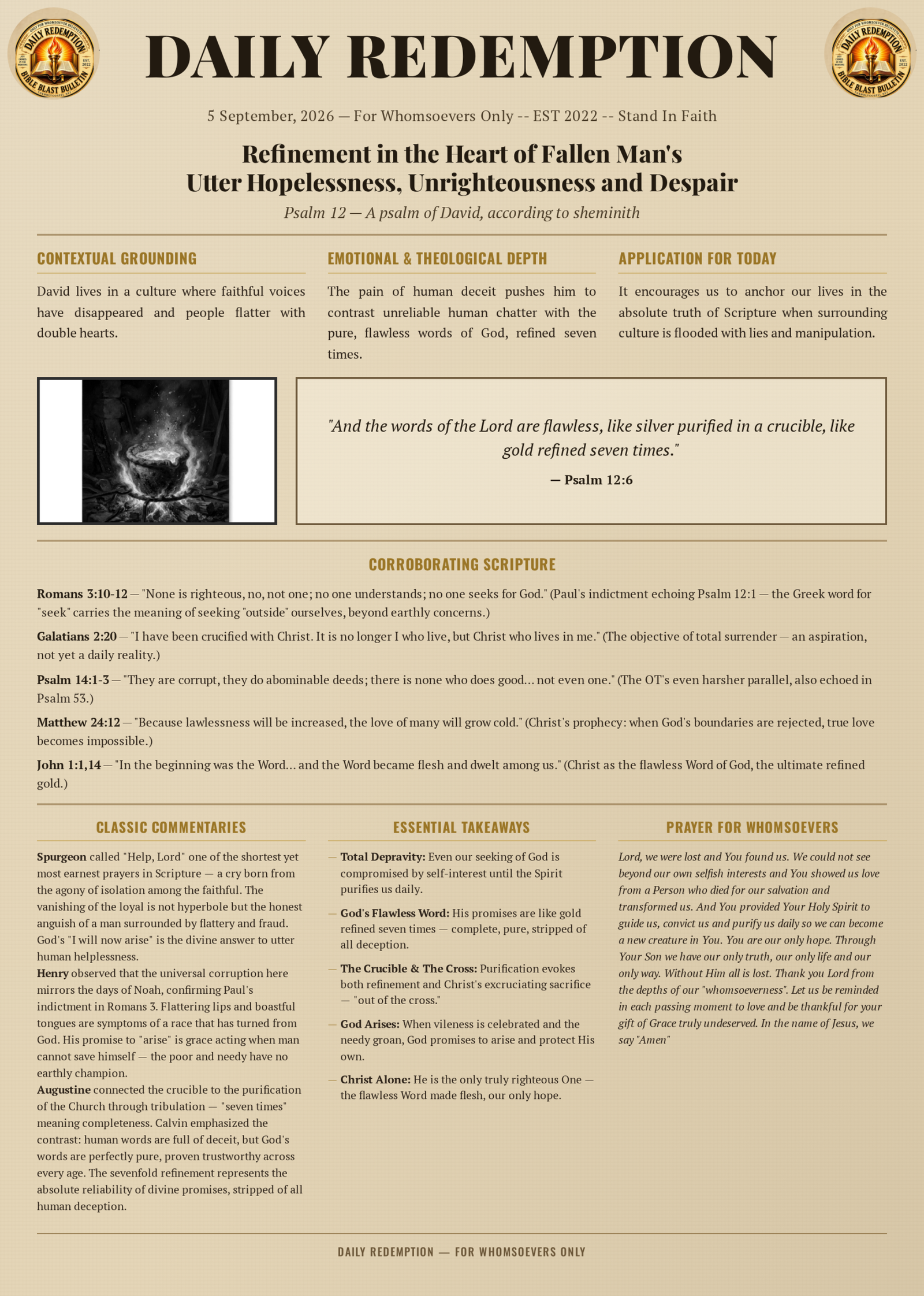
6 And the words of the Lord are flawless, like silver purified in a crucible, like gold refined seven times.
7 You, Lord, will keep the needy safe and will protect us forever from the wicked,
8 who freely strut about when what is vile is honored by the human race.
Commentary
Verse 1 is rife with corroborating scripture and you know where I am going with this. In Romans, Paul says, “None is righteous, no, not one; no one understands; no one seeks for God…” and of course we all respond, Paul aren’t you being a bit harsh? I am seeking God, there are people at my church who are searching for God. There is the old classic hymn about seeking the face of Jesus. Well, yeah maybe, but we are still fallen. We are still seeking the benefit of God rather than the person to whatever degree. Just meditate on the even more classic hymn “I Surrender All” and consider the meaning of “all”. I hereby submit for your consideration that if we truly were to surrender all we would never suffer, we could never suffer, we would (to bring in something totally disrelated) attain nirvana through Christian seeking. In fact we would no longer be seeking. We would be there. Galatians 2:20 says it is no longer me but Christ who lives through me. That is an objective to be attained not a daily reality. And before the Holy Spirit is convicting and purifying us on a daily basis none are righteous and their seeking for God is seeking God’s benefits and perks. Even peace is a benefit of God but not the Person. Sorry but case closed. Paul’s indictment stands. It has stood all this time and it will continue to stand until we are glorified and purified before the Lord forever.
So then where is the hope? In this hymn often sung to and by and with children. “Oh how I love Jesus, because He first loved me” The poor kids have no idea what an upper level, powerful and intense theological statement is disguised in that song as characterized by childlike simplicity.
One last point re Paul’s quote – the word “seek” from the Greek contains the meaning “outside” in other words, seeking outside of ourselves with out our Earthly concerns. None do that.
Oh and btw, it might not surprise to know that the Old Testament was even more harsh on the same point and it is in the Psalm that we will be covering on 7 September: “They are corrupt, they do abominable deeds; there is none who does good… they have all turned aside; together they have become corrupt; there is none who does good, not even one.” Psalm 14:1-3 and also in Psalm 53. Of course things are better than they were in the days of Noah. Aren’t they? Hmmmm?
And speaking of which, the Lord, Jesus, in Matthew in his prophesy of the end times does include in 14:12, “And because lawlessness will be increased, the love of many will grow cold.” When human beings reject God’s boundaries (lawlessness), true love becomes impossible. This results in nothing but attempts at self-preservation, deceit and manipulation when all human warmth is gone. The reductio ad absurdum. The direction that humanity in its fallen state could not ultimately avoid as it has cascaded down the ages in its ungodly state and majorly seeking out God, when and if at all, for benefits and perks and often seeking out God to disprove His existence and puruse fleshly rewards.
Verse 6 – Bible Gateway footnotes “gold” as “Earth” but gold is refined, not dirt. So this appears to refer to the hearth which could be as simple as a hole in the ground. Both images—an earthen ground furnace or a multi-stage gold refinement—serve the same spiritual point: God’s promises are completely stripped of human deception and proven totally pure.
In the same vein – 7 times means (as we know) to completion and 100% purity and set aside in total unity, stability and purity from all impurity, alteration, falsehood. Also, AI chimes in on the history of refining metals – Because ancient technology could not achieve perfectly sustained high temperatures, smiths had to cool, re-break, re-melt, and repeat the cycle multiple times to achieve high-purity bullion. Seven represents the absolute peak of this exhausting physical cycle.
The use of the word “crucible” in verse 6 might appear to be related to the word “cross”. And the mention of purification in a crucible also invokes the Cross. The original meaning though was not connected directly and intentionally. However, I can still find Messianic significance. Let us first turn to Merriam-Webster. YES! We are going to dig into the actual dictionary for the meaning of a word. How OG! lol! “Unless you’re studying Arthur Miller’s The Crucible in school, it may not be crucial to learn the story behind crucible, but it can’t hurt! Crucible looks like it should be closely related to the Latin combining form cruc- (“cross”); however, unlike crucial, it isn’t. It was forged instead from the Medieval Latin crucibulum, a noun for an earthen pot used to melt metals, and in English it first referred to a vessel made of a very heat-resistant material (such as porcelain) used for melting a substance that requires a high degree of heat. It’s possible that the resemblance between cruc- and crucible encouraged people to start using crucible to mean “a severe trial,” as that sense is synonymous with one meaning of cross, but the idea of simmering in a literal crucible also sounds plenty severe. The newest sense of crucible (“a situation in which great changes take place,” as in “forged in the crucible of war”) recalls the fire and heat required to transform some solids into liquids.”
So there you go – I let MW do it for me. I will add, though, that the etymology of the word does refer to an earthen “night-lamp” or a “melting pot for metals” and, are you ready? Ancient night lamps often had four burning wicks that formed the shape of a cross.
Moreover, because a literal metallurgical crucible undergoes extreme, punishing heat, people naturally associated it with the Latin verb cruciare (to torment/crucify), which gives us excruciating (literally, “out of the cross,” meaning pain so intense it feels like crucifixion) and it results in refinement and purification.
Classic Commentaries Corner
Charles Spurgeon noted Psalm 12:1 as one of the shortest yet most earnest prayers in all of Scripture — “Help, Lord” — a cry born from the agony of apparent isolation among the faithful. He observed that David felt himself nearly alone in a world of deceit, and that the vanishing of the loyal is not hyperbole but the honest perception of a man surrounded by flattery and fraud.
Matthew Henry observed that the universal corruption described here mirrors the days of Noah, confirming Paul’s later indictment in Romans 3. The flattering lips and boastful tongues are not merely social vices but symptoms of a race that has turned from God. Henry emphasized that God’s promise to “arise” is the divine response to human helplessness — grace acting when man cannot save himself.
Augustine connected the crucible imagery to the purification of the Church through tribulation, seeing the “seven times” as completeness and perfection. He taught that just as metal must be heated repeatedly to remove every impurity, so the people of God are refined through trials until nothing false remains.
John Calvin emphasized the contrast between human words — full of deceit and flattery — and God’s words, which are perfectly pure. The sevenfold refinement represents the absolute reliability of divine promises, stripped of all human deception and proven totally trustworthy.
Corroborating Scripture & Christological Connections
Romans 3:10-12 — “None is righteous, no, not one; no one understands; no one seeks for God.” Paul’s indictment directly echoes Psalm 12:1. The Greek word for “seek” carries the meaning of seeking “outside” ourselves, beyond our earthly concerns — and none do that in their fallen state. Even our seeking is compromised by self-interest until the Holy Spirit convicts and purifies us daily.
Galatians 2:20 — “I have been crucified with Christ. It is no longer I who live, but Christ who lives in me.” This is the objective of total surrender — an aspiration to be attained, not yet a daily reality. If we truly surrendered all, we would no longer be seeking. We would be there. The crucible of daily conviction is what moves us toward that goal.
Psalm 14:1-3 — “They are corrupt, they do abominable deeds; there is none who does good… not even one.” (Also echoed in Psalm 53.) The Old Testament was even harsher than Paul on the same point. Things are no better than in the days of Noah — human nature has not evolved, only its methods have.
Matthew 24:12 — “And because lawlessness will be increased, the love of many will grow cold.” Christ’s prophecy of the end times: when human beings reject God’s boundaries (lawlessness), true love becomes impossible. What remains is self-preservation, deceit, and manipulation — the reductio ad absurdum of fallen humanity.
John 1:1, 14 — “In the beginning was the Word… and the Word became flesh and dwelt among us.” Christ is the flawless Word of God — the ultimate gold refined seven times, the living embodiment of everything Psalm 12:6 describes. The crucible of the Cross purified Him through excruciating suffering, and through that purification He refines a people for Himself.
1 John 4:19 — “We love because He first loved us.” The children’s hymn “Oh How I Love Jesus” contains a powerful theological truth disguised in childlike simplicity: our love is only a response to His prior, initiating love. We do not seek God; He seeks us. The hope in Psalm 12’s despair is not that we find God, but that God finds us.
Essential Takeaways
- Total Depravity: Even our seeking of God is compromised by self-interest until the Holy Spirit purifies us daily. We seek God’s benefits and perks rather than His Person. Paul’s indictment stands — case closed.
- God’s Flawless Word: His promises are like silver purified in a crucible, like gold refined seven times — complete, pure, stripped of all human deception. Seven represents the absolute peak of the exhausting cycle of refinement.
- The Crucible and the Cross: Though etymologically unrelated, the crucible evokes the Cross through association — the Latin cruciare (to torment/crucify) gives us “excruciating,” literally “out of the cross.” Ancient night lamps with four burning wicks formed the shape of a cross. Purification and crucifixion are inseparably linked.
- God Arises for the Needy: When vileness is honored by the human race and the wicked strut freely, God promises to arise and protect the needy. His response to human helplessness is grace in action.
- Christ Alone Is Our Hope: He is the only truly righteous One — the flawless Word made flesh. “Oh how I love Jesus, because He first loved me” — a child’s hymn hiding the deepest theological truth: our only hope is His initiating love.
Prayer For Whomsoevers
Lord, we were lost and You found us. We could not see beyond our own selfish interests and You showed us love from a Person who died for our salvation and transformed us. And You provided Your Holy Spirit to guide us, convict us and purify us daily so we can become a new creature in You. You are our only hope. Through Your Son we have our only truth, our only life and our only way. Without Him all is lost. Thank you Lord from the depths of our “whomsoeverness”. Let us be reminded in each passing moment to love and be thankful for your gift of Grace truly undeserved. In the name of Jesus, we say “Amen”