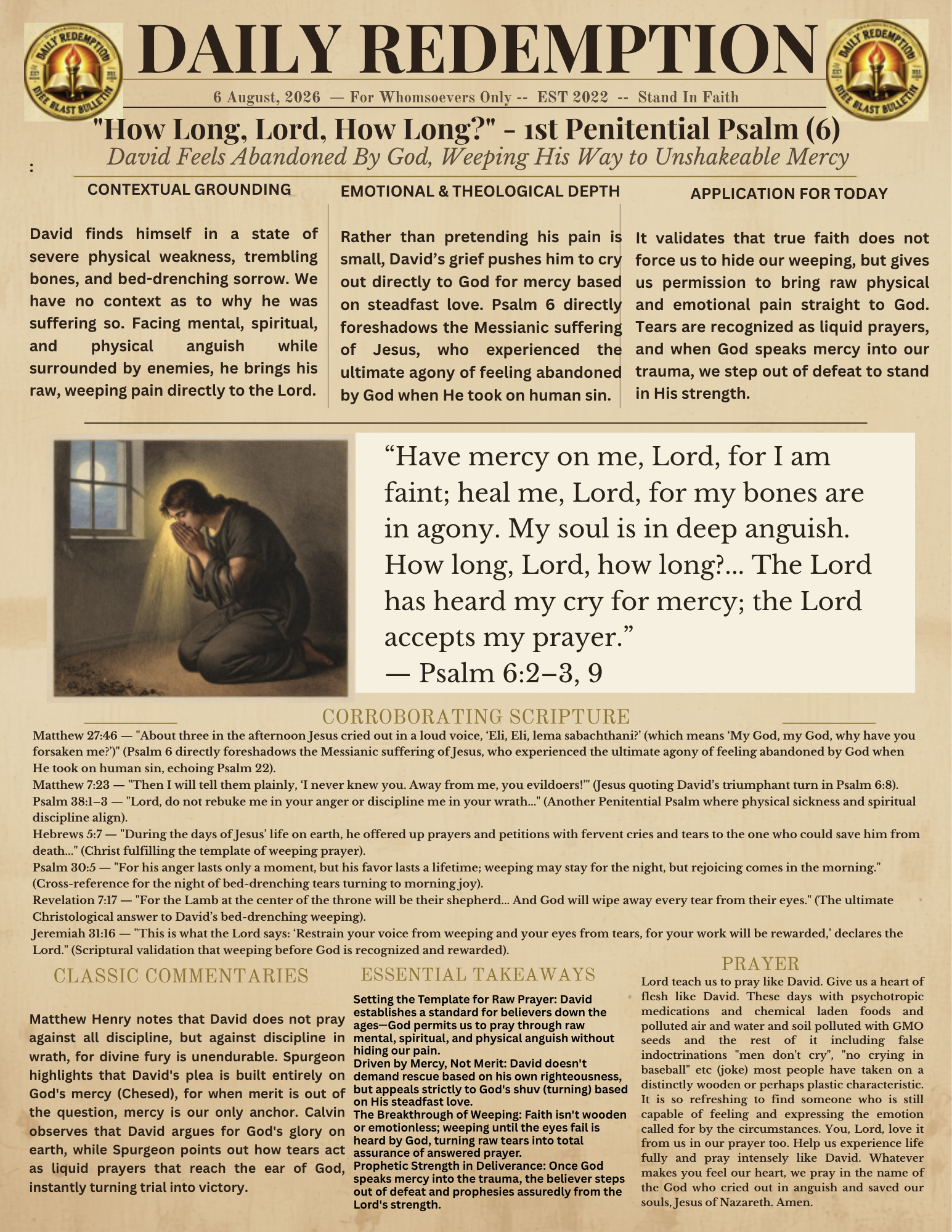
Psalm 6
Psalm 6 directly foreshadows the Messianic suffering of Jesus, who experienced the ultimate agony of feeling abandoned by God when He took on human sin. This connection peaks on the cross when Jesus cries out the opening words of another penitential lament, “My God, my God, why have you forsaken me?” which was also Jesus echoing scripture from Psalm 22. Jesus was experiencing the exact spiritual isolation David feared, yet securing the ultimate answer to David’s prayer for deliverance.
Contextual Grounding: David finds himself in a state of severe physical weakness, trembling bones, and bed-drenching sorrow. We have no context as to why he was suffering so)
Emotional & Theological Depth: Rather than pretending his pain is small, David’s grief pushes him to cry out directly to God for mercy based on steadfast love.
Application: It validates that true faith does not force us to hide our weeping, but gives us permission to bring raw physical and emotional pain straight to God.
II. HISTORICAL-REDEMPTIVE ANALYSIS
Contextual Grounding: David finds himself in a state of severe physical weakness, trembling bones, and bed-drenching sorrow. We have no context as to why he was suffering so.
Emotional & Theological Depth: Rather than pretending his pain is small, David’s grief pushes him to cry out directly to God for mercy based on steadfast love.
Application: It validates that true faith does not force us to hide our weeping, but gives us permission to bring raw physical and emotional pain straight to God.
III. CORE COMMENTARY
1 Lord, do not rebuke me in your anger or discipline me in your wrath.
Zeb Commentary: It is amazing that all these millennia later David still demonstrates to us and sets new prompts and standards for us modern humans and believers as to how we can pray and what we can say in the presence of and to the Lord. Here he tells God not to be angry or discipline him. One has to wonder what David did at this point that he was feeling so vulnerable about before the Lord. He was probably still fleeing Absalom and surrounded by enemies. Clearly, though, it was mental, spiritual and physical anguish.
[CLASSIC COMMENTARY]: Matthew Henry notes that David does not pray against all discipline, but specifically against discipline administered in wrath: “He does not deprecate the rebuke, but the rebuke in anger… Divine chastisement is tolerable, but Divine fury is unendurable.”
2 Have mercy on me, Lord, for I am faint; heal me, Lord, for my bones are in agony.
Zeb Commentary: He knew, perhaps, the Lord would forgive his tone because the pain was speaking. Mercy is something that we ask for often on Sunday mornings and that we should ask for more often. When I first joined BC we were doing a song about mercy in the worship. I felt like that was very on-point. Something we should ask for more often. When you don’t feel God’s love think for a moment how miserable our existences might be if we served a God who was not inclined to be merciful.
[CLASSIC COMMENTARY]: Charles Spurgeon (Treasury of David) points out that David’s plea appeals directly to human weakness and divine compassion: “An agony of body added to a grief of mind. The bones are the pillars of the house; when these shake, the whole building totters. His plea is not his merit, but his misery.”
3 My soul is in deep anguish. How long, Lord, how long?
Zeb Commentary: This is beautiful. He is petitioning and asking the question that many millions have asked after him when they were suffering. Again, David sets the template for so much prayer that would come after him.
[CLASSIC COMMENTARY]: Matthew Henry observes that delay in relief is often the hardest part of the trial: “‘How long?’ is the constant voice of the suffering saint. It is a question born of intense longing for reconciliation, not rebellion against God’s timeline.”
4 Turn, Lord, and deliver me; save me because of your unfailing love.
Zeb Commentary: The word “turn” is interesting. Amazing how the use of one word by David can be a topic of discussion for scholars and theologians down the ages. Why? In Hebrew, Shuvah, Yahweh! (“Turn, O Lord!”), is a kind of repentance. But we know by now that repentance means to turn in your mind from one road onto a road that embraces more godly attributes. Even though David is asking God to turn in this specific sentence, Psalm 6 is traditionally classified as the very first of the Bible’s Seven Penitential Psalms (alongside Psalms 32, 38, 51, 102, 130, and 143). David’s grief and physical agony in the surrounding verses show a heart deeply broken by sin. He acknowledges that he has no right to demand rescue; instead, he asks God to shuv purely “for the sake of your steadfast love”.
[CLASSIC COMMENTARY]: Charles Spurgeon highlights the shift to God’s covenant grace: “God’s turning to us is our salvation. Note that David builds his argument entirely on God’s mercy (Chesed), for when merit is out of the question, mercy is our only anchor.”
5 Among the dead no one proclaims your name. Who praises you from the grave?
Zeb Commentary: “think it over, Lord” wow. nobody will praise you from the grave.
[CLASSIC COMMENTARY]: John Calvin notes that David is arguing for the continuation of God’s glory on earth: “David does not deny a future life, but argues that in the realm of the dead, there is no public assembly of the church to magnify God’s name before men.”
6 I am worn out from my groaning. All night long I flood my bed with weeping and drench my couch with tears. 7 My eyes grow weak with sorrow; they fail because of all my foes.
Zeb Commentary: At least he had a couch. I always imagine David in a cave somewhere when he is at the low points of his emotional arch but he had a couch.
[CLASSIC COMMENTARY]: Matthew Henry remarks on the depth of David’s emotional overflow: “Sorrow that is kept inside consumes the spirit, but weeping before the Lord vents the grief. Tears are liquid prayers when the tongue is too heavy to speak.”
8 Away from me, all you who do evil, for the Lord has heard my weeping.
Zeb Commentary: For the Lord has heard my weeping. Intense and beautiful and amazing. David felt some alleviation of mental, spiritual, physical trauma or he just heard the voice of God coming back to him with mercy after His wrath and there has now been another discussion in the midst of David’s Psalm scribing. And then we get clued in…
[CLASSIC COMMENTARY]: Charles Spurgeon emphasizes the sudden change of tone: “What a sudden transition! Faith has won the victory. Tears have a voice that reaches the ear of God, and once the assurance of pardon arrives, the believer instantly dismisses the workers of iniquity.”
9 The Lord has heard my cry for mercy; the Lord accepts my prayer.
Zeb Commentary: We all pray sometimes. Perhaps we get mad if we feel the Lord has not responded. But did we pray like David until our tears been so intense that our eyes fail us?
[CLASSIC COMMENTARY]: Matthew Henry underlines the double confirmation: “He repeats it: ‘The Lord has heard… the Lord will receive.’ Assurance of past mercy gives unshakeable confidence for present and future acceptance.”
10 All my enemies will be overwhelmed with shame and anguish; they will turn back and suddenly be put to shame.
Zeb Commentary: Here is David prophesying assuredly from a point of strength – not his, the Lord’s.
[CLASSIC COMMENTARY]: Charles Spurgeon notes the judicial turn of fate: “The shame that once belonged to David now falls upon his adversaries. Their retreat is sudden, for when God acts, the dispersion of the wicked happens in an instant.”
IV. CORROBORATING SCRIPTURE & CHRISTOLOGICAL CONNECTIONS
Matthew 27:46 — “About three in the afternoon Jesus cried out in a loud voice, ‘Eli, Eli, lema sabachthani?’ (which means ‘My God, my God, why have you forsaken me?’)” (Psalm 6 directly foreshadows the Messianic suffering of Jesus, who experienced the ultimate agony of feeling abandoned by God when He took on human sin, echoing Psalm 22).
Matthew 7:23 — “Then I will tell them plainly, ‘I never knew you. Away from me, you evildoers!'” (Jesus quoting David’s triumphant turn in Psalm 6:8).
Psalm 38:1–3 — “Lord, do not rebuke me in your anger or discipline me in your wrath…” (Another Penitential Psalm where physical sickness and spiritual discipline align).
Hebrews 5:7 — “During the days of Jesus’ life on earth, he offered up prayers and petitions with fervent cries and tears to the one who could save him from death…” (Christ fulfilling the template of weeping prayer).
Psalm 30:5 — “For his anger lasts only a moment, but his favor lasts a lifetime; weeping may stay for the night, but rejoicing comes in the morning.” (Cross-reference for the night of bed-drenching tears turning to morning joy).
Revelation 7:17 — “For the Lamb at the center of the throne will be their shepherd… And God will wipe away every tear from their eyes.” (The ultimate Christological answer to David’s bed-drenching weeping).
Jeremiah 31:16 — “This is what the Lord says: ‘Restrain your voice from weeping and your eyes from tears, for your work will be rewarded,’ declares the Lord.” (Scriptural validation that weeping before God is recognized and rewarded).
V. ESSENTIAL TAKEAWAYS
Setting the Template for Raw Prayer: David establishes a standard for believers down the ages—God permits us to pray through raw mental, spiritual, and physical anguish without hiding our pain.
Driven by Mercy, Not Merit: David doesn’t demand rescue based on his own righteousness, but appeals strictly to God’s shuv (turning) based on His steadfast love.
The Breakthrough of Weeping: Faith isn’t wooden or emotionless; weeping until the eyes fail is heard by God, turning raw tears into total assurance of answered prayer.
Prophetic Strength in Deliverance: Once God speaks mercy into the trauma, the believer steps out of defeat and prophesies assuredly from the Lord’s strength.
VI. PRAYER FOR WHOMSOEVERS
Lord teach us to pray like David. Give us a heart of flesh like David. These days with psychotropic medications and chemical laden foods and polluted air and water and soil polluted with GMO seeds and the rest of it including false indoctrinations “men don’t cry”, “no crying in baseball” etc (joke) most people have taken on a distinctly wooden or perhaps plastic characteristic. It is so refreshing to find someone who is still capable of feeling and expressing the emotion called for by the circumstances. You, Lord, love it from us in our prayer too. Help us experience life fully and pray intensely like David. Whatever makes you feel our heart, we pray in the name of the God who cried out in anguish and saved our souls, Jesus of Nazareth. Amen.