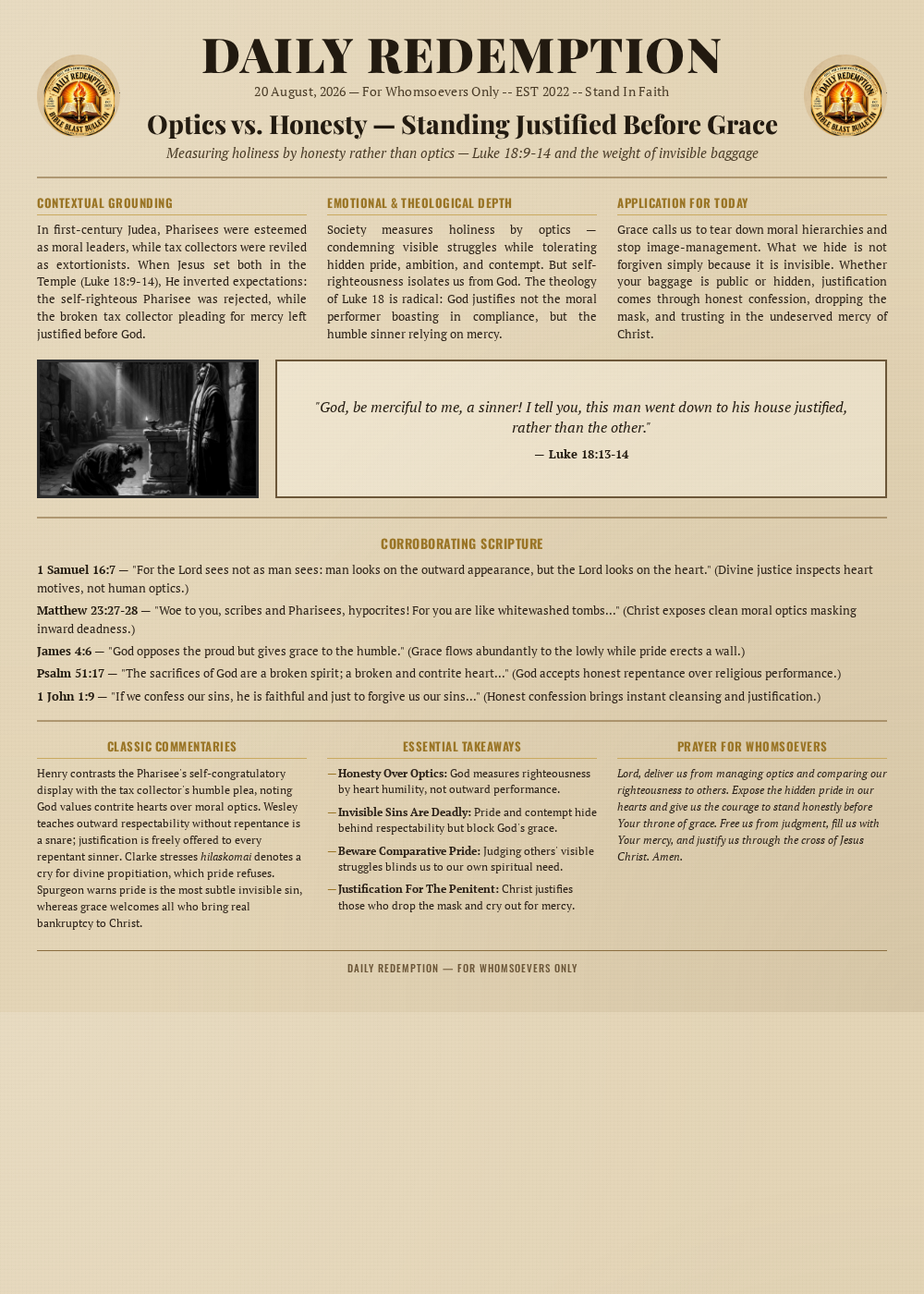
Optics vs. Honesty — Standing Justified Before Grace
The Daily Redemption Bible Blast Bulletin — 20 August 2026 — For Whomsoevers Only — EST 2022 — Stand In Faith
Human judgment relies on optics, condemning visible struggles while quietly tolerating invisible pride, but God measures righteousness by heart honesty. In Luke 18:9–14, Jesus confronts our moral hierarchies through the Pharisee and the tax collector, revealing that self-righteous contempt isolates us from God while humble confession opens the floodgates of grace. True redemption begins when we drop the mask, stop managing our image, and bring our real baggage before the throne of mercy. Anyone who cries out for God’s grace will go down to their house justified — for whomsoevers only.
Section I — Scripture Passage
Primary Scripture: Luke 18:13-14 — “But the tax collector, standing far off, would not even lift up his eyes to heaven, but beat his breast, saying, ‘God, be merciful to me, a sinner!’ I tell you, this man went down to his house justified, rather than the other. For everyone who exalts himself will be humbled, but the one who humbles himself will be exalted.”
Supporting Scriptures:
Luke 18:9-10 — “He also told this parable to some who trusted in themselves that they were righteous, and treated others with contempt: ‘Two men went up into the temple to pray, one a Pharisee and the other a tax collector.'”
1 Samuel 16:7 — “For the Lord sees not as man sees: man looks on the outward appearance, but the Lord looks on the heart.”
Matthew 23:27-28 — “Woe to you, scribes and Pharisees, hypocrites! For you are like whitewashed tombs, which outwardly appear beautiful, but within are full of dead people’s bones and all uncleanness.”
Section II — Historical-Redemptive Analysis
Contextual Grounding
In first-century Judea, Pharisees were esteemed as the pinnacle of moral purity and religious devotion, while tax collectors were reviled as traitorous extortionists in league with Rome. When Jesus set these two men side-by-side in the Temple, His audience anticipated praise for the Pharisee and condemnation for the tax collector. Instead, Jesus inverted cultural expectations. The Pharisee stood and prayed about himself, listing his fasting and tithing while treating others with contempt. The tax collector stood far off, beat his breast, and pleaded for God’s mercy. Jesus’ declaration that the tax collector left justified shattered the religious optics of the day, proving that covenant mercy responds to heart confession rather than performative righteousness.
Emotional & Theological Depth
There is a quiet tragedy in hiding behind invisible baggage. Society and religious institutions easily construct a moral hierarchy based on optics: visible struggles draw public scorn, while invisible sins — such as pride, ambition, and contempt — are quietly tolerated. The Pharisee felt secure because his sins were clean, respectable, and hidden behind religious discipline. But self-righteous contempt is a devastating barrier to grace. The tax collector, stripped of all pretense, had nothing to offer except his spiritual bankruptcy. The theology of Luke 18 is radical: God does not justify the moral performer who boasts in his compliance; He justifies the penitent sinner who trusts in His mercy.
Application For Today
Today’s Church and culture remain deeply tempted to measure holiness by optics instead of honesty. We judge those whose failures are public while envying those who harbor deceitful contentments and subtle self-sufficiency. But what we hide is not forgiven simply because it is invisible to human eyes, and what we judge in others often reflects the pride we refuse to acknowledge in ourselves. Grace calls us to tear down our artificial moral ladders. Whether your baggage is public and messy or quiet and refined, the path to justification is identical: standing before God with honest confession, dropping the mask, and casting yourself entirely upon the undeserved mercy of Jesus Christ.
Section III — Core Commentary
There’s a peculiar irony in how people handle brokenness. The sins and struggles that are most visible often draw the harshest judgment, while the invisible ones are quietly tolerated or even respected. We scorn the addict but admire the ambitious. We pity the divorced but envy the deceitfully content. The Church, at its best, offers grace to both. But too often, it mirrors the world’s moral hierarchy, measuring holiness by optics instead of honesty.
In Luke 18:9–14, Jesus confronts that very instinct. The parable of the Pharisee and the tax collector is more than a lesson in humility. It’s a piercing commentary on how human beings misjudge righteousness. It reveals how easy it is to hide behind invisible sins like pride and contempt while condemning those whose failures are simply more public. What we see isn’t always what God sees. And what we hide isn’t always forgiven simply because it’s invisible.
Two men went up to pray, but they walked in two entirely different directions. The Pharisee stood proudly, thanking God for his own performance and contrasting himself with those he deemed inferior. But the tax collector stood far off, beat his chest, and cried: “God, be merciful to me, a sinner!” Jesus delivered the ultimate verdict: the broken tax collector went home justified, while the self-satisfied Pharisee remained stranded in his own illusion.
The Daily Redemption is published by Zeb who attends Beach Church in Virginia Beach, Virginia. Here are some of his own lyrics excerpts on the topic of today’s Daily Redemption:
Polished on the outside, looking clean and clear
Hiding all the heavy baggage that we hold so dear
Pharisee on the corner, counting up his pride
Tax collector in the corner, nowhere left to hide
God be merciful to me, a sinner in the dark
Cleanse me from the hidden sins burning in my heart
Grace for the broken, grace for the blind
Hello justification, peace in my mind
God don’t judge by optics, He looks right through the show
Undeserved mercy is the only way I know
Grace on my mind, free at last
Leaving all my baggage down in the past
Section IV — Classic Commentaries Corner
Matthew Henry notes that the Pharisee’s prayer was not true prayer at all, but a boastful self-eulogy that trusted in legalistic performance while treating others with scorn. Henry observes that the tax collector’s humble plea — “God, be merciful to me, a sinner” — was accepted because God delights in contrite hearts. God rejects the proud who build their hope on outward optics, but lifts up those who cast themselves on His free mercy.
John Wesley teaches that self-righteousness is one of the most dangerous obstacles to salvation because it blinds men to their absolute need for a Redeemer. Wesley stresses that outward respectability without inward repentance is merely a whitewashed grave. Justification is never earned through moral performance, but is freely offered to every “whomsoever” who humbly turns to Christ in faith.
Adam Clarke highlights the Greek term hilaskomai used by the tax collector, which specifically denotes a plea for divine propitiation through an atoning sacrifice. Clarke notes that while the Pharisee relied on his own fasting and tithing, the tax collector placed his reliance entirely upon God’s provided atonement. Clarke emphasizes that no amount of respectable, hidden pride can save a soul, whereas honest confession opens the fountain of sovereign grace.
Charles Spurgeon preached forcefully that “pride is the monarch of human sins,” warning that religious optics often mask spiritual deadness. Spurgeon pointed out that Christ came into the world to save real, self-acknowledged sinners — not those who dress themselves in comparative morality. The tax collector went home justified because he brought his raw bankruptcy to a rich Savior.
Section V — Corroborating Scripture & Christological Connections
1 Samuel 16:7 — “For the Lord sees not as man sees: man looks on the outward appearance, but the Lord looks on the heart.” (Human judgment relies on optics and social hierarchy, but divine justice inspects the motives and posture of the hidden inner heart.)
Matthew 23:27-28 — “Woe to you, scribes and Pharisees, hypocrites! For you are like whitewashed tombs, which outwardly appear beautiful, but within are full of dead people’s bones and all uncleanness.” (Jesus repeatedly exposes the spiritual danger of maintaining clean moral optics while harboring inward corruption.)
Proverbs 16:18 — “Pride goes before destruction, and a haughty spirit before a fall.” (Invisible sins like arrogance and self-sufficiency are often far more catastrophic to the soul than public failures.)
James 4:6 — “God opposes the proud but gives grace to the humble.” (The central Christological truth of redemption: grace flows abundantly to the lowly, while pride erects a wall against God’s mercy.)
Romans 3:23-24 — “For all have sinned and fall short of the glory of God, and are justified by his grace as a gift, through the redemption that is in Christ Jesus.” (Paul dismantles all human moral hierarchies — both visible and invisible sins require the exact same precious blood of Christ.)
Section VI — Additional Corroborating Scripture
Psalm 51:17 — “The sacrifices of God are a broken spirit; a broken and contrite heart, O God, you will not despise.” (David understood that God rejects outward ritual performance when it lacks genuine, heart-level repentance.)
1 John 1:8-9 — “If we say we have no sin, we deceive ourselves, and the truth is not in us. If we confess our sins, he is faithful and just to forgive us our sins and to cleanse us from all unrighteousness.” (Honesty before God brings instant cleansing, while image-management perpetuates spiritual death.)
Galatians 6:3 — “For if anyone thinks he is something, when he is nothing, he deceives himself.” (Paul warns against the subtle delusion of comparative righteousness that leads us to look down on others.)
Isaiah 64:6 — “We have all become like one who is unclean, and all our righteous deeds are like a polluted garment.” (Even our most respectable, polished moral accomplishments are filthy rags apart from the justifying grace of Christ.)
Section VII — Essential Takeaways
— God Judges By Heart Honesty, Not Outward Optics: Human systems celebrate polished appearances, but God justifies those who come with transparent humility.
— Invisible Sins Are Equally Deadly: Pride, ambition, and contempt hide easily behind social respectability, but they alienate us from the grace of God.
— Beware The Trap Of Comparative Righteousness: Measuring your holiness against someone else’s visible struggles is a deceptive snare that blinds you to your own need for mercy.
— Justification Belongs To The Penitent: Jesus declares that the one who humbles himself and cries for mercy goes home justified before God.
— Grace Is Open To Whomsoevers Who Stop Pretending: Whether your baggage is public or hidden, Christ invites you to lay it down at the cross and receive His free forgiveness.
Section VIII — Prayer for Whomsoevers
Lord God Heavenly Father, we come before You acknowledging that we so easily fall into the trap of measuring holiness by optics rather than honesty. Forgive us for the times we have judged others for their visible struggles while quietly harboring our own invisible pride, contempt, and self-sufficiency. Strip away our need for religious performance and image-management. Give us the heart of the tax collector — a heart that stops pretending, beats upon its breast, and cries out for Your propitiating mercy. We thank You that Jesus came to justify sinners, not the self-righteous. Let Your grace wash over every “whomsoever” who feels weighed down by public shame or trapped in secret pride. May we walk in true humility, standing justified not by our works, but by the precious blood of Jesus Christ our Lord. Amen.
Daily Redemption — For Whomsoevers Only — Stand In Faith