Psalms 101-105 offer a powerful roadmap to forgiveness, restoration, and healing. This commentary unpacks the emotional depth of David’s prayers and the spiritual renewal they invite.
Finding Forgiveness and Healing -Psalms 101-105 Devotional


Forged in Scripture. Tested in sorrow and pain. Offered in humility and surrender. Confirmed in you. Joy comes in the morning.
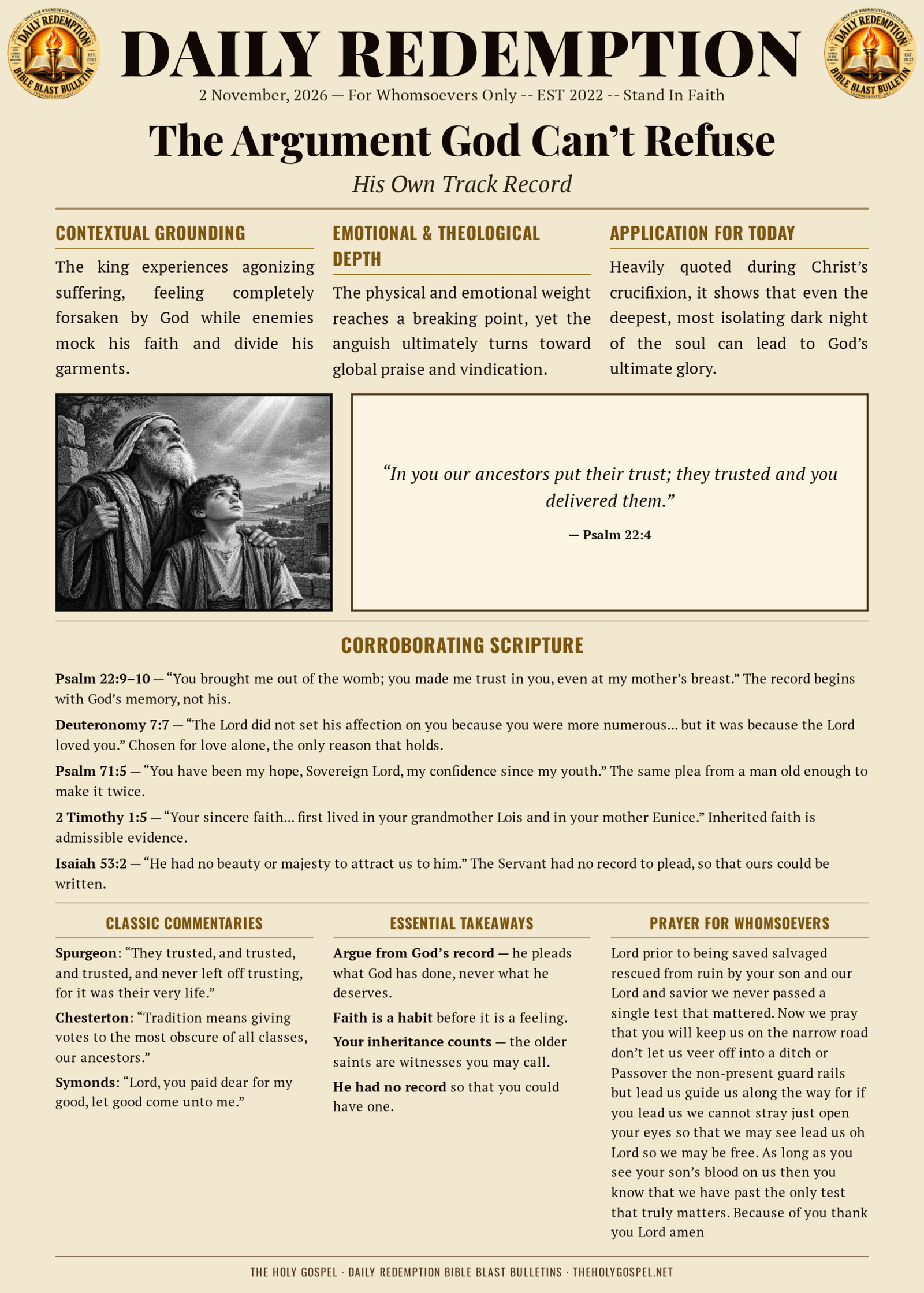
Before anything improves in Psalm 22, the sufferer starts remembering. He does not argue from his own worth, he argues from God’s history, from fathers who trusted and were delivered, and from his own birth, pulled from the womb and laid on his mother’s breast. Isaiah 53 is the deliberate contrast in the same breath, because the Servant has no rescue history to cite, having grown up like a tender shoot with no beauty to attract anyone. One man pleads a deliverance he can name and the other is the reason the deliverance exists at all. This is not putting God to the test; it is remembering that God made the test, set its terms, and passed it first. Before anything improves, the psalmist starts remembering. He reminds God what God has already done, from the fathers who trusted and were delivered down to his own birth, pulled from the womb and laid on his mother’s breast. Under silence, faith pleads precedent. Isaiah 53 is the deliberate contrast in the same post, because the Servant has no rescue history to cite, having grown up like a tender shoot with no beauty to attract anyone. One man argues from a deliverance he can name. The other is the reason the deliverance exists at all. Deuteronomy 7 and Psalm 71 stand with this one, and so does Paul’s reminder to Timothy about Lois and Eunice, because inherited faith is evidence you are allowed to cite. And far from being an instance of putting the Lord to the test, what we find here is a reminder that the Lord made the test, set the parameters, and is always the first one to pass. Contextual Grounding The king experiences agonizing suffering, feeling completely forsaken by God while enemies mock his faith and divide his garments. Emotional & Theological Depth The physical and emotional weight reaches a breaking point, yet the anguish ultimately turns toward global praise and vindication. Application Heavily quoted during Christ’s crucifixion, it shows that even the deepest, most isolating dark night of the soul can lead to God’s ultimate glory. Classic Commentaries Corner Spurgeon on the repetition: “Three times over is it mentioned, they trusted, and trusted, and trusted, and never left off trusting, for it was their very life.” Faith here is not a single decision but a habit worn into the grain. He adds, a few verses later, “Faith finds weapons everywhere. He who wills to believe shall never lack reasons for believing.” G.K. Chesterton on why an old record still counts: “Tradition means giving votes to the most obscure of all classes, our ancestors. It is the democracy of the dead.” This psalm is exactly that vote, cast by a man out of options on behalf of generations who are no longer in the room. Joseph Symonds , the Puritan, praying from the far side of it: “Lord, you paid dear for my good, let good come unto me.” He does not appeal to his own record. He appeals to the price already paid. Alexander Wedderburn on the two words doing the work: “This word, My God, takes in more than all the philosophers in the world could draw out of it.” The whole argument of this psalm hangs on the possessive. Not the God, but my God. Corroborating Scripture & Christological Connections Psalm 22:4–5 — “In you our ancestors put their trust; they trusted and you delivered them. To you they cried out and were saved; in you they trusted and were not put to shame.” He argues from precedent, not from merit.