Unsilenced In The Cistern — Preaching From The Pit
The Daily Redemption Bible Blast Bulletin — 24 August 2026 — For Whomsoevers Only — EST 2022 — Stand In Faith
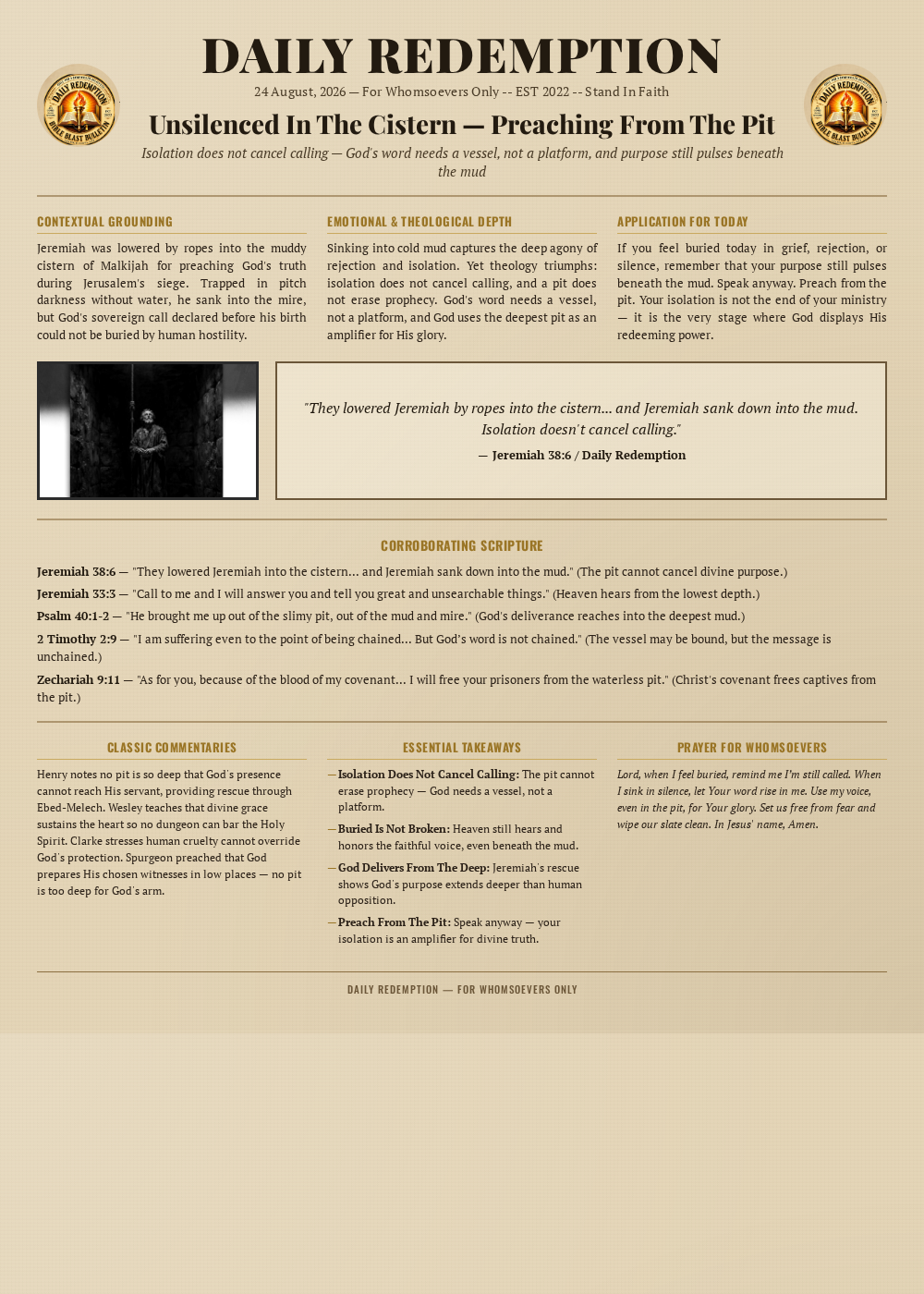
Jeremiah was lowered into a dark cistern and sank into the mud, silenced by fear and politics, but isolation could not cancel his divine calling. God’s word does not require a public platform; it requires a faithful vessel willing to speak even in obscurity. When you feel buried in grief, rejection, or silence, remember that your purpose still pulses beneath the surface. Preach from the pit — for God transforms your deepest isolation into an amplifier for His glory.
Section I — Scripture Passage
Primary Scripture: Jeremiah 38:6 — “So they took Jeremiah and put him into the cistern of Malkijah, the king’s son, which was in the courtyard of the guard. They lowered Jeremiah by ropes into the cistern; it had no water in it, only mud, and Jeremiah sank down into the mud.”
Supporting Scriptures:
Jeremiah 33:3 — “Call to me and I will answer you and tell you great and unsearchable things you do not know.”
Jeremiah 1:5 — “Before I formed you in the womb I knew you, before you were born I set you apart; I appointed you as a prophet to the nations.”
Jeremiah 1:4, 7 — “The word of the Lord came to me, saying, ‘You must go to everyone I send you to and say whatever I command you.'”
Section II — Historical-Redemptive Analysis
Contextual Grounding
Jeremiah’s ministry unfolded during the tragic final decades of the Kingdom of Judah as Babylonian armies closed in on Jerusalem. Speaking truth to a corrupted leadership, Jeremiah warned King Zedekiah and the royal officials that resistance to Babylon was futile and that repentance before God was the only path to life. Outraged by his divine message, the princes accused Jeremiah of weakening the soldiers’ resolve and demanded his execution. King Zedekiah acquiesced, surrendering the prophet to his enemies. They cast Jeremiah into the underground cistern of Malkijah in the court of the guard. Trapped in pitch darkness with no water, Jeremiah sank deep into the mire, left to suffer a slow, silent death. Yet, as recorded in Jeremiah 1 and 33, God had ordained Jeremiah before his formation in the womb and promised to answer him with unsearchable revelations. The physical pit could confine his body, but it could not extinguish the divine word entrusted to him.
Emotional & Theological Depth
The imagery of Jeremiah sinking into the cold, oppressive mud of a dark pit captures the profound psychological and spiritual agony of human rejection. Trapped below ground, deprived of light, air, and human fellowship, the prophet faced the temptation to believe that his mission was over and that God had abandoned him. Yet the theological truth of Jeremiah’s ordeal stands as a timeless beacon: isolation does not cancel calling, and a pit cannot erase prophecy. God’s word is self-authenticating and sovereign; it does not depend on elevated human platforms, political approval, or massive audiences. God requires only a consecrated vessel. In the economy of God, the cistern became not Jeremiah’s grave, but the secret sanctuary where his faith was proved and where God raised up unexpected deliverance through Ebed-Melech. Even when a servant of God is silenced by hostility, heaven continues to hear, and the prophet’s voice echoes with eternal purpose.
Application For Today
Many believers today find themselves in spiritual, emotional, or vocational pits — seasons where they feel buried under grief, rejection, silence, or overwhelming opposition. In those dark places, the adversary whispers that obscure conditions mean abandoned purpose. But Jeremiah’s narrative demands a radical response: speak anyway. Preach from the pit. If you are in a season of isolation, do not view it as the destruction of your ministry, but as the amplifier God is using to refine your voice. Your calling stands firm because it was declared by God before you were formed in the womb. Purpose still pulses beneath the mud, and the God who heard Jeremiah from the cistern will sustain and vindicate you today.
Section III — Core Commentary
Jeremiah wasn’t just rejected — he was buried. Lowered into a pit, sinking in mud, silenced by fear and politics. But even there, his voice carried divine weight.
Isolation doesn’t cancel calling. The pit doesn’t erase the prophecy. God’s word doesn’t need a platform — it needs a vessel.
Jeremiah’s story reminds us: Even when you’re buried, you’re not broken. Even when you’re silenced, heaven still hears. Even when you’re alone, your voice still echoes with purpose.
God didn’t abandon Jeremiah in the cistern. He sent rescue. He preserved the message. He honored the voice.
So if you feel buried today — in grief, in rejection, in silence — remember: Your voice still matters. Your calling still stands. Your purpose still pulses beneath the mud.
Speak anyway. Preach from the pit. Your isolation is not the end — it’s the amplifier.
The Daily Redemption is published by Zeb who attends Beach Church in Virginia Beach, Virginia. Here are some of his own lyrics excerpts on the topic of today’s Daily Redemption:
hear my heart Lord hear my soul calling out to you please make me whole
come lift me up As I pray hear my heart Lord please make a new day
I close my eyes i softly breathe I welcome you come be with me
please hear my praise My apologies hear my heart Lord set me free
Lord I let go of all of my fears All of my worries All of my tears
I come to you Just as I am but here with you I’m born again
I bare my cross confess my shame you’ve purged my heart of all my pain
You are the God who wipes my slate clean and day by day I am redeemed
Lord hear my heart and the words I say Lord teach me how to live and pray
to be in your favor show me the way To honor you and here I’ll stay
forever and ever that we may be ever closer together That’s my only plea
let things of this world dim and fade Lord you and me this glorious day
So today, if you feel buried — speak anyway. Preach from the pit. Your voice still echoes with divine purpose. This is Daily Redemption. And this is your invitation to rise, even from the mud.
Section IV — Classic Commentaries Corner
Matthew Henry observes that God’s faithful prophets have frequently suffered the bitterest malice from ungodly rulers, pointing out that Jeremiah was cast into the muddy pit specifically to cause an agonizing, hidden death. Yet Henry highlights that no place is so dark or deep that God’s presence cannot reach His servants. He notes that God raised up Ebed-Melech, an Ethiopian official, to extend compassion and pull Jeremiah out, demonstrating that God ever provides timely rescue for those who suffer for His truth.
John Wesley stresses the spiritual fortitude and ongoing grace imparted to those who undergo severe trial for righteousness. Wesley teaches that no physical prison or underground dungeon can bar the Holy Spirit from the human heart. Though Jeremiah was surrounded by mud and darkness, his communion with God remained vibrant; Wesley emphasizes that divine grace is continually offered to sustain every believer’s faith, enabling them to stand firm and pray fervently regardless of outward persecution.
Adam Clarke provides detailed commentary on the physical severity of the cistern, noting that it was a deep subterranean vault intended for water storage, filled with thick mire that engulfed the prophet. Clarke points out that while human enemies designed the pit as a quiet graveyard to silence God’s word, God turned the circumstance into a monument of His preserving power. Clarke remarks that human cruelty cannot override God’s sovereign protection over those who trust Him.
Charles Spurgeon preached passionately on Jeremiah in the dungeon, describing how God frequently prepares His chosen witnesses in the low places of suffering. Spurgeon exhorted his congregation that when believers feel sunk in the mire of trial or loneliness, they must remember that Christ Himself descended into the deepest depths of human suffering to redeem us. Spurgeon declared that no pit is too deep for the arm of God to reach, encouraging every weary soul to look up and trust in the Lord’s sure deliverance.
Section V — Corroborating Scripture & Christological Connections
Psalm 40:1-3 — “I waited patiently for the Lord; he turned to me and heard my cry. He lifted me out of the slimy pit, out of the mud and mire; he set my feet on a rock and gave me a firm place to stand.” (Jeremiah’s physical rescue from the cistern echoes David’s psalm and points directly to Christ, whom God raised from the pit of the grave to establish eternal salvation for all who believe.)
Psalm 69:14-15 — “Deliver me from the mire, do not let me sink; deliver me from those who hate me, from the deep waters. Do not let the floodwaters sweep over me or the deep swallow me up or the pit close its mouth over me.” (A prophetic lament of the suffering servant that Jeremiah embodied in the cistern, ultimately fulfilled in Jesus Christ during His agony and passion.)
2 Timothy 2:9 — “For which I am suffering even to the point of being chained like a criminal. But God’s word is not chained.” (Paul reiterates Jeremiah’s experience: evil men may imprison, bury, or chain the messenger, but God’s word remains unfettered, active, and victorious.)
Acts 16:25-26 — “About midnight Paul and Silas were praying and singing hymns to God, and the other prisoners were listening to them. Suddenly there was such a violent earthquake that the foundations of the prison were shaken.” (Isolation and physical confinement cannot stifle praise or stop the gospel; worship in the darkest dungeon unleashes God’s liberating power.)
Zechariah 9:11 — “As for you, because of the blood of my covenant with you, I will free your prisoners from the waterless pit.” (A glorious Christological prophecy assuring that through the blood of the everlasting covenant, Christ sets free those trapped in dark, waterless pits of despair and death.)
Section VI — Additional Corroborating Scripture
Genesis 37:24 — “and they took him and threw him into the cistern. The cistern was empty; there was no water in it.” (Like Joseph thrown into the pit by his brothers, Jeremiah’s ordeal reflects how God overrides human malice to preserve His messengers for a greater redemptive purpose.)
Micah 7:8 — “Do not gloat over me, my enemy! Though I have fallen, I will rise. Though I sit in darkness, the Lord will be my light.” (A bold confession of faith from the depths, affirming that darkness cannot extinguish the light of God’s presence.)
Isaiah 43:2 — “When you pass through the waters, I will be with you; and when you pass through the rivers, they will not sweep over you. When you walk through the fire, you will not be burned; the flames will not set you ablaze.” (God’s unbreakable promise to accompany His children through every drowning depth and fiery trial.)
2 Corinthians 4:8-9 — “We are hard pressed on every side, but not crushed; perplexed, but not in despair; persecuted, but not abandoned; struck down, but not destroyed.” (The enduring testimony of apostolic ministry, echoing Jeremiah’s resilience down in the mud.)
Section VII — Essential Takeaways
— Isolation does not cancel calling. The pit does not erase prophecy; God’s word requires a willing vessel, not a public platform or human approval.
— Buried is not broken. Even when silenced by opposition, fear, or dark circumstances, heaven still hears and honors the faithful voice.
— God provides rescue in the deep. Jeremiah was preserved in the muddy cistern because God’s sovereign purpose extended deeper than any human pit.
— Preach from the pit; your isolation is an amplifier. When you feel buried in grief, rejection, or obscurity, speak anyway — purpose pulses beneath the mud.
— God’s word remains unchained. Messengers may be lowered into dungeons, but the divine message remains free, powerful, and invincible.
Section VIII — Prayer for Whomsoevers
Lord, when I feel buried in grief, rejection, or silence, remind me that I am still called and set apart by You. When I sink into the mud of difficult circumstances, let Your divine word rise within my heart. Use my voice, even from the deepest pit, and transform my isolation into a platform for Your glory. Lift us up as we cry out to You; set us free from all fear, worry, and shame. Bare our hearts before You, wipe our slate clean, and teach us how to live and pray in Your grace. Thank You that even in the darkest cistern, You hear our plea and preserve our purpose. In the mighty name of Jesus, who descended to the depths and rose in victory, Amen.
Daily Redemption — For Whomsoevers Only — Stand In Faith