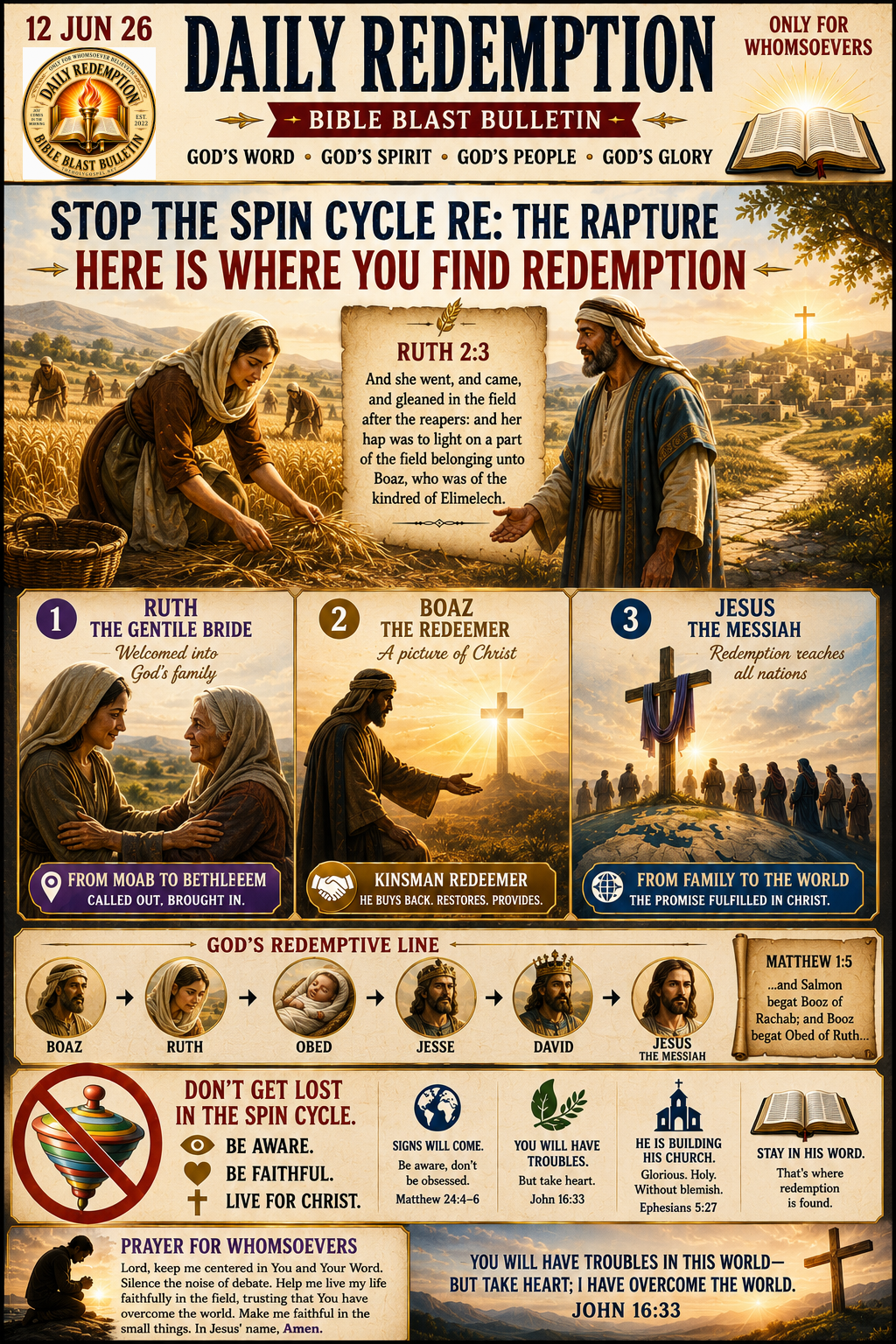
Ruth 2:3 And she went, and came, and gleaned in the field after the reapers: and her hap was to light on a part of the field belonging unto Boaz, who was of the kindred of Elimelech.
CORROBORATING SCRIPTURE
Matthew 1:5, Philippians 4:12, John 16:33, Ephesians 5:27, Genesis 1:1, Matthew 24:4–6, Ruth 4:17
Matthew 1:5 …and Salmon begat Booz of Rachab; and Booz begat Obed of Ruth…
Philippians 4:12 I know both how to be abased, and I know how to abound: every where and in all things I am instructed both to be full and to be hungry, both to abound and to suffer need.
Ephesians 5:27 That he might present it to himself a glorious church, not having spot, or wrinkle, or any such thing; but that it should be holy and without blemish.
Genesis 1:1 In the beginning God created the heavens and the earth.
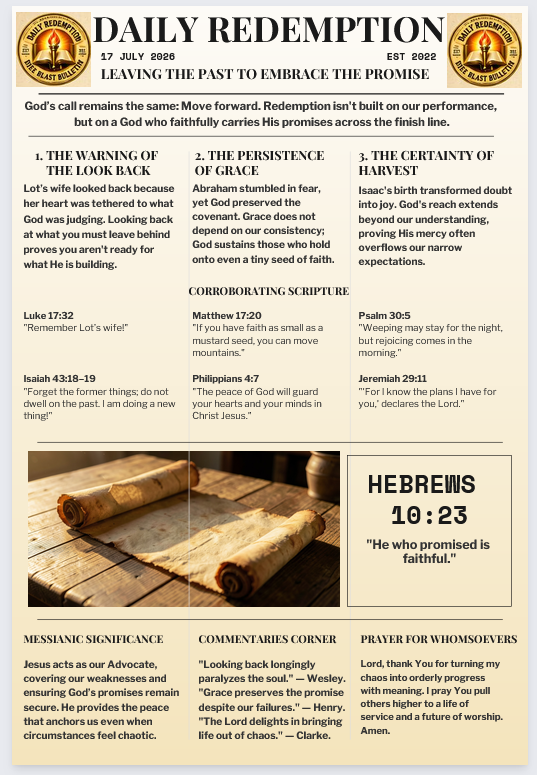
Matthew 24:4–6 And Jesus answered and said unto them, Take heed that no man deceive you. For ye shall hear of wars and rumours of wars… All these are the beginning of sorrows.
John 16:33 These things I have spoken unto you, that in me ye might have peace. In the world ye shall have tribulation: but be of good cheer; I have overcome the world.
Genesis 1:1 In the beginning God created the heaven and the earth.
Ruth 4:17 And the women her neighbours gave it a name, saying, There is a son born to Naomi; and they called his name Obed: he is the father of Jesse, the father of David.
Ruth is a very important character in the Bible, and I’m about to show you why. It’s four chapters. The Book of Ruth is four chapters, a narrative of redemption, following Naomi and her Gentile daughter-in-law Ruth, who returned widowed and destitute to Bethlehem. More on that later. Ruth’s loyalty leads her to Boaz, a kinsman-redeemer, more on that later, who marries her, restoring Naomi’s family line, and placing Ruth in the lineage of King David and Jesus Christ. Yes, she is mentioned in Matthew’s genealogy. Five women are listed in the Matthew genealogy. One of them was Ruth.
Now let’s go straight to the messianic perspective, and then we’re going to go to something very special about Ruth. The kinsman-redeemer, Boaz, who marries Ruth, and depending upon which translation that you have, you might see Boaz, you might see Ruth. You might see Ruth mentioned in a sentence that makes special mention of Boaz. Boaz serves as a kinsman-redeemer, that’s a type of Christ. Kinsman, we are considered by Jesus to be his friend, his brother. Actually, in one particular reference in the Bible, he says that we are also his sister and mother and everything else. So this directly foreshadows Jesus as the ultimate redeemer, who buys back humanity from sin and poverty. Sin and poverty and sin nature and disease and everything, which still afflict us, but we’re still free. That’s the beauty of Jesus, is that whatever it is, you see Philippians 4:12 does not say that we necessarily have superpowers. It says whatever befalls us, we can deal with it because we are in Jesus. Just as Jesus said, “You will have troubles in the world, but be of good cheer for I have overcome the world.”
Moving on. One of the reasons why Ruth is so important, aside from being one of only five women mentioned in the 42 mentioned in the genealogy of Jesus from Adam on down—by the way, that’s a whole other story, because if you know what those names translate to in Hebrew, you find it tells the whole story of Jesus basically—is the inclusion of Gentiles. A Moabite woman. Remember we were talking about Moabites last week. She’s a Gentile. She’s not Israeli. And she’s adopted into the family of God, symbolizing, oh so importantly, that the Messiah’s redemptive love extends beyond Israel to all nations. Have you ever heard that? Yahweh was just the God of Israel. He wasn’t the God of everybody. Well, I don’t know how they get to that, because you just have to read the very first sentence of the Bible, the Arishit, where it says, “In the beginning, God created,” and then He created everything.
So, the genealogy of Christ. The book of Ruth ends by connecting Boaz and Ruth to Obed, Jesse, and eventually King David, ensuring the messianic line remains intact through God’s providence. So important.
Okay, now, this is not something that people usually talk about in commentaries and the theology of Ruth and so forth, but there’s a connection to the rapture. What is he talking about? I’ll tell you, I’m not talking about the rapture anymore. I’m not talking about, is it first pre-trib, after? Live your life. Live your life. Be aware, because Jesus said to, of the signs, the deceptions, the rumors of war, the earthquakes in various places, all of those things. Be aware of those. Don’t spend any time thinking about them. Just be aware. That’s all He asked us to do. Doesn’t mean that we have to interpret it. Doesn’t mean we need to rack our brains, and get all confused, and argue about it. Where does Jesus say, argue, about whether the rapture is pre-trib, post-trib, somewhere in the middle? He doesn’t say argue, but that’s what a lot of Christians do, and I’m just done with it. I’m so done with it.
But there are interesting things to know about a lot of things. Gentile bride and Redeemer. Many interpret Ruth as a picture of the church. The Gentile bride being joined to the kinsman Redeemer, Christ, leaving her old life to be taken into His home, taken into Him. Redemption from the field. What’s the field? What is he talking about? Ruth gleans in the fields during the harvest before she is redeemed by Boaz. This is seen as a prophetic picture of the church being harvested. You ever heard that before? Harvesting of souls? Or taken, in the twinkling of an eye, right? Which basically means raptured, in this case, from the world. Before the time of tribulation or judgment. Okay. Before, after, during tribulation. I don’t know. I’m not going to argue with it. And leaving Moab, Naomi and Ruth leaving the foreign land of Moab to return to Bethlehem mirrors the church being called out of the world. But this all happens in Bethlehem, and that’s why David is from Bethlehem, and that’s why Jesus is from Bethlehem. That’s how it all worked out. At least, that’s where they ended up with the manger and everything, right? That’s how it goes.
Anyway, so that’s the Book of Ruth. It isn’t, really. It is my quick spin cycle on the Book of Ruth, because it’s what I know. And there’s a lot of people who know a lot more. And I recommend that you read from them, and I recommend that you read Ruth. And I recommend that you enjoy it, because this is the Word of God. The Book of Ruth is the Word of God. And it’s so, I mean, what’s more important than God’s Word? And people try and find so many other things that are more important than God’s Word. And they really end up in a spin cycle, or spin bin, you know, going nuts and ending up losing their freedom, losing their lives, losing their happiness, losing everything, all because they refused stubbornly to follow God and read His Word. Don’t be that person.
If you are in Virginia Beach and want to see a fresh new approach to historic liturgy being practiced with understanding and compassion, come to Beach Church and talk with Pastor Jimmy about it. Also Jessica or Vivienne. They love to talk about it. Jimmy is the one who has extracted all of this truth from the way that churches have been run for thousands of years, and said our church should be run in that same way, because that is the formula, basically, as I understand it. And I’ve got a lot to learn.
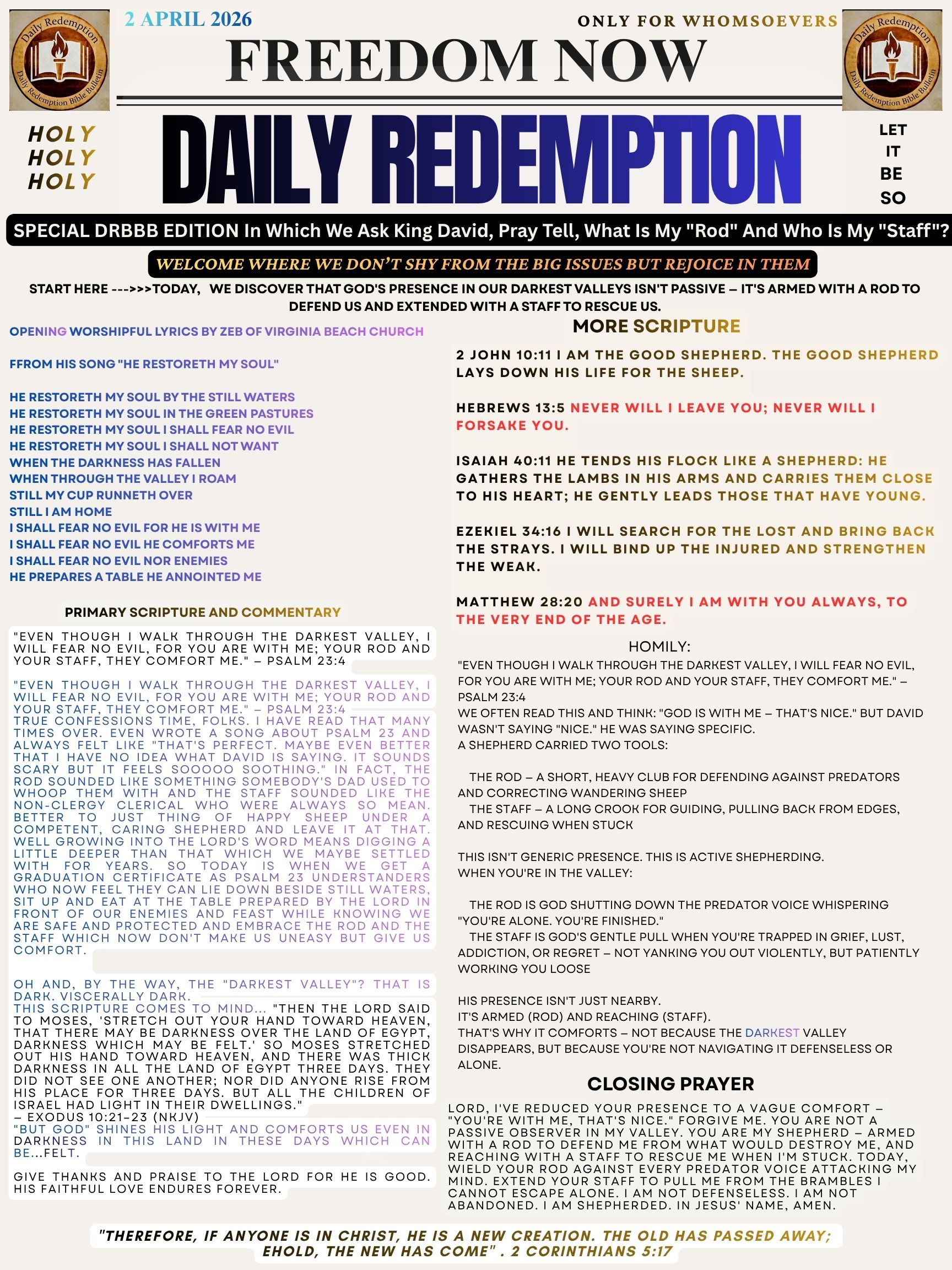
PRAYER FOR WHOMSOEVERS
Lord, keep me centered in You and Your Word. Silence the noise of debate. Help me live my life faithfully in the field, trusting that You have overcome the world. Make me faithful in the small things. In Jesus’ name, Amen.