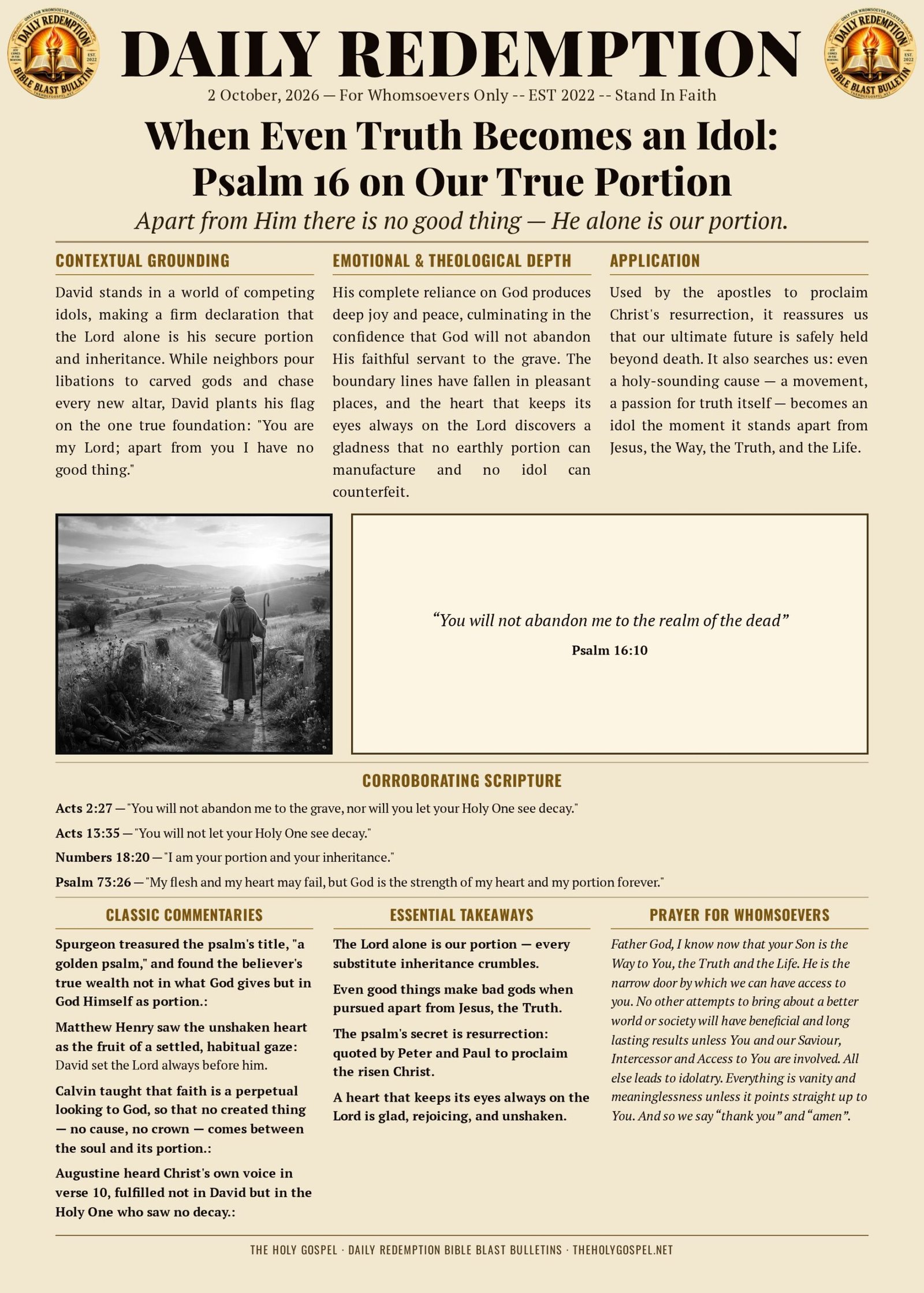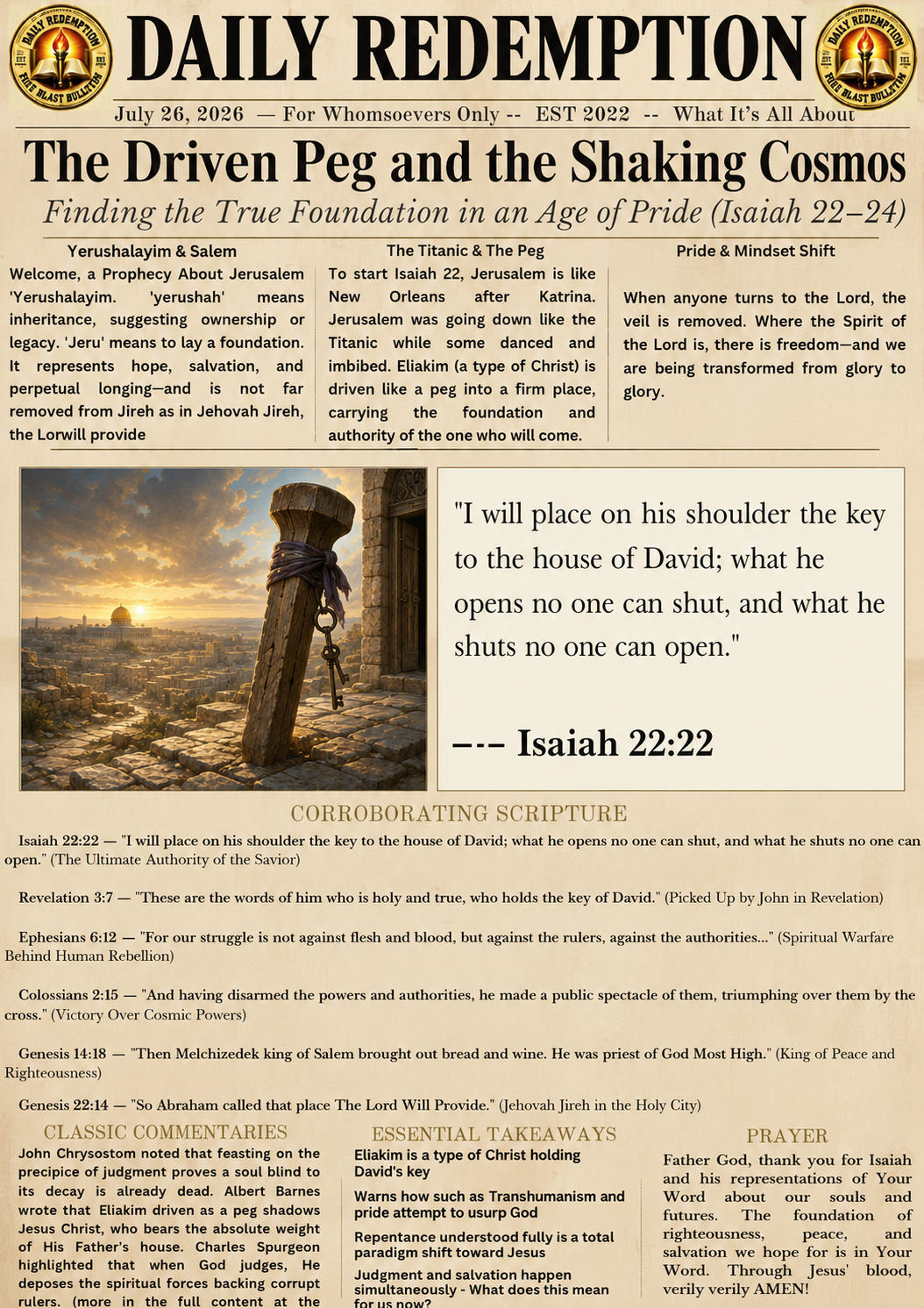
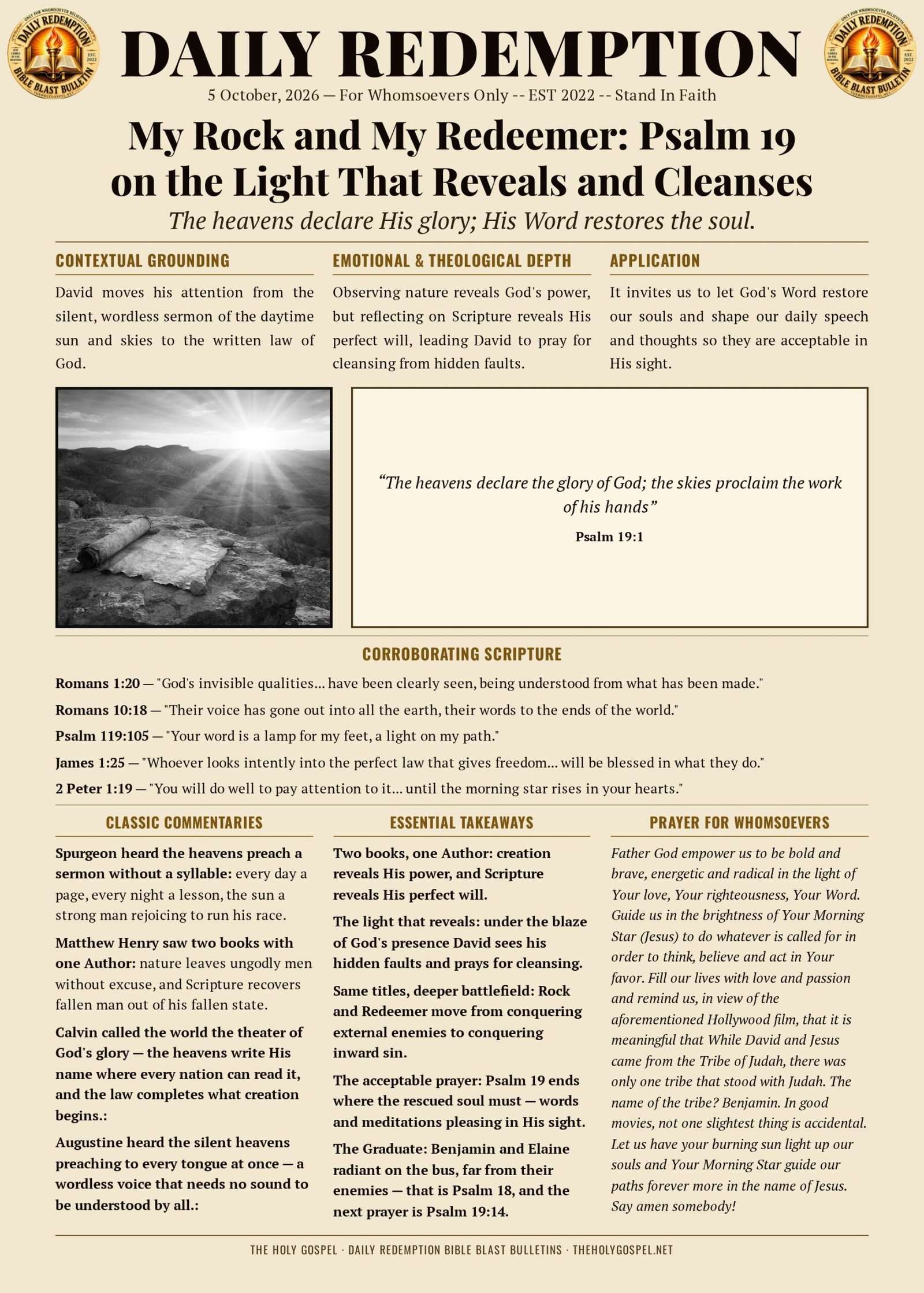
Psalm 19 opens with God’s first book — the heavens pouring out a wordless sermon, day after day, until their voice reaches the ends of the world — and then turns to His second, the perfect law that refreshes the soul and makes wise the simple. Under that double light David sees what the battlefield never showed him: his own hidden faults, and he prays to be cleansed. The Rock and Redeemer who conquered his external enemies in Psalm 18 is revealed as the only one who can conquer his internal brokenness, so the psalm ends where every rescued soul must: “May these words of my mouth and this meditation of my heart be pleasing in your sight, LORD, my Rock and my Redeemer.”
Psalm 19
For the director of music. A psalm of David.
1 The heavens declare the glory of God; the skies proclaim the work of his hands.
2 Day after day they pour forth speech; night after night they reveal knowledge.
3 They have no speech, they use no words; no sound is heard from them.
4 Yet their voice goes out into all the earth, their words to the ends of the world. In the heavens God has pitched a tent for the sun.
5 It is like a bridegroom coming out of his chamber, like a champion rejoicing to run his course.
6 It rises at one end of the heavens and makes its circuit to the other; nothing is deprived of its warmth.
7 The law of the LORD is perfect, refreshing the soul. The statutes of the LORD are trustworthy, making wise the simple.
8 The precepts of the LORD are right, giving joy to the heart. The commands of the LORD are radiant, giving light to the eyes.
9 The fear of the LORD is pure, enduring forever. The decrees of the LORD are firm, and all of them are righteous.
10 They are more precious than gold, than much pure gold; they are sweeter than honey, than honey from the honeycomb.
11 By them your servant is warned; in keeping them there is great reward.
12 But who can discern their own errors? Forgive my hidden faults.
13 Keep your servant also from willful sins; may they not rule over me. Then I will be blameless, innocent of great transgression.
14 May these words of my mouth and this meditation of my heart be pleasing in your sight, LORD, my Rock and my Redeemer.
From the Battlefield to the Sanctuary: How Psalm 18 Flows into Psalm 19
Let me help you understand how Psalm 18 flows into Psalm 19.
In 18, David finds a safe and peaceful place where he can rest safely away from his enemies including Saul and he experiences his version of the Genesis 7th day of creation. He rests. Not to say he puts on his jammies and takes a snooze nor that God did. God looked at the creation of his handiwork and rejoiced in the goodness of His own creation. David? He looks back on the wonderous works of the Lord in protecting him and guiding him to safely and peacefully rejoices in the Lord. I say he rejoiced! Ok here is something random which you might recall from a movie from the stone age c1968, The Graduate. At the end of the film Benjamin (Dustin Hoffman) runs 5 miles to the church where Mrs Robinson’s daughter Elaine, his true love is getting married. He bangs on the glass doors shouting out her name “Elaine” animalistically and then Elaine returns it in a moment that freezes everybody. He picks up the church’s cross, comes down to get Elaine while swinging the cross at any who are trying to restrain him. Then he grabs Elaine, slides the cross between the two door handles to lock everyone inside the church (symbology?) and then they run out to catch the next bus while Elaine is still wearing her wedding gown with which she was to marry the other guy. They sit on the back bench of the bus and then comes the moment that is relevant… they sit there on the bench of the bus whilst everyone stairs at them and they have the biggest, shiniest, most beautiful sh%t-kicking grins on their faces. They are radiantly basking in a light that says that God approves of their strangeness but more so of their love which is to conquer all obstacles and they experience Psalm 18 and 19. They are now safe, they can look back on how the Lord led them to a place of true love and away from their enemies. They are in a safe place, far from their enemies, those that don’t, won’t and can’t understand them. But even before the camera fades out they look a bit reflective even while the light shines on them. In 19 when David is reenacting Day 7 of creation he sees the Lord as incredibly bright and sees God’s voiceless, soundless voice spreading out commands across the universe but in that light he also is reminded in the details of his own sinfulness and prays that his pray be in God’s favor. But still they know, even while they are to reflect upon the sinfulness and strangeness of their lives and mutual experiences (including that Ben had had an affair with Elaine’s mother – Mrs Robinson “Jesus loves you more than you will know” as Paul Simon wrote.) and so this parallels what happens with David as he moves further into Psalm 19.
In Psalm 18, David calls God his “Rock” and his “Redeemer” because God saved his physical life from Saul.
But notice how he ends Psalm 19. After realizing his deep, internal sinfulness under the blazing light of God’s presence, he uses those exact same military titles, but applies them to his spiritual life:
“Let the words of my mouth and the meditation of my heart be acceptable in your sight, O Lord, my Rock and my Redeemer.” (Psalm 19:14)
David goes from the battlefield (Psalm 18) to the quiet sanctuary of creation (Psalm 19), finding that the God who conquered his external enemies is the only one who can conquer his internal brokenness.
At the end of The Graduate you can almost see the next scene that Benjamin and Elaine might have looked at each other and Benjamin said – oh my God what have I done? I used Your cross as a weapon and used it to lock our enemies in the church! And then maybe they would have gotten down on their knees and said after repentance, “Let the words of my mouth and the meditation of my heart be acceptable in your sight, O Lord, my Rock and my Redeemer.” (Psalm 19:14)
Classic Commentaries Corner
Charles Spurgeon, in his Treasury of David, hears the heavens preach a sermon without a syllable: “Day after day they pour forth speech.” Every day is a page, every night a lesson, and the sun itself is a strong man rejoicing to run his race — a bridegroom leaving his chamber, blazing joyfully across the sky for all the world to see. And when David reaches verse 14, Spurgeon notes that the warrior’s titles have followed him into the sanctuary: the Rock who sheltered him from Saul is now the Redeemer who must cleanse him from himself.
Matthew Henry sees the psalm as two books with one Author. The first, the book of nature, leaves all ungodly men without excuse: the heavens speak themselves to be works of God’s hands. But the second, the Holy Scripture, is of much greater benefit — “the whole is perfect; its tendency is to convert or turn the soul from sin and the world, to God and holiness.” Henry observes that David asks pardon not only for the sins he has discovered and confessed, but for those he had forgotten or overlooked — the hidden faults. And he closes where David closes: “No prayer can be acceptable before God which is not offered in the strength of our Redeemer.”
John Calvin called the world the theater of God’s glory, and Psalm 19 is one of its brightest acts. The heavens write God’s name where every nation can read it — His eternal power and divine nature understood from what has been made. But what nature begins, the law completes: the perfect law that refreshes the soul shows a sinner not only God’s power but His will, and under that light Calvin finds the right use of revelation — the knowledge of God leading not to admiration only, but to repentance.
Augustine, in his Enarrationes on the Psalms, hears the silent heavens preaching to every tongue at once — a voice that goes out into all the earth with no sound at all, understood by every nation without an interpreter. For Augustine the sun of the psalm is the Son of the gospel, the true Sun of righteousness rising with healing in its wings, and the soul that stands in that light does what David does: it sees its own darkness clearly and prays to be made clean.
Corroborating Scripture & Christological Connections
Romans 1:20 — “For since the creation of the world God’s invisible qualities — his eternal power and divine nature — have been clearly seen, being understood from what has been made, so that people are without excuse.” Paul confirms David’s wordless sermon: creation preaches, and everyone has heard it.
Romans 10:18 — “But I ask: Did they not hear? Of course they did: ‘Their voice has gone out into all the earth, their words to the ends of the world.'” Paul quotes Psalm 19:4 directly and applies it to the gospel going out — the heavens’ sermon becomes the pattern of the good news preached everywhere.
Psalm 119:105 — “Your word is a lamp for my feet, a light on my path.” The radiance David finds in God’s commands — radiant, giving light to the eyes — is the same light that guides the daily walk.
James 1:23-25 — “Whoever looks intently into the perfect law that gives freedom, and continues in it… will be blessed in what they do.” The mirror of the Word that reveals the hidden faults is the very mirror James says most men glance at and walk away from.
2 Peter 1:19 — “You will do well to pay attention to it, as to a light shining in a dark place, until the day dawns and the morning star rises in your hearts.” The sun that circuits the heavens points to a brighter dawn: the Morning Star rising in the heart.
Revelation 22:16 — “I, Jesus, have sent my angel to give you this testimony… I am the Root and the Offspring of David, and the bright Morning Star.” The very title Zeb’s prayer reaches for — the Morning Star who guides us — belongs to the Root of David Himself, the Rock and Redeemer of Psalm 19:14.
Essential Takeaways
- Two Books, One Author: Creation reveals God’s power and leaves us without excuse; Scripture reveals His perfect will and restores the soul — and only Scripture completes what creation begins.
- The Light That Reveals: The same blaze that declares God’s glory exposes David’s hidden faults — light always shows both, and worship grows out of seeing both.
- Same Titles, Deeper Battlefield: Rock and Redeemer move from the external enemies of Psalm 18 to the internal brokenness of Psalm 19 — the God who conquered Saul is the only one who can conquer sin.
- The Acceptable Prayer: Psalm 19 ends where every rescued soul must — asking that the words of our mouth and the meditation of our heart be pleasing in His sight.
- The Graduate at the Back of the Bus: Benjamin and Elaine radiant in the light, far from their enemies, are living Psalm 18 — and the next scene, as the commentary imagines it, is the prayer of Psalm 19:14.
Prayer For Whomsoevers
Father God empower us to be bold and brave, energetic and radical in the light of Your love, Your righteousness, Your Word. Guide us in the brightness of Your Morning Star (Jesus) to do whatever is called for in order to think, believe and act in Your favor. Fill our lives with love and passion and remind us, in view of the aforementioned Hollywood film, that it is meaningful that While David and Jesus came from the Tribe of Judah, there was only one tribe that stood with Judah. The name of the tribe? Benjamin. In good movies, not one slightest thing is accidental. Let us have your burning sun light up our souls and Your Morning Star guide our paths forever more in the name of Jesus. Say amen somebody!