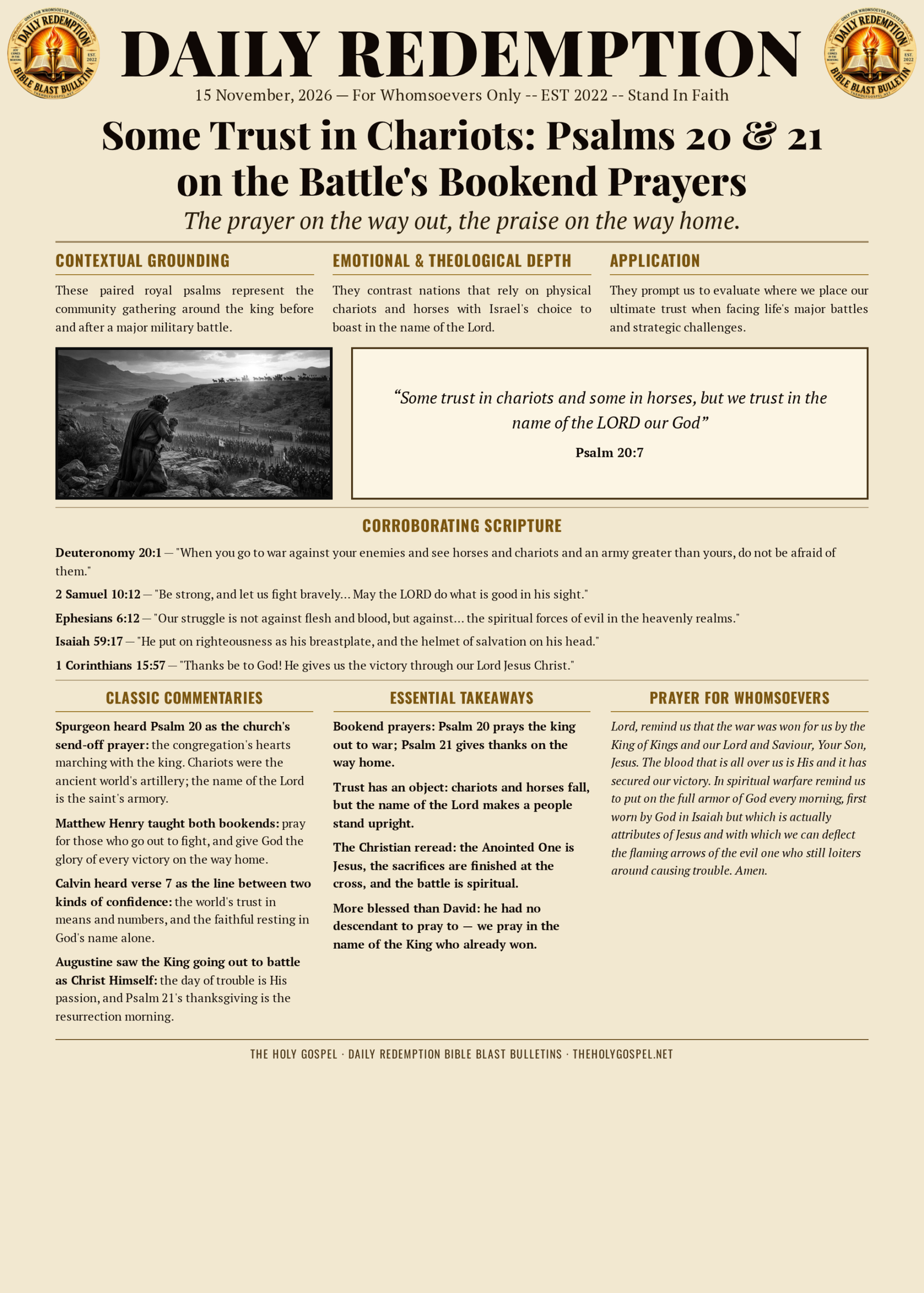
Psalm 20 is the congregation’s send-off prayer — the people gathering around David as he marches out against the Ammonite-Syrian coalition of 2 Samuel 10 — and Psalm 21 is the thanksgiving on the way home. The line between them is verse 7: “Some trust in chariots and some in horses, but we trust in the name of the LORD our God.” Zeb reads the pair through Christian eyes: the Anointed One is now Jesus, the burnt offerings are finished at the cross, the battle is against spiritual forces rather than flesh and blood, and the trust is the Holy Spirit within. David did not have his descendant to pray to — we are more blessed than that: the King of Kings has already won the war.
Psalm 20
For the director of music. A psalm of David.
1 May the Lord answer you when you are in distress; may the name of the God of Jacob protect you.
2 May he send you help from the sanctuary and grant you support from Zion.
3 May he remember all your sacrifices and accept your burnt offerings.
4 May he give you the desire of your heart and make all your plans succeed.
5 May we shout for joy over your victory and lift up our banners in the name of our God. May the Lord grant all your requests.
6 Now this I know: The Lord gives victory to his anointed. He answers him from his heavenly sanctuary with the victorious power of his right hand.
7 Some trust in chariots and some in horses, but we trust in the name of the Lord our God.
8 They are brought to their knees and fall, but we rise up and stand firm.
9 Lord, give victory to the king! Answer us when we call!
The First Question: Why War So Soon After the Rest?
The first question that one has to ask is why is David going to war so soon after his proclamation that the Lord had taken him to a safe place in Psalm 18 and that the Lord had shone his light on him and also shown him his sins.
The answer is that they are not strictly chronological but also in Psalm 18 verses 34 and 39, David explicitly sings, “He trains my hands for battle… You armed me with strength for combat.” The praise itself is what fueled his readiness to re-engage with earthly adversaries.
The next question one might ask is against whom is he getting ready to scrimmage? This “pre-game prayer” (Psalm 20 — Psalm 21 is actually after battle) is against a huge enemy, a massive military coalition formed by the Ammonites and the Syrians and it is more fully described in 2 Samuel 10.
What primarily comes to mind as a Christian is a reminder of how much more blessed we are by being in Christ. The Messianic aspect of this Psalm is how David did not have his descendant to pray to.
A Christian reading or praying Psalm 20 will often rephrase, recontextualize, or mentally pivot on several key verses because the New Covenant shifts the focus from earthly warfare, physical rituals, and human kings to spiritual warfare, Christ, and the Holy Spirit. The primary differences in how a Christian approaches the text center on four specific areas:
Shifting the Focus from a Human King to Jesus Christ
The text in Psalm 20:1, 6, and 9 asks for the Lord to answer in the day of trouble and save His anointed, looking to the king to answer when called. For David’s army, “the anointed” referred literally to David, the earthly king standing right in front of them. This is not as egocentric and more fact-based if one remembers a. who David is in relation to Christ (he will have his own throne for instance) and b. that God said David is “a man of His own heart”.
However, a Christian reads this through a Christological lens. Jesus is the ultimate “Anointed One” (Christ). Therefore, a Christian does not pray for the victory of a political ruler although praying for the worldly leaders is truly Christian; we pray in the name of Jesus, recognizing Him as the King of Kings who has already won the ultimate victory over sin and death.
Replacing Animal Sacrifices with the Final Sacrifice
The text in Psalm 20:3 asks that God remember all offerings and accept burnt sacrifices. Before marching to war, David offered physical animal sacrifices to secure divine favor. A Christian would not pray for God to accept burnt offerings. Jesus’ death on the cross was the once-and-for-all sacrifice that permanently took away sin. A Christian instead relies entirely on the finished work of Christ rather than any ongoing ritual or personal offering to gain God’s favor.
Redefining the Nature of the “Battle”
The text in Psalm 20:5 and 7 speaks of rejoicing in salvation, setting up banners in the name of God, and rejecting a trust in chariots and horses. David was dealing with physical warfare against geopolitical enemies like the Syrians. For a Christian, Scripture explicitly states that the wrestle is not against flesh and blood, but against principalities, powers, and spiritual hosts of wickedness. When a Christian claims victory or sets up banners, it is a spiritual declaration of victory over temptation, spiritual oppression, or sin, rather than the physical destruction of human adversaries.
Relying on the Holy Spirit Instead of Chariots and Horses
The text in Psalm 20:7 concludes that “we will remember the name of the Lord our God.” While the core principle remains the same — putting faith in God rather than human strength — a Christian expresses this through the indwelling of the Holy Spirit. Instead of looking outward at military hardware versus divine intervention, the Christian application focuses on internal reliance on God’s grace to endure trials, rather than expecting immediate physical deliverance from every earthly conflict.
Classic Commentaries Corner
Charles Spurgeon, in his Treasury of David, hears Psalm 20 as the church’s send-off prayer: the whole congregation speaking blessing over the king before the battle, their hearts marching with him to the field. On verse 7 he notes that chariots and horses were the ancient world’s artillery — the confidence of nations in hardware — while the name of the Lord is the saint’s armory: a trust that cannot be captured, outnumbered, or outgunned.
Matthew Henry teaches both bookends of the pair. Psalm 20 is a prayer for the success of the king and of the holy cause he fights for — the people bind their own joy to his victory, “we will shout for joy over your victory.” And Psalm 21 is the psalm for the return: giving God the glory of every success, for it is He, not the arm of flesh, that made the king rejoice in the strength of salvation.
John Calvin hears verse 7 as the line between two kinds of confidence. Worldly men, he observes, trust in means and numbers — horses, chariots, multitudes — but the faithful rest in God’s name alone, because His power is not diminished when outward helps fail. And in “his anointed,” Calvin sees David carried beyond himself to Christ: the true King whose victory the church prays for and already possesses.
Augustine, in his Enarrationes on the Psalms, sees the King who goes out to battle as Christ Himself. The day of trouble is His passion; the sanctuary from which help is sent is the heavenly country; and the victory Psalm 21 celebrates is the resurrection morning — Christ risen, seated, and the church’s thanksgiving following Him home with banners raised.
Corroborating Scripture & Christological Connections
Deuteronomy 20:1 — “When you go to war against your enemies and see horses and chariots and an army greater than yours, do not be afraid of them, because the LORD your God, who brought you up out of Egypt, will be with you.” The Torah root of Psalm 20:7 — Israel was taught from the beginning to face chariots without fear of them.
2 Samuel 10:12 — “Be strong, and let us fight bravely for our people and the cities of our God. May the LORD do what is good in his sight.” Joab’s pre-battle word to Abishai in the very campaign behind Psalm 20 — courage given over to God’s will before the fighting starts.
Deuteronomy 17:16 — “The king, moreover, must not acquire great numbers of horses for himself.” The law Israel’s kings broke when they trusted in cavalry — the very trust Psalm 20:7 refuses.
Ephesians 6:12 — “For our struggle is not against flesh and blood, but against the rulers, against the authorities, against the powers of this dark world and against the spiritual forces of evil in the heavenly realms.” Paul’s definition of the Christian’s battlefield — the redefinition the commentary traces.
Isaiah 59:17 — “He put on righteousness as his breastplate, and the helmet of salvation on his head.” The armor of God first worn by God — the attributes of Jesus that Zeb’s prayer puts on each morning.
1 Corinthians 15:57 — “But thanks be to God! He gives us the victory through our Lord Jesus Christ.” The Psalm 21 moment of the New Covenant: thanksgiving for a victory that has already been handed to us.
Revelation 19:16 — “On his robe and on his thigh he has this name written: KING OF KINGS AND LORD OF LORDS.” The anointed of Psalm 20, seen at the end of the story — riding out with the armies of heaven, the name above every name.
Essential Takeaways
- Bookend Prayers: Psalm 20 prays the king out to war; Psalm 21 gives thanks on the way home — the people of God surround their king at both ends of the battle.
- Trust Has an Object: Some trust in chariots and some in horses — they are brought to their knees and fall; those who trust in the name of the Lord rise up and stand firm.
- The Christian Reread: The Anointed One is Jesus, the sacrifices are finished at the cross, and the battle is against spiritual forces, not flesh and blood.
- More Blessed Than David: David had no descendant to pray to — we pray in the name of the King of Kings who has already won the ultimate victory over sin and death.
Prayer For Whomsoevers
Lord, remind us that the war was won for us by the King of Kings and our Lord and Saviour, Your Son, Jesus. The blood that is all over us is His and it has secured our victory. In spiritual warfare remind us to put on the full armor of God every morning, first worn by God in Isaiah but which is actually attributes of Jesus and with which we can deflect the flaming arrows of the evil one who still loiters around causing trouble. Amen.