When Will We Learn to Forsake Pride and Embrace God?
Pride is the oldest trap in Scripture, and Daniel 4 through 6 gives us three kings who fell into it. Nebuchadnezzar learned humility the hard way — seven years as a beast in the field — and came out the other side praising the King of heaven; Belshazzar never learned at all and was weighed on the scales that very night; and Darius discovered that the God of Daniel shuts the mouths of lions. The lesson for every generation is the same: God is able to humble those who walk in pride, and He is able to save those who stay centered on Him. Whatever lion’s den you are facing right now, the call is to let go of any last vestige of self-made greatness, stay faithful, and trust the living God whose kingdom will never end.
Contextual Grounding
The book of Daniel was written from the heart of the world’s greatest empire, where a Jewish exile — carried off to Babylon as a young man — rose to serve under four kings while never once bowing his worship to any of them. Daniel 4 through 6 forms a single arc of warning and hope: three Gentile monarchs, three encounters with the living God, and three very different endings. Nebuchadnezzar built Babylon into the wonder of the ancient world, was warned through a dream of a great tree cut down, and when the warning went unheeded, he lost his mind and his throne for seven seasons “until he knew that the most high God ruled in the kingdom of men” (Daniel 4:32).
The chapter breaks were never meant to be read as separate stories. Daniel 5 shows the lesson forgotten within a single generation: Belshazzar, Nebuchadnezzar’s heir, drank wine from the vessels of God’s own temple while a hand wrote his verdict on the wall, and “that very night” the kingdom fell to the Medes and Persians. Daniel 6 then carries the story into a new empire, where Darius the Mede signed a decree forbidding prayer to any god but himself for thirty days — a decree Daniel answered by opening his windows toward Jerusalem and praying three times a day, exactly as he had always done. Three kings, one message: every throne on earth is on loan from the King of heaven, and the days of every reign are numbered by His hand.
Emotional & Theological Depth
In understanding Daniel 4, I call on you and me to let go of any last vestiges of pride that did not rely upon and center in magnifying and glorifying the Lord our God, from which all good things, all talents, all wisdom flow.
Old Nebby — my nickname for Nebuchadnezzar — made the mistake of not following those things, not understanding those things. In Daniel 2, after Daniel interprets his dream, the king says, “Truly your God is the God of gods and the Lord of kings.” Yet immediately after, he goes back to building a giant golden idol of himself. What does that have to do with us? Unless maybe somebody has a golden idol of themselves in their backyard. I don’t know, but self-love that doesn’t include God can be a very dangerous thing. And if God loves you, He may test you in all sorts of ways until you come to your proper senses and stature.
In Daniel 3, after Shadrach, Meshach, and Abednego — three names that I may or may not ever be able to remember — survive the fiery furnace, Nebuchadnezzar praises God again and threatens anyone who speaks against Him. But he still views the Lord as the God of Shadrach, Meshach, and Abednego — not his God. There’s a massive difference between acknowledging that a God is powerful and humbling your own ego before Him. Nebuchadnezzar liked the idea of a powerful God, but he still thought he was the ultimate master of his own destiny. He believed he reigned by his own virtue and strength. That’s the big difference between loving the idea of an all-powerful God and still saying, “Yeah, but I’m the captain.” No, you know.
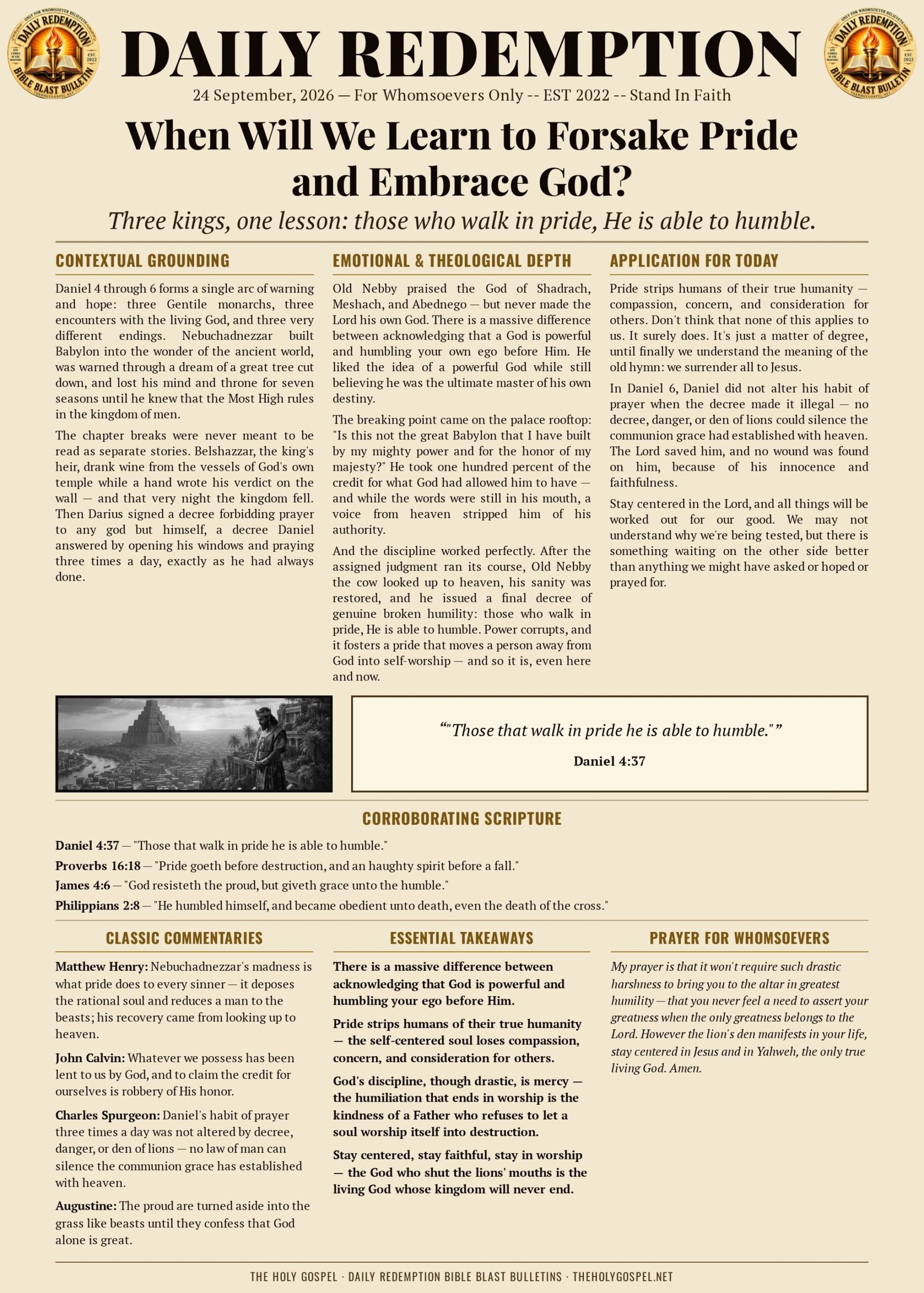
The breaking point comes a year after God gives him a direct warning through a second dream. The king is walking on the roof of his royal palace, looking out on his empire and boasting: “Is this not the great Babylon that I have built for a royal dwelling place by my mighty power and for the honor of my majesty?” (Daniel 4:30). He took one hundred percent of the credit for what God had allowed him to have. While the words were still in his mouth, a voice from heaven stripped him of his authority.
And the discipline worked perfectly. After the duration of the assigned judgment had run its course, Old Nebby the cow looked up to heaven, his sanity was restored, and he issued a final decree praising the King of heaven from a place of genuine broken humility, acknowledging that “those who walk in pride he is able to humble” (Daniel 4:37).
In Daniel 5, we see the son of Old Nebby, and the apple has not fallen far from the tree. Daniel spells it all out: “But you, Belshazzar, his son, have not humbled yourself, though you knew all this.” Instead, you have set yourself up against the Lord of heaven. You had the goblets from His temple brought to you, and you and your nobles, your wives and your concubines, all drinking wine from them. That must have been one heck of a party. You praised the gods of silver and gold, of bronze, iron, wood, and stone — the gods of things that cannot see or hear or understand. But you did not honor the God who holds your life in His hands and holds all your ways in His hands. Therefore, He sent the hand that wrote the inscription, just as He had with the tablets with Moses. And it seriously freaked everybody out. God has numbered the days of your reign and brought it to an end. You have been weighed on the scales and found wanting. Your kingdom is divided and given to the Medes and Persians. Daniel was clothed in purple and proclaimed the third highest ruler in the kingdom because he was the only one who could read those words — though he really didn’t want any of it; he was only willing to do what the Lord wanted him to do. And that very night, Belshazzar was slain. Darius the Mede took the kingdom at the age of sixty-two.
So just like the kings of Israel and Judah, not only does power corrupt, but it fosters a pride that moves a person away from God into self-love — to the degree of worship, putting oneself front and foremost, stripped to a large degree of their essential humanity. And so it goes, and so it is, even here and now.
Application For Today
So what can we learn from Old Nebuchadnezzar’s misadventures? Pride strips humans of their true humanity — things like compassion, concern for others, and consideration for others. And you have to ask at this point: how ungodly is the pride parade? Besides the fact that it makes somebody like me feel really icky — spiritually icky. The pride month of June: a public display celebrating preferences without glorifying God, when pride without glorifying God only makes us beasts. How is America flirting with judgment? Now, y’all might not agree with me, and let me just be clear: it doesn’t exactly say in the Bible “hate the sin, love the sinner,” but that’s what’s in my heart. When I see people doing these ungodly things, I don’t hate them. I want better for them. I want them to find their way, and I know that they’re lost.
Because in Daniel 4, God wanted to prove to the mightiest king on earth that he was entirely dependent on the Creator for his wealth, his power, and even his mind. Don’t think that none of this applies to us. It surely does. It’s just a matter of degree, until finally we understand the meaning of the old hymn: we surrender all to Jesus.
I have to think of Elvis here. In 1973, his Hawaii concert was broadcast by satellite across the globe and watched by more people than the moon landing, while mirrors reflected his image from above, mixed with lights and his likeness playing guitar in the galaxy. The next four years he rapidly declined, and he ultimately died unceremoniously. He knew Scripture, and he had a very humble walk with the Lord in some aspects of his personal life. But the world celebrated his greatness, and so did he — and so his pride came before his rapid decline and fall.
In Daniel 6, as often with the kings in the books of kings, it just gets worse. Darius was worse than the previous two kings, to the degree that those he had delegated power to came to him shouting, “May King Darius live forever!” Good luck with that. Having all agreed that the king should issue a decree that anyone who prays to any god or human being during the next thirty days, except to Darius, shall be thrown into the lion’s den — and signed it into a law of the Medes and Persians, which cannot be repealed. Daniel, however, did not adhere to the law. Would you? He opened his windows toward Jerusalem three times a day and prayed to God, exactly as he had always done. When the king heard the charge, he was greatly distressed and made every effort until sundown to save Daniel — but the decree stood, and Daniel went into the den, with the king saying, “May your God, whom you serve continually, rescue you.” And he said that not mockingly.
And that is exactly what happened. The Lord saved Daniel from the lions, and no wound at all was found on him, because of his innocence and faithfulness. So Darius had those who insisted Daniel be thrown to the lions suffer the fate they had wanted for Daniel — and then the king wrote to all nations and peoples of every language: people must fear and reverence the God of Daniel, “For he is the living God and he endures forever. His kingdom will not be destroyed. His dominion will never end. He rescues and he saves. He performs signs and wonders in the heavens and on the earth. He has rescued Daniel from the power of the lions” (Daniel 6:26-27).
The message for all of us is very clear and not needing much commentary: stay centered in the Lord, and all things will be worked out for our good. Jesus said that in this world we will have troubles, but to be of good cheer, for He has overcome the world — for all of us who are believers. The Lord’s ways are higher, His thoughts are higher. We may not understand why we’re being tested, but in my experience in recent days and months, whatever we are getting through with the help of the Lord, there is something waiting for us on the other side which is better than anything we might have asked or hoped or prayed for.
Classic Commentaries Corner
Matthew Henry observed on Daniel 4 that Nebuchadnezzar’s madness was a striking picture of what pride does to every sinner: it deposes the rational soul and reduces a man to the level of the beasts among whom he grazes. Henry noted that the king’s recovery came not from physicians but from looking up — his understanding returned with his eyes lifted to heaven, teaching us that humble acknowledgment of God’s sovereignty is the only medicine for a self-exalted heart.
John Calvin preached that Nebuchadnezzar’s boasting on the palace rooftop exposed the madness hidden in all human self-glory: whatever we possess has been lent to us by God, and to claim the credit for ourselves is robbery of His honor. Calvin emphasized that Daniel 4 was written for the church of every age, so that kings and commoners alike would learn that “the Most High rules in the kingdom of men, and gives it to whomever He will.”
Charles Spurgeon drew on Daniel 6 to celebrate the boldness of a believer who will not close his windows when the world forbids prayer. Spurgeon preached that Daniel’s habit of prayer three times a day was not altered by decree, danger, or den of lions — for the child of God who walks with integrity, no law of man can silence the communion that grace has established with heaven.
Augustine wrote in his City of God that the pride of earthly kingdoms is the very city that builds itself against God, while humility is the highway of the heavenly city. He saw in Nebuchadnezzar’s beastly humiliation the great lesson of all history: the proud are turned aside into the grass like beasts until they confess that God alone is great, for pride is the beginning of all sin, and humility the foundation of every soul that God restores.
Corroborating Scripture & Christological Connections
Daniel 4:37 — “Now I Nebuchadnezzar praise and extol and honour the King of heaven, all whose works are truth, and his ways judgment: and those that walk in pride he is able to humble.” The humbled king’s own final decree becomes Scripture’s clearest statement that God actively opposes human pride and restores the brokenhearted who look up to Him.
Proverbs 16:18 — “Pride goeth before destruction, and an haughty spirit before a fall.” Solomon’s proverb plays out twice in Daniel — on the rooftop of Babylon and at Belshazzar’s banquet table — proving that the principle of sowing and reaping applies to kings and kingdoms as surely as to common men.
James 4:6, 10 — “But he giveth more grace. Wherefore he saith, God resisteth the proud, but giveth grace unto the humble… Humble yourselves in the sight of the Lord, and he shall lift you up.” James states as standing law what Daniel 4 shows as lived history: God resists the proud and elevates the humbled.
Philippians 2:5-8 — “Let this mind be in you, which was also in Christ Jesus: who… made himself of no reputation, and took upon him the form of a servant, and humbled himself, and became obedient unto death, even the death of the cross.” Christ walked the opposite road from Nebuchadnezzar — downward in humility rather than upward in self-glorification — and the Father has exalted Him above every name, showing that greatness in the Kingdom of God is found through surrender.
Daniel 6:26-27 — “For he is the living God, and stedfast for ever, and his kingdom that which shall not be destroyed… He delivereth and rescueth, and he worketh signs and wonders in heaven and in earth.” Even a pagan king’s decree becomes a confession of the Gospel: the God who shut the lions’ mouths is the living God whose dominion outlasts every empire.
1 Peter 5:6-7 — “Humble yourselves therefore under the mighty hand of God, that he may exalt you in due time: Casting all your care upon him; for he careth for you.” Peter hands the church the same choice Daniel 4 through 6 presents: humble yourself under God’s hand now, or be humbled by it later — and either way, His hand is the safest place in the universe.
Essential Takeaways
There is a massive difference between acknowledging that God is powerful and humbling your ego before Him. Nebuchadnezzar praised the God of the fiery furnace long before he ever made the Lord his own God — head-knowledge of God’s power is not the same as surrendering your self-rule.
Pride strips humans of their true humanity. The one who centers everything on self loses the very things that make us human — compassion, concern, and consideration for others — until, like Old Nebby, there is more beast than man in us.
God’s discipline, though drastic, is mercy. The seven years of beast-life were not God destroying Nebuchadnezzar but saving him — the humiliation that ends in “those that walk in pride he is able to humble” is the kindness of a Father who refuses to let a soul worship itself into destruction.
Stay centered, stay faithful, stay in worship. Daniel didn’t argue with the decree or hide his windows; he simply kept praying three times a day as always — and the God who shut the lions’ mouths is the same living God whose kingdom will never end, working all things out for good for those who stay centered on Him.
Prayer For Whomsoevers
My prayer for whoever might read this is that it won’t require such drastic harshness to bring you to the altar — the table of the Lord, the provider of all things good — in greatest humility, and that you never feel a need to assert your greatness when the truth is that the only greatness is that which belongs to the Lord. However the lion’s den manifests in your life right now — first of all, I pray that there is no such thing — but if there is, I pray that you stay centered, stay faithful, stay in worship to the Lord of lords, the host of hosts, the King of kings. And may only good things come to you, even if sometimes they are disguised as a test — a test that may lead toward temptation. I hope you pass all of these tests with flying colors and come out on the other side with a much better life and a better you. I hope none of them have to be as drastic as the things Nebuchadnezzar had to go through. I pray for a happy life and a happy heart centered in Jesus, and in Yahweh, the only true living God. Amen.