Psalm 22: They Gambled For His Clothes, The Detail Nobody Could Stage
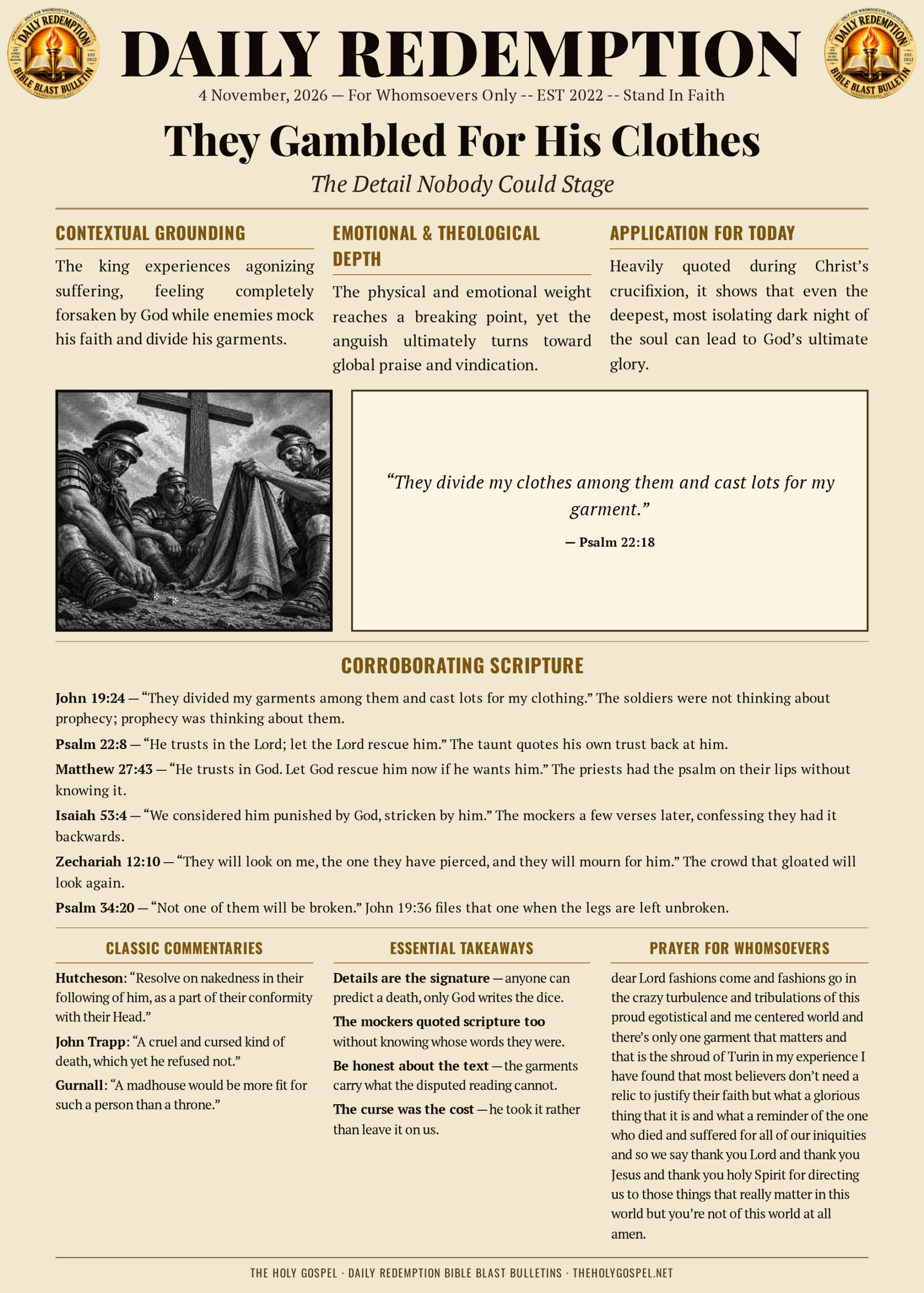
This is where Psalm 22 stops being devotional and becomes forensic. The garments divided and the lots cast sit at the top of the evidence pile because nobody stages that, and John 19:24 quotes it line for line. Below it sits the taunt, let God rescue him if he delights in him, which Matthew 27:43 puts in the priests’ mouths at the foot of the cross. Then the pierced hands and feet, with the honest textual note that the Hebrew consonants can be read as a lion, which the Septuagint, the Syriac, and a Dead Sea scroll do not. Isaiah 53:4 turns those mockers into the confessors, the same crowd later admitting they had judged him wrong. Psalm 69, Isaiah 50:6, Zechariah 12:10, Psalm 34:20, and Deuteronomy 21:23 all feed this one post.
This is the evidence post, and the details are ranked by how hard they are to dodge. The garments divided and the lots cast come first, because nobody stages that, and John 19:24 quotes it directly. Then the taunt, he trusts in the Lord, let the Lord rescue him, which Matthew 27:43 puts in the priests’ mouths at the foot of the cross. Then the pierced hands and feet, with the honest note that the Hebrew consonants can be pointed to read like a lion, which the Septuagint, the Syriac, and a Dead Sea scroll do not, and that is why the garments carry the weight. Isaiah 53:4 turns the mockers into the confessors, the same crowd later saying we considered him punished by God. Psalm 69, Isaiah 50:6, Zechariah 12:10, Psalm 34:20 and Deuteronomy 21:23 all feed this post.
Contextual Grounding
The king experiences agonizing suffering, feeling completely forsaken by God while enemies mock his faith and divide his garments.
Emotional & Theological Depth
The physical and emotional weight reaches a breaking point, yet the anguish ultimately turns toward global praise and vindication.
Application
Heavily quoted during Christ’s crucifixion, it shows that even the deepest, most isolating dark night of the soul can lead to God’s ultimate glory.
Classic Commentaries Corner
George Hutcheson, 1657, on the stripping: “He would also by this teach all his followers to resolve on nakedness in their following of him, as a part of their conformity with their Head, and that therefore they should not dote much on their apparel when they have it.” A man’s clothes are the last possession he thinks will be taken. Here they are taken and gambled over while he is still wearing nothing.
John Trapp on the manner of the death: “That was the most vile and ignominious; it was also a cruel and cursed kind of death, which yet he refused not; and here we have a clear testimony for his cross.” The cross was not an unfortunate accident of history. It was the shape obedience took.
William Gurnall on the men rolling dice for a robe: “A madhouse would be more fit for such a person than a throne, who should so far forfeit his reason, as to think that the thoughts and hearts of men were within his jurisdiction.” They believed they were disposing of him. They were being disposed of.
G.K. Chesterton on the detail that will not behave: “The most incredible thing about miracles is that they happen.” Four soldiers, a seam not worth tearing, a psalm written a thousand years earlier, and the dice fall exactly where they had to.
Corroborating Scripture & Christological Connections
Psalm 22:18 — “They divide my clothes among them and cast lots for my garment.” Not wounded, not mocked, but divided and gambled over, four centuries of prophecy in one indifferent act.
John 19:24 — “‘Let’s decide by lot who will get it.’ This happened that the scripture might be fulfilled which said, ‘They divided my garments among them and cast lots for my clothing.’” The soldiers were not thinking about prophecy. Prophecy was thinking about them.
Psalm 22:8 — “He trusts in the Lord, let the Lord rescue him. Let him deliver him, since he delights in him.” The taunt is not general mockery. It quotes his own trust back at him.
Matthew 27:43 — “He trusts in God. Let God rescue him now if he wants him, for he said, I am the Son of God.” The priests had the psalm on their lips without knowing it.
Isaiah 53:4 — “Surely he took up our pain and bore our suffering, yet we considered him punished by God, stricken by him, and afflicted.” Here are the mockers a few verses later, confessing they had it exactly backwards.
Zechariah 12:10 — “They will look on me, the one they have pierced, and they will mourn for him as one mourns for an only child.” The crowd that gloated will look again.
Psalm 34:20 — “He protects all his bones, not one of them will be broken.” John 19:36 files that one too, when the legs are left unbroken.
Deuteronomy 21:23 — “Anyone who is hung on a pole is under God’s curse.” Paul quotes it in Galatians 3:13 and tells you why the curse was worth it.
Essential Takeaways
Details are the signature. Anyone can predict a death. Only God writes the dice.
The mockers quoted scripture too. They said his words back to him without knowing whose words they were.
Be honest about the text. The garments carry the weight that the disputed Hebrew reading cannot, and saying so is not weakness, it is care.
The curse was the cost. To hang there was to be under the curse, and he took the curse rather than leave it on us.
Prayer For Whomsoevers
dear Lord fashions come and fashions go in the crazy turbulence and tribulations of this proud egotistical and me centered world and there’s only one garment that matters and that is the shroud of Turin in my experience I have found that most believers don’t need a relic to justify their faith but what a glorious thing that it is and what a reminder of the one who died and suffered for all of our iniquities and so we say thank you Lord and thank you Jesus and thank you holy Spirit for directing us to those things that really matter in this world but you’re not of this world at all amen.