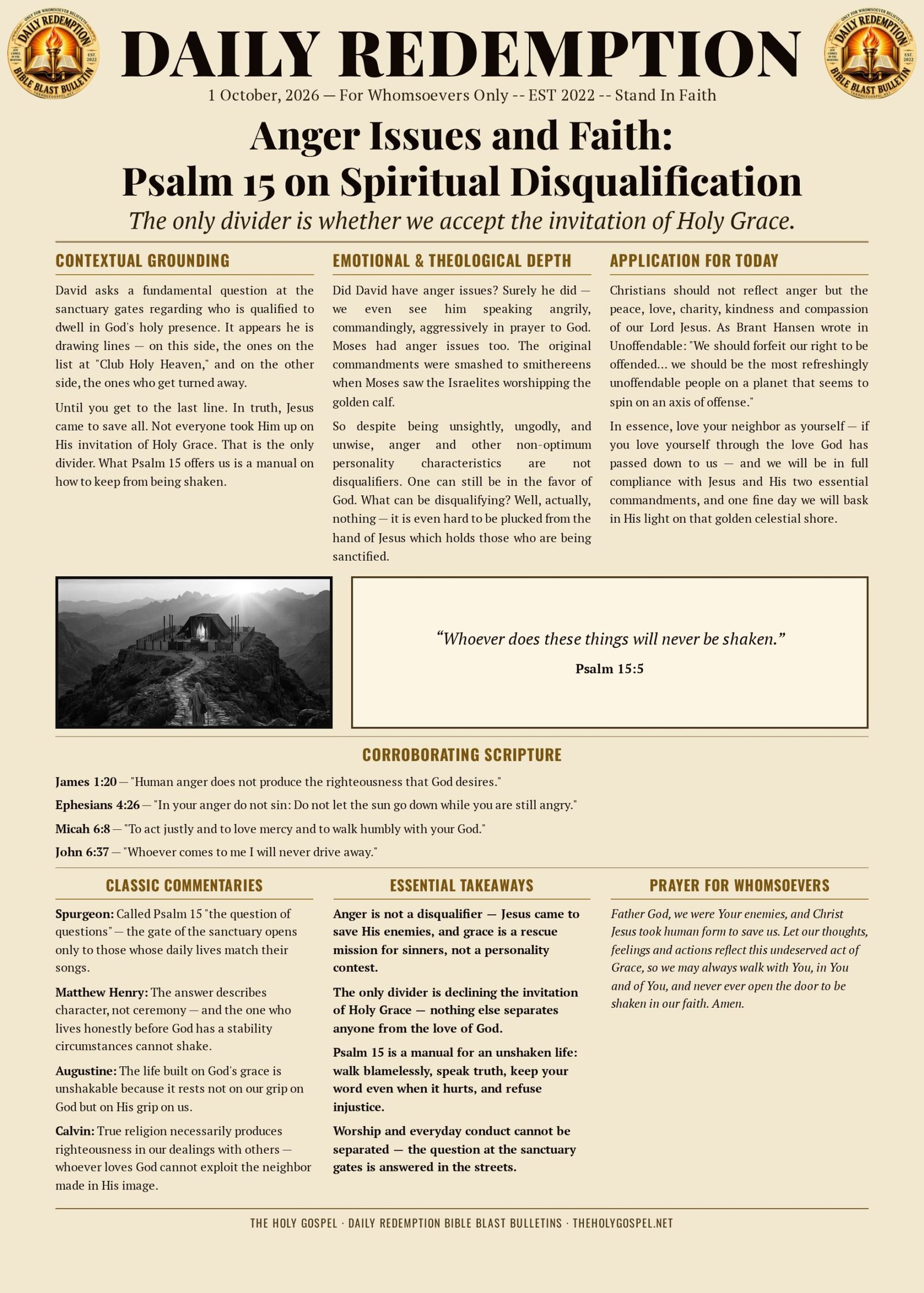
Psalm 15 asks the question of questions: who may dwell in God’s holy presence? David’s answer bypasses religious appearance and focuses entirely on integrity, truth, and how we treat our neighbors. And here is the good news tucked inside the inquiry: anger and other personality failings are not disqualifiers from the favor of God — Jesus came to save His enemies, and the only true divider is whether we accept His invitation of Holy Grace. Those who walk blameless before Him, loving neighbor as self, will never be shaken.
Psalm 15
Anger Issues and Faith: Lessons on Spiritual Disqualification
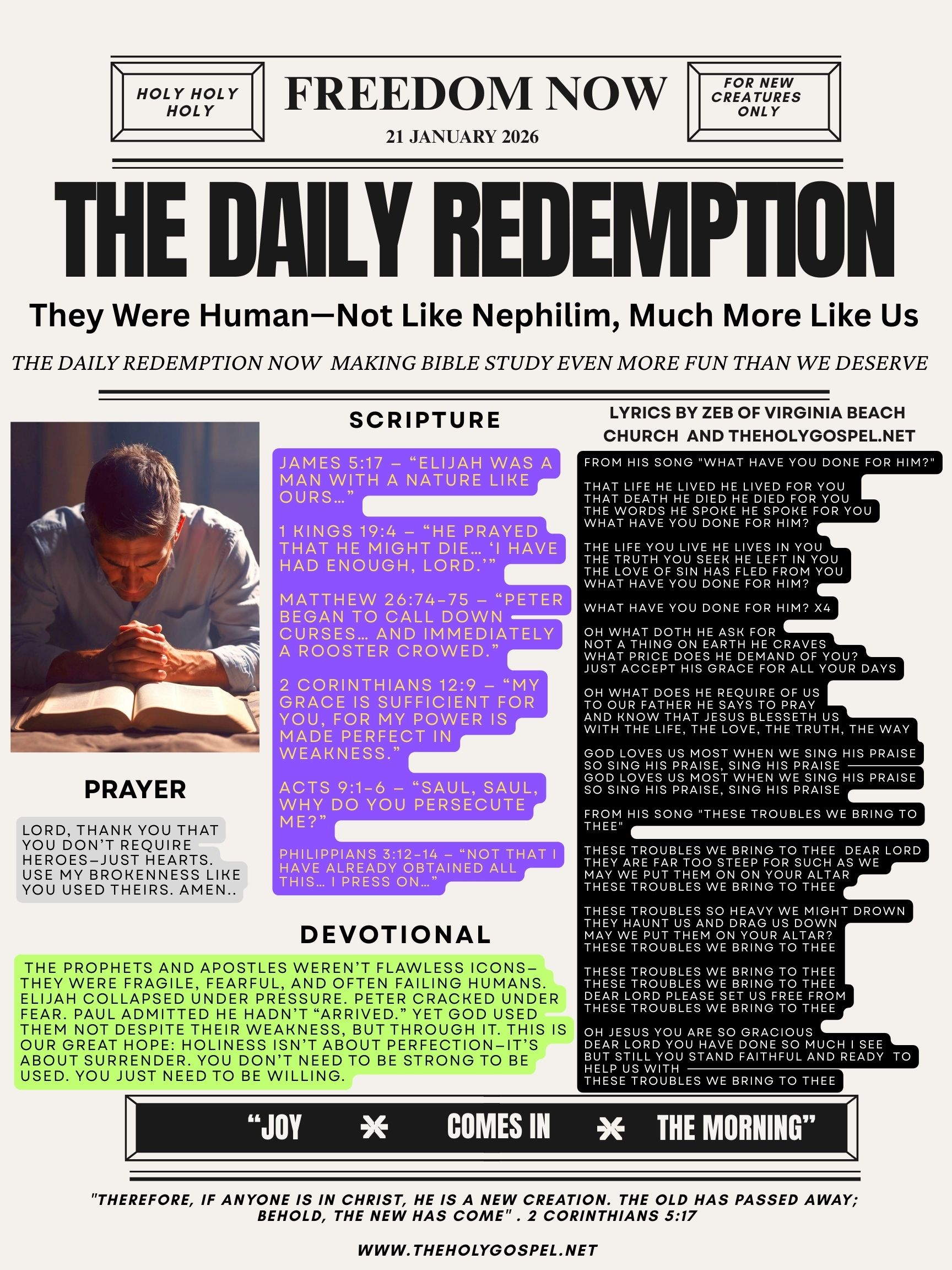
Did David have anger issues? Surely he did because we even see him speaking angrily, commandingly, aggressively in prayer to God. Moses had anger issues. The original 10 commandments (the word for commandment, btw, means “words” in Hebrew) were smashed to smithereens when Moses saw the Israelis at the foot of Mt Sinai worshipping the golden calf.
And yet, author Brant Hansen who wrote Unoffendable wrote this on the topic amongst 200 pages of gems: “We should forfeit our right to be offended. That means forfeiting our right to hold on to anger… I now think we should be the most refreshingly unoffendable people on a planet that seems to spin on an axis of offense.”
Christians should not reflect anger but the peace, love, charity, kindness and compassion of our Lord Jesus. However the question at hand is…does anger disqualify us? And are there any other personality failings which can drive a wedge between us and the love that God has for us.
If you want the short version I say this at risk that you might close the browser window and get on with your day. THIS which I say is that Jesus came to save His enemies – US! He came to save sinners and those are people that live ungodly lives. So despite being unsightly, ungodly and unwise, anger and other non-optimum personality characteristics are not disqualifiers. One can still be in the favor of God. What can be disqualifying? Well, actually, nothing, it is even hard to be plucked from the hand of Jesus which holds those who are being sanctified if one decides they want out. Jesus said to the Father – “I have not lost one that you have given me.” So what is David saying in Psalm 15?
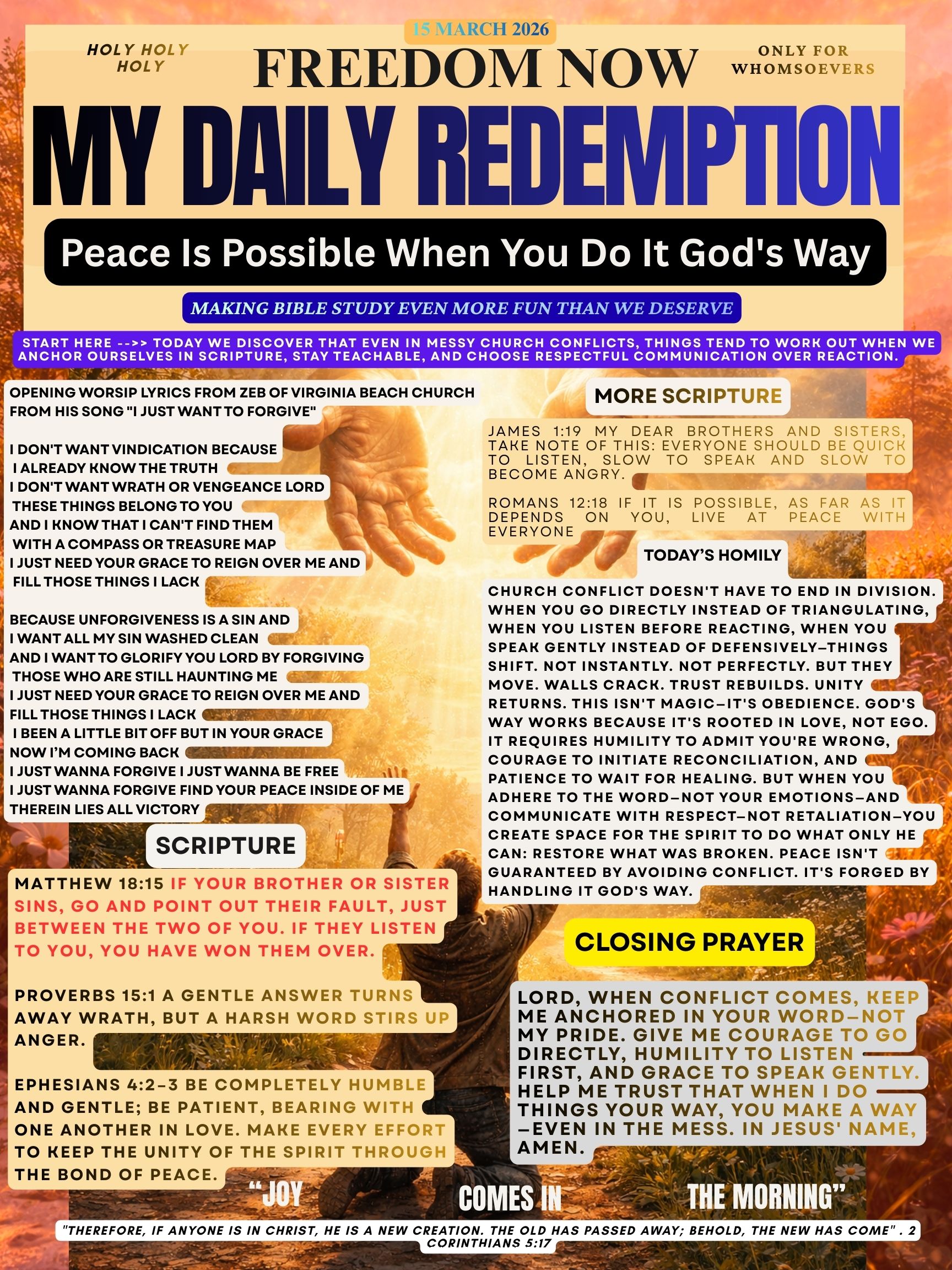
It appears he is drawing lines – on this side are the ones who are on the list at the “Club Holy Heaven” and the other side is the ones who get turned away. Until you get to the last line. In truth, Jesus came to save all. Not everyone took Him up on his invitation of Holy Grace. That is the only divider. It appears that he is drawing that line but then we get to the last line. What Psalm 15 is all about and what it offers us is a manual on how to keep from being shaken. The last word of the Psalm. In fact “one who does these things will NEVER BE SHAKEN.” And in essence what he is saying is love your neighbor as yourself (if you love your self through the love God has passed down to us) and we will be in full compliance with Jesus and His two essential commandments and one fine day we will bask in his light on that golden celestial shore.
Here is the manual from David on how to never be shaken:
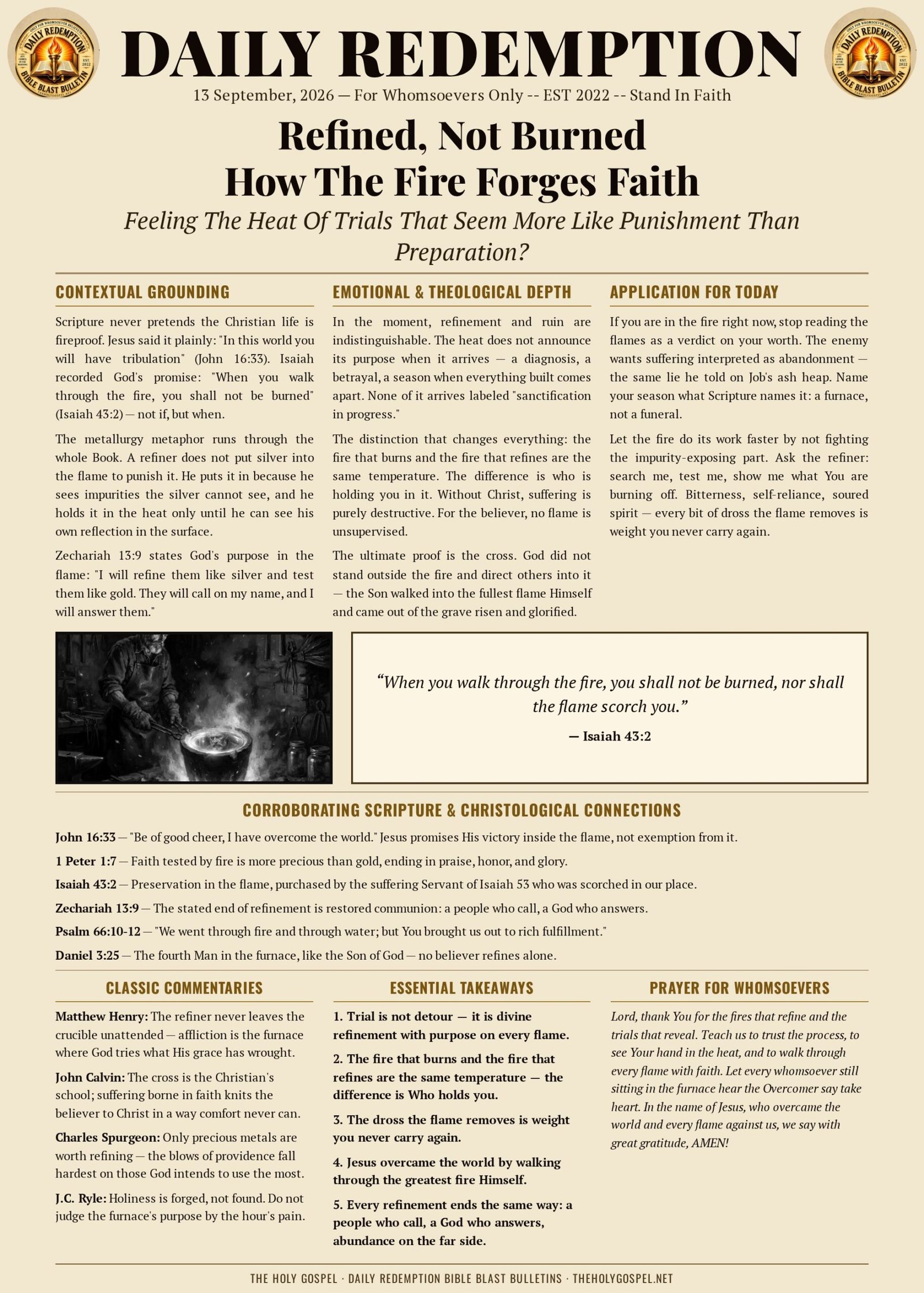
Contextual Grounding: David asks a fundamental question at the sanctuary gates regarding who is qualified to dwell in God’s holy presence.
Emotional & Theological Depth: The answer bypasses religious appearance or wealth, focusing entirely on walking with integrity, speaking truth, and avoiding harm to neighbors.
Application: It establishes that authentic worship can never be separated from how we treat people in our everyday lives.
Psalm 15
A psalm of David.
1 Lord, who may dwell in your sacred tent?
Who may live on your holy mountain?
2 The one whose walk is blameless,
who does what is righteous,
who speaks the truth from their heart;
3 whose tongue utters no slander,
who does no wrong to a neighbor,
and casts no slur on others;
4 who despises a vile person
but honors those who fear the Lord;
who keeps an oath even when it hurts,
and does not change their mind;
5 who lends money to the poor without interest;
who does not accept a bribe against the innocent.
Whoever does these things will never be shaken.
Classic Commentaries Corner
Charles Spurgeon called Psalm 15 “the question of questions” — who shall dwell with God? — and described the psalm as a portrait of the true citizen of Zion. Spurgeon observed that the qualities David lists are unglamorous: honesty in business, truthfulness in speech, faithfulness to promises even when keeping them costs us. He noted that the psalm is a rebuke to every religion that separates worship on the mountain from conduct in the marketplace — the gate of the sanctuary opens only to those whose daily lives match their songs.
Matthew Henry taught that David’s question is really about communion — not merely visiting God’s presence but dwelling there, making His tent our home. Henry emphasized that the answer God gives describes character, not ceremony: the blameless walk, the truthful tongue, the honorable dealings with neighbors, and the generous hand. He saw the closing promise — “shall never be moved” — as the reward of sincerity: the person who lives honestly before God has a stability that circumstances cannot shake, because their foundation is not the world’s approval but God’s own faithfulness.
Augustine read the psalm’s opening question as the cry of every soul that longs for permanence — not a visit to the tabernacle but an eternal dwelling with God. He taught that the list of qualifications is ultimately fulfilled in Christ, the one blameless Man who alone ascends the holy hill, and that we dwell with God by dwelling in Him. Augustine pointed to the final verse as the psalm’s great comfort: the life built on God’s grace is unshakable, because it rests not on our grip on God but on His grip on us.
John Calvin emphasized that God’s answer strips away all external pretension: the qualifications are integrity, truth, and love of neighbor — matters of the heart and the hands, not of ritual or rank. Calvin noted the justice-focused portrait here — honoring the God-fearer, keeping oaths that hurt, lending without interest, refusing bribes against the innocent — and taught that true religion necessarily produces righteousness in our dealings with others, for whoever loves God cannot exploit the neighbor made in His image.
Corroborating Scripture & Christological Connections
James 1:19-20 — “Everyone should be quick to listen, slow to speak and slow to become angry, because human anger does not produce the righteousness that God desires.” James answers the question of anger directly: anger is not the disqualifier, but it is also not the instrument — righteousness never grows out of wrath, so the believer sets it down not to earn God’s favor but because they already have it.
Ephesians 4:26-27 — “In your anger do not sin: Do not let the sun go down while you are still angry, and do not give the devil a foothold.” Paul assumes believers will feel anger — and commands that it not be nursed into a dwelling place. The problem was never the emotion; it is the resentment we build on top of it that cracks the foundation of an unshaken life.
Isaiah 33:15-16 — “He who walks righteously… will dwell on the heights; his refuge will be the mountain of God.” Isaiah gives the same answer David gave: the one whose walk is blameless, whose tongue is honest, and whose hands are clean dwells with God — the Old Testament’s portrait of holiness always runs through everyday integrity.
Micah 6:8 — “He has shown you, O mortal, what is good. And what does the Lord require of you? To act justly and to love mercy and to walk humbly with your God.” The prophets join the psalmists in teaching that God’s requirements are not secret qualifications for an exclusive club but a way of walking — justice, mercy, humility — open to everyone who will accept them.
John 6:37, 39 — “Whoever comes to me I will never drive away… And this is the will of him who sent me, that I shall lose none of all those he has given me.” Jesus Himself answers the disqualification question: no personality failing, no past, no failing disqualifies the one who comes — and none who come are ever lost.
Romans 8:38-39 — “For I am convinced that neither death nor life… nor anything else in all creation, will be able to separate us from the love of God that is in Christ Jesus our Lord.” The apostle Paul seals the verdict: the only divider is the refusal of the invitation — nothing that comes against us, and nothing that rises up within us, can wedge between the believer and the love of God.
Essential Takeaways
- Anger Is Not a Disqualifier: Jesus came to save His enemies — us. David prayed angrily, Moses smashed the tablets in fury, and both remained in the favor of God. Grace is not a personality contest; it is a rescue mission for sinners, and personality failings do not disqualify the ones He came to save.
- The Only Divider Is the Invitation: It may look like David is drawing lines at the door of “Club Holy Heaven,” but the last line reveals the truth — Christ came to save all, and the only thing that separates anyone is declining His invitation of Holy Grace.
- Yet We Are Called to be Unoffendable: Nothing can pluck us from the Savior’s hand, but the follower of Jesus should reflect His peace, love, charity, kindness, and compassion — forfeiting our right to be offended and holding on to no anger.
- Psalm 15 Is a Manual for an Unshaken Life: Walk blamelessly, speak truth from the heart, do no wrong to a neighbor, keep your word even when it hurts, lend generously, refuse injustice — in essence, love your neighbor as yourself. Whoever does these things will never be shaken.
- Worship and Everyday Conduct Cannot Be Separated: The question asked at the sanctuary gates is answered in the streets — authentic worship is never just what happens on the holy mountain, but how we treat people on every other day of the week.
Prayer For Whomsoevers
Father God, we were enemies of you and Your Son and our Saviour, Christ Jesus, took human form in order to save us. We are now inhabited by Your Holy Spirit. Let our thoughts, feelings and actions reflect this undeserved act of Grace so we may always walk with You, in You and of You and never ever ever open the door to be shaken in our faith. It is the only good that is within us. Thank you for your mercy, Lord. And all the righteousness seeking people say a hearty “AMEN” in the name of Jesus