Discovery: How to Make Heaven Move — Give Thanks to God
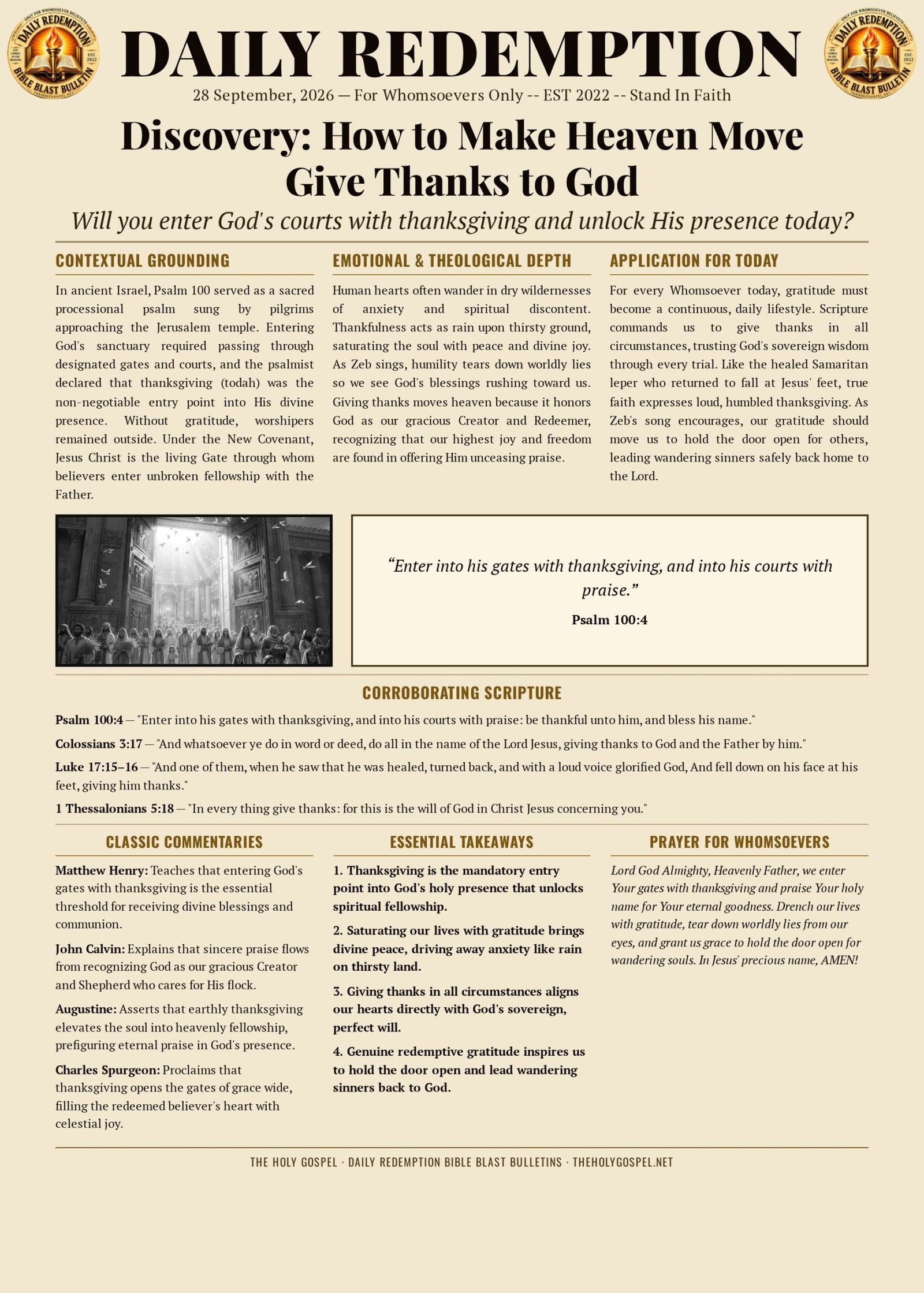
Thankfulness is not merely a polite religious sentiment, but the sacred entry point into God’s holy presence that moves the heart of heaven. As the psalmist proclaims in Psalm 100:4, we enter His gates with thanksgiving and His courts with praise, unlocking divine communion with the Father. When we drench every word, deed, and circumstance in gratitude through the Lord Jesus Christ, His presence saturates our souls like gentle rain upon thirsty ground. For every Whomsoever, choosing a lifestyle of continuous thanksgiving transforms our earthly trials, lifts our spirits in joyful freedom, and leads lost sinners home to the feet of the Savior.
Contextual Grounding
In ancient Israel’s worship, entering the sanctuary of Yahweh was a structured, sacred journey. Psalm 100 serves as a majestic liturgical Psalm of Thanksgiving (Hebrew Todah), sung by pilgrims as they ascended Mount Zion and approached the sacred temple grounds. The psalmist gives a direct, divine directive: “Enter into his gates with thanksgiving, and into his courts with praise: be thankful unto him, and bless his name” (Psalm 100:4). In the Old Testament tabernacle and temple, the outer gates and inner courts separated the common world from the holy dwelling place of God’s presence. Passing through those gates required an intentional spiritual posture. Gratitude was not an afterthought following an encounter with God; it was the required key that unlocked the gate itself. Without thanksgiving, a worshiper remained outside in the wilderness, distant from the Shekinah glory residing above the mercy seat.
The Hebrew concept of thanksgiving (todah) denotes an open-handed confession of God’s sovereign goodness, righteous character, and unshakeable covenant faithfulness. It is an act of public acclaim and sacrificial devotion that acknowledges Yahweh as the Creator, Shepherd, and Redeemer of His people. The psalm reminds us that “he hath made us, and not we ourselves; we are his people, and the sheep of his pasture” (Psalm 100:3). Thus, thanksgiving is rooted in creaturely dependence upon the Creator and covenantal trust in the Good Shepherd. To give thanks is to surrender the delusion of self-sufficiency, recognizing that every breath, every physical healing, and every spiritual blessing flows exclusively from God’s unmerited favor.
In the New Testament, this Old Testament temple imagery finds its ultimate Christological fulfillment in Jesus Christ. Jesus is the true Temple and the living Gate through whom we draw near unto God (John 10:9). Through His sacrificial death upon the cross and His glorious resurrection, Christ tore the veil of separation and granted redeemed believers direct access into the Holiest of All. Apostle Paul expands this psalm’s directive into the daily walk of the Church, commanding in Colossians 3:17 that “whatsoever ye do in word or deed, do all in the name of the Lord Jesus, giving thanks to God and the Father by him.” Under the New Covenant, thanksgiving is no longer confined to physical temple courts in Jerusalem; it becomes the continuous spiritual sanctuary where every Whomsoever abides in unbroken fellowship with the Father through the Son.
Emotional & Theological Depth
On an emotional level, human souls frequently wander in dry, parched wildernesses of anxiety, discontent, and spiritual fatigue. In a world full of noise, deception, and relentless pressure, we easily fixate on what we lack or what troubles us, allowing bitterness to build walls around our hearts. Yet, thankfulness is the divine remedy that saturates the soul like rain on thirsty ground. When you turn your heart toward God in genuine gratitude, His holy presence saturates your life with unshakeable peace, divine provision, and unceasing praise. Gratitude moves heaven because it shifts our gaze from our fragile circumstances to the infinite majesty and goodness of God.
As Zeb of Virginia Beach Church has often reminded us through his spirit-filled lyrics, true gratitude begins when we humble ourselves and see the abundance of God’s grace surrounding us every day. In his song “Thanks To Jesus We’re All Blessed,” Zeb writes: “Just be humble and be wise / Tear down the veil see through the lies / Take a deep breath or maybe two / See all those blessings rushing to you.” When we tear down the worldly veil of deception that tells us we are forgotten or abandoned, we realize that every moment of life is drenched in God’s mercy. Humility clears our spiritual vision, enabling us to see that through the finished work of Jesus Christ on Calvary, every Whomsoever is overwhelmingly blessed beyond measure.
Theologically, thanksgiving is the supreme act of worship that honors God for who He is and what He has accomplished. God’s greatest delight is not in cold, mechanical religious ritual, but in the joyful, free devotion of a redeemed heart. As Zeb expresses in his song “Your Very Best Gift To God”: “Your best gift to God is to be joyful / Your best gift to God is to be free / Your best gift to God is to say I love you / And thank you dear Lord for loving me.” Our Lord does not demand our praise to satisfy an earthly need, but because joy and spiritual freedom in Him represent the highest fulfillment of our creation. Saying “I love you” and thanking Him for His eternal love connects our earthly worship directly to the eternal songs of heaven.
Application For Today
Living out this sacred calling requires making thankfulness an unyielding, daily lifestyle rather than a seasonal occurrence. Apostle Paul delivers an absolute, non-negotiable command in 1 Thessalonians 5:18: “In every thing give thanks: for this is the will of God in Christ Jesus concerning you.” Giving thanks in all circumstances does not mean praising God for evil or tragedy, but praising Him within those trials because His sovereign grace, wisdom, and love remain unchanged. Whether in seasons of abundance or times of deep testing, every Whomsoever can anchor their soul in the assurance that God is working all things together for good to those who love Him.
The Gospel according to Saint Luke provides a striking illustration of genuine gratitude in the story of the ten lepers (Luke 17:11–19). As ten men afflicted with leprosy cried out for mercy, Jesus commanded them to show themselves to the priests, and as they went, they were cleansed. Yet out of the ten, only one—a Samaritan outsider—returned when he saw he was healed, throwing himself at Jesus’ feet in loud, humbled thanksgiving. Jesus honored this man’s grateful posture, demonstrating that gratitude is the definitive mark of true, saving faith. While nine received physical healing and hurried away, the one who gave thanks received spiritual wholeness and personal communion with the Savior.
Finally, gratitude is not intended to be a private treasure kept to ourselves; it must overflow into loving ministry toward others. In his song “You Held The Door Open For Me,” Zeb offers a profound prayer of redemptive gratitude: “Tell me Lord how can I thank you? / Tell me Lord what can I do? / Maybe I can help hold the door open / And lead another wandering sinner back home to you.” When we reflect on the immense mercy Jesus showed us by holding the door of salvation open for our souls, our highest expression of thanks is to hold that door open for others. Walk forth today as a joyful ambassador of Christ, letting your gratitude shine so brightly that it guides seeking, weary, and wandering sinners back home to the loving arms of the Heavenly Father.
Classic Commentaries Corner
Matthew Henry observed on Psalm 100:4 that entering God’s gates with thanksgiving is the proper approach for every worshiper, noting that we must never come into God’s presence without a grateful sense of His former mercies. Henry emphasized that praising God’s name is both our highest duty and our greatest privilege, for when we bless Him for His goodness, we open the door for larger divine blessings and enter into intimate communion with the Father through Jesus Christ.
Charles Spurgeon preached with fervent passion on Psalm 100:4, declaring that thanksgiving is the sacred threshold of all true worship, urging believers never to attempt entering God’s courts with silent or ungrateful lips. Spurgeon highlighted that the gates of grace are wide open to every grateful soul, proclaiming that when a redeemed child of God lifts up a song of praise, heaven moves, the shadows of doubt vanish, and the presence of King Jesus fills the soul with celestial joy.
John Calvin commented on Psalm 100:4 that true thankfulness arises from a deep, Spirit-led recognition of God’s sovereign fatherly care, asserting that we cannot truly praise God until we recognize Him as our gracious Creator and Shepherd. Calvin noted that hypocrites offer vain, external sacrifices without heart devotion, whereas genuine believers bring a sincere sacrifice of praise, knowing that thanksgiving opens the true pathway into God’s spiritual kingdom.
Augustine reflected in his expositions on the Psalms that entering God’s courts with praise is the soul’s ascent into eternal fellowship with God, teaching that earthly thanksgiving prefigures the eternal hallelujahs of heaven. Augustine maintained that when a believer thanks God in the midst of worldly tribulations, faith conquers the flesh, the heart is purified of selfish pride, and the soul is granted a sweet foretaste of celestial rest in divine love.
Corroborating Scripture & Christological Connections
Psalm 100:4 — “Enter into his gates with thanksgiving, and into his courts with praise: be thankful unto him, and bless his name.” The psalmist establishes thanksgiving as the essential, non-negotiable entry point into the divine presence and sacred fellowship of Almighty God.
Colossians 3:17 — “And whatsoever ye do in word or deed, do all in the name of the Lord Jesus, giving thanks to God and the Father by him.” Apostle Paul instructs New Covenant believers to saturate every action, word, and daily duty in heartfelt gratitude through Christ.
Luke 17:15–16 — “And one of them, when he saw that he was healed, turned back, and with a loud voice glorified God, And fell down on his face at his feet, giving him thanks: and he was a Samaritan.” Jesus honors the humble Samaritan leper whose immediate, loud thanksgiving demonstrated true saving faith and devotion to the Savior.
1 Thessalonians 5:18 — “In every thing give thanks: for this is the will of God in Christ Jesus concerning you.” Maintaining a posture of gratitude in every circumstance aligns the believer’s heart directly with the sovereign will of God.
Psalm 107:1 — “O give thanks unto the LORD, for he is good: for his mercy endureth for ever.” The unshakeable foundation of all Christian thanksgiving is God’s intrinsic moral goodness and everlasting covenant mercy.
Hebrews 13:15 — “By him therefore let us offer the sacrifice of praise to God continually, that is, the fruit of our lips giving thanks to his name.” Through Jesus Christ our eternal High Priest, believers continually offer acceptable sacrifices of praise that move the heart of heaven.
Essential Takeaways
- 1. Thanksgiving is the required entry point into God’s holy presence: We do not enter God’s courts to become thankful; we enter His gates through thanksgiving, unlocking intimate communion with our Heavenly Father.
- 2. Gratitude saturates the soul like rain on thirsty ground: Turning our hearts toward God in continuous thanks drives away spiritual drought, filling our lives with divine peace, provision, and joy.
- 3. Giving thanks in all circumstances fulfills God’s sovereign will: In every season of life, whether in comfort or trial, giving thanks anchors our faith in Christ’s unshakeable love and victory.
- 4. Genuine faith overflows in personal, humble worship at Jesus’ feet: Like the healed Samaritan leper, true believers return to glorify God with a loud voice, recognizing Christ as the source of all redemption.
- 5. Redemptive gratitude holds the door open for wandering sinners: Expressing our thanks to God inspires us to extend His love to others, guiding seeking souls back home to the kingdom of God.
Prayer For Whomsoevers
Lord God Almighty, Heavenly Father, we come before You with hearts overflowing with praise and thanksgiving. We enter Your gates with humble gratitude for Your infinite mercy, Your enduring goodness, and the precious gift of Your Son, Jesus Christ. Teach us to live in constant thankfulness, letting gratitude drench every word, deed, and circumstance of our lives. Tear down the veil of worldly deception from our eyes, Lord, so that we may see Your abundant blessings rushing toward us every day. Grant us grace to hold the door open for another wandering sinner and lead them safely back home to You. In the precious, exalted, and matchless name of Lord Jesus Christ, we say with great gratitude, AMEN!