7 Simple Steps To Bolster Your Faith
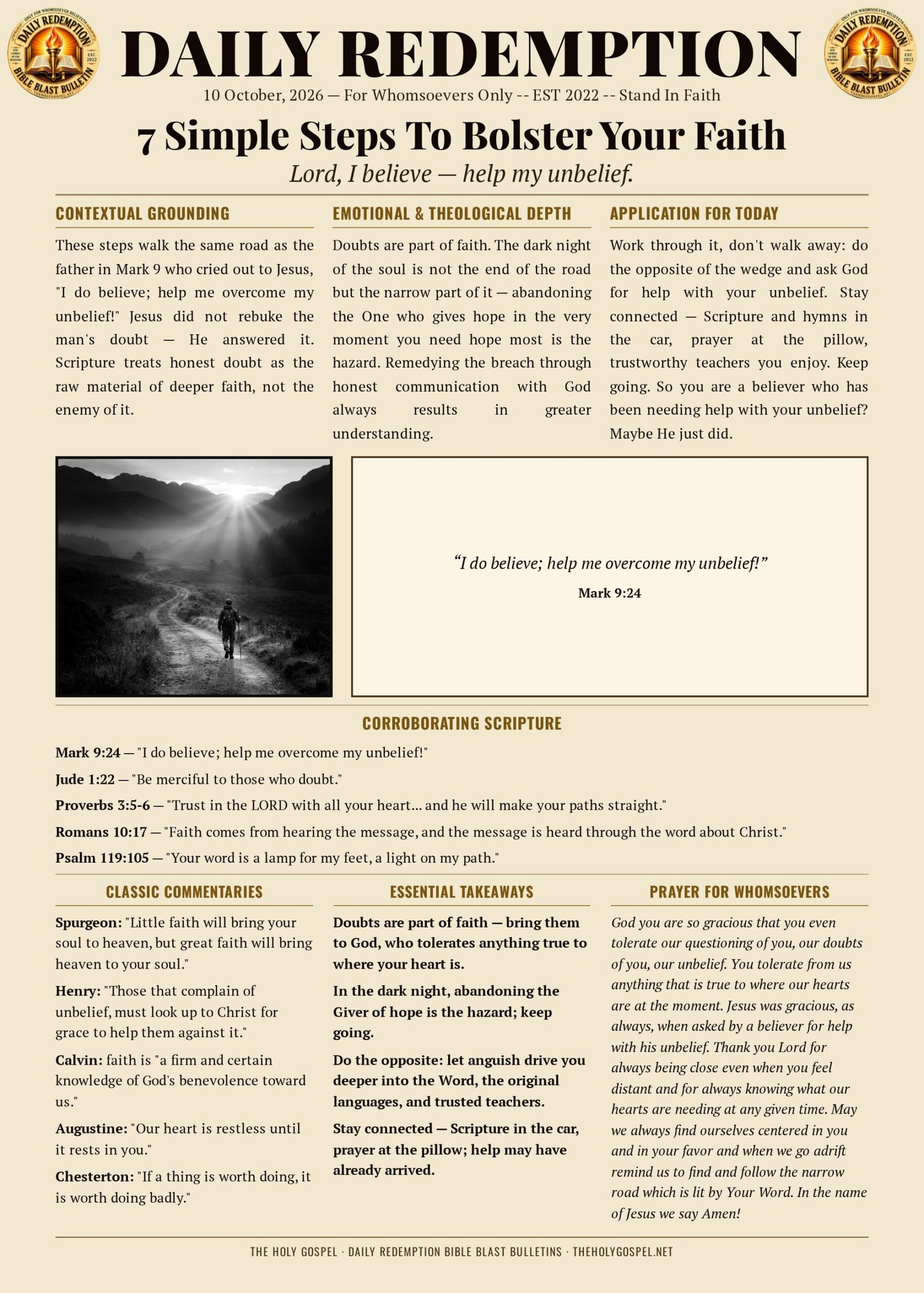
Doubts are part of faith, and the Bible’s answer is not to hide them but to bring them to a God who is the most cheerful giver — He invented the idea — and who tolerates anything true from an honest heart. These seven steps are field-tested counsel: work through the doubt instead of abandoning the One who gives hope, do the opposite of the wedge by diving deeper into the Word, stay connected with Scripture and song in the ordinary hours, and keep going through the valley. The father in Mark 9 prayed the way these steps teach — “I do believe; help me overcome my unbelief!” — and Jesus answered him. So if you are a believer who has been needing help with your unbelief, how is God going to help you? Maybe He just did.
1 Has God led you through tests to a better place you never conceived of either before or during the test? Remember that we have a God who is a cheerful giver – the most cheerful, the most giving: he invented the idea. Next He commanded us to love one another as much as ourselves and this can only be done by loving Him. Are you doubting that it was God that was involved in guiding your steps and leading you to, if not the promised land, at least a land where promises were fulfilled? Doubts are part of faith. The remedying of a breech between you and God in terms of trusting in Him and His Word always results in greater understanding. Understanding is always a composite of a toleration of closeness with agreements on the matter facilitated through communication.
2 Work through the doubt – abandoning your faith is very hazardous. In such a dark night of the soul are you sure the solution is to abandon the One that can give you hope?
3 If something in the Bible seems ungodly but is meant to represent God then do a deeper dive, perhaps using Logos software or such, into the original language and make sure it has been translated faithfully and correctly.
4 Do the opposite – instead of letting your doubts, your anguish, etc drive a wedge between you and God, ask God for help with your unbelief and dive deeper into His Word and commentaries. If nothing else, find 2-3 influencers who are not about clickbait and who have not sold out but who help you discern the scripture and who you enjoy their content (so you will keep with it) and hold on tight.
5 Don’t let life circumstances drive you away. For instance, when you are driving you can listen to the Bible on CD or Christian talk radio or Christian music. Make it a project to find old time hymn gospel-jazz or country gospel or others who can listen to while you are driving or even contemporary Christian corporate worship. Stay connected. Spend a few minutes in prayer when you hit the sack or in prayer and/or the Bible for a few minutes every morning. I find Wise Disciple YouTube channel to be very helpful. Also the deliverance prayers just go on and on and I have never heard them slip. There are also very dramatic Bible-story-based big production numbers, yes usually constructed by AI, but still very powerful stuff that can help make the Bible come to life.
6 In the valley of the shadow of death or tribulation or just chaos in your life do as Churchill was said to have said, “If you are going through hell, keep going”.
7 Find whatever kind of Bible quotes you are needing – reassuring quotes for instance, or quotes that bolster your faith.
So you are a believer who has been needing help with your unbelief? How is God going to help you? Maybe He just did.
Classic Commentaries Corner
Charles Spurgeon battled his own dark nights — the preacher of the Metropolitan Tabernacle sank into seasons of crushing melancholy — and he taught that honest doubt driven into the Word becomes deep faith. His counsel to the limping believer still stands: “Little faith will bring your soul to heaven, but great faith will bring heaven to your soul.” The Lord is not alarmed by our questions; a wobbly faith that keeps coming to Christ is worth more than a sleek certainty that never had anything to overcome.
Matthew Henry, on the father of the demon-possessed boy in Mark 9, observes that the man’s confession was itself an act of faith: he believed, knew he believed too little, and brought the insufficiency itself to Christ. Henry’s note is Zeb’s step two almost word for word: “Those that complain of unbelief, must look up to Christ for grace to help them against it, and his grace shall be sufficient for them.” Christ accepts the honest plea; He does not require perfect faith before He starts answering imperfect faith.
John Calvin defined faith in his Institutes as “a firm and certain knowledge of God’s benevolence toward us” — and he insisted that knowledge is received from the Word, not summoned from within. That is the engine of steps three and four: the doubt is not cured by looking harder at yourself but by diving deeper into what God has actually said. The believer who admits he cannot see the road is precisely the one the lamp was made for.
Augustine’s Confessions are, from first page to last, the record of a doubter who kept going: a mind stocked with every philosophy, still admitting to God, “You have made us for yourself, O Lord, and our heart is restless until it rests in you.” His witness to every whomsoever is that doubt is not the opposite of faith — stalled wandering is. The one who keeps moving toward the light, even with questions in his pockets, arrives.
G.K. Chesterton, the apostle of the imperfect attempt, would have loved a numbered list aimed at imperfect believers: “If a thing is worth doing, it is worth doing badly.” The seven steps of this bulletin do not wait for an unblemished faith to show up first — prayer at the pillow done badly, hymns in the car sung off-key, a Bible dipped into for a few fumbling minutes are all still steps, and the God who tolerates anything true from an honest heart is delighted to receive them. The Christian ideal, Chesterton warned, is not found wanting — it is found difficult and left untried. These steps are how it gets tried.
Corroborating Scripture & Christological Connections
Mark 9:24 — “I do believe; help me overcome my unbelief!” The anchor verse: the prayer for help with unbelief is itself faith praying, and Jesus heals the boy.
Jude 1:22 — “Be merciful to those who doubt.” The church’s standing order: doubt is met with mercy, not with the door.
Proverbs 3:5-6 — “Trust in the LORD with all your heart and lean not on your own understanding; in all your ways submit to him, and he will make your paths straight.” Step one’s foundation: guided steps to a better place you never conceived.
Psalm 119:105 — “Your word is a lamp for my feet, a light on my path.” The narrow road lit by the Word that Zeb’s prayer names — enough light for the next step, which is all a lamp ever promised.
Romans 10:17 — “Faith comes from hearing the message, and the message is heard through the word about Christ.” The stay-connected principle: faith is fed through the ears — which is why hymns in the car and prayer at the pillow are not decorations but rations.
Psalm 34:18 — “The LORD is close to the brokenhearted and saves those who are crushed in spirit.” Always close even when He feels distant — closeness was never measured by feeling.
John 20:27-29 — “Stop doubting and believe… Put your finger here; see my hands.” The risen Christ does not rebuke Thomas’s doubt — He invites the man’s hand into His wounds, then blesses all who believe without seeing. The most patient answer to unbelief in Scripture still carries the scars.
Essential Takeaways
- Doubts Are Part of Faith: Bring them to God — He tolerates anything true to where your heart is, and the breach mended becomes understanding gained.
- Keep Going Through the Valley: Abandoning the Giver of hope in the hour you need hope most is the true hazard — if you are going through hell, keep going.
- Do the Opposite of the Wedge: Let anguish drive you deeper — into the original languages, sound commentaries, and 2-3 faithful teachers you enjoy enough to keep with.
- Stay Connected: Scripture in the car, prayer at the pillow, hymns in the ordinary hours — and watch for the answer: maybe He just did help.
Prayer For Whomsoevers
God you are so gracious that you even tolerate our questioning of you, our doubts of you, our unbelief. You tolerate from us anything that is true to where our hearts are at the moment. Jesus was gracious, as always, when asked by a believer for help with his unbelief. Thank you Lord for always being close even when you feel distant and for always knowing what our hearts are needing at any given time. May we always find ourselves centered in you and in your favor and when we go adrift remind us to find and follow the narrow road which is lit by Your Word. In the name of Jesus we say Amen!