Jesus Blows Calvinist Predestination To Pieces: Matthew 13-15
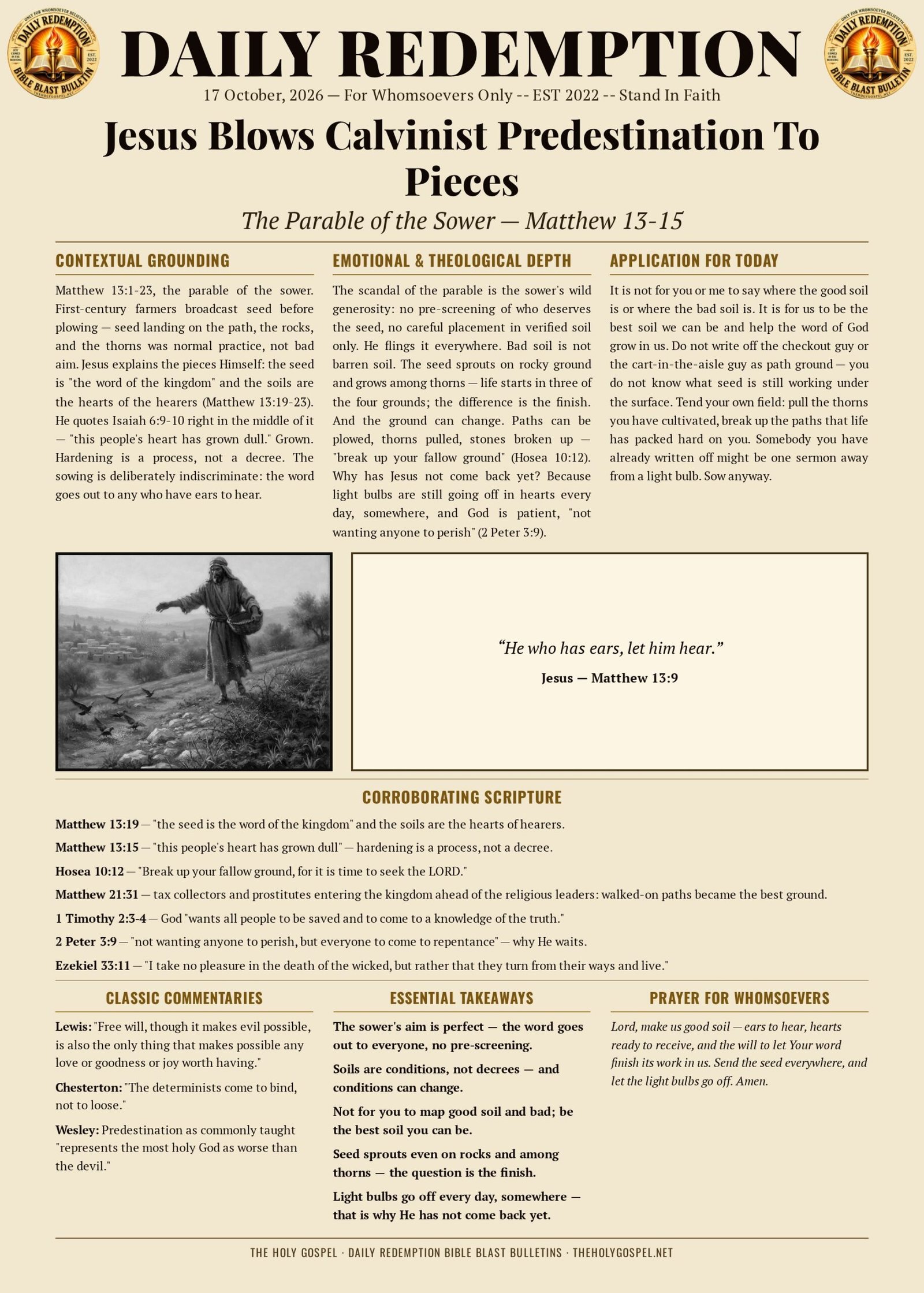
The Sower does not have bad aim — He has a scandalous generosity. In the parable of the sower, the seed is the word of the kingdom and the soils are the hearts of the hearers, and the sowing is deliberately indiscriminate: the word goes out to any who have ears to hear. That wild, unmeasured scattering is exactly what blows predestination out of the water, because a God who had already decided the outcomes would never need to fling seed onto thorns and rocks in hope that some might still grow. The question the parable leaves you with is not “why is His aim so bad” — it is “what will you do with what was thrown your way?”
Matthew 13 to 15. I loved digging deep into this. At first I read it and I’m like, wow, this farmer’s got really bad aim. The Jesus Parable of the Sower. He’s throwing seeds onto thorns. He’s throwing seeds onto rocks. He’s throwing seeds where seeds are not likely to grow. Not now, maybe not ever.
Then I realized, wait a minute, who’s throwing those seeds? Who is the farmer? And the farmer is our Lord. So why is he just throwing seeds everywhere? First of all, what I found out is that that’s how farmers sowed their seeds back in that day. They were not so presumptuous as to go, well, this is good soil and that is bad soil. They were like, these seeds can grow anywhere, even in bad soil. These seeds, which of course are the Word of God in the parable. God is throwing his words out to any who have ears to hear and eyes to see and perceive. And he’s going to see what we do with them. And therein lies the hope for me and for you.
Because you’re here to see if there’s something new that maybe you overlooked in your earlier readings of Matthew. And I’m here to see if I can help you find it. And the first thing that came to mind is, well, a God who has already decided where the good seeds are, what good soil is — are you good soil or are you bad soil? You would presume that God would know, but God made us all in his image. And then it’s a matter of what do we do with it.
Now how does bad soil become bad soil? Maybe bad upbringing, maybe whatever. But when the farmer is throwing his seeds into the thorns, into the rocks, they do grow. They just stop growing. But he doesn’t know for sure that there isn’t some good soil in and amongst the rocks and the thorns.
To you, when you see your brother, I’ll tell you what, these days not only have the hearts of men grown cold, but so have their brains. Let me give you a couple of examples. The checkout guy at Aldi’s putting the eggs in at the bottom of my insulated bag, and the shelf-stocking guy at Walmart with his big cart which he puts right in the middle of the aisle so nobody can pass. These things don’t require a whole lot of thought, you know. I mean, I think the people that I’m talking to here would have the courtesy and the understanding, the awareness of where their bodies are, the awareness of where their stuff is in relation to other people’s stuff and all of that, to say, oh, I can’t leave this in the middle of the aisle. Nobody will pass. But anyway, I digress slightly.
The point is, it’s not for you or me to say where the good soil is or where the bad soil is. It’s for us to be the best soil that we can be and help the Word of God grow in us.
Jesus said that we would do even more amazing things than he did. Now, what could he have possibly been talking about? Well, just this, and maybe other things too. But the fact that we can interpret and understand and bring out more meaning, that’s an amazing thing. God created us so that we have the capability to read something like the parable of the sower and see what this has to do with his Word, our relation to the Word, and so much more. Many are called, few are chosen, and that’s also in Matthew.
But one thing that I really enjoyed about reading this is, it just completely blows predestination out of the water. God created us, he knows our hearts, but does he just throw the seeds into the soil that he predestined to be able to help it grow? No, he throws it anywhere and everywhere in hopes that there might be somebody. Why do you think we’re still here? Why do you think that Jesus has not come back yet? Because there are some out there that might still have a lightbulb go off in their hearts and in their minds and in their souls and might be found.
And you know something? Here’s something amazing. It happens every day. Every day there’s somebody somewhere who suddenly finds that they have a relationship with Jesus. I know for me, when I was trying to find Jesus, for a time I was going, Jesus is my Lord and Savior. And all it did inside was make me tickle a little bit. But I wasn’t quite ready to — I wasn’t the popcorn that was ready to pop that time. That came later.
So even me, even I can somehow become good soil that can understand the Word and even possibly try to help others understand it as well. And that’s why I’m here. And that’s why I’m so blessed. And I hope that this has been a blessing for you. And I’ll see you in church. Amen.
Classic Commentaries Corner
C.S. Lewis, in Mere Christianity, answered the question of why a sovereign God would risk a world where seeds land anywhere at all: “Free will, though it makes evil possible, is also the only thing that makes possible any love or goodness or joy worth having.” A sower who could not miss would also be a sower whose harvest could not love. The scatter is the price of the crop — and the point of it.
G.K. Chesterton, in Orthodoxy, skewered the systems that dissolve human response into a fixed script: “It is absurd to say that you are especially advancing freedom when you only use free thought to destroy free will. The determinists come to bind, not to loose.” A doctrine that settles every heart’s outcome before the word is ever sown does not free the parable — it binds the sower’s hands.
John Wesley preached his sermon Free Grace against exactly this reading, and said the predestinarian scheme “represents the most holy God as worse than the devil; as both more false, more cruel, and more unjust.” Wesley’s charge was simple: a God who sows in hope of what He already decreed is a God whose word to “whosoever” means nothing. The parable will not sit still for that — the seed really is offered, and the soil really is ours to tend.
Corroborating Scripture & Christological Connections
Matthew 13:19-23 — Jesus explains the parable Himself: “the seed is the word of the kingdom,” and the four soils are the four kinds of hearers. The word is offered; the heart determines the outcome.
Matthew 13:15 / Isaiah 6:9-10 — “this people’s heart has grown dull.” Grown. Hardening is a process, a long accretion of small refusals and old wounds — not a zoning decree from eternity past.
Hosea 10:12 — “Break up your fallow ground, for it is time to seek the LORD.” A farming command to un-path the heart. If the bad soil were a fixed decree, plowing would be pointless.
Matthew 21:31 — tax collectors and prostitutes are entering the kingdom ahead of the religious leaders. The most trampled paths in Israel became the best ground — Christ’s own ministry report.
1 Timothy 2:3-4 — God “wants all people to be saved and to come to a knowledge of the truth.” The scope of the sowing matches the wish of the Sower.
2 Peter 3:9 — “He is patient with you, not wanting anyone to perish, but everyone to come to repentance.” Why is Jesus still waiting? Because light bulbs are still going off.
Ezekiel 33:11 — “I take no pleasure in the death of the wicked, but rather that they turn from their ways and live.” The heart of God toward the seed on the path.
Essential Takeaways
- The Sower’s Aim Is Perfect: the word goes out to everyone — no pre-screening, no verified-soil-only planting. The scatter is the method, not a mistake.
- Soils Are Conditions, Not Decrees: the seed sprouts even on rocks and among thorns. What differs is the finish — and ground can be plowed, thorns pulled, stones broken.
- Not Yours to Map: it is not for you or me to say where the good soil is. It is for us to be the best soil we can be and help the Word grow in us.
- He Sows in Hope: light bulbs go off in somebody’s heart every day, somewhere. That is why He has not come back yet.
- Even You: the popcorn that was not ready to pop one year can be the good soil of the next season. Ask Zeb. He is proof.
Prayer For Whomsoevers
Lord, make us good soil — ears to hear, hearts ready to receive, and the will to let Your word finish its work in us. Send the seed everywhere, and let the light bulbs go off. Amen.