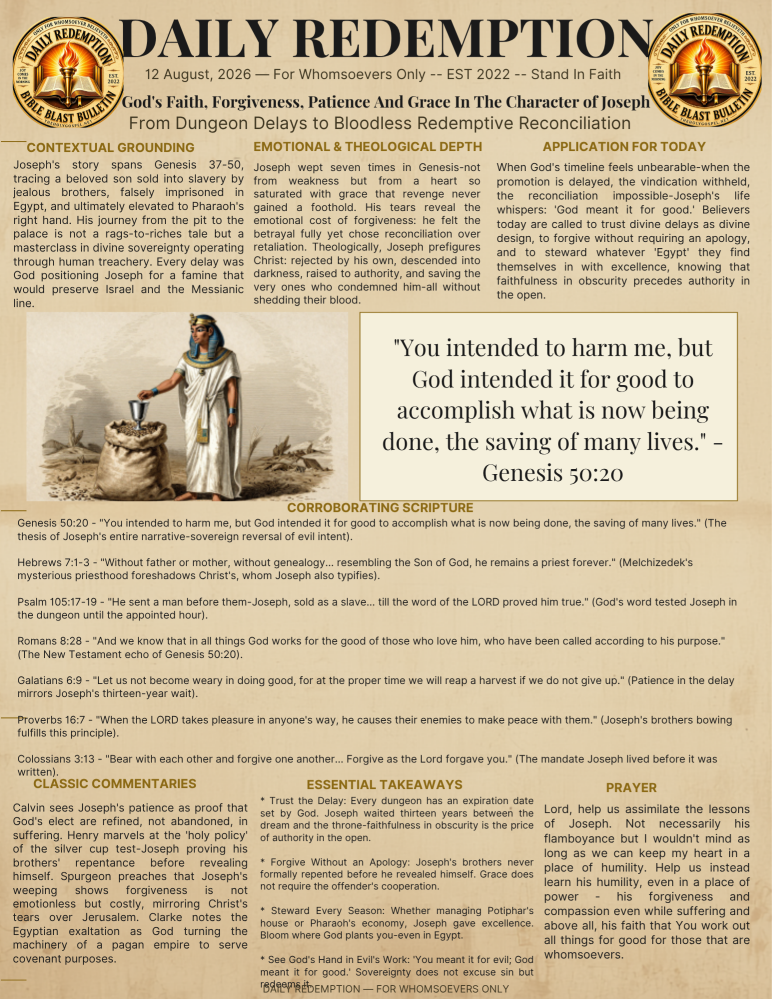
God’s Faith, Forgiveness, Patience And Grace In The Character of Joseph
### **I. SCRIPTURE PASSAGE**
**Genesis 40:7, 23; 41:16, 39–40; 42:21; 50:20**
> *“Why do you look so sad today?”*
> — **Genesis 40:7**
> *The chief cupbearer, however, did not remember Joseph; he forgot him.*
> — **Genesis 40:23**
> *“I cannot do it,” Joseph replied to Pharaoh, “but God will give Pharaoh the answer he desires.”*
> — **Genesis 41:16**
> *Then Pharaoh said to Joseph, “…There is no one so discerning and wise as you. You shall be in charge of my palace…”*
> — **Genesis 41:39–40a**
> *They said to one another, “Surely we are being punished because of our brother. We saw how distressed he was when he pleaded with us for his life, but we would not listen; that is why this distress has come on us.”*
> — **Genesis 42:21**
> *“You intended to harm me, but God intended it for good to accomplish what is now being done, the saving of many lives.”*
> — **Genesis 50:20**
—
### **II. HISTORICAL-REDEMPTIVE ANALYSIS**
Contextual Grounding:** Joseph sits as an innocent man in an Egyptian prison, forgotten by the chief cupbearer for two long years after being wrongfully enslaved and accused. Yet even in a dungeon, he displays Christ-like compassion, looking past his own suffering to care for others.
Emotional & Theological Depth:** God exacts a “light version” of revenge on Joseph’s brothers—one without bloodshed that aims for conviction, repentance, and redemption rather than destruction. By orchestrating a high-stakes “prank” with money and cups in their sacks, Joseph tests their hearts to bring them face-to-face with their past guilt.
Application:** Human promises fail and delay us, but God’s timing is never thwarted by human forgetfulness. When brought to the crossroads between self-condemnation and accepting grace, faith demands stepping onto the road of grace and trusting that God weaves every trial for ultimate good.
—
### **III. CORE COMMENTARY**
Let’s talk about Joseph, one of my favorite Biblical characters. Let’s see, who else are favorite Biblical? Melchizedek. I love Melchizedek. Come on, some applause for Melchizedek. He’s amazing. I definitely feel that he was a type of Christ, and Jesus was a type of Melchizedek, if you look at Hebrews. And Zebedee. But yeah, Joseph is like Jesus and Elvis all wound up together. You know, the Technicolor dreamcoat and all of that. But seriously, quite a flamboyant and humble character at the same time. Extravagant in some ways. Extremely good looking, apparently, it says right in the Bible. And also representing some of the characteristics that we might think of when we think of Jesus in terms of compassion and so forth.
One of the most interesting things of this section, and I’m talking about Genesis 40 to 42, one of the most interesting things is, God seeks and wreaks a kind of revenge here through Joseph on Joseph’s brothers, who were just… I saw Johnny Cash one time, and he was talking about the men that his daughters had married, and he referred to them as “not worth killing.” But this was Johnny Cash. So, anyway. Yeah, but a kind of revenge, like a light version, one that aims for reconciliation and redemption rather than mere destruction. No bloodshed. Old Testament, Genesis, and God exacts revenge without bloodshed. It’s pretty cool.
All right, so let’s take a look at what goes on here. It’s a lot about divine providence and God’s timing. We could probably talk about God’s timing in every single one of these Bible commentaries, because it’s so important, and it’s so important to us to always be keeping that in mind. If we feel God hasn’t answered this prayer, well, you expect him to do it on your timeline or his? You know?
Also the contrast between the human forgetfulness and God’s unwavering faithfulness. If you’ll remember, the cupbearer of the Pharaoh actually made a promise to Joseph, and he forgot about it. Joseph is an innocent man in prison, forgotten by men after being wrongly accused and enslaved. But even in his suffering, he shows compassion, and he’s interested in the well-being of others. He even says to somebody, *”Why do you look so sad today?”* So, Joseph embodies this Christ-like compassion, even when wronged, focusing on others’ needs instead of self-pity.
Now this, I’ll tell you what, modern term, to be pranked, you know, somebody pranked me, or, you know, I really pranked that guy. This, what Joseph did with his brothers and putting the money in the bag and the whole thing, he did actually pull quite a prank on them, and that was kind of the revenge, and there’s some sense of humor and all that too.
So, the situation with the cupbearer is that it highlights human fallibility and self-interest. The cupbearer got what he wanted after Joseph told him what his dream meant… but he forgot to tell Pharaoh to let him go. But God’s plan is not thwarted by human actions, inactions, fallibility, dementia, or anything. It just unfolds on his timeline. God says it should be done, and it will be done. This forgetfulness is part of God’s plan because it allows Joseph to stay in prison until the exact moment needed to meet Pharaoh, but that was about two years. Now, could you imagine being an innocent but incarcerated man for two more years? Two years is a long time sometimes, and could you imagine just rotting in prison? But Joseph remained faithful, remained righteous, remained Christ-like.
Okay, so then going forward to Genesis 41, Pharaoh has these dreams. He needs an interpreter, and that opens up the door for the release of Joseph because somebody tells Pharaoh that Joseph is good at interpreting dreams. Joseph is asked by Pharaoh to interpret his dream, and he gives credit immediately to God because, you know, Joseph wasn’t a psychic or a fortune teller or anything like that. He knew where his power came from. He told him that he can’t interpret dreams on his own. *”It’s not in me. God will give Pharaoh a favorable answer.”*
The elevation of him from prisoner to second in command of Egypt—Pharaoh even saying, except for the throne, you’re in charge of everything. You’re equal to me. So God demonstrates his ability to use justice and power without a physical battle or immediate punitive action against his wrongdoers.
And then Genesis 42 is the fulfillment of the prophecy, which was based upon what Joseph told Pharaoh about his dreams and the seven fat cows and the seven thin cows and how that represented drought and plenty. Years later, the famine forces Joseph’s brothers to come to Egypt and they unknowingly bow down before the second in command of Egypt. They just don’t know that it’s their brother, but it fulfilled Joseph’s childhood dreams.
Now, Joseph’s actions at this point are not about personal revenge, although they could very well have been, being left in a pit to die, but about testing his brothers’ hearts and bringing them to repentance and self-awareness of their past sins. The brothers themselves acknowledge their guilt, saying, *”We are clearly guilty concerning our brother.”* This demonstrates a form of divine revenge or justice that aims for reconciliation and redemption rather than mere destruction. God uses the natural consequence of famine to bring the family to a place of healing where the primary suffering is the internal guilt and consequence of their own actions, not a direct bloody strike from God.
But you know, I’ve been running myself through some guilt lately. It was only just today, as a matter of fact, that I had to come to the crossroads of like, all right, which way am I going to go? Continue to kick myself with guilt or accept grace. And when you get to that crossroads, the thing that presides is your faith. And if you are in Jesus, and if you do have that faith, then you can move forward from there on the road less traveled.
Ultimately, God’s plan is always at work, even when the circumstances seem bleak or unfair. Trust in God’s perfect timing and purpose, even in the midst of trials. And remember to extend grace to others as we have had grace extended to us. Always be seeking reconciliation with whoever the *dramatis personae* are in your particular drama, that they will benefit by God’s grace, and that you can extend grace to them. Even if you don’t like somebody, you still gotta love them.
—
### **IV. CORROBORATING SCRIPTURE & CHRISTOLOGICAL CONNECTIONS**
Genesis 50:20** — *”You intended to harm me, but God intended it for good…”* *(The ultimate summary of sovereign divine providence).*
Hebrews 7:1–3** — *”This Melchizedek was king of Salem and priest of God Most High…”* *(The priesthood typology referenced alongside Joseph’s Christ-like office).*
Psalm 105:17–19** — *”He sent a man before them—Joseph, sold as a slave. They bruised his feet with shackles… until the word of the Lord proved him true.”* *(Scriptural confirmation of Joseph’s divine holding period).*
Romans 8:28** — *”And we know that in all things God works for the good of those who love him…”* *(New Testament application of Joseph’s story).*
Galatians 6:9 — “Let us not become weary in doing good, for at the proper time we will reap a harvest if we do not give up.” (Remaining Faithful Through the Two-Year Delay)Proverbs 16:7 — “When the Lord takes pleasure in anyone’s way, he causes their enemies to make peace with them.” (Revenge Without Bloodshed)Psalm 37:7 — “Be still before the Lord and wait patiently for him; do not fret when people succeed in their ways, when they carry out their wicked schemes.” (Surviving the Holding Period)Colossians 3:13 — “Bear with each other and forgive one another if any of you has a grievance against someone. Forgive as the Lord forgave you.” (Extending Grace to the Dramatis Personae)Luke 6:27–28 — “But to you who are listening I say: Love your enemies, do good to those who hate you, bless those who curse you, pray for those who ill-treat you.” (Loving Those You Don’t Like)Proverbs 3:5–6 — “Trust in the Lord with all your heart and lean not on your own understanding; in all your ways submit to him, and he will make your paths straight.” (Moving Forward at the Crossroads)Psalm 40:1–2 — “I waited patiently for the Lord; he turned to me and heard my cry. He lifted me out of the slimy pit, out of the mud and mire; he set my feet on a rock and gave me a firm place to stand.” (Lifting Joseph From Dungeon to Palace)
—
V. CLASSIC COMMENTARIES CORNER”
The cupbearer’s neglect exposes the vanity of human promises, but God kept Joseph hidden until the precise hour the kingdom required a savior.” — John Wesley
“Asking fellow prisoners why they look sad reveals a heart emptied of self-pity and operating with the active compassion of the Messiah.” — A.W. Tozer
“Joseph deflected praise by declaring God would answer Pharaoh, showing that a true servant redirects all glory back to the sovereign source.” — Albert Barnes
“The high-stakes test with the silver cup was designed by divine wisdom to turn the brothers’ hidden fear into genuine conviction.” — Adam Clarke
“God wreaks holy revenge not by a swift destructive stroke, but by a quiet grace that brings offenders to their knees for reconciliation.” — Charles Spurgeon
“Rising from a pit to second in command without a single blow struck proves that God’s unshakeable timeline effortlessly lifts the humble.” — G.K. Chesterton
### **VI. ESSENTIAL TAKEAWAYS**
Christ-Like Compassion in Suffering:** Joseph focuses on others’ pain (*”Why do you look so sad?”*) even while rotting in prison under false accusations.
The Sovereign Holding Period:** Two years of being forgotten by the cupbearer kept Joseph precisely in position until Pharaoh’s dream opened the door to the throne.
Bloodless Redemptive Justice:** God’s “revenge” uses famine and Joseph’s clever tests to drive the brothers to genuine repentance and family healing, rather than destruction.
Grace Over Guilt at the Crossroads:** When past guilt or trials hit, faith requires choosing the road less traveled—accepting God’s grace and extending it to others.
—
### **VII. PRAYER FOR WHOMSOEvers**
Lord, help us assimilate the lessons of Joseph. Not necessarily his flamboyance but I wouldn’t mind as long as we can keep my heart in a place of humility. Help us instead learn his humility, even in a place of power – his forgiveness and compassion even while suffering and above all, his faith that You work out all things for good for those that are whomsoevers.